Introduction
Development of cognitive enhancing drugs for the treatment of conditions ranging from mild cognitive impairment to Alzheimer's disease represents a valuable task. A family of compounds known as ampakines are potential candidates. Despite clear-cut effects on excitability, their influence on brain energy metabolism has not been explored.
Methods
Deoxyglucose uptake and lactate release were measured in primary cultures of mouse astrocytes prepared from cortex, hippocampus or cerebellum. Immunocytochemistry was performed with primary antibodies targeted against each AMPA receptor subunit type and revealed by epifluorecence microscopy.
Results and Discussion
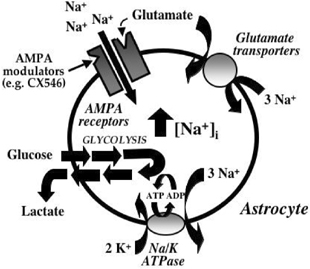
Glutamate was previously shown to enhance aerobic glycolysis i. e. increase glucose utilization and lactate production with no change in oxygen levels, in mouse cortical astrocytes by a mechanism involving glutamate uptake. It is reported here that a similar response is produced in both hippocampal and cerebellar astrocytes. Application of the cognitive-enhancing drug CX546 promoted further enhancement of glucose utilization by astrocytes from each brain area upon glutamate exposure. AMPA receptors represent the purported molecular target of cognitive-enhancing drugs like CX546 and the presence of AMPA receptor subunits GluR1-4 was evidenced in astrocytes from all three regions by immunocytochemistry. AMPA itself did not stimulate aerobic glycolysis but in presence of CX546 a strong enhancement of glucose utilization and lactate production was obtained in cortical, hippocampal and cerebellar astrocytes. The effect of CX546 was concentration-dependent with an EC50 of 93.2 μM in cortical astrocytes. AMPA-induced glucose utilization in presence of CX546 was prevented by the AMPA receptor antagonist CNQX and the negative modulator GYKI 52466. In addition, the metabolic effect of CX546 in presence of AMPA was mimicked by the AMPA receptor modulator cyclothiazide. Our data suggest that astrocyte energetics represents a novel target for cognitive-enhancing drugs acting as AMPA receptor modulators. (See Figure 1).