





Background and purpose
We applied a protein transduction technology using super anti-cell death FNK protein (artificially modified Bcl-xL) fused with a protein-transduction-domain peptide from HIV Tat protein (PTD-FNK)(Ref1, 2). We present strong protective effects with rat middle cerebral artery occlusion model in this meeting. When PTD-FNK administration was followed by administration of an immunosuppressant FK506 with 30 min interval, the protective effect was markedly enhanced. We tried to explore protective mechanisms of the combination therapy for cerebral ischemia using in vitro cell death system.
Methods
Neuroblastoma SH-SY5Y cells were cultured, and PTD-FNK and/or FK506 were administered. Then, thapsigargin (TG), a potent inhibitor of endoplasmic reticulum calcium-ATPase, was added. After 24hours, viable cells were counted under a microscope. For determination of intracellular free Ca2+ ([Ca2+]i), the fluorescence Ca2+ indicator Fluo-3 AM was added at first, and pretreated with PTD-FNK and/or FK506, and further stimulated with TG.
Results
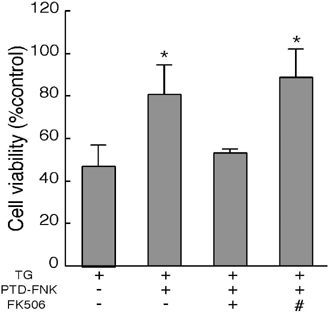
Cell viability was lost to 47.3% in the treatment with TG. PTD-FNK and FK506 showed 80.9% and 72.5% cell viability, respectively. The combination of PTD-FNK and FK506 with 30 min interval showed 88.7% cell viability(right most column of figure 1), however, the simultaneous treatment did not have protective effect. [Ca2+]i increased after the addition of TG. After the addition of FK506, [Ca2+]i also increased. In contrast, the increase of [Ca2+]i was suppressed with PTD-FNK and the combination of PTD-FNK and FK506 with 30 min time lag. If PTD-FNK and FK506 were added simultaneously, [Ca2+]i increased to similar level of TG alone treatment.
Conclusions
These experiments suggest that the combination treatment of PTD-FNK and FK506 with 30 min interval affects the movement of calcium ions, leading to protection against cell death. It is reported FK506 can cause an inhibition of endoplasmic reticulum calcium-ATPase which could increase cytosolic calcium level. Furthermore, FK506 was reported to strip FKBP12 from 1,4,5-triphosphate receptor or ryanodine receptor, making those channels “leaky” for calcium. If PTD-FNK were treated before FK506 administration, the adverse effect of FK506 (increase cytosolic calcium level) decreased and the protective effect appeared more effectively, leading to synergistic protection