Back ground and purpose
Ischemic cerebral infarction is a major cause of death. However, few practical therapies have been explored for clinical applications. We show here a potential combination therapy in a rat focal ischemic model to improve neurological symptoms as well as reduces the infarct volume at the maximum level.
Methods
As reported previously 1 , we applied a protein transduction technology using super anti-cell death FNK protein (artificially modified Bcl-xL protein, ref 2 fused with a protein-transduction-domain peptide from HIV Tat protein (PTD-FNK). Focal ischemia was produced by intraluminal occlusion of the left middle cerebral artery (MCA) with a nylon monofilament for 1.5 h.
Results
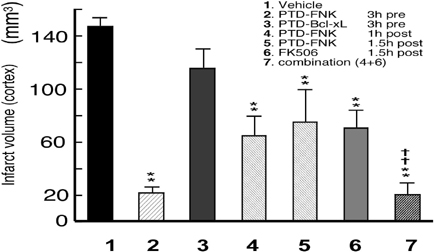
When PTD-FNK (0.25 mg/kg) was administrated intravenously at 1 hr after initiating ischemia, the infarct volume were reduced down to 50% of the vehicle treated group. Furthermore, if FNK post treatment was followed by an intravenous injection of an immunosuppressant FK506 (1 mg/kg) with 30 min interval, the infarct volume of the cortex was markedly reduced down to 14%. This procedure not only reduced the infarct volume but also markedly improved the neurological symptoms. All ischemic rats post-treated with the combination of PTD-FNK and FK506 could walk smoothly whereas untreated ischemic rats could not walk at all. The therapeutic time windows for PTD-FNK alone treatment was until 3 h after ischemia and the combination therapy elongated the timewindow to at least 4.5 h after ischemia.
Conclusions
Protein therapy with cell penetrating technology such as using Tat-PTD is quite effective for cerebral ischemia. Furthermore the combination with FK506 synergistically enhanced the protective effect. Since PTD-FNK localizes around Mitochondria and FK506 will influence the ER function, mechanisms of additive therapeutic effects of PTD-FNK and FK506 could be due to protection of both mitochondira and ER (See Figure 1).