




Background
Stilbazulenyl nitrone (STAZN) is a second-generation azulenyl nitrone with markedly enhanced antioxidant properties compared to conventional alpha-phenyl nitrones such as the experimental stroke drug NXY-059. 1 We have recently shown that STAZN therapy confers marked neurological and histological protection in cerebral ischemia and brain trauma in rats.2, 3 The purpose of this study was to define its therapeutic window in focal cerebral ischemia.
Methods
Male Sprague-Dawley rats (280–359 g) were anesthetized with halothane and subjected to 2 h of transient MCAo by retrograde insertion of an intraluminal nylon suture coated with poly-L-lysine. 4 Heating lamps were used to maintain rectal and temporalis muscle temperatures at 37.0 to 37.8 C. The drug (STAZN, 0.6 mg/kg) was administered at 2 and 4 h (n=11), 3 and 5 h (n=10), 4 and 6 h (n=10) or 5 and 7 h (n=7) after onset of stroke (i.e., 0 to 5 h after onset of reperfusion). Control rats received vehicle (DMSO; n=6) at 3 and 5 h. Additional doses were given at 24 and 48 h. Neurological status was evaluated during MCAo, at 1, 24, 48 and 72 h; a grading scale of 0–12 was employed, as previously described. 4 72 hours after MCAo, brains were perfusion-fixed and infarct volumes and brain swelling were determined.4
Results
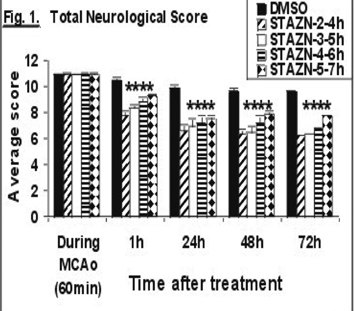
Rectal and cranial temperatures, blood pressure, plasma glucose and blood gases in the 44 animals of this study showed no significant differences between groups. STAZN significantly reduced the neurobehavioral deficit in all treated groups compared to the DMSO group (Fig 1). Treatment with STAZN also significantly reduced total infarct volume (Fig 2) and cortical and subcortical infarction at multiple levels, when administered at 2 and 4 h and 3 and 5 h compared to the DMSO group. When administration of STAZN was delayed to 4–5 h after onset of MCAo, histological protection was lost. Brain edema was not affected by STAZN.

Conclusions
These results strongly support the beneficial effect of STAZN therapy in transient focal ischemia when administered up to 5 hours after onset of the MCAo, and support its possible utility in treating patients with acute ischemic stroke.
Footnotes
Acknowledgements
Supported by NIH Grants NS46294 and NS05820.