





Introduction
We have demonstrated that infarction following transient middle cerebral artery occlusion (MCAO) is smaller in female rats and that this protection is lost after ovariectomy 1 . We have also shown that chronic progesterone administration before ischemia exacerbates striatal injury in ovariectomized rats 2 but that low dose acute progesterone treatment before and after experimental stroke is neuroprotective 3 . Allopregnanolone, a progesterone metabolite, is neuroprotective in rat traumatic brain injury 4 and may mediate progesterone's neuroprotective effects. The purpose of this study was to determine in ischemic ovariectomized mouse brain if exogenous progesterone or allopregnanolone administration can be neuroprotective.
Methods
Seven to 8 days before MCAO, C57BL/6 mice were ovariectomized and received concurrently either no hormone (OVX), 180 μg 17â-estradiol (ESTROGEN) via subcutaneous silastic implant, 15 or 30 mg 21-day release commercial progesterone (PROG) pellets placed subcutaneously, or 0. 5 or 1.0 mg allopregnanolone (ALLO) via subcutaneous silastic implant. Each animal subsequently underwent 90 minutes of MCAO by the intraluminal filament technique 5 followed by 22 hours reperfusion. Cortical (CTX) and caudate-putamen (CP) infarct volumes were determined by digital image analysis of sequential 2 mm thick coronal brain slices stained with 2,3,5-triphenyltetrazolium chloride. Laser-Doppler flowmetry (LDF) was used to estimate ischemic reduction of cortical perfusion at initiation of MCAO.
Results
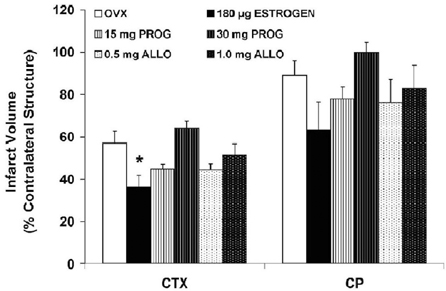
Rectal temperatures were maintained within normal physiological range and were equivalent among treatment groups. Results of CTX and CP infarct volumes are shown in figure 1. LDF (% baseline) at induction of MCAO was equivalent among treatment groups. All data are mean ± SEM. *p<0.05 from OVX.
Conclusion
Chronic, exogenous progesterone and allopregnanolone administration prior to MCAO at the tested doses did not significantly alter ischemic brain injury in ovariectomized female mice.
Footnotes
Acknowledgements
Grant Support: Supported by NIH grants RR00163, NS33668, and NR03521.