





Background and Purpose
3-hydroxy-3-methylglutaryl coenzyme A (HMG-CoA) reductase inhibitors (statins) have pleiotropic effects on ischemic brain. This study aimed to clarify the effect of statins against spontaneous stroke occurrence and oxidative brain damage caused by transient middle cerebral artery occlusion (tMCAO).
Methods
Stroke-prone spontaneously hypertensive rats (SHR-SP) were treated with pitavastatin (10 mg/kg), atorvastatin (20 mg/kg), simvastatin (20 mg/kg), or vehicle (n=5 each group) for 28 days. Physiological parameters and serum lipids were measured, and spontaneous infarct volumes were evaluated by immunohistochemical examination for MAP2. Using the simvastatin- (n=12) and the vehicle-treated (n=10) SHR-SP, we immunohistochemically detected the oxidative stress markers for lipids (HEL and 4-HNE) and DNA (8-OHdG) in their brains following 90 min of tMCAO.
Results
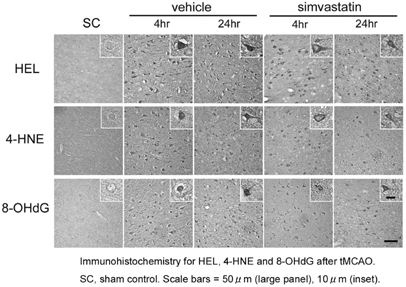
In the spontaneous stroke model, body weight and blood pressure were not different among 4 groups. Statins did not affect the serum cholesterol levels. The infarct volume was significantly smaller in the atorvastatin (3.5 ± 3.2 mm3, P < 0.05)- and the simvastatin (3.3 ± 1.1 mm3, P < 0.01)-treated groups than in the vehicle-treated group (8.7 ± 3.6 mm3). In the tMCAO model, immunoreactivities for HEL, 4-HNE, and 8-OHdG in neurons were increased at 4 and 24 hr after tMCAO in the vehicle-treated animals, while simvastatin significantly reduced such inductions (Figure 1).
Conclusions
Treatment with statins reduced infarct volume in the spontaneous stroke model, and ameliorated the oxidative stress in the tMCAO model. Our results suggest that the antioxidative properties of statins could be useful for preventing neuronal damage in cerebral ischemia.