





Background
FK506 inhibits ischemic neuronal cell death but its immunosupressive property could become a problem for clinical use. GPI-1046 is one of the ligands for FK506-binding proteins, but it dose not cause immunosuppression. Because this molecule has strong neuroprotective effect as FK506 does, we investigated whether this molecule actually ameliorates in vivo ischemic brain damage.
Methods
We used male Wistar rats of 11-weeks-old. Under the anesthesia with nitrous oxide and halothane, the origin of the right middle cerebral artery (MCA) was occluded using a nylon thread. Ninety minutes later, the cerebral blood flow (CBF) was restored by removal of the thread. At 2 hours before the ischemia and just after the CBF restoration, 30 mg/kg of GPI-1046 or vehicle was subcutaneously injected. At 24 hours after the CBF restoration, the brain was removed and the infarct volume was measured using triphenyltetrazolium chloride method. In order to confirm that GPI-1046 actually bound with FK506-binding protein, we measured rotamase activity which becomes decreased when FK506-binding protein binds with its ligand. We also performed immunohistochemistry for caspase-8, caspase-3, and cytochrome c, and investigated whether GPI-1046 prevents apoptotic machinery activation.
Results
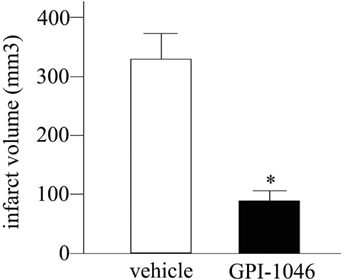
Infarct volume was significantly decreased by GPI-1046 treatment (Fig 1, *p<0. 05), indicating that this molecule exerts its neuroprotective property also in vivo. Rotamase activity was markedly increased by ischemia, but was partially reduced by GPI-1046 treatment, indicating that GPI-1046 ameliorated ischemic brain damage through binding with FK506-binding protein. Immunohistochemical analysis for caspase-8, caspase-3, and cytochrome c revealed that GPI-1046 prevented increased staining of these molecules, which indicated that GPI-1046 prevented activation of apoptotic machinery and thus reduced infarct volume.
Conclusion
Immunophilin ligand GPI-1046 was effective for ameliorating in vivo ischemic brain damage. As GPI-1046 does not possess immunosuppressive property, this molecule could be used for ischemic stroke in clinical situation. Inhibition of apoptotic machinery activation should be the mechanism of this molecule's neuroprotection.