






Abstract
The common functional single-nucleotide polymorphism (rs324420, C385A) of the endocannabinoid inactivating enzyme fatty acid amide hydrolase (FAAH) has been associated with anxiety disorder relevant phenotype and risk for addictions. Here, we tested whether the
INTRODUCTION
Endogenous cannabinoids (endocannabinoids) are lipid neurotransmitters primarily known for ‘mimicking’ the effects of cannabis on cannabinoid receptors (CB1); their critical roles in modulating human behaviors and physiologic processes, as well as their highly valued anxiolytic, analgesic, and anti-inflammatory properties, are increasingly being recognized (and investigated for therapeutic applications). Fatty acid amide hydrolase (FAAH) is a single-pass membrane protein of 579 amino acids and the primary catabolic enzfyme for the major endocannabinoid
A single-nucleotide polymorphism in the human
Genetic association studies have thus far shown that the enzyme variant that leads to a reduced expression and functionality of FAAH; i.e., higher
We recently developed [
11
C]CURB ([
11
C-carbonyl]-6-hydroxy-[1,10-biphenyl]-3-yl cyclohexylcarbamate (URB694)) the first available positron emission tomography (PET) radiotracer for imaging FAAH
9
and described kinetic analyses in which the composite parameter
MATERIALS AND METHODS
SUBJECTS
All procedures were approved by the Centre for Addiction and Mental Health Research Ethics Board. Subjects were recruited from the local community in Toronto, Canada using Internet advertisements to participate in a single PET scan study with [ 11 C]CURB. After provision of written informed consent, subjects completed a comprehensive medical/screening interview to rule out past or present significant medical conditions, neurologic illnesses or head trauma, Axis I psychiatric disorders, MR and PET counter-indication, use of medication that may affect the central nervous system, or positive drug screening for drugs of abuse.
Image Acquisition and Reconstruction
The radiosynthesis of [
11
C]CURB has been described in our previous publication.
9
The PET scanning was performed using a 3D HRRT brain tomograph (CPS/Siemens, Knoxville, TN, USA); details of the image acquisition are given in Rusjan
Arterial samples were taken from a radial artery manually at time 3, 7, 12, 20, 30, 45, and 60 minutes after injection and automatically for 22.25 minutes (automatic blood sampling system, Model PBS-101, Veenstra Instruments, Joure, The Netherlands). A metabolite corrected plasma curve was generated and used as the input function for the kinetic analysis (details in Rusjan
Subjects underwent standard proton density weighted brain magnetic resonance imaging on a Discovery MR750 3 T MRI scanner (General Electric, Mississauga, ON, Canada) for the purpose of region of interest (ROI) delineation.
Region of Interest Kinetic and Statistical Analysis
Time-activity curves acquired over 60 minutes (as per Rusjan
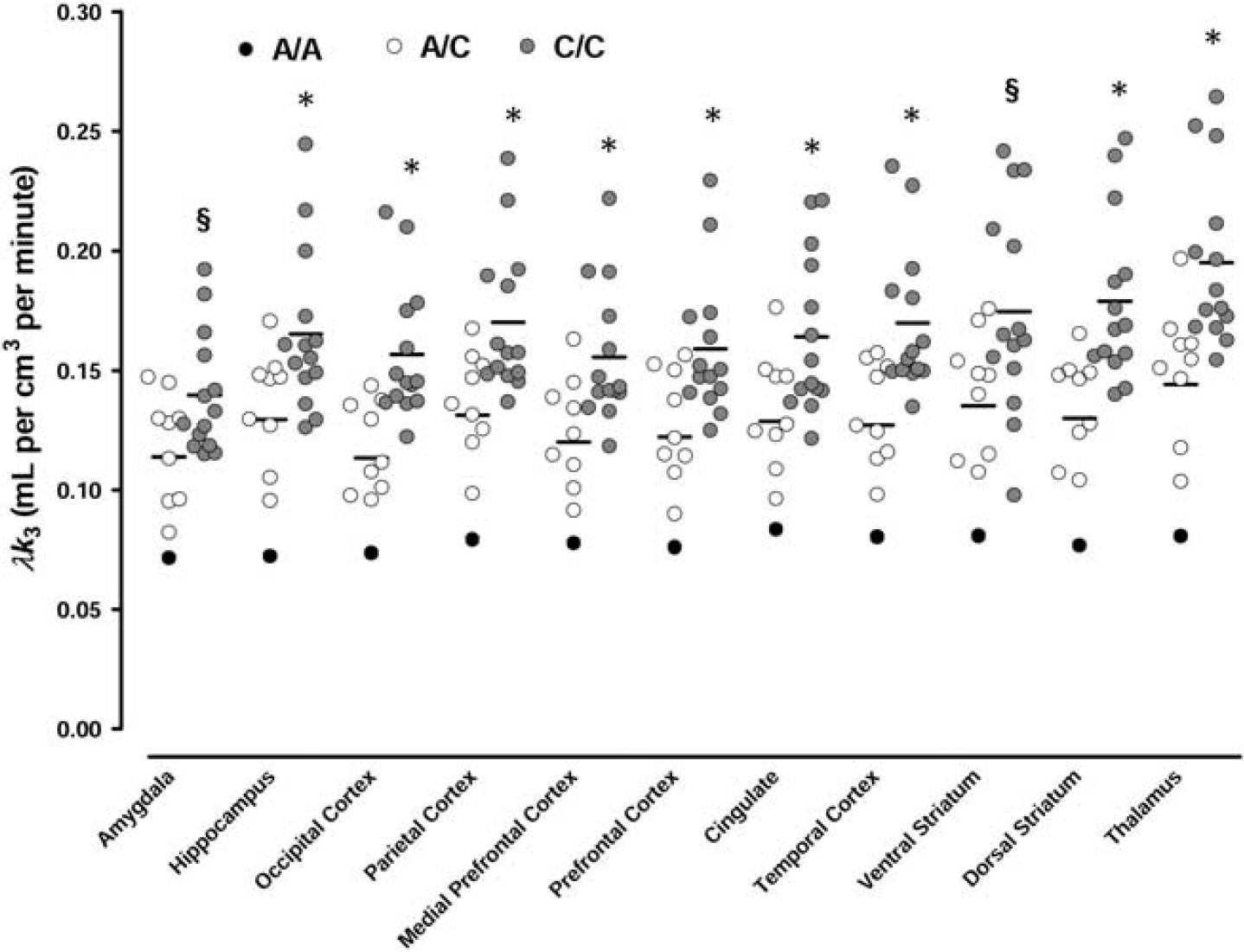
Differences in [
11
C]CURB
FAAH Genotyping
The FAAH genotype (rs324420) was determined using the Taqman SNP genotyping assay set performed on a ViiA7 thermal cycler (Life Technologies, Burlington, Ontario, Canada) with appropriate controls. Briefly 5
RESULTS
Healthy volunteers (
Demographic and clinical characteristics of subjects
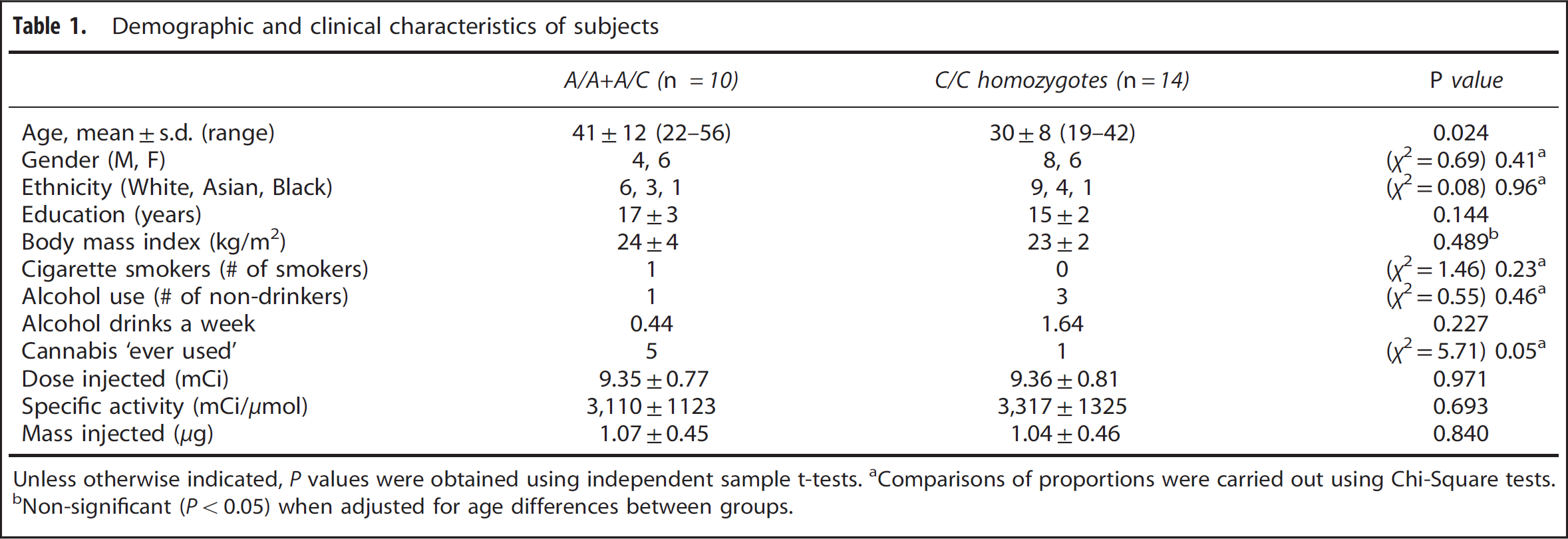
Unless otherwise indicated,
Comparisons of proportions were carried out using Chi-Square tests.
Non-significant (
Repeated measure ANOVA with age as a co-variate indicated a significant effect of group (genotype C/C vs A/A+A/C) on [
11
C]CURB binding (
DISCUSSION
We provide, for the first time,
Based on preclinical studies investigating the impact of the P129T variation on FAAH, we suggest that changes in [
11
C]CURB/PET binding reflect reduced FAAH protein levels (i.e.,
[
11
C]CURB is a recently developed PET radiotracer for FAAH and our blocking studies with a highly specific FAAH inhibitor PF-04457845 confirmed that brain [
11
C]CURB binding is very specific and sensitive to FAAH inhibition (JCBFM, submitted). This genetic report again demonstrated the sensitivity of this PET ligand to endogenous FAAH activity changes and serves to validate the modelling parameter
The reported findings have important implications for interpretation and designing of studies measuring FAAH activity with [ 11 C]CURB/PET. Genotyping the FAAH rs324420 (C385A) polymorphism and genetic profiling during statistical analysis will insure adequate comparison in cross-sectional studies aimed at quantifying FAAH activity in different clinical population, which may or may not be otherwise matched with respect to genotype. In this regard, a number of gene association studies have suggested that different frequencies of the FAAH variant may occur in certain neuropsychiatric conditions (including addictions and generalized anxiety disorder).2–4,7,8 In our sample, the prevalence of FAAH variants (C/C, 58%; A/C, 38%; A/A, 4%) was similar to that in the literature for healthy controls. Another generic point to consider was the possibility that FAAH activity driven by racial differences in the impact of the gene variant has a race-specific effect. However, we did not observe an effect of race on [ 11 C]CURB/PET binding: our genetic groups were matched with regard to race and composed, for the most part of Caucasian subjects; this suggests a similar impact of the FAAH genetic variant among racial groups; however, future studies may need to further confirm this observation.
The limitations of this report include a small sample size and that the genotypes were not matched for age; the A/A+A/C group was significantly older than C/C genotype. However, animal studies reported either no effect13,14 or an age-related increase13,15 in FAAH activity or protein and we did not observe a significant effect of age on [ 11 C]CURB/FAAH binding in the limited sample. Future comprehensive studies are needed to confirm this and further to address the relationship between FAAH genetic variation, brain [ 11 C]CURB/PET binding and peripheral measures of FAAH activity and protein or endocannabinoid levels. Examination of autopsied human brain for FAAH genotype and the association with activity/protein would also help confirm our PET findings.
In conclusion, we show for the first time that FAAH activity in brain is dependent on a common gene variant and that genotyping for FAAH rs324420 variants during [ 11 C]CURB/PET will allow better interpretation of data.
AUTHOR CONTRIBUTIONS
IB and JT contributed to study concept and design, analysis and interpretation of data, drafting/revising the manuscript for content, study coordination, and acquisition of data. RFT and QZ contributed to genetic data analysis, interpretation of data, and revising the manuscript for content. BW, EM, and DW contributed to acquisition and analysis of data and revising the manuscript for content. PR contributed to data analysis/kinetic modelling, interpretation of data, and revising the manuscript for content. BLF, RM, and VDL contributed to study medical supervision, study concept and design, and revising the manuscript for content. AAW contributed to tracer radio-synthesis, study concept and design, revising manuscript for content, and interpretation of data. SH contributed to study concept and design, revising manuscript for content, interpretation of data, and study medical supervision. SJK contributed to study concept and design, revising manuscript for content, and interpretation of data.
DISCLOSURE/CONFLICT OF INTEREST
The authors declare no conflict of interest.