






Abstract
Using a social representations lens, we examined subjective meanings of land entitlements in Central Mindanao among Muslims and Christians. In Study 1, we collected survey data from 231 students from the University of Southern Mindanao in Central Mindanao, asking them: ‘If you were to tell the story of land ownership in Cotabato, what three topics would you want to include in your story?’ Results of our hierarchical evocation analysis show that Christians are concerned with direct conflicts or actual intergroup confrontations while Muslims emphasise land issues. Study 2 implemented Focauldian Discursive Analysis to evaluate two separate focused group discussions by Muslim and Christian village leaders on the question: ‘Who really owns the land in Cotabato, specifically here in Midsayap?’ Findings indicate that Christians hold on to a legal story while Muslims use the ancestral domain narrative to cohere subjective claims to the contested territory. We discuss our results in the light of the role of legalese in an asymmetric territorial conflict and more specifically, the Framework Agreement signed last October 2012 by both the Philippine government and the Moro Islamic Liberation Front.
Keywords
Studies about the centuries-old Muslim–Christian conflict in Mindanao highlight disputed land rights as a central issue in Mindanao struggles. Researches about the Mindanao conflict point to Muslim aspirations for an independent Moro state or
One of the central sections of this Framework Agreement pertains to property rights. But are group-based understandings of land rights identical on both sides of the negotiating table? Our research addresses subjective meanings of property entitlement among Muslims and Christians in Central Mindanao, through the lens of social representations theory.
Social Representations, Political Psychology, and Asymmetric Social Conflicts
We first discuss the theory of social representations as it relates to social conflicts. Social representations are about social knowledge, and refer to a group-shared set of interconnected beliefs, values, ideas and practices about a particular social object. Although psychological in nature, social representations are conceptualised as collective phenomena, rather than as mental processes located inside the minds of individual persons. Such social representations are formed by a group, and reflect how such groups make sense of a particular social object (Philogene & Deaux, 2001).
An unexpressed opinion thriving in multiple minds remains private and relatively irrelevant to the shape of public life. However, as such opinions are communicated and mobilised publicly, they contribute to the formation of social representations. Group members hold on to such collective representations in their social landscape, and share similar subjective interpretations of their group experience (Jovchelovitch, 2001).
At this juncture, groups claim their respective social representations as social facts and ‘. . . if opinions are an insecure basis for undertaking potentially costly actions, social facts are a firm foundation from which one can act in the world’ (Elcheroth, Doise, & Reicher, 2011, p. 737). Many social conflicts which depart from political solutions and erupt into physical violence revolve around contested social representations that are treated as social facts by both antagonistic groups (Elcheroth et al., 2011). Each side formulates their claimed representations along narratives of group-righteousness (Sen & Wagner, 2005).
Group-based psychological understandings of the meaning of land entitlement in a territorial conflict are political phenomena, because such collective representations do not only reflect what is out there, but likewise shape the external political landscape (Elcheroth et al., 2011). Collective knowledge provides the basis for collective behaviours that alter the political arena. For example, if Group A believes that this particular Mindanao territory belongs to them but was unfairly grabbed by Group B, then Group A could refer to this collective knowledge as rationale for a liberation movement against Group B. It is this bidirectional interface between collective knowledge and transformative collective behavior that fuses psychology and politics. As Elcheroth et al. (2011) claim, ‘a social representations approach overcomes the duality between psychology and politics’ (p. 730).
As social representations take anchor in a group and turn into social facts, these become normative, limiting the repertoire of acceptable behaviors and shaping imperatives about how people think and behave (Elcheroth et al., 2011). However, in asymmetric intergroup clashes like Mindanao's Muslim–Christian conflict, normative social representations are associated with the dominant group, and dynamically challenged by the less dominant group (Staerkle, Clemence, & Spini, 2011). Hence, in intergroup conflicts, social representations likewise clash, as the dominant group holds on to the normative claim, while the undergroup disputes the claims with an alternative and polemic social representation about the contested social object.
Understandably, in territorial conflicts such as the Mindanao conflict, disputed claims by warring ethnic groups are fuelled by contrasting social representations that portray each group as the rightful owner of the contested land. Although highly subjective, such social representations provide the psychological landscape for engaging in intergroup armed clashes (Inzon, 2008; Sen & Wagner, 2005).
Our study describes social representations of land ownership among Christians and Muslims in Central Mindanao, the hotbed of continued armed clashes between the Moro Islamic Liberation Front (MILF) and the Christian-dominated Government of the Republic of the Philippines (Abat, 1999; Kadtuntaya Foundation, 2009). Past scholars have analysed the causes and solutions to the Mindanao conflict from a historical or political science viewpoint (Buendia, 2005; Gowing, 1977). However, this is the first study about the land issue in Central Mindanao that collects psychological data on what goes on in the collective minds of Muslims and Christians in the region.
As we explain territorial entitlements, we employ two polemic phrases commonly used in the Mindanao conflict during local discussions about land issues. To accommodate both the normative and dynamic meaning of land entitlement in Mindanao, we use ‘land ownership/grabbing’ to recognise two local meanings about land claims. Each of these terms are strongly preferred by one group and equally offensive to the other side. Christians claim to own the land, while Muslims dispute such a claim and assert instead that Christians had forcefully taken or grabbed the land away from Muslims. Further, we use the label ‘Central Mindanao’ in a liberal way, referring to the original territory of Cotabato Province created in 1914, and which presently covers entire or parts of territories in what is today known as Cotabato, Sarangani, North Cotabato, South Cotabato, Sultan Kudarat and Maguindanao.
Our study elucidates social representations of land entitlements in Central Mindanao, as associated with the phrases ‘land ownership’ and ‘land grabbing’. And, as Elcheroth et al. (2011) note: ‘Our point here is not to say which representation is right or wrong, but to show that the representations are highly consequential for the nature of the conflict’ (p. 748).
Studying the Structure and Discourse of Social Representations
The study of social representations among groups requires ‘genuine methodological pluralism’ (Elcheroth et al., 2011), and likewise depends on which aspect of the complex theory one wishes to interrogate (Philogene, 2001). Two theoretical approaches and their methodological strategies are used in this study, because they provide the most useful avenues for accessing social representations of land entitlements in the Central Mindanao territorial conflict.
The first methodological approach sees social representations as a cognitive structure of a group or society about a social object. The structured feature is not an aggregate of individual cognitions, but rather a psychological feature whose smallest analytical unit is a collective. The goal of social representations research from this theoretical view is to uncover this group-based cognitive structure. For example, one would seek to discover the collective cognitive structure of Muslims and Christians in relation to their group's meanings of land ownership/grabbing in Central Mindanao.
This structural approach to social representations has been advanced by Jean-Claude Abric (1996, 2001, 2008). One key element in this structure is a representational central core, which is resistant to change and provides meaning to other elements in the shared representation. For example, a central core of the meaning of land entitlement among Christians in Mindanao would define which aspect of the meaning of land entitlement would resist change and around which other psychological elements about land ownership would organise themselves.
A methodological strategy called the hierarchical evocation method or HEM can be employed to uncover the central core (Abric, 2001, 2008). Briefly, this method considers that a central core has a high expressive value. Elements of the central core are not only frequently communicated but also immediately evoked. HEM thus cross-measures salience or frequency, and also evocative ranking or how immediately a person mentions this representational element when asked about the social object. Details of HEM are explained in Study 1 of this article.
A second and more qualitatively inclined methodological strategy in the study of social representations sees shared knowledge as ‘discursified thinking’. Conceptually, discursified thinking can be understood as culturally embedded thematic patterns that are ‘presumed or evident in the culture of a group, so that its members may not even spell them out in communication’ (Moscovici, 2001, pp. 30–31). This brings the study of social representations into the realm of talk and communication. Basically, a discursive analysis of social representations extracts underlying themes in talk about a social object.
We note that Foucauldian discourse analysis (FDA) lends itself well to studying social representations of asymmetric groups, because the construction of social meaning in asymmetric relations involves power issues (Staerkle, Clemence, & Spini, 2011) and considerations of how such discourses act on social reality. Foucault (1972) asserts how power is constituted through discourses. FDA examines the power of discourse to construct its social object, and considers the material conditions within which such discursive constructions may take place (Willig, 2008). As dominant and non-dominant groups contest the meaning of a social object such as land entitlement, the more powerful group may shape the normative discourses, while the less dominant group can challenge these discourses with their own dynamic social representations about land entitlement. Study 2 compares social representations of two asymmetrically related groups, by looking at how Muslims and Christians talk about land entitlement in Central Mindanao. The procedural details of FDA are presented in Study 2 of this paper.
Overview of Two Studies
We implemented two studies to uncover social representations about land ownership/grabbing in Central Mindanao. Study 1 used survey data to identify the representational central core (Abric, 2001) of land entitlement among Muslims and Christians. In Study 2, we conducted focused group discussions among strategic leaders of local Muslim and Christian villages, and used a modified Foucauldian Discourse Analysis (Willig, 2008) to describe deeper discursive constructions about land entitlement in Central Mindanao.
Both studies collected data from villages in North Cotabato. This province is situated at the heart of Central Mindanao between two provinces heavily populated by Muslims on the eastern side, namely Maguindano and Lanao del Sur, and two provinces dominated by the Christians on the western side, namely Bukidnon and Davao del Sur. Cotabato is the site of hotly-contested land claims between Musims and Christians, and sporadic eruptions of armed clashes between the Moro Islamic Liberation Front and troops of the Philippine government.
Contemporary social representations of land entitlements in our selected research sites may be better understood by looking at the history of land ownership/grabbing in Central Mindanao. Hence, in order to contextualise our two studies, we now present an overview of land conflict in Central Mindanao.
History of Land Ownership/Grabbing in the Research Site
Before Spain arrived in the Philippine Islands in the 16th century, Central Mindanao was largely populated by Islamised tribes, and politically organised under a sultanate. During this period, land ownership was marked by ancestral association and communal sharing. For more than 3 centuries, Spain failed to fully subjugate Central Mindanao. By 1898, Spain negotiated with the Americans over the ownership of the Philippine Islands. The transfer of Philippine sovereignty rights from Spain to the US included Central Mindanao, and the rest of the Moro territories (The Local Government Support Program in ARMM, 2009).
The American occupation in the Philippines marked the start of shifts in the ownership of vast territories in Central Mindanao, away from Muslim communities and into the hands of Filipino Christians. Such large-scale land ownership shifts were effected through land-related legislation, and waves of Filipino Christian migrants from northern parts of the archipelago that had been Christianised by the Spaniards.
Land laws passed during the American occupation disregarded customary land ownership practices in the Cotabato sultanate. Through legislated policies, land ownership was defined as registered private or corporate land, leaving no room for the registration of the Muslims’ communal lands. A subsequent land registration act voided land grants from Moro chiefs of non-Christian tribes when made without government authority or consent (Rodil, 1994).
Christian migration to Central Mindanao likewise started during the American occupation of the Philippines. After independence from the United States in 1946, the Philippine government continued to encourage Filipino Christians from northern and central Philippines to migrate to Central Mindanao. Massive Christian resettlements were managed by government agencies. By 1960, Christians became the dominant group in what was once an Islamised sultanate in Mindanao (Gutierrez & Borras, 2004).
In the early 1970s, the Marcos administration shifted its focus from resettling Christians in Mindanao to legitimising land claims of corporations and businesses. Marcos supported the growth of an agribusiness export economy in Mindanao, based on exporting timber, sugar, pineapple, and coffee (Edgerton, 2008). With the influx of large-scale corporate enterprises and development projects, cases of Christian settlers and land grabbing on tribal lands increased (May & Nemenzo, 1985). Influential business leaders and corporations, backed by private armies, armed guards, and political warlords applied for hectares of land and displaced indigenous communities from their ancestral lands.
Disputes over land ownership and grabbing provide the socio-economic backdrop for a highly militarised intergroup relation between Muslims and Christians in Central Mindanao. The politico–military expression of such land contestations find form in deadly clashes between armed forces of the Christian-dominated Philippine state on one hand and Moro liberation fronts on the other hand. For example, during the early years of Marcos martial law regime, Central Mindanao stood out as one of the epicentres of the regime's military might as state troops commanded by top ranking generals repeatedly attempted to crush what was labelled as a Muslim rebellion (Abat, 1999). Intergroup conflicts over land in Central Mindanao persisted even after the demise of the Marcos dictatorship. Landmark examples of armed clashes of territorial claims are the fightings that erupted around the Malmar Irrigation project in Central Mindanao in 1994 (Cabilles & Senase, 1994), and intense clashes over claims to the Liguasan Marsh (Arnado and Arnado, 2004; Diaz, 2003).
We close our historical overview with a note that as both Muslims and Christians construct their social representations of land entitlement, they select their repertoire of narratives and interpretations from the broad landscape of events and subjective meanings made available by this history of land in their region. We now present the methods and findings of Studies 1 and 2.
Study 1: Structural Configurations of Social Representations about Land Ownership/Grabbing in Central Mindanao
To uncover the structure of social representations about land entitlement, we ran a survey among 231 students at the University of Southern Mindanao in Kabacan, Cotabato. The research participants consisted of 100 Christians and 131 Muslims. Our analytical goal was to get a structural picture of group representations about land entitlement, not a summated or aggregated description of land-related attitudes. We used Abric's (2008) hierarchical evocation method to analyze our data.
Hierarchical Evocation Method
Because the central core is essential to a group's knowledge about the social object, it has a high expressive value. Its elements are frequently and immediately talked about during discussions of a social object (Abric, 2001). In relation to our research, elements of the representational central core appeared often and instantly when study participants were asked to talk about land ownership in Central Mindanao. Much of the seminal work on the expressive value of the central core was published in French. Recently, however, English-based authors have likewise used the expressive element to study the central core of social representations, through the hierarchical evocation method (Abric, 2001; Parales Quenza, 2005).
The term ‘hierarchical’ indicates that elements in the collective's representational system can be seen as structured from important to not important, depending on the order in which the phrases are more frequently and instantly mentioned during free association (Abric, 2001; Parales Quenza, 2005). Note that neither frequency nor evocation ranks are stand-alone indicators of centrality. Rather, the hierarchical evocation method identifies an intersectional space that considers both how often and how quickly a representational is evoked when people speak about a social object.
We employed the free association technique to generate our data pool for social representations. Past research has likewise used the hierarchical evocation method's free association technique to study social representations (Roland-Levy, Boumelki, & Guillet, 2010; Sarrica & Wachelke, 2010; Wachelke, 2008). We asked participants the question: ‘If you were to tell the story of land ownership in Cotabato, what three topics would you want to include in your story?’ They then listed the first three phrases that came to their minds. We refer to our data pool as our evocation corpus (Gomes, Oliviera, & Sá, 2008). We collected 324 utterances about land ownership in Cotabato, which we reduced to eight categories. To further improve our classification scheme, we discussed our proposed categories at a seminar with psychology graduate students and Muslim–Christian participants from Mindanao, and formulated a final set of categories based on our workshop deliberations. We then excluded 46 phrases with low-frequency category occurrence (5% or less of the total frequency), following a data-cleaning procedure implemented by Wachelke (2008).
To obtain the structure of the social representation, we cross-measured the frequency of occurrence and the average evocation order of the themes. The representational structure is graphically illustrated as a quadrant, with rows signifying levels of representational salience (frequency) and columns indicating representational importance (evocation order). Each cell in the quadrant contains elements in the social representation of land ownership/grabbing, which are in the (a) central core (high frequency, first-evoked), (b) contrasted elements (low frequency, first evoked), (c) first periphery (high frequency, last evoked), and (d) second periphery (low frequency, last-evoked) (Abric, 2008; see also Oliveira, Mendes, Tardin, Cunha, & Arruda, 2003; Gomes et al., 2008).
Results: A Structural View of Land Entitlement Social Representations in Central Mindanao
Structure of the Representation of Land Conflict in Cotabato Among Christians
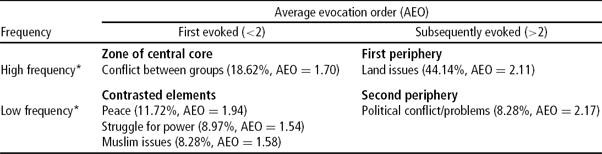
Note: *Above and below 16.7%, which is the average percentage of all Christian-mentioned categories.
Structure of the Representation of Land Conflict in Cotabato Among Muslims
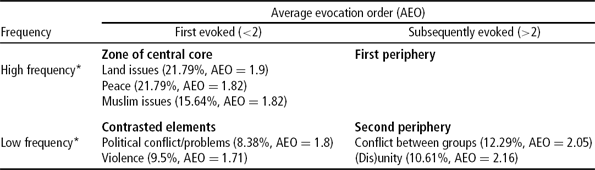
Note: *Above and below 14.3%, which is the average percentage of all Muslim-mentioned categories.
Our findings show that the social representations of land ownership/grabbing in Central Mindanao are highly polemical — what is important or core for the Christians are, for the Muslims, unimportant or peripheral. In the same manner, what the Muslims consider vital are, for the Christians, inconsequential, if not contentious.
To the Christians, the representational central core of land ownership in Central Mindanao is about conflict between groups. However, among Muslims, conflict between groups is at the periphery of their group's representation of land entitlement. On the other hand, the Muslims’ representational central core of land entitlement is about land issues, peace, and Muslim issues. None of these three categories are central to the Christians. In the Christians’ social representation of land ownership, land issues are peripheral while both peace and Muslim issues are contentious because these are important only to a few Christians.
Study 2: Discursive Social Representations About Land Ownership/Grabbing in Central Mindanao
Study 2 looked at group-based social representations of land entitlement through discursive constructions of Christian and Muslim village leaders. We used a qualitative research design, with focus group discussion (FGD) as the strategy for data collection and a modified FDA as the framework for data analysis.
We conducted our FGDs in Midsayap, a village strategically located at the juncture of Muslim and Christian provinces. As Midsayap is located at the boundary of Maguindanao and Cotabato, its population represents a mix of Muslims and Christians. Most of the Christian villages are situated around the town proper while Muslim villages are scattered along the Maguindanao side. Midsayap suffers from chronic intergroup conflict where contestations about ownership/land grabbing between Muslims and Christians remains a local controversial issue.
We facilitated two separate focus group discussions with a total of 18 elected village leaders participants. There were nine elected village chiefs and councillors in the Muslim and Chrsitian groups respectively. We gathered local leaders to access a group's discursified thinking, because social representations can be gleaned from widely diffused discourse (Elcheroth et al., 2011). In more cosmopolitan populations, such massive communication is dispersed through conventional and social media. However, the local people of Midsayap have little access to conventional media and the internet. Further, their traditional social systems remain fundamentally hierarchical, and so local village leaders hold much influence in the agentic shaping of social representations. As Elcheroth et al. (2011) assert, in the construction of social representations: ‘What counts is
At the two focus group discussions we posed the question: ‘Who really owns the land in Cotabato, specifically here in Midsayap?’ We then offered probing and summative questions to clarify the participants’ responses. The discussions used both the Filipino language and the vernacular dialect called
The transcriptions from the two focus group discussions served as our text data pool. We first read and re-read the transcribed texts in order to obtain a holistic sense of each group's story, without any attempt to cluster statements (Pe-Pua, 1985). We then employed the initial three procedural stages of FDA, as recommended by Willig (2008), namely: (1) identifying discursive constructions, (2) locating these constructions within wider discourses, and (3) exploring the action orientation of these discursive constructions. The following section presents the social representations of land entitlement as found in our discursive analysis of the focus group discussions.
Results: Muslim-Christian Discursified Thinking About Land Entitlement
Our results are divided into two parts. First, we show how representational elements of land entitlement are connected to wider discourses about land entitlement in Central Mindanao. Next, we look at the contrasting groups’ collective judgments about land-entitlement procedures.
Wider Discourses About Land Entitlement in Central Mindanao: A Legal Discourse Versus an Ancestral-Domain Discourse
Representational Elements and Wider Discourses about Land Entitlement in Central Mindanao
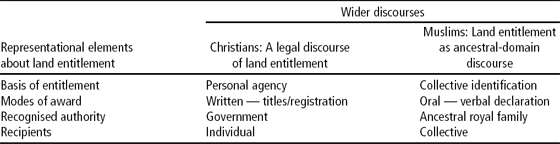
The first representational element contained in land ownership/grabbing involves the basis of entitlement. Both groups showed conflicting versions on this issue. Christians supported a legal claim by claiming that their land entitlement emanated from their individual efforts, such as developing and tilling the land:
Another shared representational element related to land ownership/grabbing was that land was awarded by recognized authorities. But the basis of awarding, and the recognized authority varied in the land-entitlement discourse of Christians and Muslims.
Christians held on to a legal narrative and repeatedly alluded to written documents such as titles and registration as the basis of land awards and proof of ownership. As a Christian participant related: ‘It cannot be said that Muslims owned the land because at the time there was no basis of ownership. In 1935, the government recruited people from Visayas and Luzon to come to Mindanao to develop the “Land of Promise”.’ Thus, this award for Christians became the basis of ownership as stated by one of the respondents: ‘Legally speaking, they (Muslims) cannot get it (land) in as much as the title is registered already in our name.’ Christians also emphasised the prominence of government agencies as authorities legitimised to dispense land. A Christian participant expressed this claim when he said: ‘Legally speaking, Muslims cannot get land from the Christians because the Department of Agrarian Reform (DAR) and Department of Agriculture (DA) already registered and titled the land under their names.’
On the other hand, Muslims invoked the ancestral-domain narrative, and claimed that land ownership was awarded through the verbal declarations of their elders, who were the original landowners. Muslims challenged the Christians’ claim of ownership by highlighting how the land titles were introduced by colonisers and intensified by the ‘new government’ and not by their elders who were the original owners of the land in Mindanao. As one Muslim participant said: ‘Before the Spaniards arrived in Mindanao, our royal leaders and other natives owned the lands here in North Cotabato. When they (Spaniards) came, they introduced titling which they called
Both groups held representational elements about the nature of land ownership, but their analytical units differed. Among Christians, entitlement was individually based and depended on who held the legal title of the contested land. On the other hand, among Muslims land ownership was a collective phenomenon. Muslims referred to their collective ownership as
Group Judgements About Land-Entitlement Process
Contradictory Group Judgments About Land Acquisition Processes
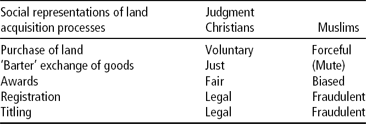
We now show how judgements about the procedural elements of land entitlement differed between Christians and Muslims. Participants from both groups judged the practice of acquiring land through purchase or barter (goods exchange) in opposite ways. Christians asserted that the land they owned was voluntarily sold to them by Muslims. In addition, they also offered just and fair compensation for the land they bought from the Muslims. Therefore, Christians saw the process of purchasing land through money or exchange of goods as voluntary and fair, as stated by a Christian participant: ‘
On the contrary, Muslims construed that the selling of land to Christians by their fellow Muslims was done out of fear, force and helplessness. One Muslim claimed that: ‘The land was sold cheap because Christians were already occupying it. My father said that even if we did not sell it, there was no guarantee we could get our land back. That was how we lost our land.’ Another Muslim expressed the same experience in these words: ‘We were not sure we could be able to get our land back. We had no other choice except to sell it. We were told that in the long run the lands would all end up in their hand because they were “government”.’
The exchange of goods or ‘barter’ was repeatedly mentioned by Christians as the mode by which they acquired their land from the Muslims. As shared by a Christian participant: ‘Because the early Cebuano settlers were good to the Muslim leaders — the
The discourse about the manner and procedures involved in the awarding, registering and titling of lands contained intense contestations and accusations. The Christians constructed these processes as fair, legal and legitimate whereas the Muslims construed the same processes as government-aided, orchestrated land grabbing, and thus fraudulent and biased. A Muslim participant narrated these processes of land grabbing:
Christians claimed that the lands they own were awarded to them as part of the resettlement program of the government. Others also claimed that parcels of land they own now were given as a gift by the original owners, namely by the
Christians also claimed that their lands were registered by government agencies after being awarded by the government, or given as a gift by a Muslim leader, or buying them through exchange of goods or by cash. For their part, Muslims construed this as fraudulent because old Muslim leaders did not have titles then and those who already had were betrayed by government agencies into subdividing lands through the Comprehensive Agrarian Reform Program (CARP) which were eventually assumed by Christians. To express how Christians benefited from the registration process at the expense of Muslim, one participant said: ‘The land was registered in a government office, but our grandfather did not know anything about government procedures.’
Christians relied on the titling of land to get the assurance of land ownership. Hence, it was important that when they bought the lands, they immediately proceeded to process the registration and titling of these lands, as a Christian participant stated: ‘. . . to make the transaction legal, the Christians had the land titled. That was how land ownership was transferred. It was done properly; there was no coercion.’ On the other hand, the Muslims did not bother about titling because for them, land ownership belongs to God, as stated by one participant: ‘They did not bother with titles because they believed that what they own actually belong to Allah. Because titles are necessary nowadays, many are losing their untitled land. They have no idea who ordered settlers to occupy their lands.’
In summary, Christians judged the process of land purchase and/or barter as voluntarily done, while Muslims claimed such processes were forcefully implemented. In relation to procedures of land awarding, titling, and registration, Christians saw these as fair and legal, while Muslims maintained that such procedures were biased and fraudulent. The action-orientation of these polemic discourses are elucidated in the Discussion section.
Discussion
In this section, we highlight contradictory elements in social representations of Muslims and Christians. Next, we examine representational differences in the light of social asymmetry or inequality between the two groups. We end our discussion by looking at our study's implications on the ongoing Central Mindanao peace process.
Our results demonstrate the marked difference in the social meaning of land entitlement between Muslims and Christians in Central Mindanao. By looking at the structure of social representations in Study 1, we found out that what is at the central core of one group's shared knowledge lies at the peripheries of the other group's representation.
Christians see group conflict as central to the story of land ownership. They use the term
Our findings show that one group's central core is another group's peripheral representation of land ownership. When asked about the story of land ownership, Christians immediately and frequently talk about group conflicts, but Muslims rarely speak of overt conflict. On the other hand, land issues occupy the central core of Muslims’ social representation of land ownership. Interestingly, Christians likewise frequently mention land issues, but in the sequence of their evocations, group conflict precedes land issues. Table 1 shows how land issues are in the first periphery of Christians’ social representations, indicating that although many Christians associate land issues with the story of land ownership, land issues do not immediately come to mind (i.e., are subsequently evoked) when Christians think about land ownership.
Study 2 collected qualitative data to elucidate the quantitative findings in Study 1. The results of Study 2 explain why Christians are concerned about intergroup confrontations, and why Muslims emphasise land issues.
Christians see themselves as legally owning the land, having acquired ownership of this land through fair means. They allude to discursive elements of personal effort, legal land titles, and government bureaucratic land awards as they claim land ownership. Their concern then is to hold on to what they see as rightfully theirs, and avoid both intergroup fighting and addressing land issues.
The Muslim discourse about land ownership stands orthogonal to the Christian story. Muslims maintain that Christians do not own the land because the latter acquired the land through unfair, deceptive, and fraudulent means. The Muslims’ claim to land ownership is not a legal story, but rather a narrative about ancestral domain. In their discourse about land entitlement, they cite oral declarations rather than land titles, and land awards from the sultanate's royal family line rather than from a government bureaucracy. Further, Muslim land claims are about collective rather than individual rights.
Foucauldian Discourse Analysis encourages an analytical extension of the discourse to explore the action orientation of discursive constructions (Willig, 2008). Because “collective behavior can often be influenced more powerfully at the level of meta-representations than of intimate beliefs” (Elcheroth et al, 2011, p. 729), we ask, what collective actions can be inspired by the respective narratives of Christians and Muslims?
Land owning narratives provide Christians reasons to hold on to their individual lands, vigorously and righteously condemning any armed confrontations in the name of land issues. On the other hand, land grabbing storylines give Muslims their collective basis to reclaim lands perhaps even in combative ways, because such lands are socially represented as having been forcefully and fradulently taken away from them. These representations may fuel collective behaviors such as Muslim liberation movements for territorial claims.
We note patterns in the social representations of the comparative groups which, we surmiss, may be generalized to other asymmetric teritorial conflicts as well. Legal narratives, such as the legalese of Christian claims to land, tend to be utilized by more powerful groups, rather than by nondominant groups in a conflict. Such legal claims to social meaning increase the chances that the representation becomes normative during social contestation. However, the dynamism of an alternative representation may contest the normative representation in an asymmetric clash (Staerkle et al, 2011). For example, the Muslims’ alternative meaning of land entitlement as ancestral domain challenges the normative Christian meaning of ownership based on legal land titles.
The nondominant group's meaning of land entitlement as ancestral domain has occupied centerstage in peace talks between the Philippine Government (GPH) and the Moro Islamic Liberation Front (MILF). But because ancestral domain is not a normative social representation in Central Mindanao, its inclusion in previous peace drafts has stirred much political debate and even triggered military skirmishes. For example, in 2008, a proposed peace agreement called the Memorandum of Agreement on Ancestral Domain (MOA-AD) triggered Christian-mobilized street protests which escalated into armed clashes between the MILF and government military forces.
Recently, peace efforts have been renewed, and in October 2012, a Framework Agreement was signed by the Philippine Government and the MILF. On a positive note, we point out that the Framework Agreement encompasses what both Christians and Muslims consider important in their representation of land issues in Central Mindanao. The recently signed peace agreement contains the dual language of (direct) conflict cessation, and the recognition of Muslims’ ancestral domain. This language of peace framed along the lines of the quieting down of intergroup clashes in this region may appeal to Christians, because direct conflict lies in the central core of the meaning of land ownership. On the other hand, a section about Muslims’ control over a defined territory called Bangsamoro (Moro Nation) aligns with the central representational core of the meaning of land entitlement among Muslims.
However, we note that the actual implementation of the Framework Agreement's section on property rights for specific land tracts may produce interpretative problems on-the-ground because group meanings attached to land enttlement are different among Christians and Muslims. More specifically, the Framework Agreement states that:
The italicized words in the above quote emphasize parts of the Framework Agreement that may be interpreted in different ways by Muslims and Christians. On both sides of the peace negotiating table, meanings may differ about what constitute
Our findings about the contested meaning of land ownership on-the-ground may be useful to lawmakers who will craft the Bangsamoro Law. A Transition Commission (TransCom) to draft the Bangsamoro Law has just been convened, and started meeting in April 2013. The TransCom is headed by the lead negotiator of the Moro Islamic Liberation Front, and is composed of eight members from the MILF and seven members from the government. Although legal in nature, the Bangsamoro Law could address various land issues that arose through history as a consequence of what Muslims view as incomprehensible and unfair legalese. The shift of Muslims’ attitude toward a legal language about land comes along with a shift from an acutely asymmetric to a more equal relationship between the government and the MILF.
Footnotes
Acknowledgments
This research was supported by Ateneo de Manila University's Institute of Philippine Culture and a Loyola Schools Scholarly Work Faculty Grant.