






Abstract
On the French island of Corsica, a 57-y-old woman without significant medical history was stung on the left thumb while she was taking care of an ornamental Ficus benjamina plant. Immediately, she felt intense pain in her hand. She saw a strange caterpillar, later identified by the local poison center as Acharia stimulea. The pain in her hand was evaluated as 8 of 10 using the numerical pain rating scale; only a slight erythema was visible on her skin. Symptoms disappeared within 2 h with use of local anti-inflammatory ointment and oral painkillers. Three other caterpillars emerged out of the soil of the potted plant during the following week. This sting by a saddleback caterpillar is exceptional in Corsica. French garden store owners and healthcare professionals should be informed that caterpillars can be imported across the oceans to Europe on different plants.
Introduction
Caterpillars are butterfly and moth larvae, and several species are equipped with venomous chitinous spines that are capable of penetrating human skin and causing envenomation. 1 Several species of stinging caterpillars are found in the southeastern United States, but the most notorious are the saddleback caterpillar (Acharia stimulea) and the puss caterpillar (Megalopyge spp). 2 Both have been responsible for clinical descriptions of intense pain with proximal radiation. 3
The saddleback caterpillar, A stimulea (formerly Sibine stimulea), has a striking appearance (Figure 1). It belongs to the order of Lepidoptera (butterflies and moths) and the family of Limacodidae (slug-like caterpillars). Larvae are slug-shaped and approximately 2.5 cm (1 in) long and 1 cm (0.4 in) wide when fully grown. They are brown at both ends, with hollow spine-covered tubercles (horns), a green “saddle blanket” middle trimmed with white, and a central purple-brown oval spot like a saddle also edged with white, hence the common name.1,4,5
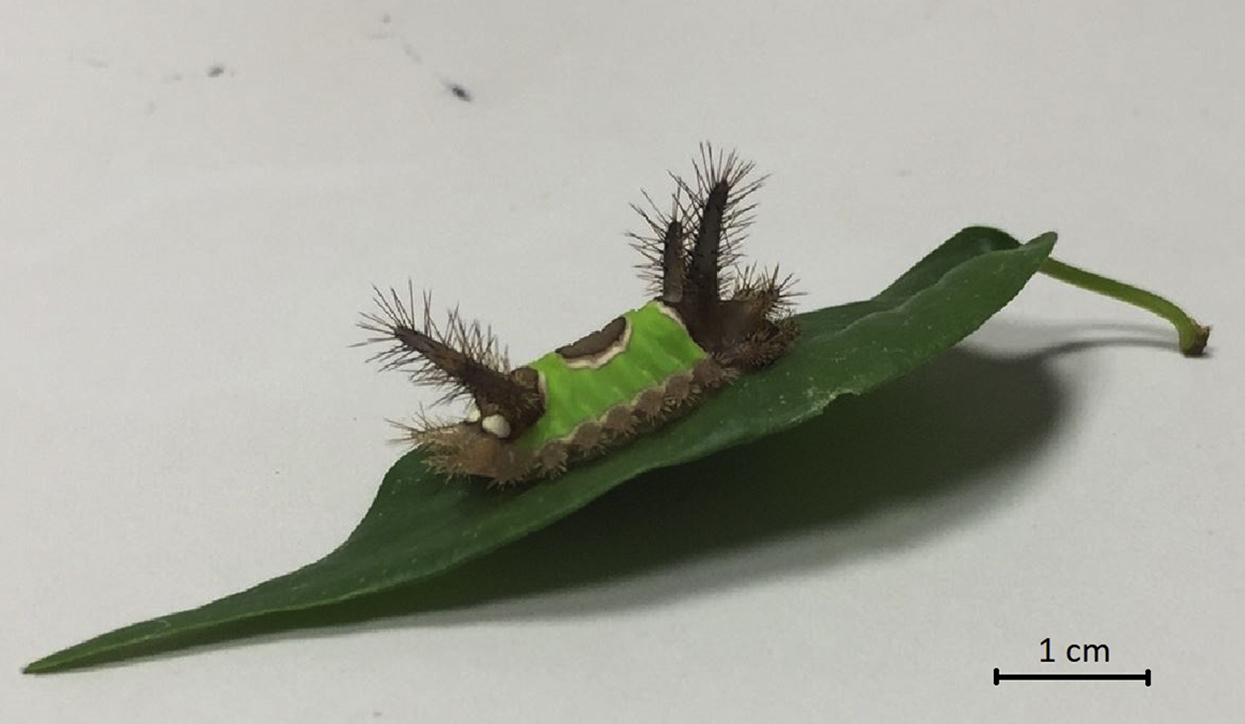
Acharia stimulea on a Ficus benjamina leaf (Torrents).
The saddleback caterpillar is a passive, slow-moving caterpillar that usually remains hidden in foliage. 5 It has tufts of true urticating spines lined with hypodermal cells that secrete toxins, the chemical composition of which remains obscure. 2 Stings have been very rarely reported in European countries because the caterpillar is not native to Europe. We describe an observation after skin contact with an A stimulea caterpillar imported to the French island of Corsica on a Ficus benjamina plant.
Case Report
A 57-y-old woman without significant medical history was stung on the left thumb while she was taking care of her ornamental plants. Immediately, she felt intense pain in her hand. She saw a strange caterpillar (Figure 1) on a leaf of the exotic F benjamina she bought 1 mo earlier in a local garden center in Corsica, France. The plant was still in its original pot.
The sting caused localized pain that radiated to the whole arm, causing skin pallor and generalized discomfort 3 min after the event. She decided to call the emergency department, which contacted the local poison center. The poison center identified the caterpillar as a saddleback caterpillar, A stimulea (Figure 1).
The pain in her hand was evaluated as 8 of 10 using the numerical pain rating scale; no sting mark was visible on her skin, only a slight local erythema with no edema. Local anti-inflammatory ointment (diclofenac, topical 2%) and oral painkillers (paracetamol 400 mg plus codeine 20 mg) were prescribed with home monitoring. Symptoms resolved within 2 h. According to the patient, 3 more caterpillars of the same species emerged from the soil of the potted plant during the following week. The patient presented no sequelae. Investigation showed that this Ficus came from Mexico where A stimulea are indigenous, and it was the only case reported from the garden center in Corsica.
Discussion
In a 1-y prospective study of 112 caterpillar envenomations reported in 1990, the caterpillars involved could only be identified in 68% of cases. 6 The authors were from the southeastern United States, which caused bias in the caterpillars involved. In the study, 4 caterpillar species were strongly associated with stings: the buck moth caterpillar (Hemileuca maia), the Io moth caterpillar (Automeris io), the woolly asp/southern flannel moth caterpillar (Megalopyge opercularis/Lagoa crispata), and the saddleback caterpillar.4,6 A stimulea stings are very rare in Europe because the species is not indigenous. One pediatric case was described in southwest France from an imported Areca tree, and 2 cases were reported in the United Kingdom: 1 in Wales, from a caterpillar nestling in an ornamental plant, and the other at a garden center in Somerset. In all of these European cases, the caterpillars arrived after being transported across the Atlantic Ocean on imported plants. 5
In our case, only 1 sting was reported, but the saddleback caterpillar is able to cause multiple stings on the same patient. 2 Cases of ingestion or oral contact have also been reported.7,8 The most common symptoms associated with this caterpillar’s sting are localized pain, erythema, and swelling. Edema is often described with normal vital signs and no fever.2,5 These symptoms are not always reported. For our patient, nothing was noted except slight erythema. The lack of urticarial lesions with A stimulea is known and is similar to other species. 4 However, an urticarial reaction that cleared completely in about 2 h has been reported; 71 h after the caterpillar sting, the same patient presented an acute vesicular eruption in the sting area, which cleared promptly with the use of a topical corticosteroid gel. 2 Biopsy of the urticarial lesion was performed and showed an unremarkable epidermis with marked reticular dermal edema and a sparse superficial perivascular lymphohistiocytic infiltrate. 2 Contact urticaria or, more rarely, an acute eczematous reaction is also possible. 2 The classical clinical presentation of such incidents shows a skin reaction in the shape of an erythematous halo that can become hemorrhagic and vesicular. In our case, no biopsy was performed owing to the lack of local signs. Excruciating pain is characteristic of each envenomation, evaluated at 8 of 10 using the numerical pain rating scale in this case. This pain may be accompanied by systemic manifestations such as skin pallor and discomfort owing to the pain intensity, but generally symptoms resolve within a few hours.
The general management of this caterpillar sting is entirely supportive. It includes immediate soap-and-water washing of the sting site and application of ice packs to reduce the stinging sensation. 5 Spines should be removed with adhesive tape or blackhead-removing pads, 4 and administration of antihistamines may help relieve itching and burning. 5 Topical corticosteroids may reduce the intensity of the inflammatory reaction, 2 and appropriate analgesics should be prescribed for pain. This treatment may be combined with local anesthesia in the emergency department. 9
This clinical case describes an exceptional sting by a nonindigenous saddleback caterpillar in Corsica. Caterpillars such as A stimulea can be imported across oceans on plants such as Areca or Ficus trees. Garden store owners and health care professionals should be informed about this risk.
Footnotes
Acknowledgements
Author Contributions: Article writing (RT); writing assistance (CS, MG); envenomation management (JR); review and supervision (LdH, NS); approval of final version of manuscript (all authors).
Financial/Material Support: None.
Disclosures: None.