






Abstract
Introduction
One of the most popular destinations in Yosemite National Park is Half Dome. Overcrowding at the turn of the 21st century prompted a restriction of hiker access to cable handrails to the summit without technical rock climbing equipment. Prior epidemiological study of Half Dome deaths is not known to the authors. Our goal was to identify trends among all Half Dome–related fatalities in Yosemite National Park.
Methods
Multimedia sources were searched for deaths involving the cable handrails, subdome, summit, technical climbing, or base jumping. Results are reported as mean±SD (range).
Results
Twenty-nine confirmed deaths occurred on Half Dome, with 2 additional deaths likely on Half Dome. Age was 32±14 (16–86) y; 4 were female. Activity at time of death included technical climbing (36%), suicide (26%), utilizing cable handrails (16%), hiking (16%), and base jumping (6%). Of the cable handrail-related fatalities, only 2 were due to weather. There were 3 medically related deaths due to cardiac disease and altitude.
Conclusions
We identified 31 Half Dome deaths over 85 y. A minority were attributable to unfavorable weather or unskilled hiking participants. Climber registration could provide dependable denominators for accident incidence statistics. A renewed focus on suicide prevention is warranted.
Keywords
Introduction
Yosemite National Park (YNP) is 1 of the top 5 most visited national parks in the United States. Half Dome’s sheer face with 3 sides of smooth, granite slopes at 2700 m (8800 ft) is among the most popular features in YNP. The first reported summit of Half Dome was in 1875 by George Anderson, who drilled climbing aides during his ascent, which serves as the foundation for the current cable handrails installed by the Sierra Club in 1919.1,2 These cable handrails are a nontechnical route to the summit and transverse a slope of 45 to 60 degrees without requiring the use of rock climbing equipment.
Visitor modeling estimated 1200 users of the cable handrails on a typical day in 2008. 3 The cable handrails to the summit are easily accessible by hikers who are able to complete the 23 to 26 km (14–16 mi) hike. Technical rock climbers (hereafter referred to as “climbers,” with the act of technical rock climbing as “climbing”) have routes up the sheer face and steeper sides but also use the cable handrails to descend from the summit after their climbs for the 13 km (8.2 mi) hike back to the trailhead.
Overcrowding on the cable handrails and the environmental impact of overutilizing the natural features of Half Dome led to the creation of the Half Dome Plan (HDP). 1 The HDP limited access by hikers to cable handrails traversing the final 122 m (400 ft) to the summit. The HDP does not restrict climbers’ access to the cable handrails for descent after their climbs; only hikers using the cable handrails are required to possess a recreational permit to access Half Dome.
The HDP, when implemented in 2010, issued 400 hiker-use permits for the cable handrails. During the summer of 2011, an automated visitor tracker device on the Half Dome Trail recorded 312 daily passers-by, without discriminating the proportion of returning climbers, day hikers not accessing the cable handrails, or hikers with permits. 4 This is a substantive drop from 1200 daily visitors on the cable handrails prior to permitting. Currently, only 300 permits are available per day, the majority of which are distributed via a preseason lottery months in advance of a summer visit to Yosemite. Investigating trends among causes of death on Half Dome may identify strategies to reduce mortality while preserving visitor enjoyment and access to an iconic landmark.
Methods
The YNP search and rescue (SAR) records, the American Alpine Club’s (AAC) registry of North American climbing accidents, news reports, and books on deaths in YNP were searched for descriptions of fatalities on Half Dome. YNP SAR documents were cross-referenced to verify all of the deaths recorded between 2005 and 2015. SAR records provide an approximation of age from the responding rangers on scene. The age of the deceased was confirmed for all cases between 2005 and 2015 using digital copies of obituaries.
Any deaths that involved the cable handrails, climbing, base jumps, and accidents on the summit or subdome (a steep granite formation with switchbacks leading to the cable handrails) were included. Deaths that occurred on hiking trails below subdome were excluded because the authors were unable to determine if those hikers were destined for Half Dome. Descriptive statistics were used. Results are reported as mean±SD (range).
Results
Twenty-nine confirmed deaths over 85 y occurred on Half Dome. The remains of a hiker found at the base of Half Dome and a National Park Service worker who disappeared near Half Dome never to be recovered bring the total deaths to 31. The earliest death recorded was in 1930, with the most recent in 2015. There was an average of 1 to 2 deaths per decade until 1980 to 1990, when there were 8 deaths. This was surpassed in 2000 to 2010 with 9 fatalities. This current decade has seen 4 deaths already (Figure 1).
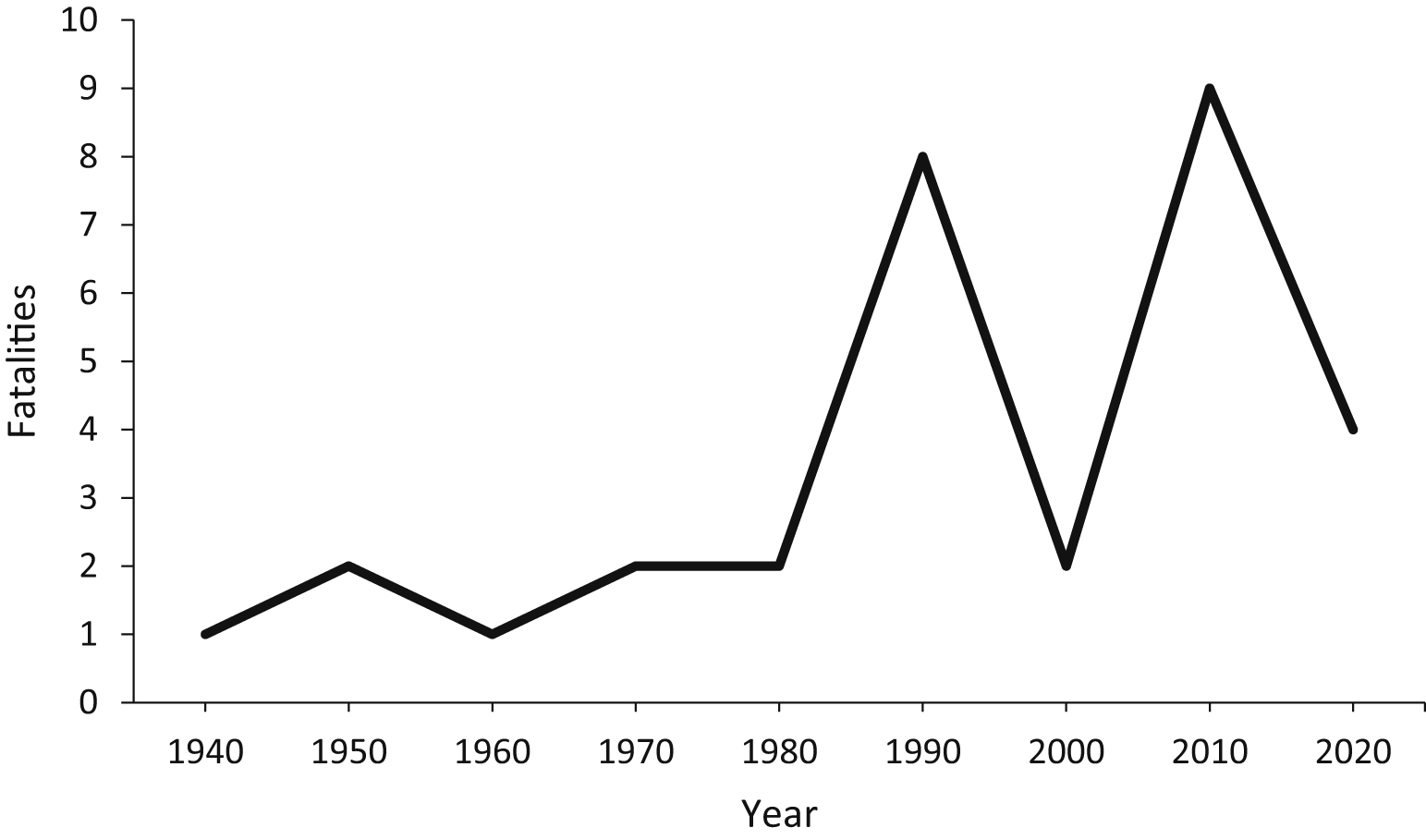
Fatalities on Half Dome per 10 y. From 1930–1939 there was 1 death on Half Dome; 1940–1949 had 2 deaths; 1950–1959 had 1 death; 1960–1969 had 2 deaths; 1970–1979 had 2 deaths; 1980–1989 had 8 deaths; 1990–1999 had 2 deaths; 2000–2009 had 9 deaths; and 2010–2018 (present) has had 4 deaths in total.
Age was 32±14 (16–86) y with a median of 27 y; 4 were female. There were 11 climbers (36%), 8 suicides (26%), 5 cable handrail-related falls (16%), 5 hikers (16%), and 2 base jumpers (6%) (Table 1).
Fatalities by activity
Brief narratives for each fatality are listed (Table 2). Of the climbing accidents (11; 36%) 2 occurred near the cable handrails when they were laid flat on the granite for the winter season. Suicides (8; 26%) were all males, mostly under age 30 y. Hiker falls from the cable handrails (5; 16%) were as common as other causes of hiker-related mortality (5; 16%). Weather-related falls from cable handrails were secondary to lightning and a hailstorm. Lightning was ultimately responsible for 4 deaths. The fall attributed to overcrowding involved inadvertent lost footing while talking with peers and in no distress, waiting to ascend on the cable handrails. Medical mortality included 2 cardiac deaths and 1 related to altitude. Base jumping fatalities resulted from chute dysfunction once deployed, not malfunction. One chute became tangled in itself, and the other cartwheeled in the wind and then folded, resulting in a free fall.
Description of fatalities by activity
F, female; M, male.
Discussion
Available news articles, books, and spokespersons for YNP have purported most fatalities on and around Half Dome were related to errors in visitor judgment regarding weather, packing necessary essentials, or deficient backcountry self-awareness. The book Off the Wall: Death in Yosemite concluded, “The take-home lesson here… is that the people who die traumatically in Yosemite die mainly—almost universally—due to their own poor judgment.” 5 In a 2007 San Francisco Chronicle article, a ranger was quoted: “We’ve only had the one fatality where other factors like bad weather didn’t play a part, so there’s no pattern.” 6 However, the data from our research does not support these views. The top causes of death will be discussed in descending order of frequency.
The highest percentage of fatalities (36%) was associated with climbing. Climbing accounted for 19% of all SAR incidents in YNP from 1990 to 1999. 7 Injury or fatality rates cannot be determined because climber registration is not required in YNP. Bowie et al surveyed all injured climbers reporting to the YNP medical clinic in a 3.5-y span and found 11 fatalities of 220 subjects (case fatality rate 6%). 8 A 2010 review article suggested the case fatality rate of climbing should be in the range of 0 to 28%. 9 Our results suggest climber registration could be an intervention to gather more data regarding the deadliest activity on Half Dome.
The second most common etiology of death (26%) on Half Dome was suicide. Though 8 deaths over 85 y may appear small, this is not an isolated finding. Suicide was the second cause of tourist fatalities in all federal lands in the National Park Service system, second only to motor vehicle crashes, when examined in 2003–2004. 10 Suicides seen on Half Dome suggest “suicide tourism,” in which individuals travel long distances to another location to commit suicide. 11 Despite this being an observed phenomenon with safety nets under bridges and tall buildings, research to define a successful strategy to reduce suicide tourism for natural landmarks is lacking. 12
Cable handrail falls have been disproportionately featured in public media as due to overcrowding and poor weather, which has not been evidenced by a single study. The HDP intended to reduce overcrowding by targeting the density of hikers on the cable handrails. 13 Overcrowding incidents represented only 1 of the 31 deaths in our study, making the HDP’s impact on fatalities unclear. The assertion that poor weather was the culprit of falls from the cable handrails may be related to near misses being inappropriately grouped with deadly incidents. Accounts of near misses highlighted issues with gripping the cable handrails in cold conditions rather than footing issues alone, which may be a significant factor in fatal falls. It is difficult to draw meaningful conclusions on improving the safety of the cable handrails based on only 5 deaths in over 8 decades.
Limitations
The most significant limitation of this study was its reliance on non–peer-reviewed references to obtain data. The most credible information obtained was from YNP and the AAC registry, but these were not comprehensive, necessitating other information be obtained to supplement these gaps. Although the core data may be valid, there was no quality standard among news reports, media coverage, and other published data. Dates, persons involved, and location may be correct, but there was no assurance that details surrounding each death were accurately described.
Reporting fatality rates would be optimal; however, it was not possible to estimate the denominator of total participants of each activity to calculate this statistic. The number of deaths was overall so small (31), representing an average of 0.3 deaths per year, that the authors described the categorization of deaths by activity to enable meaningful discussion. Additionally, it is possible there were delayed deaths outside of YNP secondary to injuries or illnesses incurred on Half Dome. The association between the original cause and outcome may never have been linked, meaning these deaths would not be reflected in our results.
Another potential limitation is our categorization of the cause of death. In most cases this was unambiguous; however, we categorized falls occurring when the cable handrails are laid flat as climbing accidents. We did this because after the cables are taken down in the off season, most hikers use climbing equipment to protect against falls. This should not have a significant impact on interpreting the results as long as the reader is aware of this categorization.
Conclusions
We identified 31 Half Dome deaths over 85 y. A minority were attributable to unfavorable weather or unskilled hiking participants, despite the contrary being a popular assertion. Climber accidents accounted for the highest proportion of deaths, warranting consideration of climber registration to provide dependable denominators for accident incidence statistics. Suggestions for future practice include public education focusing on adequate hand protection for use on the cable handrails, climber registration, and prospective research on nonfatal injury and illness. Suicide prevention needs to stay on the public radar until further research and successful strategies to address this complex issue are identified. A study on the morbidity and mortality impact of the HDP could address some of the limitations inherent to this historical analysis.
Author Contributions: Study concept and design (GR, SS); acquisition of the data (GR, SS); analysis of the data (GR, SS); drafting of the manuscript (GR, SS); critical revision of the manuscript (GR, SS); approval of final manuscript (GR, SS).
Financial/Material Support: None.
Disclosures: None.
Footnotes
☆
This work was presented in a research poster session at the Wilderness Medical Society (WMS) Summer Conference and Annual Meeting, Monday, July 31, 2017, Breckenridge, CO.