






Abstract
Objective
Helicopters are commonly used in search and rescue operations, and accidents have occurred during helicopter search and rescue (HSAR) missions. The purposes of this study were to investigate whether the HSAR accident rate in the United States could be determined and whether any common contributing factors or trends could be identified.
Methods
Searches were conducted of the National Transportation Safety Board aviation accident database, the records of the major search and rescue and air medical organizations, and the medical and professional literature for reports of HSAR accidents.
Results
A total of 47 civilian HSAR accidents were identified during the study. Of these, 43% involved fatal injuries, compared with a 19% fatality rate for US helicopter general aviation accidents during the same time period and a 40% rate for helicopter emergency medical services. The HSAR accidents carried a significantly higher risk of fatal outcomes when compared with helicopter general aviation accidents (2-tailed Fisher’s exact test, P < .0005). Accidents that occurred at night and under instrument meteorological conditions did not have a statistically significant increase in percentage of fatal outcomes (P > .05). The number of HSAR missions conducted annually could not be established, so an overall accident rate could not be calculated.
Conclusions
Although the overall number of HSAR accidents is small, the percentage of fatal outcomes from HSAR accidents is significantly higher than that from general helicopter aviation accidents and is comparable to that seen for helicopter emergency medical services operations. Further study could help to improve the safety of HSAR flights.
Introduction
Helicopters have become a common tool in search and rescue (SAR) operations in the United States and elsewhere in the world. 1 Helicopter operations are inherently hazardous, and accidents and fatalities have occurred during helicopter search and rescue (HSAR) operations.2,3 The purposes of this study were to determine whether the civilian HSAR accident rate in the United States could be established and whether any common contributing factors or trends could be identified.
The use of the term “accident” in this report is not meant to suggest that the tragic events discussed here were unavoidable. Many, if not most, of the accidents reviewed had controllable factors that could have potentially prevented or reduced the severity of the event. 3 The term is used here to remain consistent with its use by the National Transportation Safety Board (NTSB) to describe a specific set of circumstances (see Methods).
Methods
Permission to conduct this study and a waiver of consent were granted by the Institutional Review Board of Sonoma State University, Rohnert Park, California. A literature search was conducted using MedLine, EBSCO Host, CINAHL, MD Consult, Web of Science, and Google Scholar databases using the following keywords: search and rescue accident, search and rescue crash, SAR accident, SAR crash, search and rescue helicopter, SAR helicopter, search and rescue aviation, SAR aviation, helicopter accident, and helicopter crash.
A search was also performed of the NTSB Aviation Accident Database and Synopses 4 using the keywords “search and rescue,” “search,” “rescue,” and “SAR” to locate reports of HSAR accidents. The published records of the International Commission for Alpine Rescue–Air Rescue Commission (ICAR-ARC), 5 the National Association of Search and Rescue (NASAR), the Mountain Rescue Association (MRA), and the Concern Network Archives were reviewed for reports of HSAR accidents. The ICAR-ARC, the NASAR, the MRA, and the major manufacturers of aircraft used in HSAR were contacted to determine whether they had any additional unpublished data or reports related to civilian HSAR accidents.
Data from these searches were entered into a FileMaker Pro Advanced database (FileMaker, Santa Clara, CA). The records were filtered to locate civilian HSAR accidents that met the study inclusion criteria and occurred in the United States between January 1, 1980, and December 31, 2013. The filtered results were exported to an Excel (Microsoft, Redmond, WA) spreadsheet for analysis.
The inclusion criteria defined civilian HSAR as SAR missions conducted in the United States by non-Department of Defense (DOD), non-Department of Homeland Security (DHS) rotor-winged aircraft. Although DOD and DHS aircraft are widely used in SAR operations, the NTSB does not investigate accidents involving DOD or DHS aircraft, and accident reports for DOD and DHS aircraft were not publicly available for the study period. The study criteria included aircraft owned or operated under contract or agreement by state and local law enforcement, fire service, and other governmental agencies (including volunteer pilots and aircraft), by aircraft owned or operated under contract by the US Forest Service and the National Park Service, and by helicopter emergency medical services (HEMS) operators when the helicopter was actively engaged in SAR operations. All of these operators must report aviation incidents and accidents to the NTSB. 6
An accident was defined using the NTSB criteria as an event “that takes place between the time any person boards the aircraft with the intention of flight and all such persons have disembarked, and in which any person suffers death or serious injury, or in which the aircraft receives substantial damage.” 6 Meteorological conditions were as reported in the accident reports. Time of day (daylight vs darkness) were determined by the reported time of the accident and by whether darkness was mentioned in the accident report. Accidents that occurred during training or maintenance activities were excluded.
Percentages of fatal outcomes occurring in HSAR, helicopter general aviation (HGA), and HEMS accidents were compared using the 2-tailed Fisher’s exact test. Statistical significance was assumed at a level of p < .05. Because of the sample size and distribution, the central tendency for annual total accidents and fatal accidents was calculated as the median with an annual range. Data analysis was performed using internal tools and macros in Microsoft Excel for Mac 14.1.0.
Results
The literature review located no academic papers related to HSAR accidents. Reports of individual accidents were found in the published records of ICAR-ARC and Concern Network Archives. The published reports of NASAR and MRA referenced the ICAR-ARC reports, with no independent data. The ICAR-ARC provided additional unpublished data that did not include any previously unidentified accidents. None of the other SAR organizations or aircraft manufacturers contacted possessed any unpublished data related to HSAR accidents. No information was located that could establish the total number of HSAR missions conducted annually in the United States.
A total of 45 accidents involving civilian HSAR activity was identified in the NTSB database during the study period. Two additional events that met study criteria but were not reported by the NTSB were identified in the ICAR-ARC reports. It is not clear why the NTSB did not investigate these accidents, as they appear to meet the NTSB accident criteria and other accidents that occurred under similar circumstances were investigated. No additional accidents were found from any of the other sources consulted. The final study dataset consisted of 47 events.
In the study group of 47 events, 20 accidents (43%) resulted in fatal injuries, with a total of 32 fatalities. During the same period, the HGA fatal accident percentage was 19% of total accidents (1390 of 7221). 4 Approximately 40% of HEMS accidents (105 of 260) during the study resulted in fatal injuries.4,7 These fatality percentages were compared using the 2-tailed Fisher’s exact test. The HSAR accidents carried a significantly higher risk of fatal outcomes compared with HGA accidents (P < .0005), whereas HSAR and HEMS accidents did not have a statistically significant difference in fatality risk (P > .05).
Twelve of the 20 fatal HSAR accidents also resulted in nonlethal injuries to other occupants. Of the 27 nonfatal HSAR accidents, 12 resulted in nonlethal injuries and 15 resulted in no injuries (Table 1). The annual HSAR accident rate ranged from 0 to 4 per year (median 1), with 10 of the 34 study years having no accidents. Fatal accidents ranged from 0 to 3 per year (median 0), with no fatal accidents during 22 of the study years (Figure).
Accident outcomes
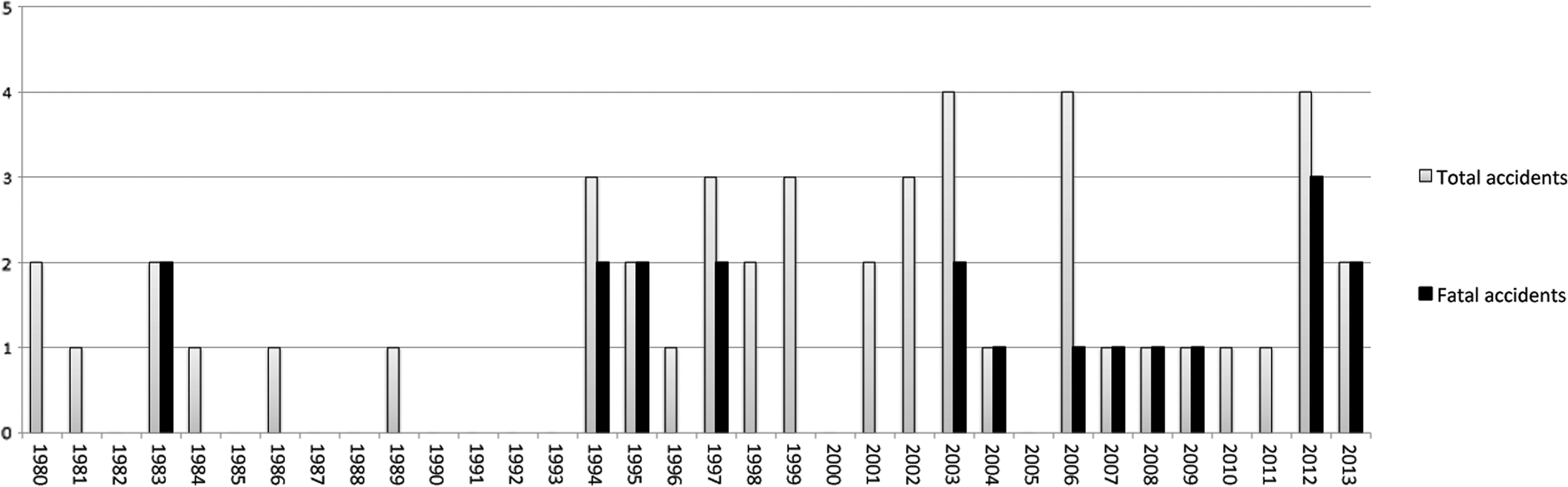
Total accidents (open bars) and fatal accidents (solid bars) by year.
The majority of accidents (36 of 47, 77%) occurred under visual meteorological conditions (VMC); only 3 (6%) occurred under instrument meteorological conditions (IMC) and 3 (6%) during whiteout conditions. Weather conditions were not reported for the remaining 5 accidents (11%). Accidents occurring under VMC had a 42% fatality percentage (15 of 36), whereas all 3 accidents occurring under IMC and 1 each under whiteout and unknown weather conditions resulted in fatal injuries. Roughly 75% of the accidents (35 of 47) occurred during daylight conditions. Of the 12 accidents occurring at night, 8 involved fatalities (67%), and 12 of 35 (34%) occurring during daylight resulted in fatalities. Using the 2-tailed Fisher’s exact test, there was no statistically significant difference in fatality percentages between accidents occurring under VMC versus IMC (P > .05) or between those occurring during daylight versus nighttime hours (P > .05).
There were 43 accidents involving damage to the aircraft, with 17 (40%) resulting in fatalities. Four accidents involved injuries without aircraft damage, 3 of which were fatal. These fatal injuries resulted from a crewmember being struck by the aircraft rotor system, a rescuer who fell while being hoisted, and a flight crewmember who fell from terrain while outside the helicopter. The nonfatal injury involved a crewmember who was struck by the rotor system. The types of events in both total accidents and fatal accidents are listed in Table 2.
Nature of accidents
Public use aircraft (law enforcement, fire service, or other public service operators) accounted for 47% of all accidents (22 of 47), followed by private contractors at 28% (13 of 48) and unknown service type at 13% (6 of 48). Of the fatal accidents, 65% (13 of 20) involved public use aircraft, with HEMS operators and private contractors each accounting for 15% (3 of 20) (Table 3).
Accidents by service type
HEMS, helicopter emergency medical services.
Discussion
In the absence of data about the number of HSAR missions performed annually, the accident rate cannot be calculated as a factor of the number of missions performed or of flight hours logged. What can be determined is the proportion of accidents that result in fatal injuries, which may be used as an indicator of accident severity. The overall number of HSAR accidents is small, but the percentage of fatal outcomes from HSAR accidents is significantly higher than that for HGA accidents. The fatal HSAR accident percentage is comparable to that seen in HEMS operations, which has been reported to carry the highest risk of fatal accident outcomes in civilian helicopter aviation. 8 Public use operators accounted for the largest percentage of total accidents and fatal accidents, but in the absence of data regarding the number of HSAR missions conducted annually by particular types of service providers, no conclusions can be drawn about the relative level of risk for any class of provider.
The HSAR accidents occurring during darkness or under IMC had nonsignificantly higher percentages of fatalities than daylight or VMC accidents. Although these findings do not establish a higher risk of fatal outcome from accidents occurring under these conditions, increased accident risk during inclement weather and darkness is well established and documented in the air medical literature,7,8 and it may be reasonably presumed that HSAR flights in conditions of reduced visibility also carry a higher level of risk. An organized preflight risk assessment that takes weather conditions and time of day into account has become a required safety tool in HEMS operations 9 and is advocated for use in civilian HSAR mission planning, 3 but no data are available about how widely such tools are used in HSAR operations.
Study Limitations
The most significant limitation of this study is that the total number of HSAR missions conducted annually in the United States is unknown. The portion of the total conducted by any particular service type is also not known. A further limitation is that this dataset may be incomplete. The 2 accidents described that were reported by the ICAR-ARC but not investigated by the NTSB suggest that other similar events may have occurred in the past, but they were not uncovered by this review.
There may also have been other factors not reported in the NTSB accident reports or other sources that influenced the outcome of some of these events, such as the level of pilot and flight crew HSAR experience and familiarity with the search area and terrain. Less detail is contained in the NTSB reports issued before the early 1990s, and the ICAR-ARC reports were not available before 1998.
It may be reasonably assumed that the vast majority of, if not all, HSAR flights originate under VMC. All 3 IMC accidents reported here resulted from inadvertent entry into IMC. That may introduce some selection bias when comparing VMC and IMC accidents.
Conclusion
The percentage of fatal outcomes from civilian HSAR accidents is more than twice that for HGA accidents and is comparable to that seen in HEMS operations. The results reported here support the current recommendations that SAR managers, pilots, and searchers use a cautious and considered approach when evaluating the risks of HSAR flight. 1 –3
This subject would benefit from additional study, particularly in the form of a comprehensive survey of HSAR provider agencies nationwide to develop accurate estimates of the number of US civilian HSAR missions conducted annually, the nature of the weather conditions and time of day for these missions, the proportions conducted by the different types of service providers, and the prevalence of using organized preflight risk assessment tools. Another valuable area of investigation would be a comprehensive review of accidents involving DOD and DHS aircraft that occurred while participating in civilian HSAR operations. Further study could provide SAR managers and pilots with information that could be used to help reduce the risks of HSAR flights.
Footnotes
☆
An abstract of this research was presented at the 32nd Annual Summer Meeting of the Wilderness Medical Society, July 10–15, 2015, Breckenridge, Colorado.