






Abstract
The Indian crested porcupine,
Introduction
The Indian crested porcupine,
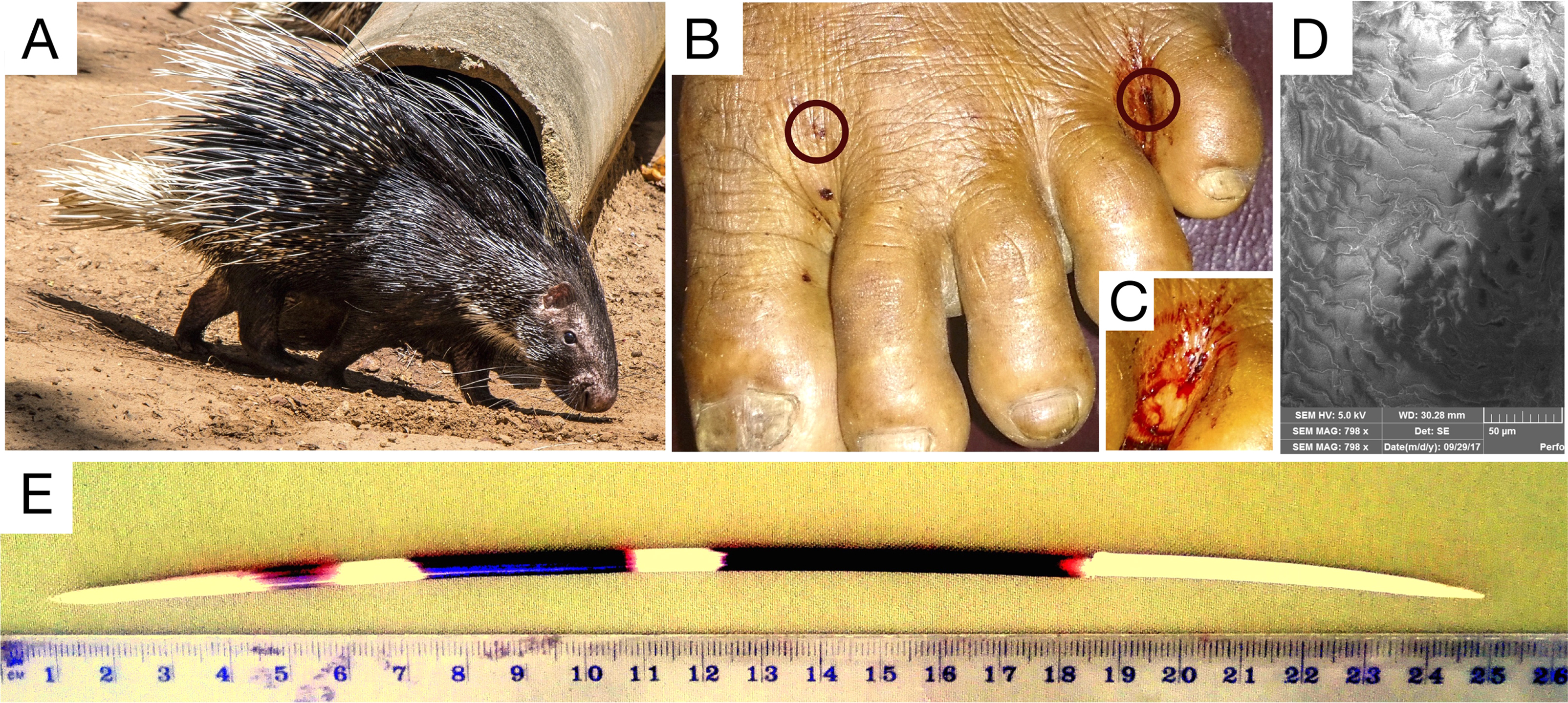
A, Indian crested porcupine
Injuries caused by quills range from minor peripheral penetrating injuries (eg, limbs) to internal organ penetration subsequently leading to death from peritonitis.4,5 Injuries related to porcupine quills are common among several species of animals,
6
and reported quill-related injuries to humans are most typically from relatively small quill-bearing porcupines (Table 1). However, the mechanism of injury, sequelae, and management of
Summary of reports on porcupine quill-related injuries to humans
NR, not reported.
Year of publication.
Year of incident.
We describe the case of a man who sustained injuries from contact with
Case Presentation
A 50-year-old farmer was on his way home, riding a motorbike at high speed. His left foot collided with a porcupine that was crossing the road, and 6 quills were embedded in the dorsum of his left foot. He experienced severe pain and mild bleeding from the wounds. He sought medical care from a primary care hospital (Galnewa District Hospital) within half an hour of the incident. At Galnewa District Hospital, the quills were removed with pliers, and prophylactic intravenous cefuroxime 750 mg and metronidazole 500 mg were administered every 8 h. Diclofenac sodium (100 mg every 12 h orally) was provided for analgesia.
The patient was transferred to a tertiary care hospital (Teaching Hospital Anuradhapura) the next day due to persistent swelling of the foot. The examination at the Teaching Hospital Anuradhapura revealed that the left foot was swollen, and 6 quill marks were found on the dorsum of the left foot (Figure 1, B and C). No infection, bleeding, or groin lymphadenopathy was observed. Apart from mild pain at the site, the patient was conscious, rational, and all other vital parameters were stable. The previously prescribed medications were continued, and he was advised to keep the foot elevated. Four days later, his symptoms and signs abated and he was discharged. He was reexamined after 3 weeks and no complications from the injury were noted.
Discussion
Porcupines belong to 2 main families: Old World (African or Indian crested porcupine;
Furthermore, the porcupine can stamp its feet, growl or grunt, and rattle the hollow quills at the back of its tail.
9
These actions will deter most predators. Sometimes porcupines swing their quill-covered tails toward the potential threat and move backward.
2
These mechanisms enable the porcupine to release the quills into the offending animal’s body.
9
Contrary to popular belief, porcupines cannot shoot their quills when agitated.
10
The barbs on the quills of the North American porcupine permit easy penetration into the victim’s tissue.
11
The strong adhesion in the tissue is due to the backward-facing spread of the scales, which makes removal difficult.
11
The scales on the tip of the quills of the
The incidence of
Porcupine quill injuries often lead to pain, bleeding, swelling, and probably an increased risk of secondary infection due to environmental exposure of the wound to bacteria. Therefore, the affected skin surface should be thoroughly cleansed, and the patient should be administered antibiotics to cover both gram-positive cocci and anaerobes.12,13 Tetanus toxoid is also recommended. Quills should be firmly gripped with pliers and removed by applying a strong force directly opposite to the direction of penetration without twisting or breaking the quills. Radiography (x-ray or computed tomography) may assist in assessing the depth of the penetration and rule out any internal injuries before careful removal of the quills.
Pain management should be based on the severity of pain (visual analogue scale can be used to assess the level of pain). If there is evidence of bleeding, it can be stopped by applying firm pressure on the site or elevating the affected area. 5
People who travel at night should be aware of the nocturnal habits of porcupines and be alert to their potential presence in immediate surroundings. Travelers should carry a light source (head lamp) to visualize the animal at a distance and avoid it. Although porcupines have a keen sense of smell, they have poor eyesight and should be given a wide berth. 10 Indian crested porcupines are terrestrial animals; hence, most injuries may occur to the lower limbs. Therefore, it is advisable to wear footwear that is impervious to penetrating injuries when traversing the jungle. If faced with an aggressive porcupine, it is advisable to walk slowly away from the porcupine, leaving plenty of room and time for the porcupine to leave the area.
Acknowledgments: The authors thank Mr Ishan Senaverathne for the image of an Indian crested porcupine in captivity at the National Zoological Gardens of Sri Lanka. The authors also acknowledge the help extended by Drs Sunil De Alwis (Deputy Director General of Health Services; Training Research) and N. Ekanayake (Director Medical Research Institute) as well as Mr K. Wickramarathne (Technical Officer-in-Charge of Electron Microscope, Medical Research Institute) for facilitating the electron microscopy photographs of Indian crested porcupine quills. The authors especially thank the editorial team of the
Authors Contributions: Study concept (SPBT); literature review and drafting and editing of the manuscript (SPBT, BTBW); data collection (BDBT).
Financial/Material Support: None.
Disclosures: None.