






Abstract
Objective
The purpose of the present study was to investigate the effects of an upper body compression garment (UBCG) on physiologic and perceptual responses while cycling in a hot environment.
Methods
Twenty recreational road cyclists were pair-matched for age, anthropometric data, and fitness level (V̇O2 max) and randomly assigned to a control (CON) group (n=10) of cyclists who wore a conventional t-shirt or to a group (n=10) of cyclists who wore UBCG. Test session consisted of cycling at a fixed load (∼50% V̇O2 max) for 30 minutes at an ambient temperature of ∼40°C (39.9±0.4°C), followed by 10 minutes of recovery.
Results
Significantly greater (P = .002) rectal temperature (Trec) was observed at the end of exercise in the UBCG group (38.3±0.2°C) versus CON group (37.9±0.3°C). Significantly greater heart rate (HR) was observed in the UBCG group at minute 15 (P = .01) and at the end of exercise (187±9 vs 173±10 beats/min; P = .004) for UBCG and CON, respectively. Furthermore, participants who wore UBCG perceived a significantly greater (P = .03) thermal sensation at the end of exercise. During recovery HR and Trec remained significantly greater (P < .05) in the UBCG group.
Conclusions
The use of an UBCG increased cardiovascular and thermoregulatory strain during cycling in a hot environment and did not aid during recovery.
Introduction
It is well known that exercise endurance can be impaired in hot compared with temperate climates. 1 Even at modest environmental temperatures (21°C), some reduction in exercise capacity is apparent and performance is impaired progressively as the environmental heat stress increases. 2 Furthermore, when the environment becomes hot and humid, there is an increased risk of heat stroke due to a decreased capacity to evaporate sweat. In recent years, many strategies have been implemented to delay increases in body temperature during exercise, to prevent hyperthermia, and to improve athletic performance in such adverse environmental conditions. Examples include cold water immersions, fanning, external ice-pack application, and ice slurry ingestion.
The use of compression garments (CGs) during exercise have become popular, although fundamental effects on cardiovascular and thermoregulatory strain remain unclear. Claims from manufacturers include enhanced comfort perception, 3 increased muscle blood flow, and/or enhanced lactate removal. 4 Furthermore, recent developments in these garments have led to claims of thermoregulatory benefits. When male athletes exercise at 55 to 75% of the maximal oxygen consumption (V̇O2 max) in moderate warm conditions (25°C and 50% relative humidity), the greatest sweat rates occur on the central (upper and mid) and lower back. 5 As the evaporative cooling effect of sweat from the skin’s surface is the main mechanism to reduce heat storage during exercise, clothing textiles designs that facilitate the heat dissipation in the upper body may lead to decreased body temperature increments and therefore delay the onset of hyperthermia during exercise. According to manufacturers, this type of garment reduces heat gain, maintaining a constant core temperature due to improved sweat efficiency. A hypothetically lower heat gain also is suggested to delay hyperthermia during exercise in hot environments and therefore reduce the thermoregulatory strain. Furthermore, the use of this garment may reduce the cardiorespiratory strain during recovery, lowering heart rate (HR) values by increasing venous return due to compression. 3
Previous studies investigating the effects of lower body CGs have not found differences in thermoregulatory responses during exercise at different ambient temperatures. 3 ,6,7 For instance, Goh et al 6 evaluated the effects of a lower body CG while running at 2 environmental conditions (10°C and 32°C), and no difference in core temperature was observed when compared with a control garment. Moreover, Barwood et al 7 did not observe any thermoregulatory benefit when examining the thermal effects of a lower body CG while running in a hot environment (35°C) with a representative radiant heat load (∼800 W·m–2). Recently, Leoz-Abaurrea et al examined the effects of an upper body compression garment (UBCG) on thermoregulatory and cardiovascular responses during intermittent cycling at a moderate intensity in a thermoneutral (23°C) 8 and hot environment (40°C). 9 The authors concluded that the use of UBCGs did not reduce the thermoregulatory strain during exercise at both environmental conditions. It seems, therefore, that these kinds of garments have failed to provide any thermoregulatory benefit. Additionally, the intermittent cycling protocol performed in these studies seem unlikely to happen during real cycling conditions. Intermittent exercise could be defined as repeated bouts of intense exercise separated by short recovery periods.
The aim of the present study was to evaluate the effects of a heat dissipating UBCG on thermoregulatory, cardiovascular, and perceptual responses during continuous cycling at a moderate intensity in a hot environment. It was hypothesized that the use of UBCGs would not mitigate the thermoregulatory or cardiovascular strain in recreational road cyclists during exercise in the heat.
Methods
Participants
Twenty recreational road cyclists, 16 men and 4 women, volunteered to take part in this study. Inclusion criteria were as follows: healthy and nonsmoking, with no history of cardiopulmonary disease, and a minimum of 2 sessions of aerobic exercise/week, ≥1 hour per session. Participants were matched in pairs by age, anthropometric measures, and fitness level (maximal oxygen uptake [V̇O2 max]). One participant from each pair was assigned randomly to the UBCG (n=10) group (wearing an upper body compression garment) or to the control (CON; n=10) group (wearing a conventional t-shirt). See subject characteristics in Table 1. Testing occurred during the winter season to ensure no acclimatization to the heat. Participants were informed verbally of all procedures and any possible risks of discomforts associated with the experiment before giving written consent. The study was approved by the Ethic Committee of the Public University of Navarre, in conformity with the Declaration of Helsinki. Based on previous studies,8,9 a minimum sample size of 10 participants was determined to achieve a statistical power of 80%.
Subject characteristics of the UBCG and CON groups
CON, control; HRmax, maximal heart rate; UBCG, compression group; V̇O2 max (L/min), absolute maximal oxygen uptake; V̇O2 max (mL·kg–1·min–1), relative maximal oxygen uptake.
Values are mean±SD.
Values in parenthesis are 95% confidence interval (absolute values).
Preliminary Testing
In a preliminary session, V̇O2 max of each participant was determined in a thermoneutral environment (20−23°C) using a continuous incremental test to voluntary exhaustion on a cycle ergometer (Ergoselect 200, Ergoline, Bitz, Germany). Exercise intensity was increased gradually until the criteria were met (described afterwards). After a 5 minute warm-up at 50 W, participants began cycling at 50 W with increasing increments of 25 W every minute. V̇O2 max was defined as the plateau in oxygen uptake despite increasing work rate. The criteria for determining V̇O2 max were a respiratory exchange ratio of >1.1, HR >95% of the subject’s age predicted maximum heart rate (HRmax), or visible signs of exhaustion, such as breathlessness or the inability to maintain the required power output.
The UBCG group wore a commercially available (X-Bionic, Energy accumulator, Switzerland) short sleeve UBCG made of 94% nylon, 4% elastane, and 2% polypropylene, generating ∼1 to 3 mm Hg of compression, 10 whereas the CON group wore a commercially available (Domyos, France) short sleeve non-UBCG made of natural fabric (100% cotton). In both situations participants wore the same cycling shorts and socks. The garment fit for each subject was in accordance with the manufacturer’s instructions.
Experimental Design
Each group performed a unique exercise trial in a hot and dry environment at 39.9±0.4°C, 34±3% relative humidity, and 2.5 m·s−1 airflow. Experimental trials were conducted at the same time of the day to minimize circadian variations. The female menstrual cycle also was taken into account to eliminate the influence of differences in hormonal status. Subjects were asked to refrain from training and strenuous activity in the 24-hour period prior to testing and to refrain from all dietary sources of caffeine and alcohol. After instrumentation subjects entered a thermoneutral chamber (20−22°C) and rested on a chair for 5 minutes (rest 1). Then they entered a hot environment (∼40°C) and rested while seated on a cycle ergometer with legs extended and feet resting on foot rests for another 5 minutes (rest 2). The cycling trial consisted of 30 minutes at a moderate intensity (∼50% V̇O2 max). After exercise, participants rested for 10 minutes on the cycling ergometer. Airflow at 2.5 m·s−1 was delivered toward the subjects’ chest by an electric fan (Orbegozo, model SF 3343, Spain), which was calibrated before the study with an anemometer (Windwach Pro, Flytec instruments, Switzerland). The fan was on during the whole protocol to simulate real cycling conditions.
Measurements
The night before the experimental trial participants were instructed to consume the same meal and to drink 500 mL of water during dinner. On the day of testing participants were asked to consume 500 mL of water 2 hours before the trial to increase the likelihood they would begin the trials in a euhydrated state. 11 On arrival to the laboratory, participants voided their bladder. Subsequently, nude body mass was measured using a medical scale (Seca, Toledo, OH) accuracy (±0.05 kg). Body weight loss (Wtloss) was determined as the difference in nude body mass pre- and postexercise (%). Sweat rate was calculated as the difference in Wtloss/time (g·min−1). Body fat percentage was assessed prior to exercise using a multifrequency segmental body composition monitor (Tanita MC-980, Arlington Heights, IL).
Rectal temperature (Trec) was measured using a sterile rectal thermistor (model 4600 precision thermistor thermometer, YSI, Yellow Springs, OH) inserted 10 cm past the anal sphincter. 6 HR was recorded continuously using a HR monitor (Polar, model FS2c, Kempele, Finland). Systolic and diastolic blood pressures were measured on the left arm using an automatic blood pressure monitor (Omron, model M6W, Kyoto, Japan). Mean arterial pressure (MAP) was calculated as diastolic blood pressure + (0.33 · (systolic blood pressure - diastolic blood pressure)). 12 Oxygen consumption (VO2) was measured breath-by-breath, using open-circuit spirometry (Vacumed, Ventura, CA) at a sampling rate of 10 seconds. The gas analyzer was calibrated before each trial using a calibration gas mixture 15% O2, 5% CO2 (Praxair, Madrid, Spain), and the flowmeter was calibrated using a Jaeger 3L calibration syringe (Vacumed, Ventura, CA). All the physiologic measurements were recorded at rest 1, rest 2, minute 15, minute 30, and recovery.
The participant’s rating of perceived exertion using a Borg 6-20 scale 13 and subjective sensation in respect of thermal sensation, sweating sensation, and clothing wetness sensation 14 were recorded at minute 15 and minute 30. Ratings of thermal sensation ranged from 1 (very cold) to 9 (very hot), sweating sensation ranged from 1 (dry) to 4 (wet), and clothing wetness sensation ranged from 1 (vigorously shivering) to 7 (heavily sweating).
Statistical Analysis
Statistical analyses were performed using the statistical software SPSS 17 (SPSS Inc., Chicago, IL). Data were screened for normal distribution of variances using a Shapiro-Wilk normality test. Independent sample t tests were used to assess group differences in the variables (Wtloss and sweat rate). A 2-way analysis of variance (time by treatment) was performed to evaluate differences in the physiologic variables measured throughout the exercise trial (physiologic variables and perceptual responses). If a main effect was detected, post hoc analysis was conducted with Tukey’s honest significant difference test. All data are presented as mean±standard deviation (SD) alongside 95% confidence intervals. Effect sizes (ES) were calculated according to Cohen’s d 15 as trivial (<0.2, trivial), small (0.2−0.49), moderate (0.5−0.79), and large (≥0.8). Statistical significance was set at P < .05 for all statistical tests.
Results
As shown in Table 1, no statistical difference in age, height, weight, body fat, HRmax, and V̇O2 max was observed between groups. No statistical differences in Wloss or sweat rate were observed between garment conditions after the protocol (Table 2). HR increased from rest 1 to rest 2 for both garment conditions (P < .05), although no significant difference in HR at rest was found between groups (Figure 1). After 15 minutes of cycling, HR was significantly greater (P = .01; ES = 1.45, large effect) in the UBCG (175±8 beats/min) group than CON (161±12 beats/min) and remained significantly different at the end of exercise (P < .01; ES = 1.54, large effect) in UBCG (187±9 beats/min) vs CON (173±10 beats/min). During recovery HR remained significantly greater in the UBCG condition (P < .01; ES = 1.69, large effect). No significant differences (P > .05) in Trec at rest 1 and 2 were observed between garment conditions (Figure 2). However, Trec was significantly greater (P < .01; ES = 1.56, large effect) in the UBCG condition (38.3±0.2°C) vs CON (37.9±0.3°C) at the end of exercise. During recovery Trec remained significantly greater (P = .03; ES = 1.17, large effect) in the UBCG group. Furthermore, thermal sensation was significantly greater (P = .03; ES = 0.98, large effect) in the UBCG at the end of exercise. No differences in MAP, rating of perceived exertion, clothing wetness sensation, and sweating sensation were found during exercise (Table 2).
Physiologic and perceptual variables assessed at the end of exercise for the UBCG and CON groups
CON, control; UBCG, compression group.
Values are mean±SD.
Values in parenthesis are 95% confidence interval (absolute values).
Significantly different between garment conditions P < .05.
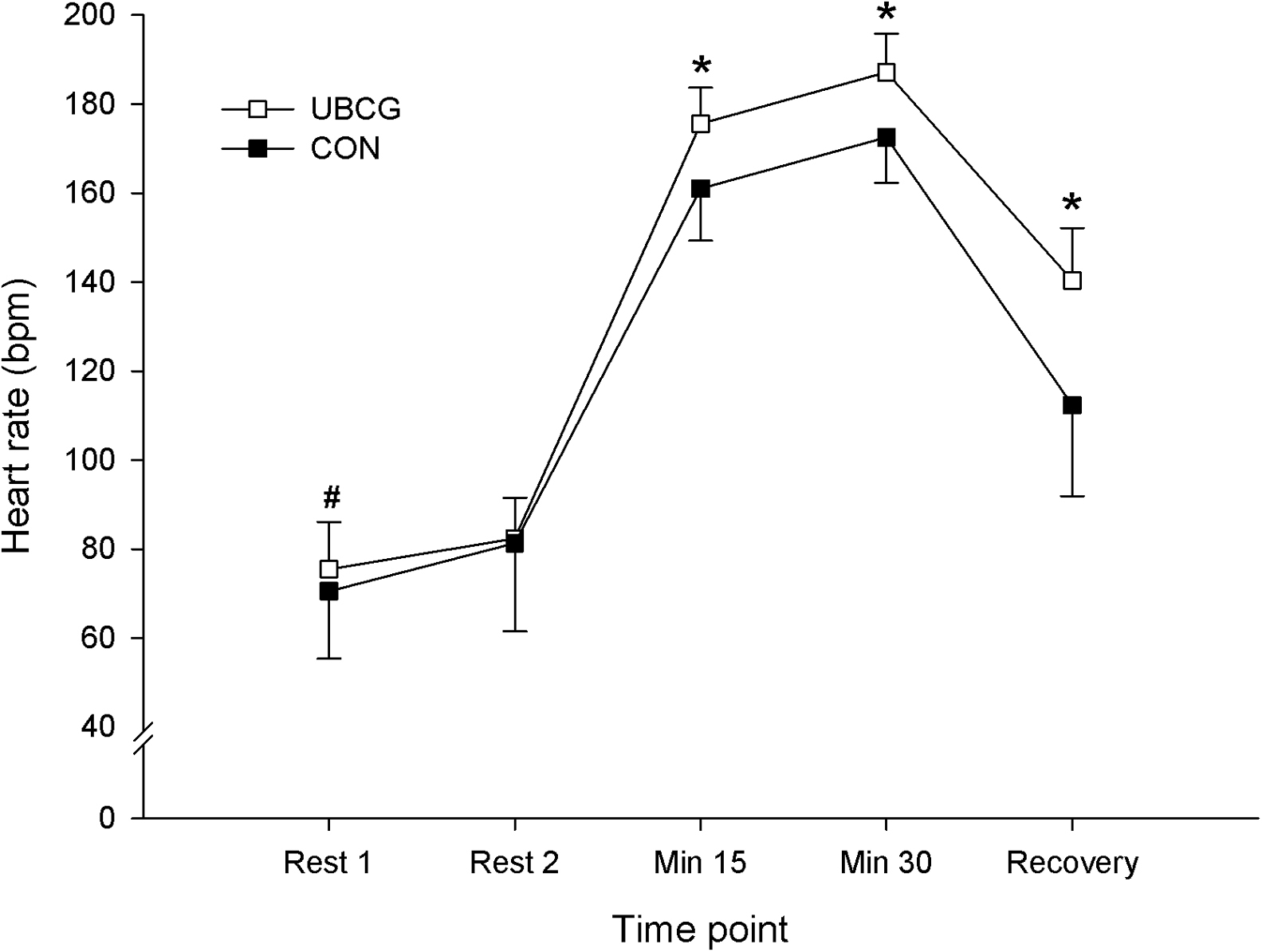
Heart rate during experimental trial. □, Upper body compression garment (UBCG); ■, Control (CON). * Significantly different between garment conditions (P < 0.05). Values are presented as mean ± SD.
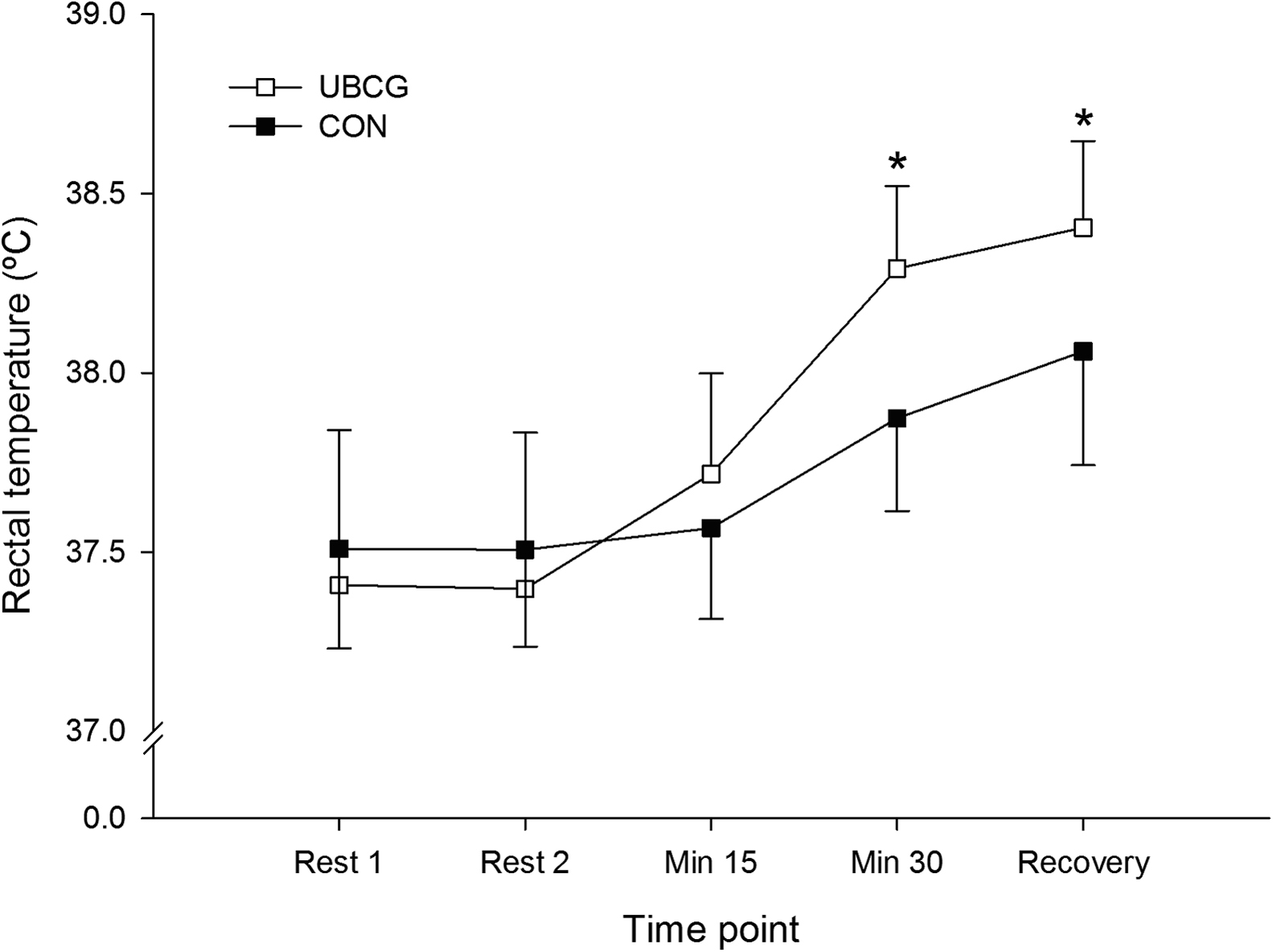
Rectal temperature during experimental trial. □, Upper body compression garment (UBCG); ■, Control (CON). * Significantly different between garment conditions (P < 0.05). Values are presented as mean ± SD.
Discussion
The main finding of this study was that the group of participants who wore the UBCG finished the 30-minute exercise bout at 40°C with significantly greater thermoregulatory and cardiovascular strain compared with participants who wore a control garment. The outcomes of the present study are contrary to manufacturers´ claims of the possible benefits of wearing UBCG and suggest that the use of these types of compression garments might be counterproductive during exercise in adverse environmental conditions.
At rest, Trec remained constant and did not differ between groups. It has been shown that resting in hot ambient conditions increases skin temperature but has a limited effect on core temperature unless the exposures are extreme and prolonged. 16 Perhaps a 5-minute rest at ∼40°C was not sufficient to observe increases in Trec. Conversely, during passive heat stress cardiac output increases with HR as the primary driving force behind the increases. 17 In the present study, HR increased significantly in both groups when entering a hot environment (P < .05). However, no significant difference in HR between groups were observed during rests. MacRae et al 18 found increases in HR when participants moved from a chair to a cycle ergometer, regardless of the type of garment they wore. Therefore, in the present study, increases in HR at rest could be due to an ambient temperature change (from 20–22°C to 40°C) and/or a posture induced change (from a chair to a cycle ergometer).
During exercise, significantly greater Trec was observed in the UBCG group after 30 minutes of cycling (Figure 2). Previous studies have not observed differences in thermoregulatory responses between garments during exercise. 4 ,6,8,9,18 The possibility of a greater Trec in the UBCG group compared with the CON group may be due to the amount of sweat that participants lost during the trial. It has been documented that dehydration induces hyperthermia when cycling in the heat during 2 hours of exercise. 19 However, no differences in Wtloss were observed between groups. Thirty minutes of exercise was possibly not sufficient to induce meaningful changes in Wtloss in the participants. This eliminates the possibility that a greater Wtloss caused greater increases in Trec. Conversely, pressure exerted on the skin is known to produce an inhibitory effect on the sweating rate. 20 It has been suggested that the skin pressure caused by sportswear worn in warm environments could produce quicker increases in core temperature, resulting in earlier fatigue. 21 Although the present study did not measure the level of pressure exerted of the compressed limbs, as demonstrated by Tanaka et al 21 pressure exerted by the UBCG may have increased core temperature during exercise. Further studies wearing UBCG in hot environments would be helpful to elucidate this.
Significant differences in HR between garments appeared during exercise and remained statistically different until the end (Figure 1). These results are consistent with previous research by MacRae et al 18 who concluded that full-body CGs worn in warm/hot environmental conditions had adverse cardiovascular effects during short-term exercise (<1 hour). When body temperature rises, skin blood flow increases to dissipate the metabolic heat from the core to the skin. 22 The higher skin blood flow results in a greater HR caused by a redistribution of blood to the cutaneous circulation. Hence, it is possible that the greater Trec observed in the UBCG group may have caused significantly higher HR at the end of exercise (minute 30) due to the augmented cardiovascular demand. These suggestions should be taken with caution because blood flow was not measured and MAP was not significantly different between groups.
Thermal sensation was significantly higher in the UBCG group at the end of exercise (Table 2). This finding is consistent with a previous study where participants perceived the CGs warmer and less comfortable than a control garment. 18 Perhaps, a greater thermal response in the UBCG group could be the result of a significant greater Trec and/or HR compared with the CON group, although this would require further research.
During recovery, HR remained significantly higher in the UBCG group. The wearing of CG has been suggested as a possible method that may aid in athletes’ recovery.23,24 However, previous studies have produced conflicting results regarding the potential benefit of CGs during recovery. 8 ,9,25 The present data did not support the benefits of using CGs during recovery from exercise. Furthermore, a significantly greater HR was observed in the UBCG group during recovery (Figure 1). This is consistent with a previous study where the use of UBCG resulted in a significantly smaller reduction in HR during recovery at 40°C. 9
Therefore, we conclude that the use of an UBCG did not help reduce the cardiovascular strain during passive recovery in a hot environment. Rectal temperature remained higher in the UBCG group suggesting the inability to dissipate the heat during recovery.
Limitations and considerations
Future studies should focus on investigating the mechanism behind upper body compression garments during exercise in hot environmental conditions. Additional physiologic measures, such as, skin blood flow and skin temperature would have provided additional insight into the mechanisms underlying the results of the present study. Although the present study did not quantify compression applied on the upper body by the CGs, past data using identical garments have reported a small level of compression (∼1−3 mm Hg).
Conclusions
Greater thermoregulatory (P < .01) and cardiovascular strain (P < .01) were observed in the group of cyclists who wore an UBCG compared with those who wore a control garment after 30 minutes of exercise in a hot environment. Furthermore, thermal sensation remained significantly higher (P = .03) in the UBCG group during exercise. During recovery, rectal temperature (P = .03) and heart rate (P < .01) remained significantly higher in the UBCG group. Hence, recreational road cyclists exercising in hot environments should avoid wearing UBCGs due to increased thermoregulatory and cardiovascular strain. The use of UBCGs should be limited to the individuals exercising in the heat in order to prevent the appearance of hyperthermia. Further research should be done to determine the mechanism behind CGs during exercise in the heat.
Acknowledgment: The authors thank all the participants for making this study possible.
Author Contributions: Study concept and design (ILA, RAJ); acquisition of the data (ILA); analysis of the data (ILA); drafting of the manuscript (ILA); critical revision of the manuscript (RAJ); and approval of final manuscript (ILA, RAJ).
Financial/Material Support: None.
Disclosures: None.
Footnotes
Submitted for publication July 2016.
Accepted for publication March 2017.