






Abstract
Objective
When people are involved in outdoor activities, it is important to be able to assess a situation and make rational decisions. The goal of this study is to determine the effects of 90 minutes of light-intensity exercise in a hot environment on executive functioning capabilities of healthy individuals.
Methods
In this prospective laboratory study, 40 healthy male and female subjects 18 to 45 years of age performed treadmill exercise while wearing athletic clothing and a backpack in either a hot or temperate environment. Vital signs, core and skin temperature, and perceptual measures (thermal sensation, sweating, comfort, and perceived exertion) were measured before, during, and after the treadmill test. Cognitive function was measured before and after the treadmill test using the Wisconsin Card Sorting Test (WCST) and a Psychomotor Vigilance Test (PVT).
Results
Subjects in the hot condition reached a similar core temp of 38.2° ± 0.5°C vs 37.7° ± 0.3°C (P = .325) in the temperate group but had a higher heart rate (P < .001) and skin temperature (P < .001). Hot and normal temperature groups did not differ in their PVT performance. There were more correct responses (P < .001), fewer errors (P < .001), and more conceptual responses (P = .001) on the WCST after exertion in both the hot room and normal temperature room conditions. Perseverations and perseverative errors (P = .002) decreased in both groups after exertion.
Conclusions
Conditions of mild heat stress coupled with modest rehydration and short hiking treks do not appear to negatively affect executive function or vigilance.
Introduction
Severe heat illness can result in cognitive impairment. However, the effects of heat stress on cognition are less clear. Early studies of heat stress demonstrated that environmental temperature greater than 29.4°C could impair cognitive skills, tracking, and dual task performance. 1 During exercise, brain temperature can exceed body core temperature by 0.2°C. 2 With rising core and brain temperatures, cognitive performance deteriorates. 3 It is generally agreed that the magnitude of cognitive impairment resulting from heat stress is related to the intensity of the heat stress and the complexity of the task, leading to the creation of thermal tolerance limits for workers.4,5
Many individuals are placed in situations requiring adequate planning and decision-making abilities while suffering heat stress below the threshold for what is considered a clinical heat illness. It is important for an individual working in a hot environment to be able to assess situations and make appropriate decisions (eg, map reading while hiking). Altering this ability would place the individual at great risk for accidents or becoming lost.
It has been reported that heat stress can lead to cognitive deficits in the setting of significant dehydration.6,7 Gopinathan et al 6 reported declines in short-term memory and attention when individuals exercising in a hot room exceeded 2% water loss from sweating. These authors suggested that a decrease in attention would reduce the ability to perform more complex tasks. 6 This was confirmed in a later study using both exercise and passive heat stress to induce dehydration. 7 Although the study did have a rehydration arm, it is unclear whether the exercise-induced heat stress or the passive heat stress in euhydrated subjects itself would affect cognition. In contrast, a recent report of severe exertional heat stress created by 50 minutes of exertion in thermal protective clothing did not demonstrate cognitive deficits immediately after exertion but did reveal mildly impaired performance on a psychomotor vigilance test 60 to 120 minutes later. 8
There have been variable reports of the effect of exercise on cognition. Prior studies have demonstrated that active exercise has a negative effect on prefrontal dependent actions such as executive functioning, 9 whereas others have shown that acute bouts of exercise had no influence on executive processes. 10 The majority of these studies are limited to soldiers and endurance athletes, groups who may be more highly trained than recreational hikers and athletes. Therefore, we sought to determine the effects of prolonged light exercise in a hot environment on executive functioning capabilities. We hypothesized that healthy individuals would score worse on the Wisconsin Card Sorting Test (WCST) and a test of psychomotor vigilance (PVT) after completing a laboratory simulation of a hiking excursion.
Methods
The study was approved by the University of Pittsburgh Institutional Review Board. Fifty subjects were recruited and provided written informed consent. After screening failures, 40 subjects were randomly assigned into 2 groups of 20, with 1 group backpacking at 40% to 45% V˙
Demographics and morphometrics
Data shown as mean (95% CI).
Screening
Before entering the protocol, subjects reported to the laboratory for a survey, physical examination, and exercise stress test. In addition to the physical examination, they had resting electrocardiogram, body fat measurement by means of 3-site skinfold analysis, and pregnancy test if applicable.
11
Inclusion criteria included healthy and physically fit males and females 18 to 45 years of age with no known prior medical history that would prevent participation in treadmill testing. To assure a basal level of physical fitness sufficient to complete the protocol, subjects had to possess a V˙
Subjects performed a modified Bruce protocol graded exercise stress test on a treadmill to determine aerobic capacity and cardiovascular function. Female subjects were required to take a urine pregnancy test before each testing day and were excluded if a positive result was confirmed. Subjects were asked to refrain from caffeine, tobacco, and exercise 12 hours before the stress test. During testing, we collected vital signs, 12-lead electrocardiogram, and oxygen consumption (V˙
The WCST is commonly used to measure executive function. This test requires the subject to develop and maintain an appropriate problem-solving strategy. 12 Subjects start with 4 baseline cards that are different colors, shapes, and number of objects. The subject then sorts the 64 cards based on a sorting rule of color, shape, or number. The sorting rule is initially unknown to the subject. The subject must discover the rule through feedback that appears on the bottom of the screen. After 10 correct responses the sorting rule changes, and the subject must rediscover the rule. The number of errors a subject makes after the sorting rule changes is known as perserveration. A perseverative response is the number of errors made that would have been correct in the previous set, while a perseverative error is the total number of errors made after the rule changed. Higher perseverative errors and responses indicate impaired executive function. How well the subject is able to learn the correct sorting principle is referred to as the conceptual level response. These variables allow evaluation of the subject's executive function through his or her ability to apply external feedback, strategically plan, and inhibit responses. To minimize the learning effect on the WCST, we collected the baseline data at the screening visit, which ranged from days to weeks before the protocol visit.
Protocol Visits
Subjects reported to the laboratory at least 1 week after their initial visit. They were asked to wear a cotton T-shirt, athletic shorts, cotton socks, and athletic shoes. To ensure euhydration subjects were instructed to avoid alcohol and caffeine 12 hours before the visit. Additionally, they were asked to consume 1 L of water the evening before and 500 mL of water the morning of the protocol. A urine sample was collected from the subject, and hydration status was measured by assessing specific gravity. Participants with urine specific gravity >1.020 were asked to consume another 500 mL of water and wait 30 minutes before continuing.
Subjects were weighed nude, and baseline vital signs including skin and core temperature, blood pressure, heart rate, and respiratory rate were measured. They were fitted with a heart rate monitor (Polar, Kempele, Finland) placed around the chest. Core temperature was measured with an indigestible capsule and radio receiver (HQ Inc, Palmetto, FL). Subjects took the capsule 8 hours before arrival to minimize confounding influence of recently consumed food or fluid. 13 Skin thermistors were applied over the supraspinatus, the triceps brachii, the clavicular head of the pectoralis major, and the anterior quadriceps femoris muscle to calculate skin temperature measurements. 14 Immediately before exercise and entering the testing room, the subjects completed the Walter Reed PVT. 15 The Walter Reed PVT is a measure of reaction time. This 5-minute test requires the subject to press a button on a personal digital assistant (PDA) device in response to the appearance of a visual target. The reaction time 10 ten slowest reaction times are recorded along with minor lapses of attention and false starts (impulsivity). Previous studies have shown that the learning effect is minimal on similar tests of alertness. 16
Subjects wore a backpack filled with bags of sand equaling 20% of their body mass. Participants then walked on a treadmill in a heated room (35°–38°C) or a normal temperature room (22°–24°C) based on random assignments and followed a protocol representing prolonged exercise. Subjects walked on the treadmill for a total of 90 minutes, starting at 4.0 km/h and a 10% grade. Every 30 minutes, subjects had 10-minute break in the room (total, 110 minutes). They were given 100 mL of water during the breaks. The treadmill speed was adjusted every 10 minutes to maintain a walking gait requiring the subject to work at 40% to 45% of V˙
The protocol was stopped if the subject's heart rate reached 10 beats/min more than age-predicted maximal heart rate, if the body core temperature exceeded 39.5°C, if he or she had an unstable gait, or the subject requested to stop.
Immediately after the exercise period, the subjects exited the treadmill but remained in the testing room. They were then readministered the WCST and the PVT. The subject was then weighed nude a final time and allowed to recover in a room temperature room in a seated position. Subjects then had access to unlimited fluids. Vital signs were measured until they returned to baseline.
Data Analysis
A total of 6 time points were analyzed (the beginning and end of each 30-minute walking period) for vital signs, temperatures, and perceptual measures by repeated-measures ANOVA conditioned on group (hot vs temperate) and time, with post hoc tests applied to determine time points that were different from baseline. The variables within the WCST and PVT were analyzed by 2-way ANOVA condition on group (hot vs temperate) and time (pre vs post). Significance was set at P ɐ .05. Based on pilot work conducted before the study, 20 subjects per group provided 80% power to detect a change of 46% in perseverative errors on the WCST and 95% power to detect a difference of 0.5°C in body core temperature.
Results
Physiological Changes During Exertion
Forty fit individuals completed all elements of the study (Table 1). Heart rate rose during exertion and partially recovered during the rest periods from a mean of 72 beats/min (95% CI, 66–77) before exertion to 117 beats/min (95% CI, 122–124) after exertion in the temperate condition, and from 72 beats/min (95% CI, 68–76) to 140 beats/min (95% CI, 132–147) in the hot condition (P < .001). Higher heart rates during exertion (P < .001) and greater rise in heart rate with time (P = .008) were noted in the hot condition (Figure 1). However, heart rates at the end of the final exercise period were well below age-predicted heart rate maximum in both groups.
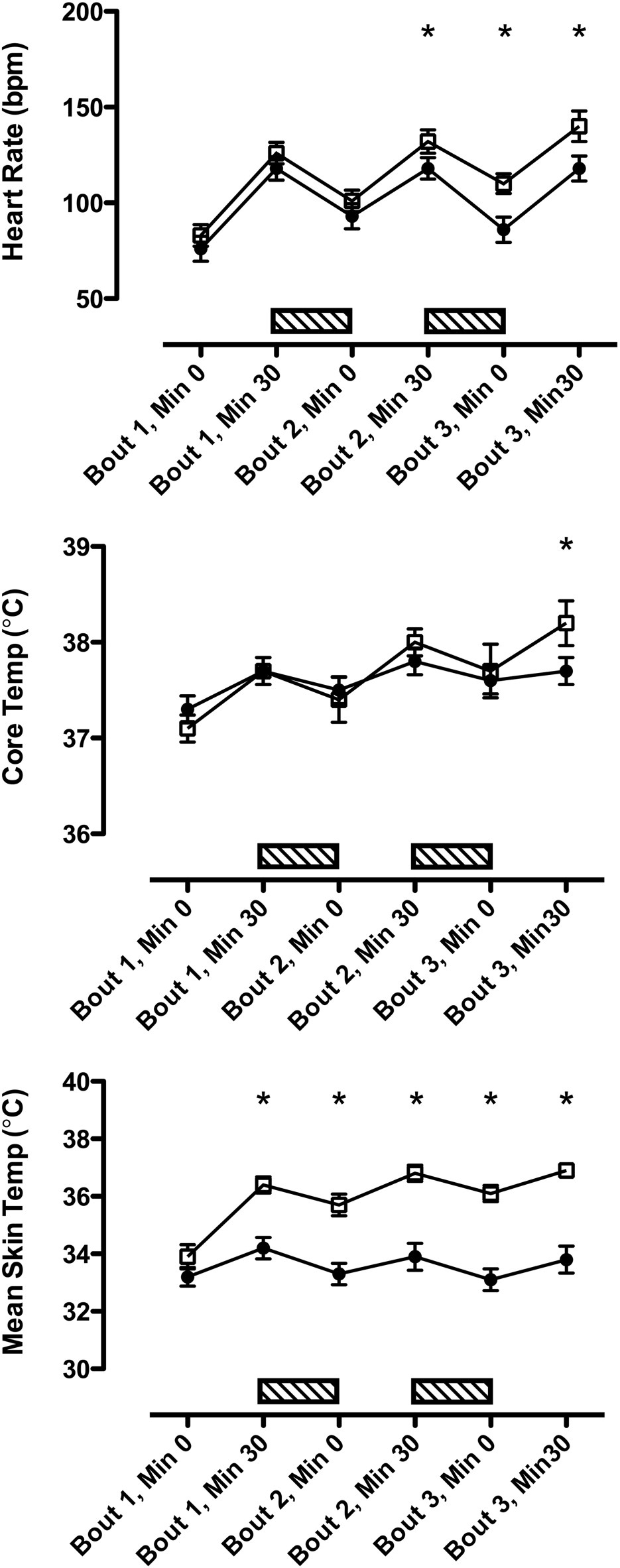
Graphical representation of heart rate (top panel), body core temperature (middle panel), and mean skin temperature (bottom panel) responses during exercise. Hatched bars indicate rest periods between 30-minute bouts of treadmill exercise in hot (square) and normal (circle) temperature conditions. *P < .05, difference from pre-exercise value.
Body core temperature slowly rose throughout exertion with some recovery during the rest periods (P < .001) from 37.2°C (95% CI, 37.1–37.3) to 37.7°C (95% CI, 37.6–37.9) in the temperate condition and 37.1°C (95% CI, 36.9–37.2) to 38.2°C (95% CI, 38.0–38.4) in the hot condition. Although the rate of rise in core temperature was higher in the hot condition (P = .007), the overall difference between temperate and hot conditions was not significant (P = .08; Figure 1). Similarly, mean skin temperature rose during exercise with partial recovery during the rest period (P < .001). Mean skin temperature was higher (P < .001) and rose more rapidly in the hot condition (P < .001; Figure 1).
Both men (temperate, 1.1 kg; 95% CI, 0.9–1.3; hot, 1.9 kg; 95% CI, 1.5–2.3; P = .007) and women (temperate, 0.8 kg; 95% CI, 0.7–1.0; hot, 1.7 kg; 95% CI, 0.8–2.5; P = .02) lost more body mass from sweating after exercise in the hot condition.
Perceptual Changes During Exercise
Time (P < .001) and group (P < .007) differences were identified for perception of comfort, thermal sensation, perceived exertion, and sweating (Figure 2). The rate of rise in measures of sweating (P = .004) and thermal sensation (P = .025) was greater in the hot condition. Generally, the perceptual measures rose during exertion, and during rest periods they partially recovered in the hot condition and recovered to near-baseline values in the temperate condition.
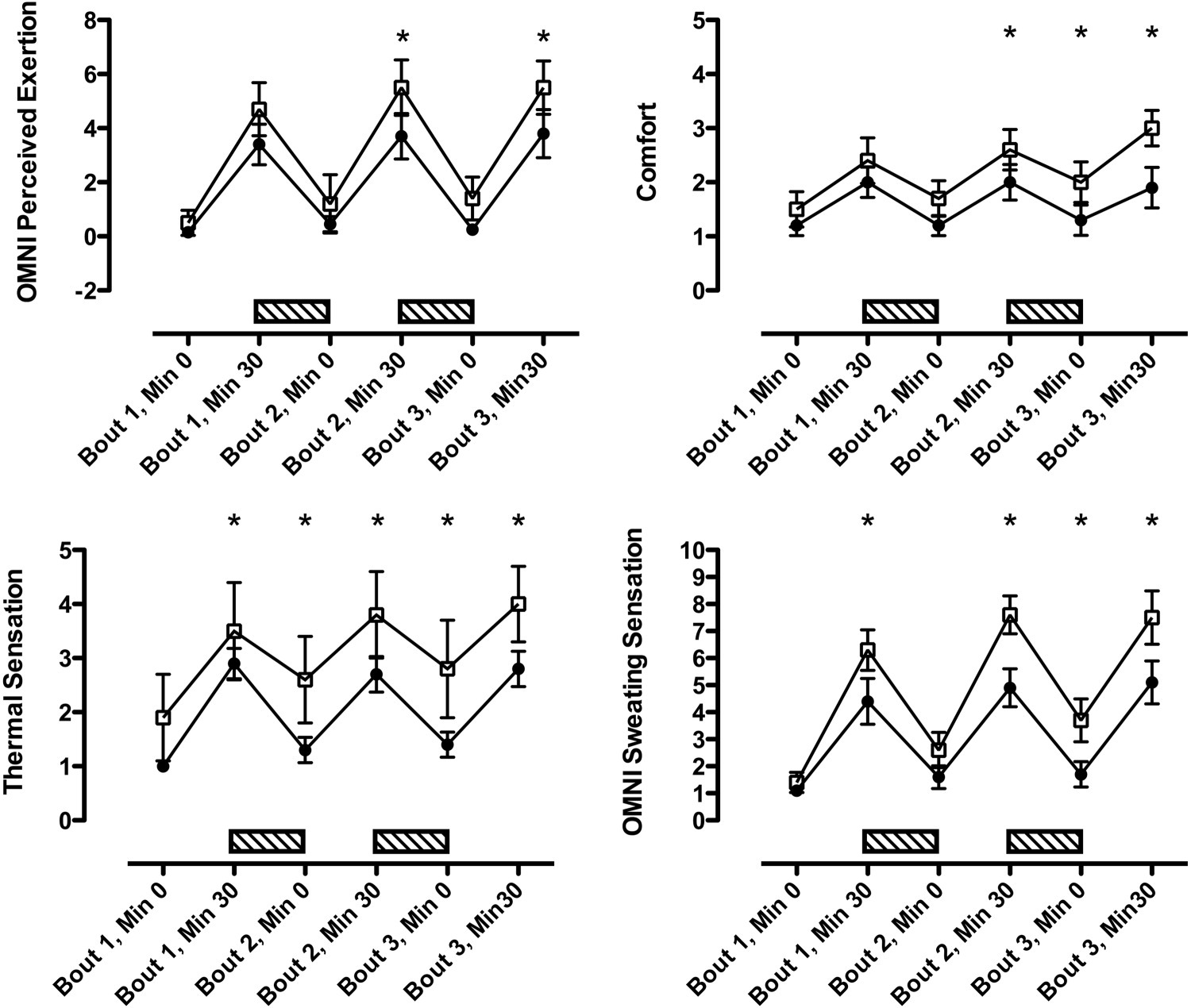
Graphical representation of perceptual responses during exercise. Hatched bars indicate rest periods between 30-minute bouts of treadmill exercise in hot (square) and normal (circle) temperature conditions. *P < .05, difference from pre-exercise value.
Cognitive Measures
Hot and normal temperature arms did not differ for measures of psychomotor vigilance (Table 2). For the WCST, there were more correct responses (P < .001), fewer errors (P < .001), and more conceptual responses (P = .001) after exertion in both the hot and temperate conditions (Table 3). Perseverations and perseverative errors (P = .002) decreased in both groups after exertion. A greater number of perseverations and perseverative errors at baseline in the temperate condition group resulted in overall group differences.
Results of psychomotor vigilance test (PVT)
Data shown as mean (95% CI).
Results of Wisconsin Card Sorting Test (WCST)
Data shown as mean (95% CI). All variables differed between baseline and post exertion (P < .05).
Discussion
Moderate-intensity exercise of 90-minute duration in a hot environment produced modest changes in physiology compared with a temperate environment when modest rest breaks and hydration were provided every 30 minutes. We failed to identify differences in psychomotor vigilance after treadmill exertion in hot and normal temperature conditions. Changes in executive function identified in the WCST test were consistent with either a learning effect or a heightened arousal. The study protocol simulated a recreational hiking excursion and resulted in the anticipated physiological changes. Differences in heart rate and mean skin temperature in the hot condition when compared with the normal temperature condition, without a concomitant difference in body core temperature, indicates a compensable heat stress condition, which is common in the recreational setting. This is confirmed by higher perceptions of sweating and thermal sensation in the hot condition without differences in perceived exertion.
It has been suggested that with the onset of hyperthermia there will be an increase in both physiological and mental fatigue. Cognitive brain functions can be classified into both simple and complex tasks. Tests of psychomotor vigilance measure attention, reaction time, and impulsivity. Subjects in the present study did not change from baseline nor showed an effect with rising skin temperature and thermal perception. This is consistent with prior studies that have shown no change and occasionally enhancement of simple tasks during exercise and heat stress and may indicate that a large change in body core temperature is required to induce significant mental fatigue. 5 ,18,19
More-complex tasks involve executive function skills that encompass strategic planning, making rational decisions, resisting temptation, and problem-solving. Subjects in our study showed significant improvement after exercise in both the temperate and hot conditions when compared with the baseline testing. Although an arousal effect of exercise on cognitive functioning cannot be entirely dismissed, we believe this represents a learning effect of the WCST. 20
Submaximal exercise has been shown to result in arousal, enhancing various aspects of cognitive function. Improved reaction time and accuracy after 80 minutes of submaximal cycling have been reported, but subsequently an increased number of errors were noted after 2 hours of exercise. 21 However, the arousal effect is lost with central fatigue and the dehydration that accompanies prolonged exercise 22 or exercise accompanied by heat stress and hypohydration. 6 ,23,24 Given the intermediate-exertion interval of 110 minutes and hot environment, the reduction in perseveration (errors made after the planned switch in the middle of the card sorting test) and perseverative errors (errors that would have been correct in the previous stage) was unanticipated. Both groups showed a decrease in these variables as compared with the baseline. The temperate condition group had higher baseline numbers even though none of the subjects had any baseline cognitive deficits that resulted in differences between groups. It is possible that this is a chance finding. It is also possible that the subjects in the hot condition did suffer a mild deficit in cognitive performance that was not sufficient to cause overtly bad performance but instead resulted in less improvement than seen in the temperate condition.
Another component of exertional heat stress that may impact cognition is hydration status. It has been reported that there is a decrease in cognitive function at 2% dehydration of body mass by means of active or passive heat stress.6,7 Although modest hydration was provided during rest breaks, hypohydration did result in both groups. As compared with the temperate condition, subjects who exercised in the hot environment did lose more than 2% of their body mass, but did not show a decline in mental status. It is possible that even minimal rehydration was able to stave off some of the negative effects of hyperthermia or that a combination of hypohydration and more severe hyperthermia is required to elicit changes in healthy subjects.
There are some modest limitations associated with this study. The random assignment resulted in a greater proportion of males in the hot condition group. Although this could have been overcome with a crossover design, there was concern about a learning effect in the commonly available tests of executive function if administered before and after multiple sessions. Because of its widespread usage, the WCST has been characterized as the gold standard for assessing executive functioning. 25 However, the test has been tightly linked to reasoning ability and, like many purported tests of executive function, is difficult to deploy in young healthy individuals. 25
The simulation was designed to be analogous to a steady uphill backpacking trek. Our subjects were young healthy individuals starting the exercise in euhydrated conditions. These data may not be representative of individuals suffering chronic diseases or those starting exercise in hypohydrated conditions. In addition, subgroups of hikers venturing out on longer day trips or multiday trips in hotter conditions would likely be at greater risk. The subjects in the hot temperature group had not equilibrated at the end of exercise and may have suffered more significant heat stress in longer duration exercise bouts. These individuals may be at additional risk. Finally, we cannot speak to cognitive function beyond the immediate exercise. Our laboratory has recently shown that some deficits in psychomotor vigilance do not manifest themselves before 60 to 120 minutes after the end of exertional heat stress. 8 This may be important for hikers who must hike the second leg of a trek after a rest period of an hour or more.
In conclusion, simulated hiking treks in conditions of mild heat stress coupled with modest ongoing hydration do not significantly affect executive function or psychomotor vigilance in healthy individuals. Future studies should address longer treks and follow cognitive function for longer intervals after the end of exercise.