






Abstract
Objective
Ski mountaineering is becoming a popular sport. The ascending techniques (tracks) can be divided into 3 different groups: flat field, direct ascent, and traversing. This study examines the relationship between different mechanical loads on the foot and the 4 different mountaineering ascending techniques.
Methods
All subjects used the same pair of ski boots and the same skis while performing the 4 different ascending techniques. An in-shoe dynamic pressure measuring system was used to measure the mechanical load on the foot soles of each ski mountaineer. The foot sole was divided into 6 anatomic sections to measure the different loads in each section.
Results
Thirteen men with an average age of 29 years were enrolled in the study. The results showed small, not significant differences in the mechanical foot load in the flat field or in the direct ascent. The average mechanical foot load was highest on the valley side foot while traversing (179 kPa to 117 kPa). The higher load forces were in the medial ball of the foot and the longitudinal aspect of the foot side closer to the hill.
Conclusions
The higher impact placed on the valley side foot and the concentration of force placed on the medial ball of the valley side foot suggested the influence of the track on the load pattern of the foot sole. This higher impact may result in upward forces that affect the force distribution in the ankle and knee joints.
Introduction
Ski mountaineering is becoming a popular sport. In ski mountaineering, the athlete gains vertical height with special skis prepared with skins under the ski that prevent backsliding during ascent. The ski mountaineer is free to choose the level of exertion used to perform the maneuvers required for this sport. After reaching the highest point of the ascent, the athlete removes the skins and uses the skis to descend.
There are essentially 3 different techniques used while ski mountaineering. The first is in a flat field without gaining any height (Figure 1A), the second is directly ascending the slope to gain height as quickly as possible (Figure 1B), and the third is traversing the slope with or without gaining any height (Figure 1C).
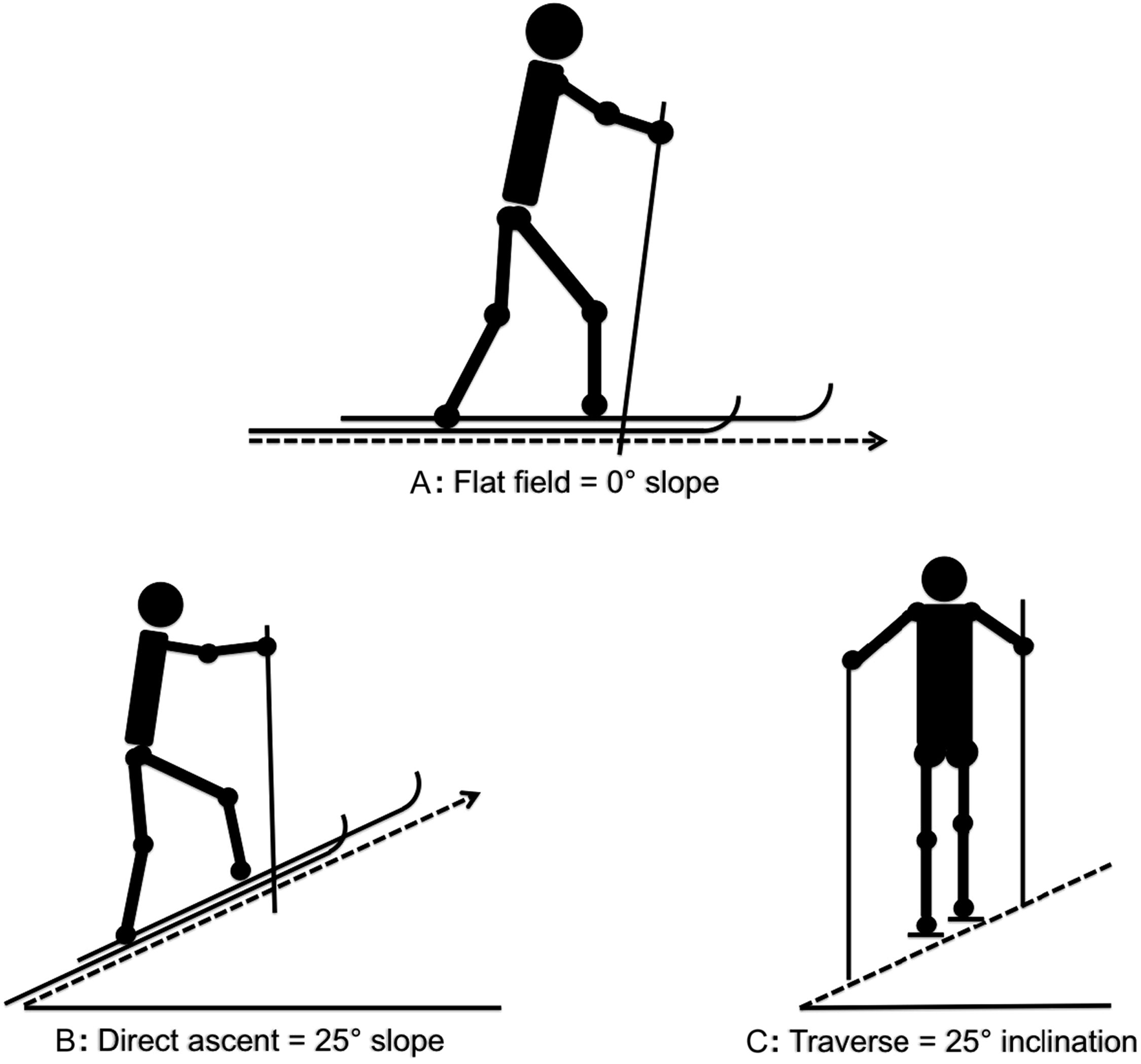
Different types of ski mountaineering: A) flat field, B) direct ascent, and C) traverse.
Patients we have seen in our orthopedic department who have complained of knee pain have mentioned that pain increases during ski mountaineering, specifically during traversing. In response to these patient complaints, we reviewed the literature and found no published information on the role of foot load in ski mountaineering. We report here on the first of 3 studies we conducted to examine the relationship between lower limb joint pain and foot loading during varying ski mountaineering ascending techniques. This first study attempts to establish the different mechanical loads on the foot in healthy subjects that occur during ski mountaineering.
Methods
Study Population
All subjects were male, and all skiers had performed at least 5 ski tours during the last 2 years so they did not need help to perform the skiing techniques asked of them. No study subjects were in treatment for or had been treated before the study for any orthopedic pathologies that might influence performance. The foot lengths for all subjects ranged between 267 mm and 286 mm. These subjects were chosen because, in spite of having slightly different foot lengths, they all wore the same size ski boot for ski mountaineering and were, therefore, all able to comfortably wear the exact same pair of ski boots used for load testing.
Study Design
In this experimental study, the mechanical load on the foot soles was evaluated. The subjects performed the 3 different ski mountaineering tracks: flat field, direct ascent, and traversing. The subjects repeated each track 10 times. Only 5 complete repeats in the middle (4 to 8) were analyzed to allow time for each subject to accelerate to a steady pace and subsequently decelerate. The foot sole was divided into 6 sections (Figure 2): medial ball of the foot, lateral ball of the foot, medial midfoot, lateral midfoot, medial heel, and lateral heel.
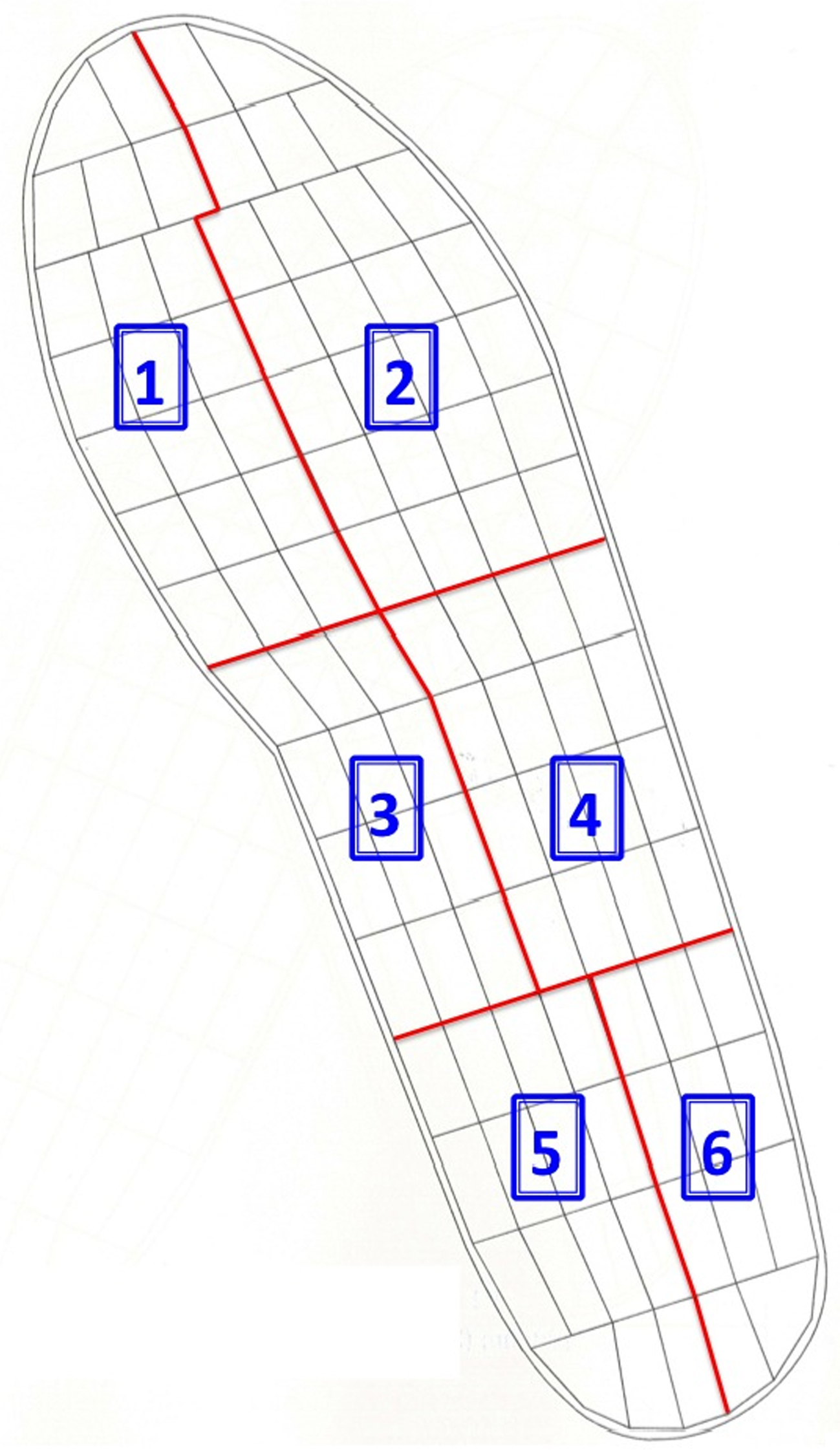
Six sections of the foot sole: 1) medial ball of the foot, 2) lateral ball of the foot, 3) medial midfoot, 4) lateral midfoot, 5) medial heel, and 6) lateral heel.
The mean of the maximal pressure in each section across all steps was calculated. Three tracks and 4 techniques were analyzed: in plane level and fall line the movement for each foot was the same, so the average for the left and right foot was calculated. Owing to the different heights of the steps, the movement of the uphill leg and the downhill leg are different when traversing, so all uphill foot data (left and right foot) and downhill foot data (left and right foot) were combined. The unit used for pressure was kilopascal (kPa).
The subjects performed all techniques using the same ski boots (Dynafit ZZero-4 2008; Salewa Oberalp AG, Bozen, Italy) size 43 (US 9.5), on the same 170-cm skis (Bergrettungsski; Skitrab srl, Bormio, Italy), and on the same bindings (Dynafit TLT Vertical; Salewa Oberalp AG, Bozen, Italy). All measurements were performed at Seegrube within the Nordkettenbahn skiing area in March 2011.
Because the measurements were performed on healthy persons during the course of their normal sporting activity, this study was exempt from Ethics Board review. All participants provided written consent before participating in the study.
Instruments
The mechanical load of foot soles was measured by the in-shoe dynamic pressure measuring system Pedar-x/E3 (Novel GmbH, Munich, Germany). In that system, a 1.9-mm-thick insole is placed between the shoe and foot. Pressure is measured by 99 sensors per foot. The data are collected by a wearable data collection system. Data are sent by Bluetooth wireless connection to a computer for processing.
Experimental Setting
For the flat field setting, each subject ski mountaineered 10 times over a distance of 20 m on flat, packed snow. For direct ascent, the subjects performed 10 times a 20-m-long straight track with an average incline of 25 degrees. To reduce the inclination of the foot, the ski bindings were equipped with standard heel lifters. The heel lifters were a 30-mm-high support fixed on the backside of the bindings to reduce the natural flexion of the feet. Heel lifters are standard with all customary ski mountaineering bindings. For the traverse setting, the subjects performed a walk of 20 m within a 7-m-long wooden ramp in the middle of the course. The ramp had a lateral inclination of 25 degrees. On the ramp, 2 vertical wooden rails (1 cm high) were fixed to lead the skis while traversing (Figure 3). A total of 20 repetitions was performed and measured, 10 with the right foot and 10 with the left foot. For all 3 types of techniques, only the 5 meters in the middle of the course (repetitions 4 to 8 of 10) were analyzed to capture the most consistent repetitions.
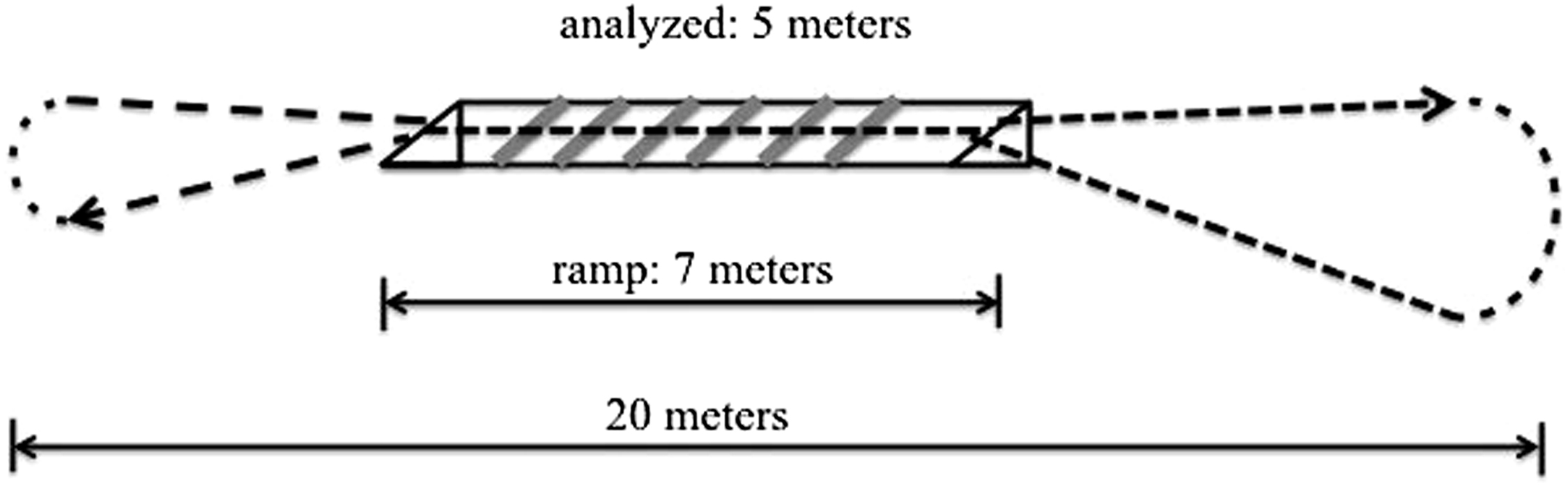
Traverse course.
Statistics
Statistical analyses were performed with IBM SPSS Statistics, version 17 (IBM Corp, Armonk, NY). Left and right feet were measured in accordance with Wiegerinck et al 1 and Orendurff et al 2 , and the peak pressure of only 1 foot was evaluated. All variables were tested for normal distribution with unmodified Kolmogorov-Smirnov goodness-of-fit tests, with significance set by P < .05.
In this study, we compared the average maximum pressure on different zones of the sole of the foot. We calculated an analysis of variance (ANOVA) for repeated measures for the global significance among the 4 positions of the foot (flat plane, direct ascent, hill side traverse, and valley side traverse) in the 3 different techniques of ski mountaineering within each zone and Sidak tests for pair-wise post-hoc comparison. In addition, an ANOVA for repeated measures was calculated for the whole sole with Sidak tests for pair-wise post-hoc comparison.
Results
Thirteen subjects with an average age of 29 years (range 24–42 years) enrolled in this study. The average weight was 76 kg (range 70–95 kg), and average body mass index was 23.6 kg/m2 (range 20–31.4 kg/m2). The subjects were all experienced ski mountaineers. Mean pressure (kPa) in different foot sections for the flat field track, direct ascent track, traverse hill side track, and the traverse valley side track are shown in Table 1.
Main pressure in different foot sections
Values are mean ± SD (range). Main pressure in foot sections (FS) is in kPa (n = 13).
There was a significant difference in the mechanical load on the medial ball of the valley side foot (Table 2), and a significantly higher total mechanical foot load on the valley side ski (Table 3).
P values for different loads of medial ball of the foot (section 1)
P values of the different loads of the entire foot sole
Discussion
This study measured the mechanical foot load of 4 different ski mountaineering techniques. The results showed small differences in the mechanical foot load when ski mountaineering either in the flat field or in the direct ascent (using a heel lifter).
Owing to the anatomical axis of the lower limb, the pressure on the foot has a direct impact on the forces placed on the joints of the lower limb. This flow of force from the sole of the foot to the knee joint has been shown by other studies. 3 The higher and more inconsistent loads placed on different foot sections during traversing, which was needed to improve the contact on the hill side edge of the ski, most likely caused an inconsistent load on joints of the lower limb.
Our study is limited by the small sample size (n = 13) and by our participants being young, healthy, and athletic men. However, ski mountaineering is a sport performed by people of both sexes, in higher age groups, and who have undergone orthopedic surgeries. 4 –6 Although the foot loads experienced by subjects outside of the age range we studied are assumed to be the same as those of the study subjects, we plan to conduct a similar study with older joint patients in the gait laboratory after we construct a ski mountaineering simulator.
Our study confirmed our hypothesis that the higher impact placed on the valley side foot and the concentration of force placed on the medial ball of the valley side foot is the influence of the track on the load pattern of the foot sole. This higher impact may result in upward forces that affect the force distribution in the ankle and knee joints.