






Abstract
Introduction
Rapid location of avalanche victims by companions using avalanche transceivers is of utmost importance to prevent asphyxiation. The objective was to determine whether electromagnetic interference from heating elements in gloves worn by rescuers or victims can impair the receiving or transmitting function of avalanche beacons.
Methods
Commercially available heated gloves from 3 different manufacturers were examined during a simulated search with 3 common brands of avalanche transceivers. Distance to target beacon at first signal detection and accuracy of direction to target, as indicated by the arrow from the direction indicator, were evaluated.
Results
Preliminary tests showed that transmitting and receiving signals are degraded by electromagnetic interference caused by rectangular pulses emitted by activated heating elements. Field tests revealed significantly reduced distances of first signal detection when heated gloves were turned on near receiving avalanche transceivers (P<0.001; Wilcoxon signed-rank test). Decreased distance to target beacon ranged between 1.9 m (5%) and 41.5 m (94%) at first detection, depending on the avalanche transceiver used.
Conclusions
Avalanche transceivers are susceptible to electromagnetic interference from gloves with electric heating elements. We do not recommend using heated gloves when performing a transceiver search for avalanche victims because it can lead to a delay in rescue.
Introduction
Rapid location and extrication of completely buried avalanche victims by companion and organized rescue is of utmost importance to prevent asphyxiation. The use of avalanche transceivers (ATs) has been shown to significantly reduce burial time. 1 Extrication of avalanche victims within 15 min is associated with increased chance of survival and favorable outcomes. 1 -3 During signal search with the rescuer AT (receiving AT), multiple-antenna digital beacons can transmit and detect electromagnetic waves and display the estimated distance from the source.4,5 Once a signal is received, the AT displays an arrow to guide the rescuer to the target AT (transmitting AT). Coarse search is performed to rapidly detect signals from buried victims, whereas fine search specifies the accurate location. During the initial coarse search, the displayed distance should rapidly decrease as the rescuer approaches the buried avalanche victim. Within 3 m of the victim, fine search is assisted by increased frequency of beeping as the rescuer approaches the victim. Metallic objects and magnetic or electric devices close to the rescuer AT can significantly delay rescue. 6 Even worse, such objects can cause rescuer ATs to give false readings of distance and direction to the source and impair signal processing if there are multiple buried victims with ATs. 7 Electromagnetic interference (EMI) of ATs from simultaneous use of mobile phones or digital cameras already has been reported.8,9 It has been recommended that electronic devices should be kept further than 40 cm from the rescuer AT. 8 Pacemakers, continuous glucose monitors, and insulin pumps have been shown to compromise rescuer AT readings during searching when the device is close to the receiving beacon.10,11 Use of gloves, socks, and shoes with electric heating elements (HEs) in cold environments is becoming more common. So far, no scientific information is available on EMI from HEs on AT function. 12
We investigated whether EMI from HEs of heated gloves affect receiving and transmitting function of avalanche rescue beacons during field application.
Methods
The influence of electric HE on the function of ATs was investigated in the laboratory and under true environmental field conditions. According to the ethics committee of the Medical University of Innsbruck, the study was exempted of approval because no research on human beings was conducted. Five voluntary investigators from Mountain Rescue Tyrol performed the test runs. Written consent of investigators for publication of results and permission for their likeness to be reproduced in the article was obtained. The study followed the checklist for evaluations based on observational methodology and the checklist for experimental design.13,14
We examined 3 pairs of commercially available heated gloves from 3 different manufacturers, namely, Hestra Power Heater 5 Finger (Martin Magnusson & Co AB, Hestra, Sweden), Sunwill (Sea&Mew Consulting, Paris, France), and Zanier Heat.stx Finger (Zanier-Sport Gesellschaft m.b.H., Innsbruck, Austria). Measurements were made with 3 different brands of ATs (Mammut Barryvox S [Mammut Sports Group AG, Seon, Suisse], Pieps Pro BT [PIEPS GmbH, Lebring, Austria], and Ortovox 3+ [ORTOVOX Sportartikel GmbH, Taufkirchen, Germany]).
According to the principles of translational research, preliminary tests were conducted in a shielded radio frequency chamber in a laboratory to verify EMI from HEs of the gloves. Oscillographic recording displayed the characteristic rectangular pulse (positive-going edge followed by a negative-going one) from the current drawn by the heating gloves. Electric HEs of gloves were turned on at a distance of 10 cm of a target AT. Oscillography (TDS 2024, Tektornix GmbH, Köln, Germany), recorded by an Ortovox F1 AT (ORTOVOX Sportartikel GmbH, Taufkirchen, Germany) via earphone jack connection in receiving mode, was obtained and visually analyzed. Intense EMI from HEs of the gloves is illustrated in Figure 1. The distance between the target AT and rescuer AT was 2 m. Our oscillographic investigation of the current drawn from the batteries of the HE revealed a pulse width modulation frequency (frequency of variation between high-amplitude signal and low-amplitude signal) between 10 Hz and 49 Hz and a duty cycle (ratio between time on and time off) ranging from 25% to 96%, depending on brand and energy levels.
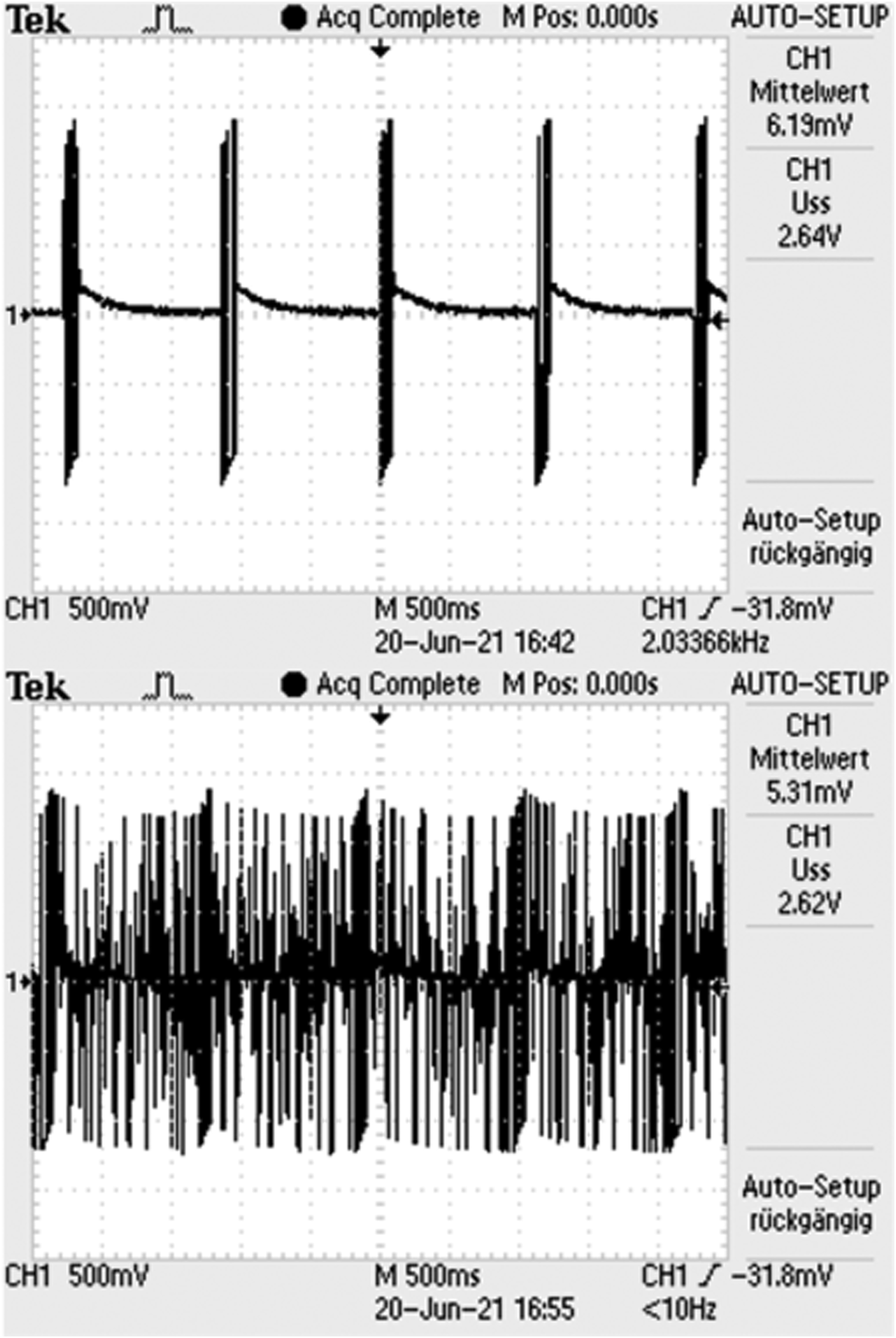
Oscillograms for operating mode of Ortovox F1 while receiving signal from transmitting avalanche transceiver (AT). Upper display shows regular signals of the transmitting AT; lower display shows noise from external interference of on-state heating element (Hestra Power Heater 5 Finger) at high amplitude between the regular signals of the transmitting AT.
Five volunteers of the Austrian Mountain Rescue used 3 brands of common ATs in receive mode to search for a buried AT in transmit mode. The target AT (Mammut Barryvox S) was buried horizontally below 1 m of snow with the display facing up toward the snow surface and with the x-antenna in a direct line to search the run starting point.15,16 Fifty meters from the target AT, investigators started to walk at a constant speed (range: 1–2 m·s‒1) directly to the transmitter, following a measuring tape on the ground (Figure 2). The investigators were holding the rescuer AT horizontally in the right hand, aligned in walking direction, with the right arm in front of the body and the left arm hanging by the side. The power setting of the heated gloves was at maximum output during the investigations. All electronic devices other than those that used ATs (eg, cellphone) were removed from the test area before the investigations. We performed 3 measurements at the point of first signal detection: 1) distance to target AT when the first signal was detected (from the measuring tape on the ground); 2) deviation in displayed distance to target AT compared with the actual distance (calculated difference between distance to target AT by measuring tape and distance to target AT on rescuer AT display); and 3) accuracy of direction to target AT as indicated by the arrow from the direction indicator on the rescuer AT display (Figure 3). The transition to fine search was triggered by the displayed distance on the rescuer AT within approximately 3 m from the target AT. 3 We did not measure time to completion but watched for the occurrence of EMI throughout the complete search run from the starting point until the rescuer AT was positioned directly above the target AT. Reduction was defined as the difference between mean of the reference (measurements without heating gloves) and the mean of the used brand of ATs in on-state per investigated HE.
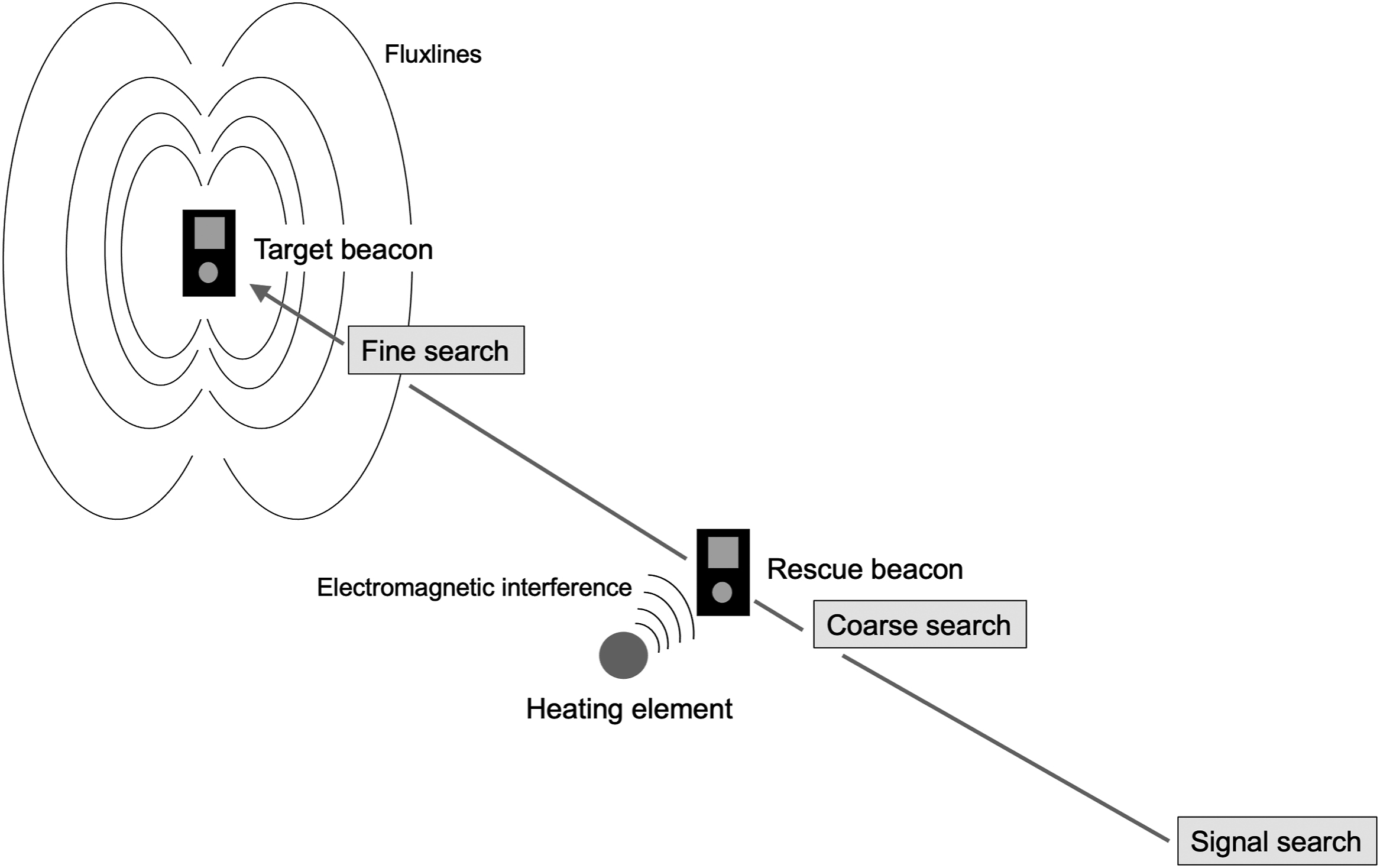
Potential electromagnetic interference from heating elements during signal search, coarse search, and fine search of avalanche victims.
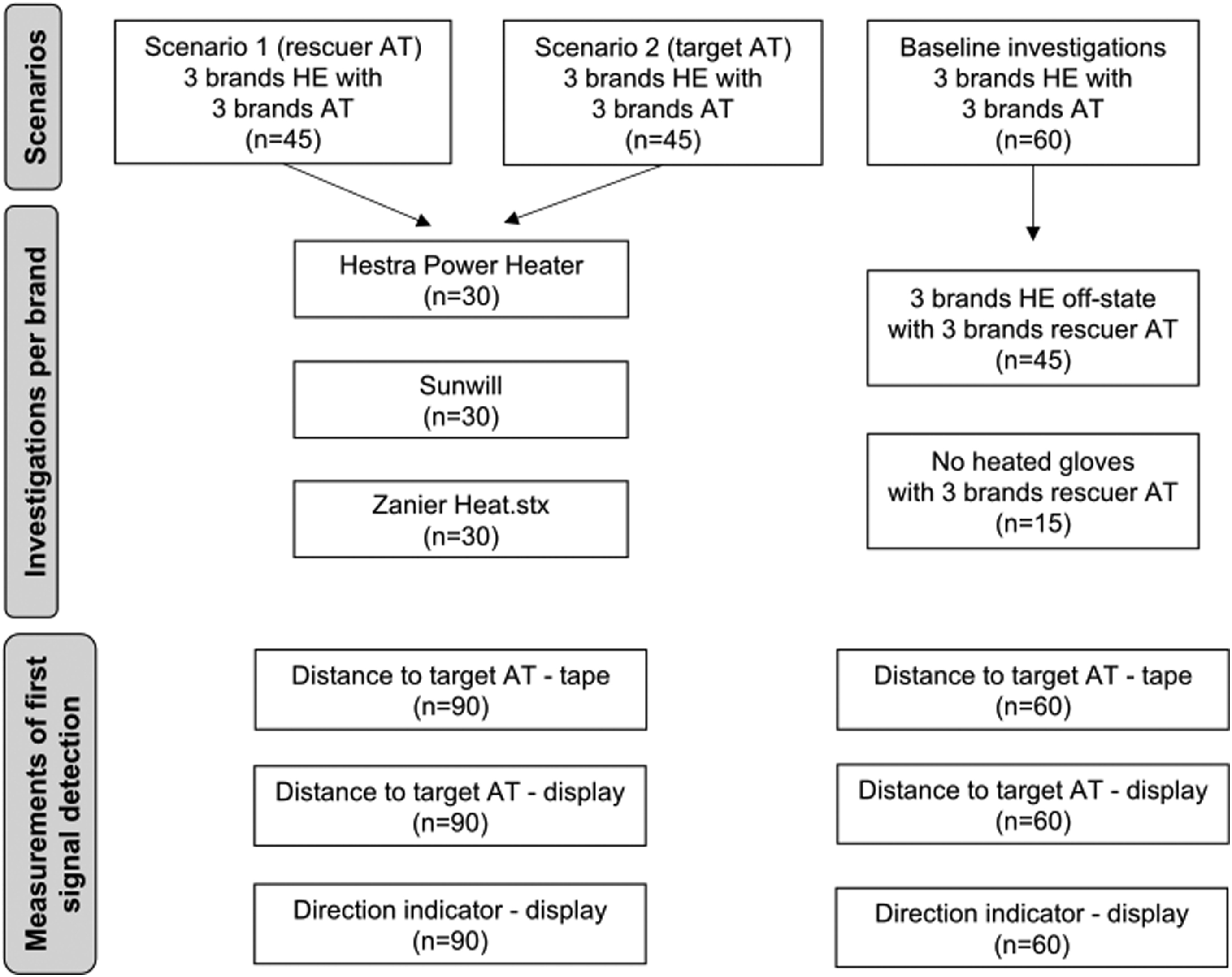
Trial setup and numbers of investigations and measurements. AT, avalanche transceiver; HE, heating element.
In the first scenario, we observed EMI from HE on the rescuer AT. Gloves with on-state HEs were worn by the rescuer during the search. In the second scenario, we observed EMI from the HE on the target AT (Figure 3). The HE was placed directly above the buried transmitter. For each scenario we performed 5 runs with each brand of HEs in on-state (maximum power setting, 3.7 W, new set of fully charged batteries) and 5 runs with HEs in off-state. For reference measurements the participants performed 5 runs with each of the 3 brands of ATs but without heated gloves. Overall, 150 runs were performed (Figure 3).
The alternate hypothesis was that EMI from HEs impairs the function of commonly used ATs. It was not our intention to analyze variety of user applications, differences between brands of AT, or differences between manufactured products with HEs. Assuming a correlation of 0.99 under null hypothesis using Fisher z-transformation, the estimated sample size was minimum 5 investigations per scenario to achieve a power of 80% and a level of significance of 5% (2-sided). The primary end point was distance to target when the first signal was received. The secondary end point was deviation of distance to target AT on display compared with distance to target AT by measuring tape. The tertiary end point was accuracy of the direction indicator on rescuer AT display. The null hypothesis was that the 2 groups were equal. Data analysis was performed using SPSS (version 25; SPSS INC, IBM, Armonk, NY). Distribution of normality was assessed by Kolmogorov-Smirnov test. Mean values and standard deviation as a measure of statistical dispersion were reported for between device nonparametric statistics using the Wilcoxon signed-rank test. P values of <0.05 were deemed significant.
Results
Reference measurements without HE revealed first signal detection at distances between 36.4 m and 44.3 m for 3 different brands of ATs (Table 1). When operating rescuer ATs with heated gloves, reduced distances of first signal detection were observed. On-state heated gloves revealed distances between 2.8 m (6% of baseline measurement) and 25.3 m (57%) at first signal detection. Off-state heated gloves were associated with less reduction in distances of first signal detection (Table 1). Average reduction of distance at first signal detection from all beacons tested was significantly decreased with on-state heated gloves (P<0.001) compared with references. The maximum reduction in distance of first signal detection was 41.5 m (94%). When heated gloves were in close vicinity of the target, signal interferences were observed only in a few cases. Incorrect direction indications at the rescuer AT display were observed on 2 occasions, whereas signal loss and an additional ghost signal occurred once. Moreover, EMI was not identified by product-specific software of one of the ATs during the investigations.
Comparison of pooled reductions in distance of first signal detection with 3 brands of heating gloves using 3 different brands of avalanche rescue beacons
Brands of tested on-state heating gloves (Hestra, Sunwill, Zanier).
Brands of used avalanche beacons (Mammut Barryvox S, Pieps Pro BT, Ortovox 3+).
Reference values: without gloves.
Effects of HEs on target ATs were less pronounced than effects on rescuer ATs. Distance of first signal detection differed significantly among the 3 brands of HEs (P<0.003). Off-state heated gloves had little observed effect on distance to AT signal detection. Display indications of distance to target did not differ significantly between rescuer ATs and target ATs during fine search and differed less than 10 cm. Overall, display indications of direction frequently revealed little deviations from the accurate direction. Marked deviations of more than 90° were observed twice with one brand of AT.
Discussion
We observed that gloves with HEs markedly affect AT function. Especially in rescuer ATs, the gloves from the 3 tested brands significantly decreased reception of the first signal.
The oscillographic investigation of the current drawn from the batteries of the HE revealed different magnetic fields depending on whether HEs were on-state or off-state. Accordingly, the magnetic fields of the HEs interfered with the transmitted signal of the AT. When testing heated gloves at maximum power, EMI occurred with a frequency of 49 Hz. Impairment of first signal detection and false direction indication as observed in our study can lead to delayed location and extrication of the victim in avalanche accidents. Delayed extrication of avalanche victims is associated with reduced survival and worsened clinical outcome.4,17,18 Rescue algorithms for avalanche accidents should consider the potential of prolonged search and rescue missions from EMI caused by electric devices.5,19
Furthermore, EMI caused by HE was more pronounced in rescuer ATs. Interference by on-state HEs was most frequently observed during the initial signal detection and coarse search but not during fine search. The fact that electronic devices compromise AT function is more pronounced in receiving mode than in transmitting mode is known and has been previously reported. 20 Our study revealed that even off-state heated gloves can interfere with AT function depending on the brand. This should be investigated more in detail in further studies.
There was only minor impairment of target AT function when HEs were in close vicinity buried under the snow. There was little signal impairment from the target AT during fine search and incorrect direction indications at the AT display were observed only twice. Presumably, the stronger signal in close range to the target AT is more robust to EMI. According to manufacturer’s information, the Pulse Barryvox S can alert the user with a 457 send failure message in case of identified EMI. When the beacon shows “457 SEND failure!” on the display, any electronic device within 40 cm distance has to be moved away. We cannot determine why EMI was not identified by the product-specific software of the AT during the investigations.
Limitations
Tests were not performed in real avalanche accident scenarios. Potential confounders such as extreme environmental and weather conditions were not accounted for. We did not record intervals between starting search and locating the victim. In addition, we did not evaluate individual performance of AT users in difficult terrain. Brands of the used AT, the location of the target AT, and direction of search were known to participants and investigators. Furthermore, the target AT was placed on a straight surface in a burial depth of 1 m superficially enough to allow EMI. Our study only evaluated 3 types of gloves with HEs and 3 brands of AT; it is unknown whether other products have similar performance.
Conclusions
Impairment of AT function by electric devices has been reported. With our study, we add another device to this list of potential confounders. Backcountry recreationists and mountain rescuers should be aware that EMI from HEs of gloves can compromise detection of signals by avalanche rescue beacons. We recommend avoiding the use of heated gloves in companion or during search of avalanche victims in order to avoid delay of rescue.
Footnotes
Acknowledgments
The authors thank Mr Hermann Spiegel, Helmut Lengerer, Hugo Reindl, Lukas Ruetz, and Nils Hackl from Mountain Rescue Tyrol for conducting the tests in the backcountry environment.
Author Contributions: study concept (MI, WL); study design (WT, MI, WL); acquisition of the data (WT, MI, TL); analysis of the data (WT, FJW, WL); drafting and critical revision of the manuscript (WT, MI, TL, FJW, WL). All authors approved the final manuscript.
Financial/Material Support: Austrian Mountain Rescue Service provided all types of commercially available heating elements and avalanche transceivers.
Disclosures: None.