






Abstract
Objective
To measure on-slope speeds of alpine skiers and to compare their ability to accurately estimate their actual speed with regard to measured speed, age, sex, skill level, helmet use, and risk-taking behavior.
Methods
Skiing speeds of 416 adult skiers (62% men, 38% women) were measured with a radar speed gun. Skiers were interviewed about their age, sex, skiing ability, helmet use, and risk-taking behavior. Additionally, skiers had to estimate their measured speed as accurately as possible. The difference between estimated and measured speed was described as error of estimation (EE).
Results
Mean measured speed (±SD) of all participants was 48.2 (±14.3) km/h. Pearson correlation coefficient between the actual speed and the estimated speed was 0.57 (P < .001) for all participants. Skiers underestimated their measured speed on average by 5.8 km/h or 8.1%. A multiple hierarchical linear regression analysis revealed that when skiing speed is increased by 1 km/h the EE significantly decreases by 0.5 km/h. Male sex, higher skill level, risky skiing behavior, and younger age groups showed a significantly better ability to estimate skiing speed, whereas ski helmet use did not.
Conclusions
Skiing speed, age, sex, skill level, and risk-taking behavior seem to influence the ability to estimate actual speeds in recreational alpine skiers.
Introduction
In alpine skiing, severe injuries are often related to excessive speed. 1 –4 In ski racers, injury rates per 1000 runs have been reported as 4.9 (slalom), 9.2 (giant slalom), 11.0 (super-G), and 17.2 (alpine downhill). 2 In recreational skiers, Aschauer et al 5 reported that 12% of injured skiers reported excessive speed as a potential cause of their injury. Additionally, in a study by Takakuwa and Endo, 4 a higher injury severity was associated with an increasing incidence of injuries that occurred when skiing out of control with an excessive speed. Therefore, to prevent high-speed injuries in recreational alpine skiing, preventive recommendations include avoiding excessive speed during skiing.3,6 Thus, it would be advantageous if skiers were able to estimate their individual speed on a slope as accurately as possible. In addition, to avoid accidents caused by collisions with other skiers it seems important to be able to estimate speeds from approaching skiers on the slopes. In a study by Shealy et al, 7 50 participants were asked to estimate their actual speed, which had been measured by radar speed gun. Skiers and snowboarders were fair at estimating their speed, but they tended to underestimate their speed the faster they go. 7 In general, skiing speed seems to be related to different factors including sex, age, helmet use, skill level, and risk-taking behavior. 7 –9 However, Shealy et al 7 did not consider such additional factors when evaluating the ability to estimate actual speed. Therefore, the aim of this study was to measure the on-slope speeds of skiers and to compare their ability to accurately estimate their actual speed with regard to measured speed, age, sex, skill level, risk-taking behavior, and ski helmet use.
Methods
Study Population
This study was performed in 4 typical ski areas on 6 different days in the western part of Austria in the winter season of 2008–2009. Speed measurements were performed on slopes of medium difficulty because most skiing injuries occur on such slopes. 10 Steepness of the slopes was comparable within all 4 ski areas. As far as possible, speed data were obtained from consecutive skiers, ie, after a skier's speed has been measured the next downhill skiing person was randomly selected for speed measurement. 8 A single trained observer used a radar speed gun with an accuracy of ±1% to 2% (Speed Watch, Sierzega, Thening, Austria) from a stationary location directly in the path of the skier. Discrete measurements were obtained when skiers approached. The recorded speed value (km/h) was the maximum speed attained during the period the subject was under observation. Research assistants waiting at the bottom of the slope were informed about the measured person via walkie-talkie. Measured subjects were stopped and invited to participate in this study. Inclusion criterion was an age older than 17 years. More than 90% of these subjects agreed to participate. Age, sex, height, weight, nationality (Austrian, German, others), and helmet use were recorded. In addition, age was classified into 4 age groups (≤30, 31–40, 41–50, >50 years). Self-estimated skill level (expert, advanced, intermediate, beginner) was assessed according to Sulheim et al. 11 Skiers were divided into more-skilled (advanced and experts) and into less-skilled (beginner and intermediates) skiers as a tendency was observed to underestimate individual skiing ability. 11 In addition, subjects were asked whether they considered themselves to be a cautious or risk-taking skier according to Ruedl et al. 12 Finally, subjects had to estimate their actual speed. This data set was also used in previously published articles.8,9 All research was conducted ethically according to international standards and guidelines set out by the Helsinki Declaration, 13 and skiers gave their informed consent for the interview. In addition, the retrospective data analysis of this study was approved by the Institutional Review Board of Sport Science Innsbruck.
Statistics
As a measure to estimate individual speed we calculated absolute differences between estimated and measured maximum speed. A negative value of this error of estimation (EE) means an underestimation, a positive value, an overestimation of actual speed. The closer the EE is to 0, the better the ability to estimate the individual speed. The relation between measured and estimated speed for all participants was investigated using Pearson product-moment correlation according to Shealy et al. 7
The ability to estimate actual speed depending on measured speed is graphically illustrated in the Figure.
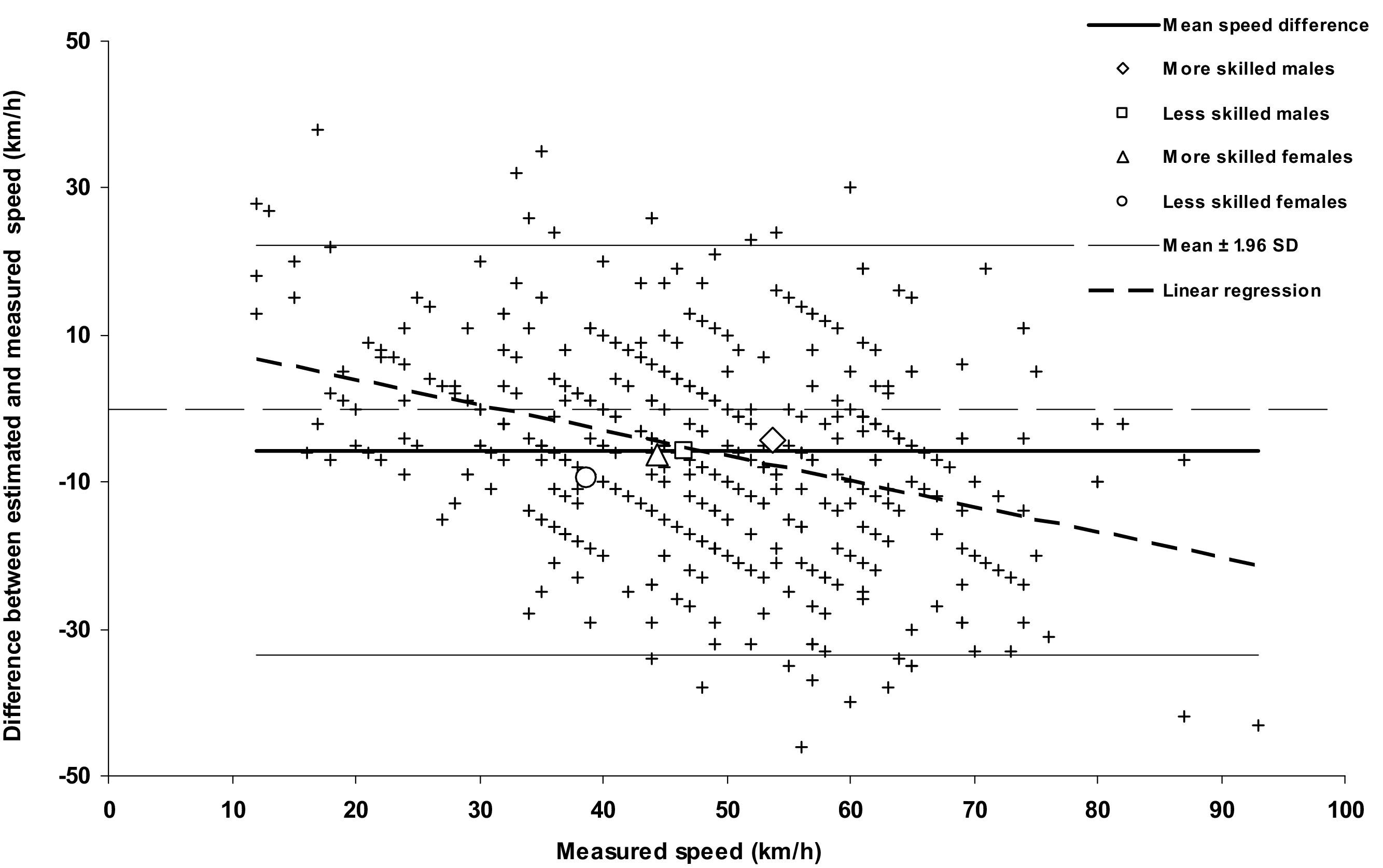
Error of estimation (EE; y axis) with regard to skiing speed (x axis). Parallel lines of data are because participants estimated their speed with an accuracy of ±5 km/h.
A multiple linear regression analysis was used to estimate the influence of age groups, sex, risk-taking behavior, and ski helmet use on skiing speed. In addition, a multiple hierarchical linear regression analysis was used to estimate the influence of skiing speed, age groups, sex, risk-taking behavior, and ski helmet use on the EE.
All probability values were two-tailed, and values of .05 or less were considered to indicate statistical significance.
Results
In total, 416 adult skiers (62% men, 38% women) with a mean (±SD) age of 41.8 (±13.3) years, mean height of 175.2 (±8.8) cm, and mean weight of 75.1 (±14.2) kg participated in this study. Regarding nationality, 38.9% were Austrians, 47.6% were Germans, and 13.5% were from other countries.
Mean measured speed and mean estimated speed of all participants were 48.2 (±14.3) km/h and 42.4 (±16.2) km/h, respectively. The Pearson correlation coefficient between the actual speed and the estimated speed was 0.57 (P < .001) for all participants. Skiers underestimated their measured speed on average by 5.8 km/h or 8.1% (Figure). In Table 1, mean measured skiing speed and mean EE are presented with regard to age groups, sex, skill level, risk-taking behavior, and ski helmet use. Results of the linear regression analysis reveal a significant influence of age, sex, and risk-taking behavior, but not of ski helmet use on skiing speed (Table 2).
Mean values (±SD) of measured speed and error of estimation with regard to age groups, sex, skill level, helmet use, and risk-taking behavior
EE, error of estimation.
Negative values of EE show an underestimation of measured speed.
Results of the multiple linear regression analysis of factors influencing skiing speed
B is the unstandardized coefficient. SE B is the standard error of B and β is the standardized coefficient.
Regarding the multiple hierarchical linear regression analysis with entering all factors, ski helmet use was not shown to have a significant influence on the EE. Therefore, ski helmet use was not considered in the final model of the multiple hierarchical regression analysis. The final model meeting various assumptions (adjusted R2, Durbin-Watson statistics, multicollinearity) explains 24% of the variance of EE (Table 3).
Model summary a
Dependent variable: error of estimation (EE) (km/h).
Predictors: (constant), measured speed (km/h).
Predictors: (constant), measured speed (km/h), sex.
Predictors: (constant), measured speed (km/h), sex, skill level.
Predictors: (constant), measured speed (km/h), sex, skill level, risk-taking behavior.
Predictors: (constant), measured speed (km/h), sex, skill level, risk-taking behavior, age groups.
Table 4 shows the results of the multiple hierarchical regression analysis, which reveals that when skiing speed is increased by 1 km/h the EE significantly decreases by 0.5 km/h (Table 4, Figure). Men, more-skilled skiers, and risky skiers estimated their speed more accurately by a mean of 7.4, 4.5, and 3.7 km/h compared with women, less-skilled skiers, and cautious skiers, respectively. In comparison with the age group older than 50 years, all other age groups showed a significantly better ability to estimate their speed by 3.7 to 5.6 km/h (Table 4).
Results of the multiple hierarchical regression analysis of factors influencing the error of estimation
Discussion
The main results of this study were that skiing speed, age, sex, skill level, and risk-taking behavior seem to influence the ability to estimate actual speeds in recreational alpine skiers, whereas ski helmet use did not.
In comparison to our results, Shealy et al 7 reported an average speed for skiers of 45 km/h on open slopes, whereas in wooded areas and terrain parks speeds were less than 25 km/h. 14 The reported correlation coefficient of 0.56 (P < .005) in 50 skiers and snowboarders in the study by Shealy et al 7 is similar to our own study. Our finding that slope speeds were underestimated by participants in the present study on average by 6 km/h or by 8% also agrees with the observations of Shealy et al. 7 However, because kinetic energy increases as the square of the velocity, there is a big difference between underestimating by 8% when skiing at 40 km/h and 70 km/h, respectively. In addition, according to the Figure, a few skiers showed an inability to estimate actual skiing speed. For example, they skied at a speed of 60 km/h and estimated a speed of 20 km/h. This inability to estimate actual skiing speed might dramatically contribute to the risk of crashes.
In alignment with Shealy et al, 7 our study found that men skied faster than women, which might be attributable to an on average higher skill level and more risky behavior in men.9,15
Our results suggest that the ability to estimate speed was influenced by the skier's actual speed. Skiers with a speed of up to 30 km/h tended to overestimate and faster skiers tended to underestimate their speed, respectively (Figure). Beside skier's speed, according to the calculated β values in Table 3 mainly sex followed by skill level, age groups younger than 51 years, and riskier behavior showed an impact on the ability to estimate speeds as accurately as possible. One could speculate that more-skilled skiers (mostly men) ski more days per season and have a higher skiing experience (in years) compared with less-skilled skiers, resulting in a better ability to accurately estimate their speed. In addition, Ruedl et al 9 showed that self-reported risk-taking behavior is associated with higher speed, male sex, and higher skill level. The fact that women show on average a lower ability to estimate their speeds might be partly related to a greater proportion of less-skilled skiers among women. 16 A lower skill level, however, is associated with an increased injury risk in alpine skiing. 17 –19
Age showed a significant influence on skiing speed as well as on the ability to estimate actual speeds. In comparison to an age older than 50 years, younger persons skied on average significantly faster, which might be related to a better physical fitness level and a riskier behavior in younger ages.9,12 Older skiers showed impaired ability to estimate speed accurately. This has been explained by an age-related decline in the ability to sense changes in velocity. 20
In this study, helmet users did not ski significantly faster than those who did not use helmets. In contrast, Shealy et al 7 reported that helmet users skied significantly faster than those who did not use helmets (50 vs 47 km/h). Therefore, discussions took place about the potential influence of wearing a ski helmet on an increasing level of risk taking resulting in a higher injury outcome. 12 ,21,22 However, Scott et al 21 found no evidence of risk compensation among helmet users in skiers and snowboarders. In addition, Hagel et al 22 found no evidence that helmet use increased the risk of severe injuries or high-energy crash circumstances. In a recent study by Ruedl et al, 12 the personality trait of sensation seeking, not the wearing of a ski helmet, appears to be associated with riskier behavior on the ski slopes. In this study, wearing a helmet did not negatively affect the ability to estimate actual speeds. Therefore, helmet use should be recommended in alpine skiing as ski helmets have been shown to reduce head injury risk by 35% in general and by 59% among children.23,24
Study Limitations
A few limitations have to be considered. First, speed measurements obtained by GPS 25 would be more accurately compared with speed measurements made with a radar speed gun. However, Shealy et al 7 verified radar speed gun measurements by comparison with a GPS device and found that all comparisons were within the stated ranges. In addition, getting a high number of participants' on-slope measurements with a radar speed gun is more practical than taking GPS measurements. Second, data on speed estimation show wide variability, and the interpretation of mean values may be misleading. As shown in the Figure, however, only 24 (5.8%) skiers were out of the range of the mean EE ± 1.96 SD. Third, self-reporting to questions might lead to underreporting or overreporting of health-risk behaviors affected by cognitive and situational factors. 26 Fourth, our results are primarily generalizable to central European skiers and mostly to Germans and Austrians. However, our data seem to be consistent with data from North America.
Conclusions
In conclusion, speed, age, sex, skill level, and risk-taking behavior seem to influence the ability to estimate actual speeds in recreational alpine skiers. An age older than 50 years, female sex, lower skill level, and cautious behavior were associated with a decreased ability to estimate actual speed. The ability to estimate skiing speed accurately is an important prerequisite to avoidance of crashes on ski slopes. Prevention programs should include training of speed estimation, which could easily be integrated in ski education courses.
Footnotes
Acknowledgment
Speed measurements were financially supported by the Austrian Ski Federation.