






Abstract
Background
While the mean injury rate from snow sports in Austria is low (less than 2 injuries per 1000 skier days), there is little information about fatalities on Austrian ski slopes.
Objective
The purpose of this study was to evaluate incidence and causes of fatalities among recreational skiers and snowboarders over a 5-season period on Austrian ski slopes.
Methods
All traumatic and nontraumatic fatal ski accidents from the 2005-2006 through the 2009-2010 winter season were compiled by members of the Federal Ministry of the Interior. Data on age, gender, nationality, gear used, altitude, accident cause, primary cause of death, and helmet use were collected. The number of fatalities was related to a million skier days during this 5-year period.
Results
In total, 207 fatalities were registered during this time period. An overall incidence of 0.79 deaths per million skier days was calculated. Mean age was 50.9 ± 17.7 years. More than 85% of all fatalities occurred in males and 93.1% in skiers. Mean altitude was 1706.1 ± 517.7 m above sea level. In total, 52.7% were nontraumatic deaths, with the majority (73%) attributed to cardiac arrest. Regarding traumatic deaths, 41.2% died after a fall, 18.6% after collision with another skier, and 35.1% after an impact with a solid object. Head injury was the primary cause of death in 46.4% of traumatic deaths.
Conclusions
Death is a rare event in recreational winter sports on Austrian ski slopes. Nevertheless, awareness of potential risk factors and common dangers may impact snow riders' behavior and help reduce the incidence of on-slope fatalities.
Introduction
During the 2008-2009 winter season, several high profile fatal incidents involving celebrities reignited the debate about ski helmet use. 1 In Austria, a collision between a German politician and a mother of 4 children occurred on a ski slope on New Years Day 2009. The politician wearing a ski helmet survived with a traumatic brain injury while the woman not wearing a helmet died. In Canada, actress Natasha Richardson died after sustaining a traumatic head injury while skiing without a helmet on a beginner slope in Quebec in March 2009. In addition to traumatic deaths, previous studies have found sudden cardiac death to be the most common cause of nontraumatic death at altitude during leisure time activities such as recreational skiing.2,3 Although about 8 million skiers and snowboarders visit the Austrian Alps annually, 1 the mean injury rate is low—at less than 2 injuries per 1000 skier days. 4 There is little information, however, about ski fatalities on Austrian ski slopes. Thus, the goal of this study was to evaluate incidence and causes of fatalities among recreational skiers and snowboarders over a 5-season period on Austrian ski slopes.
Methods
All fatalities (including traumatic and nontraumatic deaths) on Austrian ski slopes from the 2005–2006 through the 2009-2010 winter season were compiled by members of the Federal Ministry of the Interior (Alpinpolizei), who are qualified alpinists and have paramedical training. Data on age, gender, nationality, gear used, altitude, accident cause, primary cause of death, and helmet use were collected at the death scene and stored by the Federal Ministry of the Interior and the Austrian Kuratorium für Alpine Sicherheit. Cause of death was determined by emergency physicians on the scene using information from companions and eyewitnesses. Incidence of fatalities was calculated based on number of skier days during this 5-year period. The Federation of Austrian ski lift companies provided the number of skier days per year.
Results
There were 207 registered fatal injuries during the 5-year period, with an average of 41.4 ± 6.4 fatalities per year (Figure). Mean age was 50.9 ± 17.7 years. More than 85% of all fatalities occurred in males, and 93.1% in skiers (vs snowboarders). Of all the victims, about 32%, 44%, and 24% were inhabitants from Austria, Germany, and other countries, respectively. Mean altitude at time of death was 1706.1 ± 517.7 m above sea level.
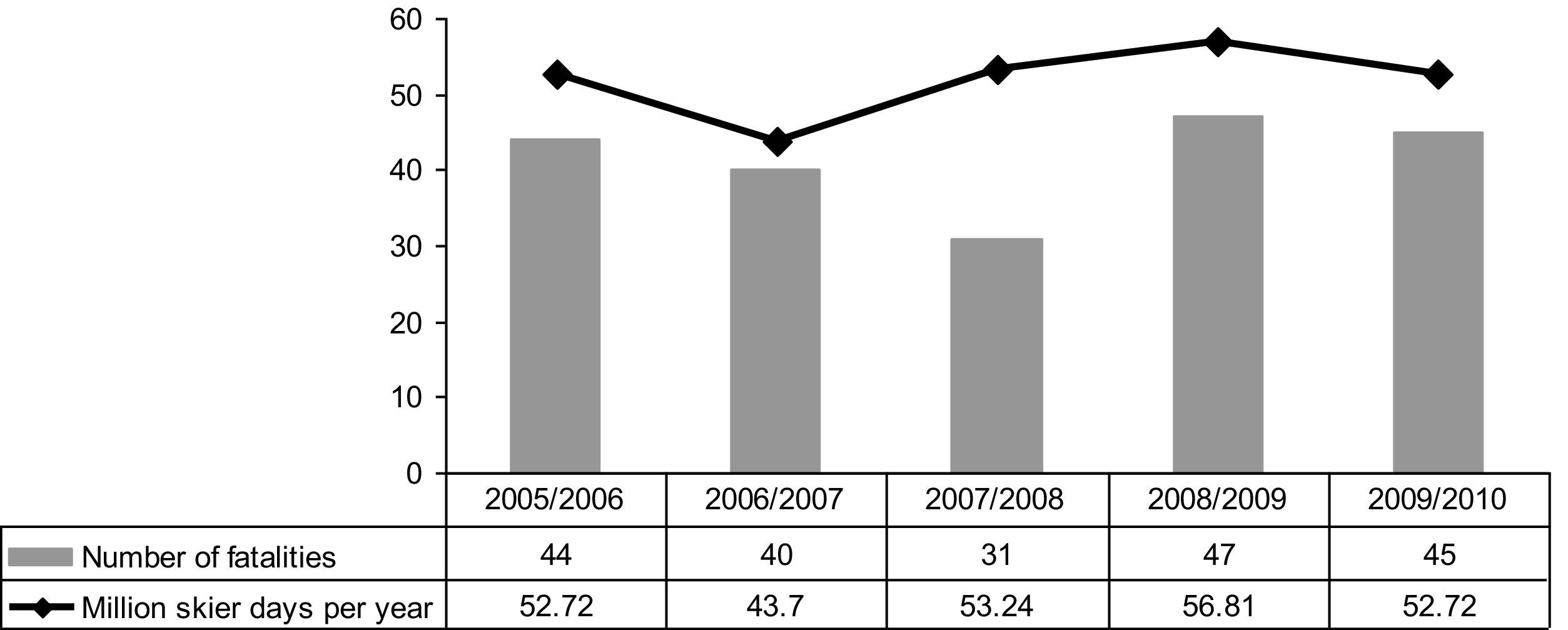
Number of fatalities and million skier days per year from winter season 2005–2006 to 2009–2010.
The overall incidence was 0.79 deaths per million skier days, with an incidence of 0.42 nontraumatic deaths and 0.37 traumatic deaths per million skier days. In total, 108 (52.7%) were nontraumatic deaths (Table 1) and 97 (47.3%) were traumatic deaths (Table 2). In 2 cases, the cause of death was unknown. Mechanisms of death are listed in Tables 1 and 2. Cardiac arrest caused the majority (73.1%) of nontraumatic deaths. Over one third of traumatic deaths were due to collisions with solid objects, including natural objects such as trees and rocks as well as man-made objects such as pylons, fences, and a snow groomer. Of the traumatic deaths, head injury was the primary cause of death in 45 victims (46.4%). Of those, 10 (22.2%) wore a helmet. Fatal head injuries occurred in 18 (40.0%) victims because of falls, in 6 (13.3%) because of skier collisions, in 19 (42.2%) because of solid object collisions, and in 2 (4.4%) because of avalanche deaths.
Demographic data and mechanisms of nontraumatic deaths (N=108) on Austrian ski slopes
Demographic data and mechanisms of traumatic deaths (N = 97) on Austrian ski slopes
Discussion
The incidence rate of 0.79 deaths per million skier days in Austria is well in accordance with the study by Shealy et al 5 reporting 0.75 deaths per million ski visits in the United States. However, while we included all fatalities on ski slopes, Shealy et al 5 documented only traumatic fatalities. In our study, the incidence of traumatic deaths was lower, at 0.37 per million skier days. The majority of fatalities on Austrian slopes were nontraumatic deaths.
We found that mainly male skiers older than 50, at an average altitude of 1700 m, were involved in most deaths, suggesting that gender, age, and altitude may be important risk factors for death on the ski slope. Other studies 2 ,5,6 have also shown that primarily males are involved in fatalities on ski slopes. A potential reason for the higher death rate in male skiers might be that males show, in general, higher risk-taking behavior on ski slopes, and they ski faster compared to females.7,8 Interestingly, our data demonstrated that males also account for the vast majority of nontraumatic deaths on Austrian ski slopes. This might be related to greater overall cardiovascular risk in men than in women. Burtscher and Ponchia 3 also found that sudden cardiac death (SCD) was the most frequent cause of nontraumatic death in males older than 34 at high altitude during recreational winter sports. They observed that unusual physical activity during the first days at altitude, and prolonged abstinence from food and fluid intake during exercise at altitude, were the most important triggers contributing to an increased risk of SCD. 3
In about 46% of traumatic fatalities, head injury was found as the primary cause of death. But only 22% of those with a fatal head injury used a ski helmet, despite the fact that helmet use reportedly increased up to 60% in the past few years on Austrian ski slopes. 9 Based on current industry standards, helmets are designed to offer protection in direct collisions at speeds only up to 22 km/h. 10 In comparison, mean speed on Austrian ski slopes is about 44 km/h. 8 Although helmet use significantly decreases nonlethal head injury risk, 1 helmets have not been shown to reduce the overall incidence of fatalities in skiing and snowboarding. 10
In conclusion, death is a rare event in recreational winter sports on Austrian ski slopes. Nevertheless, awareness of potential risk factors and common dangers may impact snow riders' behavior and help reduce the incidence of on-slope fatalities. Future studies should include randomized trials comparing different educational (eg, web-based) interventions derived from proven-change models with the goal of minimizing risk behavior and, potentially, deaths on the ski slopes.