






Abstract
Background/Objective
Traumatic brain injury (TBI) is an important cause of morbidity and mortality in skiing and snowboarding. Although previous studies have advocated the use of a helmet to reduce the incidence of TBI, only a minority of skiers and snowboarders wear helmets. The low use of helmets may be partially due to controversy regarding their effectiveness in a high-speed crash. The protective effect of a ski helmet is diminished at the high speeds a skier or snowboarder can potentially obtain on an open slope. However, ski areas have undergone significant changes in the past decade. Many skiers and snowboarders frequent nontraditional terrain such as gladed areas and terrain parks. Since these areas contain numerous physical obstacles, we hypothesized that skiers and snowboarders would traverse these areas at speeds slow enough to expect a significant protective effect from a helmet.
Methods
Speed data were obtained via radar analysis of 2 groups of expert level skiers and snowboarders traversing a gladed woods trail and terrain park.
Results
A total of 113 observations were recorded. Forty-eight observations were made of 9 skiers and snowboarders in gladed terrain, and 65 observations were conducted of 21 skiers and snowboarders in the terrain park. In 79% of the cases in gladed terrain and 94% of the instances in the terrain park, observed speeds were less than 15 mph.
Conclusions
Skiers and snowboarders navigate nontraditional terrain at speeds slower than on open slopes. At the observed velocities, a helmet would be expected to provide significant help in diminishing the occurrence of TBI. Medical authorities should advocate the use of helmets as an important component of an overall strategy to reduce the incidence of TBI associated with skiing and snowboarding.
Introduction
Skiing and snowboarding are extremely popular winter sports in the United States and worldwide. Nearly 60 million skier visits occur annually in the United States alone. 1 Each year an estimated 139 300 skiers and snowboarders sustain injury serious enough to require treatment in a hospital emergency department. 2 Traumatic brain injury (TBI) is the leading cause of death and serious morbidity associated with skiing and snowboarding. 3 Use of a helmet while skiing would appear to be a logical strategy to reduce the incidence of TBI. A 1999 study by the US Consumer Product Safety Commission estimated that 7700 head injuries could be prevented each year by universal helmet use among skiers and snowboarders. 4 Recent studies offer objective data that confirm the efficacy of helmets in reducing the incidence of head injuries. 5 –7 Consequently, a growing number of investigators are recommending helmet use for all skiers and snowboarders.3,8–10 However, observed helmet-use rates remain low, particularly among adults.11,12
Wearing a ski helmet provides a number of advantages including increased warmth and protection from face and scalp contusions and lacerations due to impact with tree branches, ski and snowboard edges, etc. However, controversy exists as to the degree of protection a helmet provides in a high velocity crash. The effectiveness of protective headgear is diminished as impact velocity increases. Based on current industry standards, helmet designs offer only limited protection in direct collisions at speeds greater than approximately 15 miles per hour (mph). 13 Skiers on open slopes with groomed terrain may obtain speeds of 25 to 30 mph. 14 At such speeds, the protective effect of a helmet is diminished. As a result, there has been reluctance on the part of some authorities to strongly endorse the use of helmets.
Since the introduction of snowboarding and shaped skis, the activities of both skiers and snowboarders at resorts have changed dramatically. Modern skis and snowboards make skiing easier in a variety of difficult snow conditions, particularly in wooded areas. Consequently, skiers and snowboarders are increasingly venturing off of traditional open slopes into gladed forest and backcountry areas beyond the resort's boundaries. As a result, many resorts now offer a wide variety of gladed trails rated at expert and even intermediate levels. In addition, the bidirectional nature of snowboards and modern skis has made it possible for skiers and snowboarders to perform jumps and tricks on or over a variety of manmade and natural obstacles in a manner similar to skateboarding. In response, ski resorts have introduced terrain parks featuring half pipes, jumps, metal rails, and other obstacles. Since a large number of skiers and snowboarders are increasingly drawn to these areas of the resort, we investigated the speeds at which they traverse this terrain. We hypothesized that the frequent turns required to navigate these areas limit even advanced skiers and snowboarders to relatively slow speeds amenable to protection by a helmet. In an effort to determine the usual maximal velocities in these areas, we recruited an expert cohort of skiers and snowboarders for this study.
Materials and Methods
Approval for this study was obtained from the Institutional Review Board of the University of Vermont. We observed skiers and snowboarders in several discrete areas within 2 major northeastern ski resorts. A single trained observer utilized a radar gun (Stalker Sport model, Plano, TX) from a stationary location directly in the path of the rider. Discrete measurements were obtained as the skier or snowboarder approached and departed the observer's location. Measured speeds were verbally transmitted to a recording device and later transcribed. Because the sensitivity of the radar gun was poor at speeds less than 11 mph, measurements of 10 mph or less were indicated as a null reading by the device. Accordingly, speeds of 11 mph or faster were recorded as individual data points, and all observations less than 11 mph were grouped together.
During the first series of measurements, 9 male expert-level members of the resort's ski patrol were observed in a designated gladed trail within the resort. The trail was rated as a single black diamond trail (advanced level) by the resort. The cohort consisted of 2 snowboarders, 2 telemark skiers, and 5 alpine skiers. The skiers and snowboarders were observed at 3 discrete areas within the glade and instructed to ride aggressively.
In the second series of observations, a separate group of 21 male skiers and snowboarders were measured performing on “rails” in the terrain park at a second resort. Rails consist of a variety of long metal tubes, which skiers and snowboarders attempt to slide or grind along. Rails typically are elevated several feet off the snow surface. The snow surface is generally hardpacked from a high degree of machine and foot traffic alongside. The participants were a group of expert-level skiers and snowboarders as defined by participation in the finals portion of a statewide rails competition.
Results
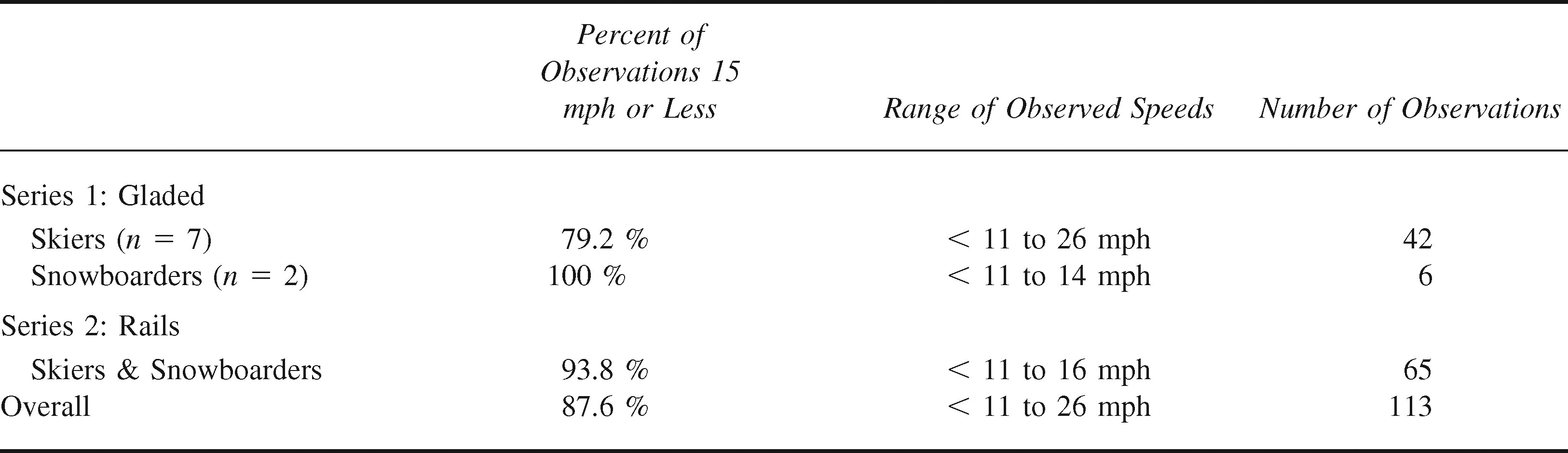
In the majority of instances both skiers and snowboarders traversed nontraditional terrain at relatively slow velocities. In 87.6% of the observations, measured speeds were below 15 mph. Table 1 summarizes the speed observations for riders on the gladed terrain at the first resort (Series 1) and on the rails section of the terrain park at the second resort (Series 2).
Observed speeds in gladed terrain and on rails
Discussion
The speed of expert level skiers and snowboarders on nontraditional terrain, such as glades and terrain parks, appears to be considerably slower than previous reports of skiers on open slopes. 14 Although there is variation, a considerable amount of time is spent at speeds slow enough for a ski helmet to provide a significant degree of protection. The large number of obstacles requires the skier or snowboarder to make frequent changes in direction that appear to limit overall velocity. Each change in direction to navigate around an obstacle carries the obvious risk of collision with trees or exposed rock. Skier-tree collisions have been previously recognized as a known hazard. In a recent study by Levy, skier-tree collision was cited as the most common mechanism for severe head injuries in skiers admitted to a regional trauma center. 3 While a ski helmet may provide only limited protection to a skier in a high velocity impact on an open slope, our study indicates that they may have significant benefit to skiers in gladed areas and off piste in other wooded areas.
There may be additional advantages to helmet use by backcountry skiers. A recent study by Johnson et al has advocated the use of a helmet by skiers and snowboarders traversing backcountry areas prone to avalanche. 15 Most avalanche-related deaths are ultimately due to asphyxia. However, their study of a series of avalanche fatalities in Utah revealed a 61% incidence of associated closed-head injuries (CHI). The authors speculate that use of a helmet would decrease the incidence of CHI and improve the chance for self rescue and survival.
Our study demonstrates that skiers and snowboarders traverse rails at slow speeds. During a fall off of a rail there is considerable potential for head injury due to impact with either the metal rail or the hard packed snow surface typically associated with terrain parks. In addition, snowboarders are particularly vulnerable to the “opposite edge phenomenon.” The opposite edge phenomenon is a violent and sudden frontside or backside fall from which it is difficult for riders to protect themselves. These falls occur backwards in 68% of the cases and usually occur on mild-to-moderate terrain. Acute subdural hematoma as a result of shear injury to the occipital portion of the brain typically results. 16 Protection of the occiput from a helmet may therefore be of particular value to snowboarders in terrain parks.
Our research was limited to only specific areas of nontraditional terrain. It is possible that higher velocities would be observed elsewhere in the resort. In addition, the relatively small number of test subjects is a potential limitation of our study. However, both groups deliberately were composed of smaller groups of expert-level skiers and snowboarders in an effort to determine the probable higher end of velocities likely to be experienced by the general skiing public.
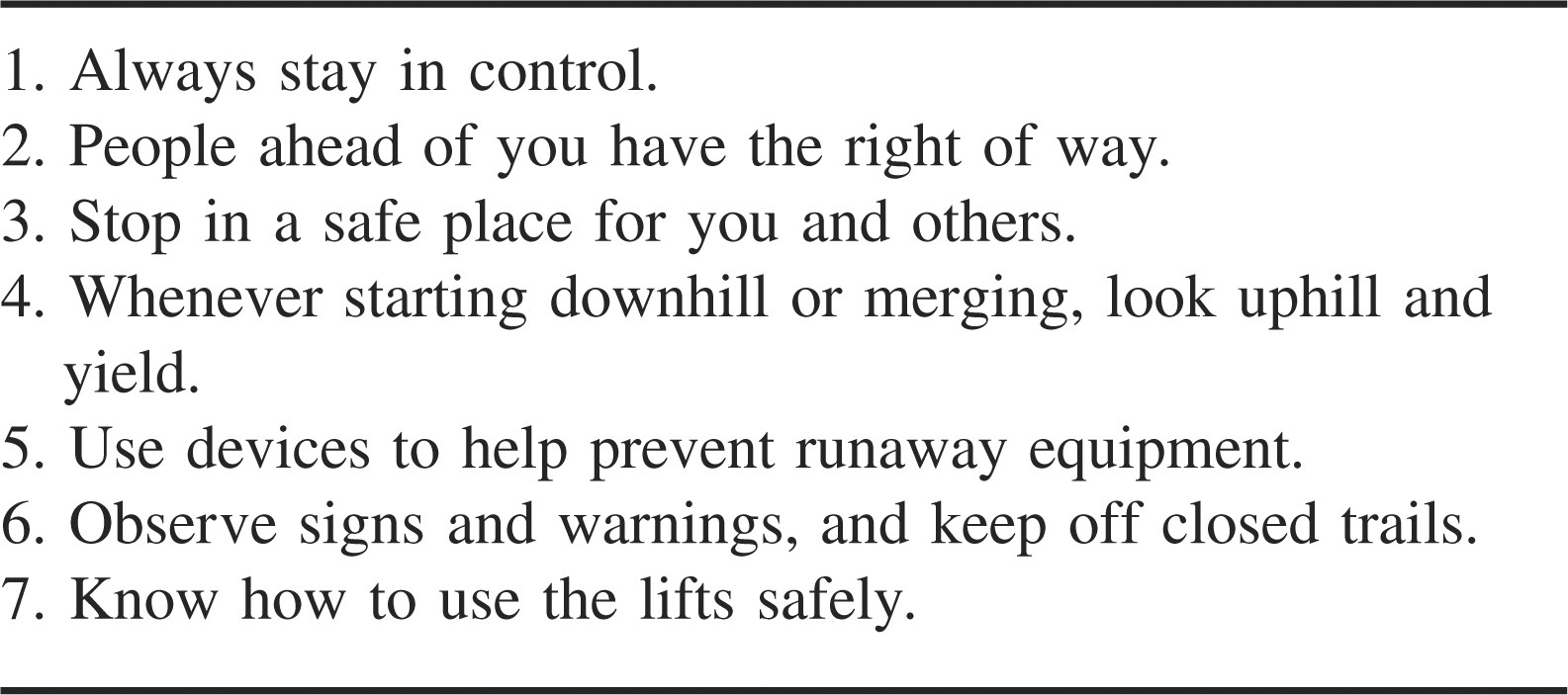
It is essential that helmets be viewed as only a portion of an overall strategy to reduce the risk of injury while skiing. A ski helmet provides no protection from severe thoracic or abdominal injuries and will provide only limited head protection in a high-speed collision. Obeying the Skier's Responsibility Code and skiing in control at all times is the best protection from sustaining injury while skiing or riding (Table 2). However, our data indicate that skiers and snowboarders spend a considerable portion of their time at speeds where a helmet may be expected to have a significant protective effect.
Skier's Responsibility Code
Other researchers are accumulating objective evidence that use of a helmet can decrease the risk of head injury in an accident. A recent study by Sulheim in the Journal of the American Medical Association concluded that wearing a ski helmet was associated with a 60% reduction in the risk for head injury. 7 Hagel et al recently demonstrated a similar risk reduction for head injury of 29% to 56% when a helmet was utilized. 5 There appear to be no objective data to discourage the widespread use of helmets. Helmets do not increase the risk of sustaining an associated neck injury, nor do they appear to encourage the use of riskier behavior.5,17 However, despite the potential advantages, helmet use among skiers and snowboarders appears to remain suboptimal.11,12 Unlike the strong endorsement of helmet use for bicycle safety, the medical community has been slow to endorse the use of helmets for skiing. Health care professionals and other authorities should be aware of the changes occurring within the sports of skiing and snowboarding and adapt their recommendations accordingly. Skiers and snowboarders traverse nontraditional terrain at speeds where a ski helmet would be expected to provide significant protection. Helmets appear to have a significant protective effect on skiers and snowboarders and their use should be strongly endorsed.