






Abstract
The purpose of this case study is to examine the physiological/behavioral factors leading up to heat exhaustion in a male wildland firefighter during wildland fire suppression. The participant (24 years old, 173 cm, 70 kg, and 3 years firefighting experience) experienced heat exhaustion following 7 hours of high ambient temperatures and arduous work on the fire line during the month of August. At the time of the heat-related incident (HRI), core temperature was 40.1°C (104.2°F) and skin temperature was 34.4°C (93.9°F). His work output averaged 1067 counts·min−1 (arbitrary units for measuring activity) for the 7 hours prior to the HRI, a very high rate of work over an extended time period during wildfire suppression. In the 2.5 hours leading up to the heat incident, he was exposed to a mean ambient temperature of 44.6°C (112.3°F), with a maximum temperature of 59.7°C (139.5°F). He consumed an average of 840 mL · h−1 in the 7 hours leading up to the incident and took an average of 24 ± 11 drinks · h−1 (total of 170 drinks). The combined effects of a high work rate and high ambient temperatures resulted in an elevated core temperature and a higher volume and frequency of drinking than typically seen in this population, ultimately ending in heat exhaustion and removal from the fire line. The data demonstrate that heat-related incidents can occur even with aggressive fluid intake during wildland fire suppression.
Heat-Related Illness
Heat-related illnesses can manifest in occupations that demand a high amount of physical work in high ambient temperatures. Heat-related illnesses include heat edema, cramps, syncope, heat exhaustion, and heat stroke. 1 Symptoms occur when the metabolic heat production from muscle activity and/or heat acquisition from the environment are greater than the ability of the body to dissipate heat. This limits the ability to maintain core body temperature within a safe range, resulting in hyperthermia. While performing strenuous work, the inability to dissipate body heat can result from a multitude of factors, including lack of environmental acclimatization, poor physical fitness, dehydration, medications, drugs, supplements, high body mass, specific genotypes, muscle injury, and illness.2,3 The purpose of this case study is to examine the physiological/behavioral factors leading up to a heat-related incident (HRI) during wildland fire suppression.
Presentation of Case
In the summer of 2004, during a hydration study, 4 we captured physiological data from a male wildland firefighter (WLFF) (24 years old, 173 cm, 70 kg, and 3 years firefighting experience) who experienced heat exhaustion during a work shift. The participant was in the water-drinking-only group. In the 2.5 hours leading up to the heat incident, the individual was exposed to a mean ambient temperature of 44.6°C (112.3°F), with a maximum temperature of 59.7°C (139.5°F) (see Figure 1 for pattern of ambient exposure). During this time period, he had 113 minutes (75%) of exposure to temperatures ≥40°C (104°F). His work output averaged 1067 counts · min−1 for 7 hours, a very high rate of work over an extended time period during wildfire suppression (typical work outputs are 300–600 counts · min−1 for a day [see Figure 2]). 4 –6 The participant's core temperature reached a maximum of 40.1°C (104.2°F) prior to the incident; the pattern of core temperature leading up to the incident can be seen in Figure 3. Average skin temperature for the 7 hours leading up to the heat injury time point was 33.1°C (91.6°F), whereas at the time of the heat injury, skin temperature was 34.4°C (93.9°F). In response to his high work output and exposure to high temperatures, he drank an average of 840 mL · h−1 (5.9 L) in the 7 hours leading up to the incident. He took an average of 24 ± 11 drinks · h−1 over the 7 hours leading up to the heat injury (total of 170 drinks). As a result of his heat exhaustion, he was evacuated from the fire line via helicopter for immediate medical attention, a very rare occurrence in the wildland firefighting community.
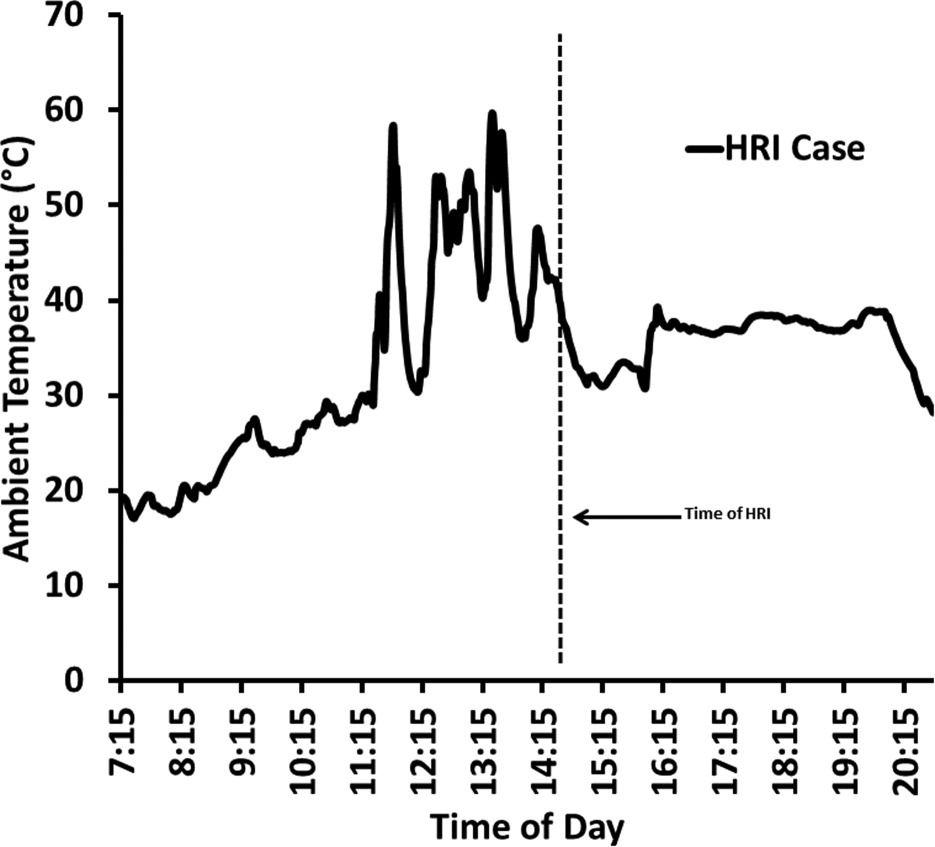
Ambient temperature (°C) during the work shift.
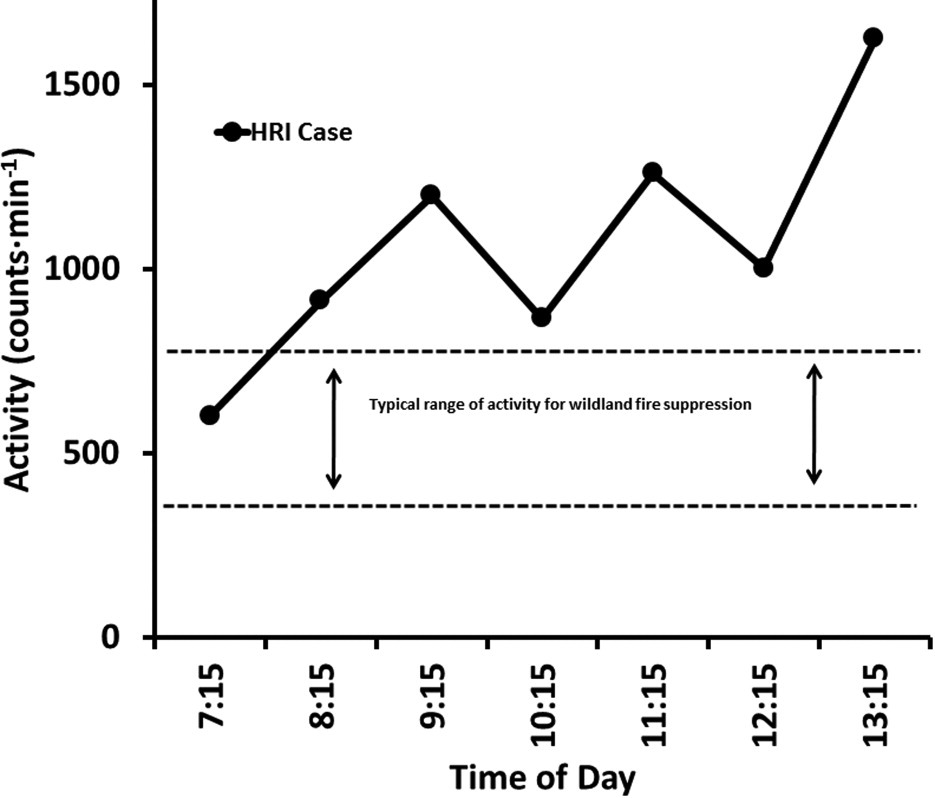
Activity patterns in the 7 hours leading up to the heat incident.
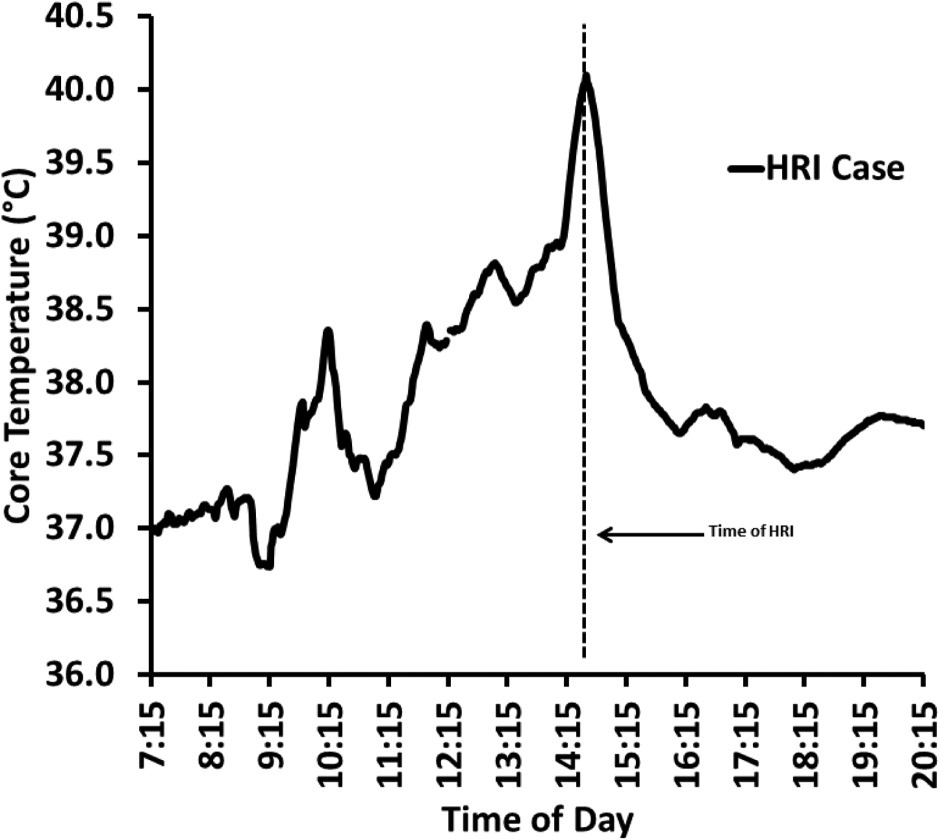
Core temperature (°C) during the work shift for participants and HRI case study subject.
Novelty of Case Situation
The rate of HRIs during work is relatively low. In an 11-year analysis of occupational HRIs in Washington State, Bonauto et al determined third quarter (July, August, and September) workers' compensation time claim rates attributed to HRIs were 158.8 per 100000 FTE (1 FTE = 2000 work hours) for fire protection. 1 This means, for example, 1 out of every 630 firefighters experienced an HRI during the third quarter that prevented them from attending work. Considering the low incidence rate of HRIs, and the few people tested during the field study (n = 16), the odds of capturing data from an HRI (based upon data from Bonauto et al) during the third quarter are minimal (1 in 101 385 work days), making this an incredibly rare data set to acquire. Capturing this kind of data in a laboratory setting would likely never occur because preventive measures would be in place to stop a participant before he/she achieved this level of heat stress; thus, the field research model allowed for such a situation to occur.
Physiological Monitors
Prior to the work shift, the participant ingested a core temperature capsule (Mini Mitter, A Respironics Company, Bend, OR) and had a skin temperature sensor (Mini Mitter, A Respironics Company, Bend, OR) placed on the lateral side of the left deltoid. To collect ambient temperature, an additional surface temperature sensor was placed on the outside of the VitalSense monitor holster (Mini Mitter, A Respironics Company, Bend, OR) that was worn on the subject's belt. The participant was provided with a specially outfitted backpack hydration system (3-liter capacity Camelback). The system was equipped with a digital flow-meter system affixed inline to allow for the measurement of drinking characteristics (drinking frequency and drinking volume). 7 Activity data were collected using the Actical actigraphy units (Mini Mitter, A Respironics Company, Bend, OR) via methods previously described. 5
Commentary
Wildland fire suppression is a seasonal occupation that encompasses long work shifts (approximately 16 hours) over 14-day cycles with 2 days of rest in between. For seasonal workers in the western United States, the fire season usually lasts from May to September. We have previously determined that the energy expenditure associated with wildland fire suppression ranges from 12 to 26 MJ · day−1 (2868 – 6214 kCal · day−1). 8 Additionally, the daily water turnover rates (over 5 days) in WLFFs averaged 6.7 ± 1.4 L · d−1 (94.8 ± 24.1 mL · kg-1 · d−1). 9 Although these numbers indicate daily work efforts and hydration demands higher than most field occupations, the majority of time spent during wildland fire suppression is sedentary, accounting for approximately 61 to 66% of work time. 5 Most of the work activity is at a light intensity with intermittent bouts of moderate and/or vigorous activity. All WLFFs wear standard fire equipment: Nomex long-sleeve shirt and pants, mid-calf leather logger boots, a 100% cotton short-sleeve undershirt, leather gloves, hard hat, and a 12 to 20 kg pack containing food, water, safety gear, and work tools. 8 A report by Missoula Technology and Development Center in Spring 2006 discusses that heat-related injuries are a substantial risk during wildland firefighter training and job performance because of frequent high ambient temperature conditions, elevated work intensity, fatigue, hydration challenges, wearing uniforms/protective gear, and carrying packs. 10
The combination of an arduous work effort and high ambient conditions are likely the key contributors to this heat episode, and the participant's increased rate of fluid consumption (2.6 times higher than other firefighters working alongside him) did not prevent the rise in core temperature.
In the 7 hours prior to the HRI case study subject's heat injury, his work rate was the highest individual work rate this laboratory has observed with this methodology (data reviewed from 132 individual participants, totaling 321 work days) 4 –6 (and J.S.C., unpublished data, 2005 and 2008). As evidenced by this incident, WLFFs should slow down work rates (if possible) when exposed to high ambient/fire temperatures to mitigate the risk for heat injuries, since metabolic heat dissipation becomes increasingly difficult.
More substantial than the subject's high work rate was his exposure to extreme ambient temperatures over extended duration. In the 2.5 hours leading up to the heat injury, the HRI case spent 113 minutes at temperatures ≥40°C (104°F), of which 41 minutes were at temperatures ≥50°C (122°F); the average temperature during the 2.5 hours was 44.6°C (112.3°F). The combined effects of accumulating heat from the environment and generating metabolic heat from a high work rate set the stage for compromised thermoregulation. As a result of his arduous work rate and the elevated ambient temperatures, his core temperature exceeded 40°C (104°F), yet he maintained an ample gradient between core and skin in the 2 hours preceding the injury (4.8 ± 3.8°C; 9.2 ± 1.6°F); thus, he was still able to dissipate heat to the periphery. His skin temperature never exceeded 35°C (95°F) in the 2 hours leading up to his injury. It is difficult to ascertain whether attainment of 40.1°C (104.2°F) was a critical, performance-limiting temperature for this participant. In past literature, exceeding 40°C (104°F) during exercise was considered a “critical” temperature that had potential to limit performance,11,12 yet there is recent evidence to challenge this theory as long as skin temperatures remain cool during self-regulated exercise intensities. 13 To alleviate exposure to very high temperatures when working arduously, a WLFF should periodically withdraw from the heat and find cooler refuge if feeling excessively hot from exposure to high ambient/fire temperatures.
During the work shift, the subject consumed copious amounts of fluid (5.9 L, 840 mL · h−1) over the course of 7 hours. Compared to typical wildfire suppression drinking patterns, this is a very high rate of fluid consumption (mean consumption for other participants in this study was reported at 504 ± 472 and 285 ± 279 mL · h−1, depending on type of drink consumed). He drank very frequently, taking an average of 24 ± 11 drinks · h−1 over the 7 hours leading up the heat injury (total of 170 drinks). The other firefighters working alongside him consumed 9 ± 6 drinks · h−1 over the 7 hours leading up to the heat injury, meaning the heat case participant drank 2.6 times more frequently. This may have been a learned drinking-strategy behavior since he was an experienced WLFF, or it was in response to his increasing work output and core temperature. Despite his elevated intake of fluids in response to arduous work output and high ambient temperatures, he still suffered heat injury. These data suggest that practices promoting abundant drinking may: 1) not be able to compensate for the heat production/exposure associated with arduous work rates and high ambient environmental temperatures; and/or 2) provide a false sense of protection during periods of arduous work.
Since heat casualties were not part of the project goals, much is unknown regarding this episode outside of fire line evacuation due to heat exhaustion. Nonetheless, the combined effects of a high work rate and high ambient temperatures resulted in an elevated core temperature and a higher volume and frequency of drinking than typically seen in this population, ultimately ending in heat exhaustion and removal from the fire line. The data demonstrate that heat-related incidents can occur even with aggressive fluid intake during wildland fire suppression. Thus, strategies beyond classic hydration recommendations are necessary to alleviate heat injuries in situations that might be life-threatening to the individual or those around the individual if a heat injury occurs.
Footnotes
Acknowledgments
Research funded by the United States Forest Service (USFS) and Mineral Resources (manufacturers of Elete). The views, opinions, and/or findings contained in this publication are those of the authors and should not be construed as an official United States Forest Service position, policy, or decision unless so designated by other documentation.