






Abstract
Objective
The purpose of this project was to determine the effects of wildfire suppression on muscle glycogen utilization in wildland firefighters (WLFFs).
Methods
Wildland firefighters (n = 11) participated in the study. Muscle biopsies were obtained from the vastus lateralis pre- and post-work shift. Activity patterns were measured using an Actical activity monitor positioned on the chest. Food was consumed ad libitum and recorded using a food log and interview. Differences were analyzed using paired samples t-tests and relationships were assessed using Pearson r correlation coefficients. A significance level of p < .05 was set.
Results
Body weight was similar pre- to post-work shift (85.9 ± 9.1 and 85.6 ± 8.8 kg, respectively). Muscle glycogen decreased from pre- to post-work shift, 101 ± 7 to 80 ± 5 mmol/kg wet wt, p < .05. Average activity counts were 175 ± 60 counts/min. Mean percent of time spent in each intensity category included: sedentary (74 ± 7%), light (21 ± 5%), and moderate/vigorous (5 ± 2%). There was a significant relationship between minutes completing vigorous activity and glycogen utilization (r = −.76, p < .05), and between minutes spent completing vigorous activity and pre-shift glycogen content (r = .79, p < .05). Kilocalorie intake during the work shift was 9.2 ± 2.9 MJ/d (2195 ± 699 kcal/d).
Conclusions
This study demonstrates the variety of self-selected nutritional and activity habits of WLFFs, and emphasizes the relationships between moderate/vigorous activity and muscle glycogen. The current data suggest that the food provided was adequate to maintain muscle glycogen levels pre- to post-work shift.
Introduction
Dietary habits of wildland firefighters (WLFFs) vary based upon food availability, the location of the fire, and the urgency of the suppression efforts.The intake patterns are a function of available quality provisions as well as adequate time to consume foods during ongoing work periods. Wildland firefighters most often stay at a base camp where catered food is consumed for breakfast and dinner, and sack lunches are eaten during the work shift. Wildland firefighters can also be located outside of an organized fire camp (spike camp), meaning they set up a self-sufficient camp in a remote location closer to the fire lines and eat meals-ready-to-eat (MREs) or other food rations for breakfast, lunch, and dinner.
The specific job tasks of WLFFs vary from day to day and from hour to hour, often in hostile environmental conditions and steep, mountainous terrain.1,2 On certain days, an entire crew will construct a fire line (removal of topsoil to construct a fire break to prevent further spreading) from the start of a work shift until the end of the work shift. However, on a typical work day a 20-person wildland fire crew will divide into smaller squads composed of 4 to 5 people. These squads have separate tasks, such as sawing and clearing debris, digging line, scouting, and laying hose. Within each squad, certain members have different tasks, such as lookout, further varying the day-to-day job demands. The physiological demands between crews or among crew members are not uniform, thereby resulting in a heterogeneous workforce with varied nutritional/hydration requirements that range from 12 to 26 MJ/d (2868–6214 kcal/d) and 6.7 ± 1.4 L/d (94.8 ± 24.1 ml/kg d).1,2
A low carbohydrate (CHO) diet over consecutive days while engaging in exercise training can lead to reduced resting muscle glycogen levels. 3 For WLFFs, the combination of insufficient CHO intake and varied work demands over the course of a 14-day rotation provides the framework for fluctuations in intramuscular fuel sources, especially muscle glycogen. Beginning work tasks or exercise with inadequate muscle glycogen stores has been shown to decrease exercise time to exhaustion, while increasing the perception of effort. 4 It is critical for optimal safety that WLFFs have adequate nutritional intake to make appropriate decisions and avoid dangerous situations, as well as have the energy available to escape hazardous circumstances should they arise. This requires an aggressive strategy towards the use of eat-on-the-go products and other high carbohydrate choices during the work shift as previously suggested.5,6
The purpose of this project was to determine the effects of wildfire suppression on muscle glycogen utilization in male and female WLFFs. The information collected in this study will help describe patterns of glycogen use during extended work shifts, providing information to help make appropriate nutritional decisions for optimal performance, recovery, and safety.
Methods
Participants
Participants included both male (n = 9) and female (n = 2) WLFFs (86 ± 9 kg, 183 ± 8 cm) from a Type I Interagency Hotshot crew in Western Montana. Type I Interagency Hotshot crews are elite teams of professional wildland firefighters consisting of both career and temporary employees trained in a multitude of fire suppression equipment, such as using hand tools, shovels, chain saws, pumps, and engines, and understanding and practicing safe helicopter operations. Hotshots must participate in regular physical conditioning activities and achieve specific physical standards in order to be on a Hotshot crew. Prior to data collection, all participants read and signed the consent form previously reviewed and approved by the University Internal Review Board. Each participant wore and carried traditional WLFF gear including: Nomex long-sleeved shirt and pants, midcalf leather logging boots, a 100% cotton short-sleeve undershirt, leather gloves, a hard hat, fire tools, and a 12- to 20-kg pack. Daily firefighting tasks during the period of data collection included hiking over varied terrain, constructing fire line, and managing water hose. Three and 2 days prior to study commencement were rest days for the firefighters, and little physical activity was completed. On the day prior to study commencement, participants were actively fighting fire under similar conditions as when data were collected.
Research Design
Participants reported to the investigators at 6:00
Body Weight
Body weight was taken pre- and post-work shift on a calibrated electronic scale (Ohaus CW-11, Pinebrook, NJ), with participants wearing Nomex pants and a t-shirt.
Muscle Biopsies
Biopsies were taken pre- and post-work shift from the vastus lateralis muscle of the same leg using a 4mm Bergstrom percutaneous muscle biopsy needle with aid of suction. 7 The second biopsy was obtained from a separate incision 1.5 to 2 cm proximal to the previous biopsy. Excess blood, connective tissue, and fat were removed and samples were immersed in liquid nitrogen and stored at −80°C for later analysis of glycogen content using an enzymatic spectrophotometric method. 8 The CV for duplicate samples was 2.4 ± 0.4% (mean ± SE).
Actigraphy
Activity counts were obtained using Actical activity monitors. The Actical was placed in the left chest pocket of the Nomex fire shirt and secured on a white foam core square (∼7.6 cm × 7.6 cm). 6 Activity counts were averaged into 1-hour intervals and were expressed in counts/min. Intensity of activity was determined by activity count cut points (≤ 99, 100–999, and ≥ 1000 for sedentary, light, and moderate/vigorous, respectively) as has been previously reported during similar work. 5
Heart Rate
Heart rate was collected by equipping participants with the Hidalgo Equivital™ Physiological Monitor (Cambridge, U.K.) according to manufacturer directions. Each unit was checked in real time on a computer using Hidalgo software and Bluetooth technology to ensure proper function. Data were downloaded onto a computer and converted into Excel files for data analysis.
Diet
The WLFFs in the current study only had MREs at their disposal for caloric consumption during the study period. Participants were allowed to eat and drink ad libitum throughout the day. Each participant was provided a notebook and pencil to record foods consumed. In addition to collecting food logs, each participant was interviewed regarding the food records in order to ensure accuracy. For analysis, nutrition fact labels were used when available. In addition, The Food Processor Nutrition and Fitness Software (ESHA Research, Salem, OR) program was used when needed.
Statistical Analysis
Data are presented as mean ± standard deviation. Differences between pre- and postglycogen data and body weight were analyzed using a paired samples t-test. Relationships were analyzed using Pearson r correlation coefficients. Data were analyzed using the Statistical Package for Social Sciences version 13.0 (SPSS Inc., Chicago, IL). A significance level of p < .05 was set.
Results
Body Weight
Body weight was similar pre- to post-work shift (85.9 ± 9.1 and 85.6 ± 8.8 kg, respectively).
Muscle Glycogen
Muscle glycogen decreased significantly from pre- to post-work shift, 101 ± 7 to 80 ± 5 mmol/kg wet wt., p < .05 (Figure 1).
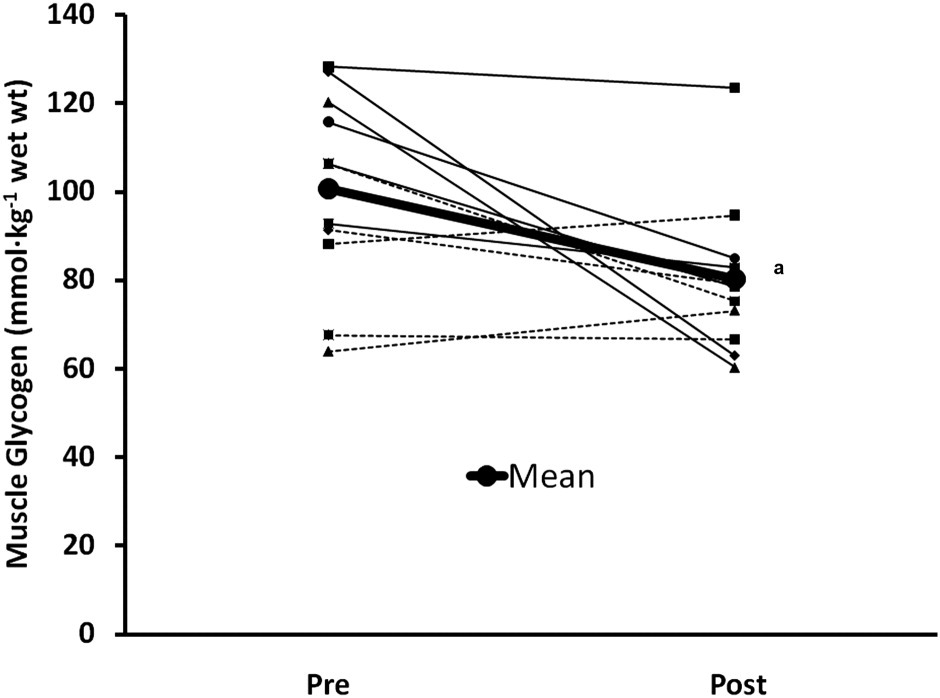
Individual wildland firefighter participant muscle glycogen utilization during the work shift. Mean glycogen decreased significantly from pre- to post-work shift, p < .05.
Activity Patterns
Activity patterns can be seen in Figure 2. Average activity counts were 175 ± 60 counts/min. Mean percent of time spent in each intensity category included: sedentary (74 ± 7%), light (21 ± 5%), and moderate/vigorous (5 ± 2%). Mean daily minutes performing moderate/vigorous activity were 27 ± 14 (range 6–50 min). There was a significant relationship between minutes completing vigorous activity and glycogen utilization (r = −0.76, p < .05, Figure 3) and between minutes spent completing vigorous activity and pre-shift glycogen content (r = .79, p < .05, Figure 4).
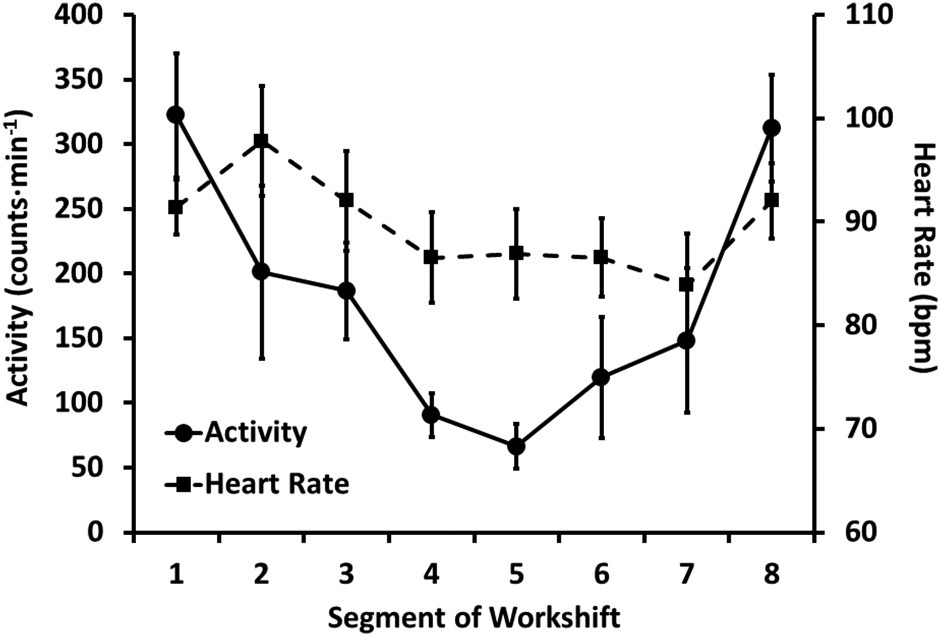
Wildland fire suppression activity patterns during the work shift.
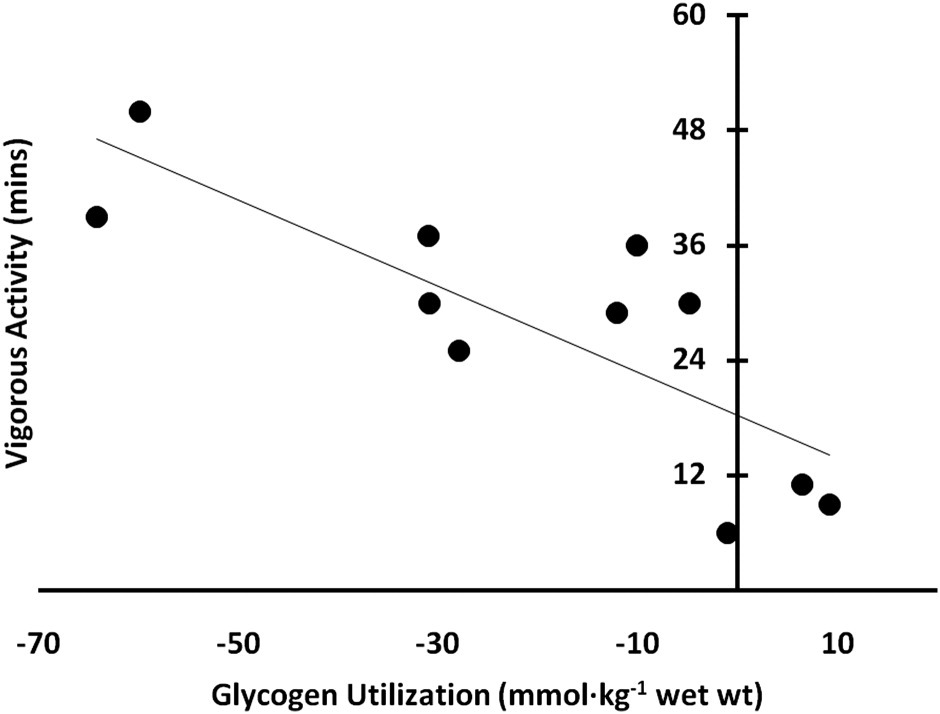
The relationship between time spent completing vigorous activity and glycogen utilization during wildland fire suppression activity, r = −.76, p < .05.
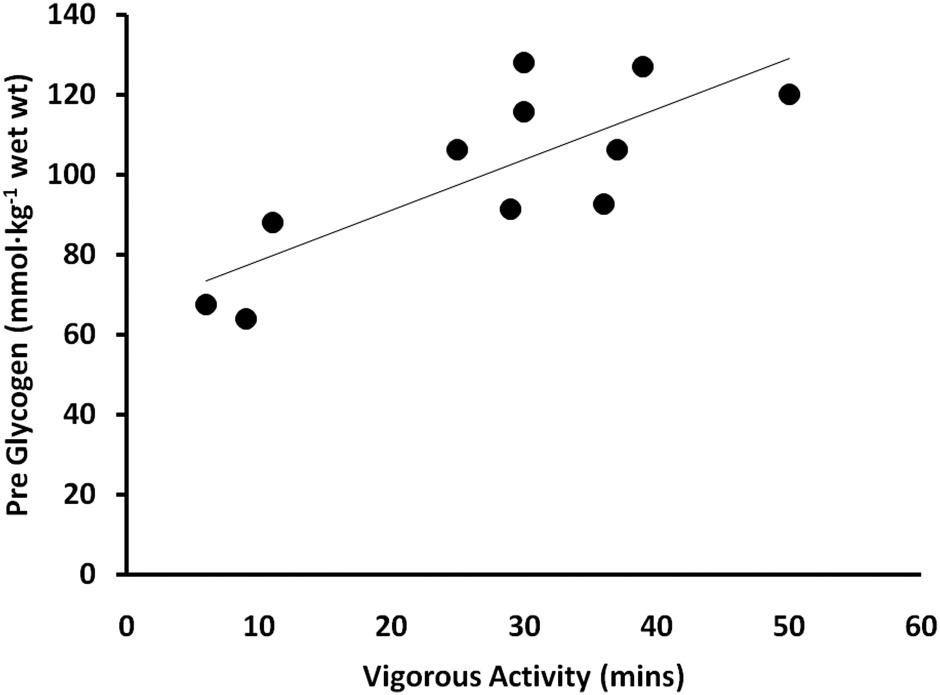
The relationship between pre-work shift glycogen levels and time spent completing vigorous activity during wildland fire suppression, r = .80, p < .05.
Heart Rate
Mean hourly heart rate was 90 ± 11 beats per minute (bpm). Hourly heart range ranged from 56 to 123 bpm. For heart rate patterns during the work shift, see Figure 2.
Dietary Intake
Total estimated kilocalorie intake during the work shift was 9.2 ± 2.9 MJ/d (2195 ± 699 kcal/d). See Table 1 for a detailed assessment of dietary consumption during the work shift.
Macronutrient intake during a wildland fire suppression work shift
Total kilocalorie intake was 2195 ± 699.
Discussion
The novel aspect of this project includes the collection of muscle biopsy samples from wildland firefighters during actual wildfire suppression efforts. The participants were actively engaged in wildfire suppression and therefore self-selected work output and ate/drank ad libitum. The findings demonstrate the diversity of activity patterns and self-selected nutritional intake, as well as the ability of firefighters to maintain adequate levels of muscle glycogen to sustain work output during the work shift. Additionally, relationships between vigorous activity and glycogen use and absolute content were demonstrated.
Daily activity counts ranged from 78 to 276 counts/min, with a mean of 175 ± 60 counts/min, indicating the diversity of work tasks within a WLFF crew. Diversity in activity is not only determined by the size and age of the fire or the terrain that a fire is in, but also by the job(s) designated to the individual WLFF and/or crew. The majority of time was spent in the sedentary category (74%), while 21% was spent completing light activity. Only 5% of the work shift included moderate/vigorous activity. These findings are in agreement to previous research done with similar wildland fire suppression crews, 6 though work activity in this study was a bit lower. A limitation of accelerometers is the ability to accurately quantify work in uphill and downhill walking, since speed of movement strongly influences accumulation of activity counts. 9 The current fire required that the WLFFs work in steep terrain, which increased the difficulty of the job. Thus, the Actical will log low activity counts because the participants are moving slowly, even though they are working vigorously by hiking steep terrain and carrying equipment.
The diversity in muscle glycogen change (−64 to +9 mmol/kg wet wt., see Figure 1) from pre- to post-shift demonstrates the variability of job tasks and self-selected food intake patterns during the work shift. Though some participants had substantial decreases, muscle glycogen levels never fell to what might be described as a work-limiting level. However, when the need arises for strenuous activity, muscle glycogen stores get reduced, evidenced by the strong relationship between time spent completing moderate/vigorous activity and the change in muscle glycogen concentration from pre- to post-work shift (Figure 3). Inadequate feeding during periods of demanding exercise can lead to reduced glycogen stores, which impairs physical performance. 3 If feeding post-work shift is not sufficient to replace muscle glycogen stores, there is the potential for a reduced work capacity during subsequent days. In this study, there was a strong relationship between pre-shift glycogen and time spent completing moderate/vigorous activity (Figure 4). This suggests that starting the work shift with higher glycogen stores enables firefighters to complete more moderate/vigorous activity. As a result, following bouts of strenuous activity, muscle glycogen stores must be replenished during or following the work shift to maintain optimal performance over extended periods of time (12–16 hour work shift for 14 consecutive days). In order to maximize glycogen stores for the next several days' work following difficult work shifts, WLFFs should feed aggressively with high CHO food items and sport drinks.
A reasonable strategy to reduce muscle glycogen loss during prolonged work is to feed frequently during exercise. 10 –12 In previous research, participants consumed placebo or CHO during 10 hours of upper body, cycle, and treadmill exercise. 11 When fed CHO, muscle glycogen loss was minimized by 52% compared to placebo feeding. Another strategy to replenish lost glycogen would be the provision of varied high CHO sources post-shift. 13 However, during “spiked-out” situations when only MREs are provided, the low level of CHO (53%, 167 ± 23 g CHO; range 112–218 g CHO) and a poor variety and flavor of CHO foods (ie, bread, crackers, etc) limit glycogen resynthesis potential. The MREs provide a disproportionate percentage of substrates required for extended work (36% fat, 53% CHO, and 12% protein). For endurance athletes, CHO intake should constitute 70% of total kilocalories. 13 For the typical MRE, the amount of CHO is ∼17% less than this recommendation.
The current data suggest that the food provided was adequate to maintain muscle glycogen levels since glycogen only decreased 21 mmol/kg wet wt during the work shift. However, it should be emphasized that work output in the current study averaged 175 ± 60 counts/min, with a range of 78 to 276 counts/min. This is considerably lower than previous studies with WLFFs (average counts/min over the entire work shift 724, 627, 551, 451, 352, and 252).5,6 Although the food provisions were sufficient to maintain glycogen on the present fire, during a more strenuous work day the food items in the MRE may be insufficient to adequately fuel the WLFFs. If WLFFs are working in remote locations, living in “spike camps,” and subsisting on MREs, the provision of a greater diversity of high CHO foods may be necessary to maintain muscle glycogen stores over successive work days. Despite the low volume of work activity in this study, this is the reality of the occupation, as hard and easy rotations fluctuate throughout the course of a season. During days of lessened work, it would be of benefit for WLFFs to feed aggressively and bolster muscle glycogen stores in order to prepare for upcoming rotations that may incur more arduous work.
The purpose of the current study was to determine the effects of wildland fire suppression on muscle glycogen utilization. Wildland firefighting is an inimitable situation in which multiple factors, such as work output and dietary intake, not only vary from person to person, but also from day to day. A limitation of interpreting muscle glycogen use is a lack of dietary control and activity patterns for participants the day/evening prior to their morning muscle biopsy. Additionally, the work activities of WLFFs use multiple muscle groups, especially those in the upper body; wildfire suppression requires digging a fire line, clearing brush, chainsawing, and moving hoses, all of which predominantly use upper body muscle groups. Yet, WLFFs spend considerable time hiking to and from the fire line and up and down hills throughout the work shift. Thus, biopsies from the vastus lateralis may not best reflect global glycogen utilization during a work shift that consists of job tasks requiring predominantly upper body muscles.
In short, this study demonstrates the variety of self-selected nutritional and activity habits of WLFFs, and emphasizes the relationships between moderate/vigorous activity and muscle glycogen. Future research should consider the adequacy of food items consumed during “spiked-out” situations to sustain adequate replenishment of muscle glycogen stores over successive days of wildland fire suppression to best maintain safety and performance during extended operations. Additionally, investigations on the impact of glycogen depletion/resynthesis during more arduous wildland fire suppression activities than in the current study would be of further benefit to characterize the substrate demands of the occupation.
Footnotes
Acknowledgments
Funding was provided by Air Force Research Laboratories FA 8650-06-1-679.
Project presented via poster presentation at the 2009 American College of Sports Medicine National Conference in Seattle, WA: Effect of Issued Meals on Muscle Glycogen Levels in Wildland Firefighters, 1458, Board #60, May 27, 2009.
Disclaimer: The views, opinions, and/or findings contained in this publication are those of the authors and should not be construed as an official United States Forest Service position, policy, or decision unless so designated by other documentation.