






Abstract
The key concepts and technologies developed in our laboratories in Purdue University for the miniaturization of mass spectrometry analysis systems are introduced. Mass analyzers of simple geometries with a novel atmospheric pressure interface were used to allow reduction in the size of the ion trap mass spectrometer. Ambient ionization methods were developed and coupled to miniature mass spectrometers to allow direct MS analysis of complex samples without sample preparation and chemical separation. The performance of desorption electrospray ionization, low temperature plasma probe, paper spray, and two handheld MS systems, Mini 10 and Mini 11, are described with demonstrations of capabilities for chemical analysis.
Mass spectrometry (MS) is a highly sensitive and selective analytical technology for both qualitative and quantitative chemical analysis. It is used widely in analytical laboratories for academic research, industrial product development, and regulatory compliance with particular importance in proteomics, drug discovery, environmental monitoring, food regulation, forensics, and homeland security. For analysis of complex chemical mixtures, mass spectrometers typically are used in conjunction with chromatographic chemical separation methods, such as gas chromatography ( A. Chemical analysis using lab-scale mass spectrometry (MS) systems. B. Conceptual design of a miniature MS device for automated chemical analysis.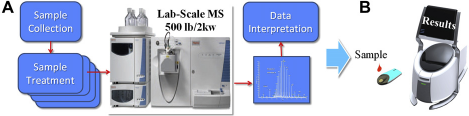
At Purdue University, we have been putting major effort into the miniaturization of the MS analysis systems with goals of not only developing MS systems of small size, lower power, and lower cost, but also enabling rapid analysis using these systems with minimum requirements for special skills or knowledge from the operators.
3
As an idealized example shown in Figure 1B, a user could complete an analysis done simply by dropping the sample onto a cartridge and inserting it into a miniature MS analysis device. This type of device could be placed in a physician's office, at airport checking points or police stations, or even in a family home, wherever fast chemical analysis is needed. The function and capability of these MS devices would necessarily be highly specialized when compared with the current laboratory
Ambient Ionization Methods
The concept of ambient ionization has been developed and pursued to eliminate any extra steps before the MS analysis can be performed. When using a mass spectrometer for chemical analysis, the analyte molecules are first ionized and the mass-to-charge ratios of these ions are then measured using a mass analyzer, which is operated in vacuum. 4 Many ionization methods have been developed over the years, including electron impact ionization (EI), 5 chemical ionization (CI), 6 matrix-assisted laser desorption ionization (MALDI), 7 electrospray ionization (ESI), 8 atmospheric pressure chemical ionization (APCI), etc. The EI, CI, and MALDI are implemented in vacuum, whereas ESI and APCI are at atmospheric pressure, which is why they are also called “atmospheric pressure ionization” methods. To minimize matrix effects, especially for the analysis of complex mixtures, the analytes are extracted and samples with well controlled matrices are prepared before they are analyzed using these ionization methods for MS analysis. Ambient ionization methods differ from these methods in that analytes in raw samples are directly sampled and ionized for MS analysis, which enables high throughput analysis because they require no sample preparation. Desorption electrospray ionization (DESI) 9 and direct analysis in real time, 10 developed in 2004 and 2005, respectively, have been followed by more than 30 ambient ionization methods, resulting in hundreds of publications in this area. 11 At Purdue, we have developed several ambient ionization methods and applied them for a wide variety of applications. Here, we introduce three of them, DESI, 9 low temperature plasma (LTP) probe, 12 and paper spray (PS) ionization.13,14
Desorption Electrospray Ionization
DESI uses charge droplets for ionizing the analyte molecules in a sample (Fig. 2A). Electrospray with a high DC voltage (3—5 kV) and sheath gas (nitrogen normally) is used to generate the high velocity charged droplets that impinge on the sample, forming a thin solvent layer on the sample surface and generating secondary microdroplets which leave the surface.
15
The analytes are extracted into the liquid, ionized through process such as proton transfer, and are carried away from the surface in the secondary droplets. In the course of desolvation, dry ions of the analytes are formed in air and transferred into the mass spectrometer for MS analysis. As an example, 10 pg of trinitrotoluene on paper can be directly analyzed using DESI (Fig. 2B).
16
The applicability of DESI to direct analysis of nonvolatile compounds in condensed-phase samples has been demonstrated, including explosives on unclean surfaces,
16
ingredients in pharmaceuticals tablets,17,18 illicit drug in body fluids,19,20 drugs and lipids on biological tissues,
21
agrochemicals on fruits,22,23 among other examples.
Desorption electrospray ionization (DESI) for direct sampling ionization for MS analysis. A. Schematic setup of a DESI for MS analysis. B. Mass spectrum recorded of desorption ionization of 10 pg trinitrotoluene on paper, negative MS. Reprinted with permission from Ref. 16. C. Automated 2D DESI source for high-throughput analysis and imaging. D. Imaging of rat brain tissue using DESIeMS, 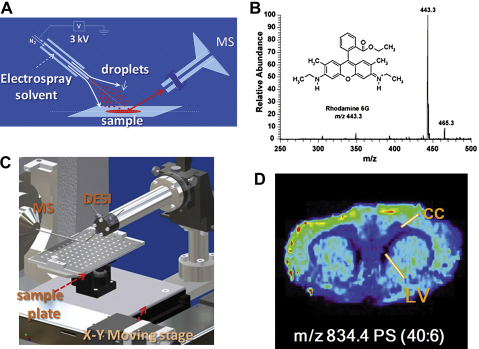
Chemical imaging capabilities have been developed using DESI24,25 with a lateral resolution of about 200 μm.
26
A two-dimensional (2D) DESI imaging device is shown in Figure 2C, where the position of the DESI source is fixed relative to the inlet of the mass spectrometer, and the sample plate is precisely moved in the
LTP Ionization
The LTP probe is another type of ambient ionization source that uses active species generated in a low power plasma to desorb and ionize the analytes in untreated samples.12,32 A LTP can be generated by dielectric barrier discharge.
33
The discharge gas, such as helium, argon, nitrogen, or air, is passed through an alternating electric field, which is created by applying a high-voltage AC (∼3kV, 30 kHz) between two electrodes with dielectric barrier material layers in between to restrict the discharge current. A device shown in Figure 3A allows the plasma species to be extracted out of the discharge region, by a combination of the force from the gas flow and electric field, for sampling the chemicals on a surface. The temperature at the sampling spot on surface is around 30 °C12 and no macroscopic damage occurs to the materials to be analyzed. As shown in Figure 3B, the chemicals on a human finger can be directly analyzed using the LTP probe.
12
Low temperature plasma (LTP) ionization. A. Schematic setup of the LTP probe. Adapted with permission from Ref. 12. B. Detection of l μg cocaine on a human finger. Adapted with permission from Ref. 12.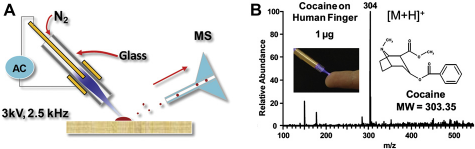
The LTP has been applied for analysis of explosives on surfaces, 12 ingredients in olive oil, 32 agrochemicals on fruits,34,35 illicit drugs in raw urine, 12 etc. Direct analysis of chemicals in bulk aqueous solutions has been achieved using LTP. 12 Interesting capabilities for fragmenting 36 and modifying peptides 36 using LTP have also been developed. Some advantages of LTP, including low gas flow rate (<400 mL/min), the capability of using air as discharge gas, no stringent requirement of sampling angle, and capabilities for large area sampling, make it a good ionization candidate for portable MS instruments.
PS Ionization
The PS ionization is a newly developed method of generating ions directly from samples on a paper substrate.13,14 As shown in Figure 4A, a simple two-step process is performed for analysis of samples in extremely complex matrices, such as whole blood samples. First, the sample is loaded onto a chromatography paper of triangle shape, 5 mm in the base and 10 mm in height; then a high-voltage DC signal (e.g., 5 kV) is applied to the paper while a small amount of solvent (10 μL of methonal/water, 1:1 in volume) is added onto the paper to generate ions. A spray plume similar to that for a nano-ESI is observed (Fig. 4A)
13
and the softness (amount of internal energy deposited controlling the degree of fragmentation in the mass spectrum) of PS is also found to be identical to that of nano-ESI.
Paper spray (PS) ionization. A. Atypical operation process of applying PS for analysis of a dried blood spot and the comparison of sprays between PS and nano-ESI. Adapted with permission from Ref. 13. B. Analysis of therapeutic drug in dried blood spot, MS and MS/MS analysis of 400 pg atenolol and 20 pg atenolol, respectively, in 0.4 μL blood. Adapted with permission from Ref. 14.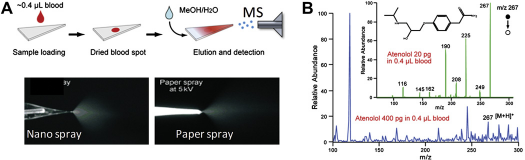
Paper is a good material for sample storage and has also been widely used in chromatographic separation. The capability of generating ions directly from the paper allows the development of a wide variety of applications for rapid analysis. During the characterization of PS, methanol/water solutions containing organic compounds, amino acids, peptides, and proteins were sprayed and ESI-alike spectra were obtained. 14 Chemicals present on environmental surfaces can be collected onto the paper by wiping and subsequently analyzed with PS. Dried spots of biofluid samples including urine, serum, and whole blood can be directly analyzed. The therapeutic drugs in dried blood spots (Fig. 4B) can be quantitatively analyzed over their therapeutic ranges. 13 Online reactions can also be implemented to improve the sensitivity for target analytes, which has been demonstrated in the analysis of cholesterol in human serum using a paper substrate preloaded with betaine aldehyde, which reacts with the hydroxyl groups on the cholestrerol 14 to improve the ionization efficiency of cholesterol significantly.
As a summary, the DESI, LTP, and PS represent a set of techniques with complementary characteristics for direct sampling and ionization for MS analysis. Their key features for implementation are listed in Table 1. Although DESI serves as a versatile method for analysis of a wide range of compounds and has shown its capability of tissue imaging, the LTP is a top candidate for in-field applications because of the minimum requirement for consumables. Although analysis using PS might not be as instantaneous as DESI or LTP, in terms of sampling, its compatibility for sample cartridge design and potential for quantitative analysis make it very attractive for medical and other regulatory applications.
Summary of the characteristics of the ambient ionization methods

Miniature Mass Spectrometers
At Purdue, the miniaturization of mass spectrometers has gone through three stages, the miniaturization of the ion-trap
After several iterations in the design of the integrated instruments, two handheld mass spectrometers, the Mini 10
40
and
The performance of the Mini 10 and Mini 11 has been demonstrated with the traditional atmospheric pressure ionization methods (APCI and nano-ESI) and the ambient ionization methods, such as DESI, LTP, and PS. The direct analysis of benzene in air can be performed with a limit of detection of 0.6 ppb (Fig. 5B); peptides and proteins (at extended mass ranges) can be analyzed using nano-ESI and MS/MS can be implemented to acquire peptide sequences (Fig. 5C, D)
44
; direct sampling ionization using DESI and LTP allowed analysis of raw samples without pretreatment, for example in the analysis melamine in whole milk with a LOD of 250 ppb.
34
Handheld miniature mass spectrometers and their analytical performance. A. Mini 11 mass spectrometer, 4 kg and <35 W. B. Monitoring of benzene in air at different concentrations using Mini 10 (10 kg, 70 W)with atmospheric pressure chemical ionization. Reprinted with permission from Ref.44. C.MS/MS analysis of peptide, Mini11withnano-ESI, (Met-Arg-Phe-Ala)1 μg/mL. Reprinted with permission from Ref.41. D. Analysis of proteins using Mini 11 with nano-ESI and extended mass range, Cytochrome C, 200 μg/mL. Reprinted with permission from Ref. 41.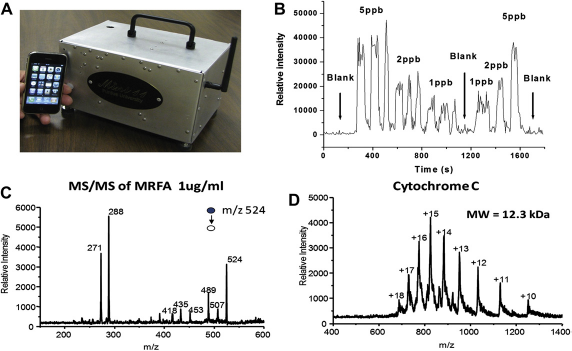
Summary
As capable as mass spectrometers are for chemical analysis, their use for a much wider range of applications is limited not only by their size but also the sample workup required. The development of the miniature mass spectrometers reveals the possibility of the ultimate development of MS analysis systems at the consumer product level while the emergence of ambient ionization shifts the paradigm from simply shrinking traditional GC- or LC-MS systems to developing specialized MS units with direct sampling capabilities. The criteria for evaluating these systems will also not be the general set of rules used for the current laboratory MS systems, but by the adequacy of their performance for the target application for which they are designed.
Footnotes
Acknowledgment
Research is supported by the National Science Foundation (CHE 0847205, CHE 0848650 and DBI 0852740), the National Institute of Health (1R21EB009459-01), and W. H. Coulter Foundation (Early Career Award for Translational Research in Biomedical Engineering).