






Abstract
Many components in biological matrices influence the result of an analysis, affecting assay sensitivity and reproducibility. Improved matrix management becomes critical as requirements for higher assay sensitivity and increased process throughput become more demanding. There are several robotic laboratory automation systems that are commercially available, which serve to minimize matrix interference by performing purification and extraction protocols. However, there is an unmet need of inline matrix effect reduction solutions to reduce the processing time and cost for automated sample preparation. In microfluidics, effective matrix management is essential for developing fully integrated systems capable of meeting these requirements. This review surveys current biological matrix management techniques for liquid chromatography-tandem mass spectrometry (LC-MS/MS) methods and binding assays with a view toward building automatable processes. For some systems, simple sample-preparation methods, such as dilution and protein precipitation (PPT), are sufficient, whereas other systems require labor-intensive methods, such as liquid-liquid extraction (LLE) and solid-phase extraction (SPE). To achieve high throughput, PPT, LLE, and SPE have been adopted to 96-well-plate format. Online SPE has also been coupled with LC-MS/MS to automate sample preparation and analysis of urine, plasma, and serum matrices. However, offline processing of whole blood is still required to obtain plasma and serum. The ultimate goal of implementing sample preparation to reduce matrix effects within untreated sample is to achieve reproducibility and sensitivity required by the application; therefore, inline sample preparation integrated with molecular analysis will be highly significant for laboratory automation. Electrokinetic methods have the potential of handling whole-blood, urine, and saliva samples and can be incorporated into microfluidic systems for full automation. Optimization of analysis conditions and the use of appropriate standards have likewise assisted in reducing or correcting matrix effects and will also be discussed.
Keywords
Introduction
In bioanalysis, matrix components present in biological samples can affect the response of the analyte of interest. These phenomena, termed generally as matrix effects, can lead to inaccurate quantitation and are, therefore, important to be addressed in bioanalytical method development and validation. 1 –3 Appropriate matrix management geared toward minimizing or correcting these effects is essential in developing any reliable method. Some sample-preparation procedures have been of tremendous significance in reducing matrix effects. However, as the demand for assay sensitivity rises because of the evaluation of increasingly potent drugs and the detection of extremely low-concentration biomarkers, the need for more effective sample-preparation methods becomes more pressing. The selection of sample preparation to minimize the matrix effect is heavily determined by the specimen type and the molecular analysis platform used for analyte detection. The throughput, reagent volume, flow rate, and various protocol parameters of matrix-reduction sample preparation should be compatible with the downstream molecular analysis, and ultimately, fully integrating inline sample preparation functionality within the molecular analysis unit would be ideal for laboratory automation. Furthermore, these methods need to be fast, cost-effective, and have the ability for high throughput. 4 It is also important to have methods that can be easily automated and integrated into an analytical module. There have been successes in coupling online solidphase extraction (SPE) methods with liquid chromatography-tandem mass spectrometry (LC-MS/MS) methods, thus, allowing for the creation of fully automated systems for detecting analyte in urine, serum, and plasma. 5 –7 For whole-blood samples, however, removal of insolubles (blood cells or cell debris from hemolysis) is still required before sample injection. 8 In addition, most microfluidic systems require offline sample preparation; effective sample preparation techniques that can be readily integrated into microfluidic systems and have the ability to manage whole blood samples would be particularly useful. 9 Certain medical applications, such as point-of-care (POC) devices could stand to greatly benefit from the development of these techniques.
Matrix effects are complex and system specific. Each biological matrix presents different management challenges, and each type of analytical method is affected by matrix components differently. The focus of this review is to discuss matrix effects on LC-MS/MS methods and binding assays (immunoassays and nucleic acid hybridization assays) from urine, blood, and saliva, the most common types of biological matrices. Approaches for handling matrix effects will be discussed. Among the approaches, emphasis will be placed on current sample-preparation methods for reducing matrix effects and their status or potential for cost-effective, high-throughput processing and integration to analytical modules. Optimization of analysis conditions (e.g., LC-MS/MS parameters and assay reagents) and the use of appropriate standards have likewise assisted in reducing or correcting for matrix effects and will also be covered.
Matrix Effects of Different Analytical Methods
The primary matrix effect associated with LC-MS/MS methods is ion suppression or enhancement caused by the co-eluting matrix components. This effect can be caused by both inorganic and organic endogenous substances, including salt, carbohydrates, amines, urea, lipids, peptides, and metabolites. 10 Exogenous substances, such as dosing media, formulating agents, and anticoagulants, can also result in ion suppression. Ion suppression was first reported by Kebarle and Tang in the early 1990s. 11 Different mechanisms have been proposed to explain this phenomenon. A possible explanation is that the matrix compounds compete with analyte for the limited charge on the droplet surfaces and, thus, affect ionization of analyte. Another possible explanation is that interfering compounds increase the droplet's viscosity and surface tension, thereby decreasing solvent evaporation rate. As a result, a lesser amount of analyte is able to reach the gas phase. It has also been suggested that nonvolatile materials in the matrix can decrease the rate of droplet formation though coprecipitation of the analyte and, therefore, prevent droplets from reaching the critical radius required for gas phase ions to be emitted. 11 –13 However, the actual mechanism is still unknown. Matrix effects are often assessed by the postcolumn infusion and the postextraction spike methods. 3 The postcolumn infusion method involves constant infusion of analyte after the initial injection of an extract from the sample. It gives a qualitative assessment and can identify chromatographic regions that are likely to be influenced by matrix effects. 14 In the postextraction spike method, the responses of analyte in buffered solution and a blank matrix are compared, providing a quantitative assessment of any matrix effects. 15
For ligand-binding assays, nonspecific interactions of matrix components with assay components, analytes, and surfaces are the major cause of matrix effects. For instance, when a matrix component is bound nonspecifically to the antibody (an assay component) in an immunoassay, lesser antibody sites are available to bind the analyte, resulting in a weaker signal. There are also instances where matrix components (e.g., serum protein) bind nonspecifically to an analyte (e.g., hormone), decreasing antibody-antigen interaction. 16 For surface plasmon resonance-based biosensors, nonspecific adsorption of matrix components has been the main type of matrix effect. 17
There are very few reports on the matrix effects of nucleic acid hybridization assays. However, hybridization assays are not free of matrix effects and require sample preparation steps. The obvious matrix components that can affect a hybridization assay are the cell membranes that enclose the DNA and RNA. Cell lysis is, therefore, necessary to disrupt the cell membrane for DNA or RNA extraction. In addition, cell debris resulting from the lysis also could clot the extraction and chromatography columns and cause nonspecific binding to assay surfaces, necessitating their removal.
Challenges in Managing Biological Matrices
Urine, blood, and saliva are among the most commonly encountered types of biological matrices. Each of these matrices has properties that present challenges in matrix management.
Urine
The management of urine matrices is difficult, because urine may contain several components that not only influence the signal response but also are of variable concentrations, dependent on diet and liquid intake. Table 1 summarizes the typical constituents found in urine that can contribute toward matrix effects. Organic molecules (e.g., urea and amino acids), proteins (e.g., albumin and immunoglobulins), crystals (e.g., calcium phosphate and uric acid), and cells (white blood cells and transitional cells) are often found in urine samples and can bind nonspecifically to an assay surface (e.g., sensors and microtiter plates). Many of these compounds could cause ion suppression in LC-MS/MS analysis if co-eluted with the analyte. Furthermore, because the concentrations of these constituents are inconsistent across samples, correcting for the background signal is difficult.
Constituents of infected urine that can contribute toward matrix effect

Variation in composition also affects other physical properties, including pH, ionic strength, density, and viscosity. In fact, urine pH ranges from 4.5 to 8, whereas osmolality varies from 50 to 1300 mOs/kg. 18 These fluctuations can influence many aspects of an analysis. In ligand-binding assays, pH and ionic strength have been shown to impact the binding affinity between the sample and assay components, resulting in response signal variations. 17 Sample preparation steps could also be susceptible to differences in these conditions. For example, ion-exchanged SPE operates on the electrostatic interaction between the sample and a solid phase and is, therefore, also sensitive to pH and ionic strength. Electro-kinetic phenomena, such as dielectrophoresis and electrothermal flow, which are used for sample transport and isolation in microfluidic systems, are likewise vulnerable to differences in electrical conductivity (ion concentration) and pH. Aside from pH and ionic strength, viscosity could be influenced by cell concentration within a sample, thereby affecting the operation of the microfluidic system performing the analysis.
Blood
Whole blood has one of the most complex matrices (Fig. 1). Many matrix components can affect the signal response of a bioanalytical process. Serum proteins often bind nonspecifically to analytes or a surface resulting in reduced sensitivity. 17 Endogenous phospholipids have been identified as a major source of matrix effects in LC-MS type of analysis. 19 Anticoagulant, which is used in blood collection to prevent coagulation of blood, has been found to have significant effect on extraction and LC-MS/MS analysis. 20 The high viscosity of blood also alters the binding efficiency and specificity for detection. Some informative biomarkers, such as transplant rejection markers, are embedded inside distinct subsets of lymphocytes at extremely low concentrations. Matrix management for detecting this type of analyte is even more challenging, because even low levels of residue matrix components can skew the analysis.

Common contributors to the matrix effects in blood.
A final complicating factor in blood matrix management is that removal of blood cells or cell debris from hemolysis is necessary for analysis. Centrifugation and filtration, a pair of conventional techniques for blood cell separation, are difficult to implement in an automated microfluidic format.
Saliva
Saliva is an attractive fluid for biological analysis, because it allows for noninvasive sampling procedures. Saliva assays have been used since early 1980s primarily for the detection of small molecule drugs and steroids. 21 Despite its attractively easy sampling procedure, saliva has been less commonly used as a sample source, and results from saliva analyses tend to be viewed as less reliable than analyses performed using other biological fluids. This is mainly because saliva is a difficult matrix to manage. Saliva matrix has significant effects on sampling. It has been shown that saliva pH is influenced by flow rate, which affects analyte excretion. For example, Kato et al. showed that stimulated collections of saliva increased the saliva pH and resulted in lower concentrations of cocaine. 22 Jenkins et al. had similar findings in their work on comparing the concentrations of heroin and cocaine in saliva with concentrations of the drugs in plasma. 23 Because there is always lesser analyte in saliva than in urine or blood, stimulation is often necessary to obtain a sufficient volume of sample for analysis. Careful method validation for saliva sampling is therefore essential for using saliva from the sample specimen. In addition to complications arising because of pH, results obtained from saliva can also be affected by drug residues in oral or nasal cavities. 24
Immunoassays of saliva are also subject to matrix effects. Fulton et al. reported that mucins and alpha amylase in saliva matrix could cause suppression of antibody binding in some radioimmunoassays for steroid detection. 25 The results shown by Mitchell and Lowe also demonstrated that saliva matrix caused suppression of antibody-binding enzyme in immunoassays for testosterone, 26 and removal of saliva medium was necessary to eliminate the matrix effects.
Current Approaches in Dealing with Matrix Effects
Sample Preparation
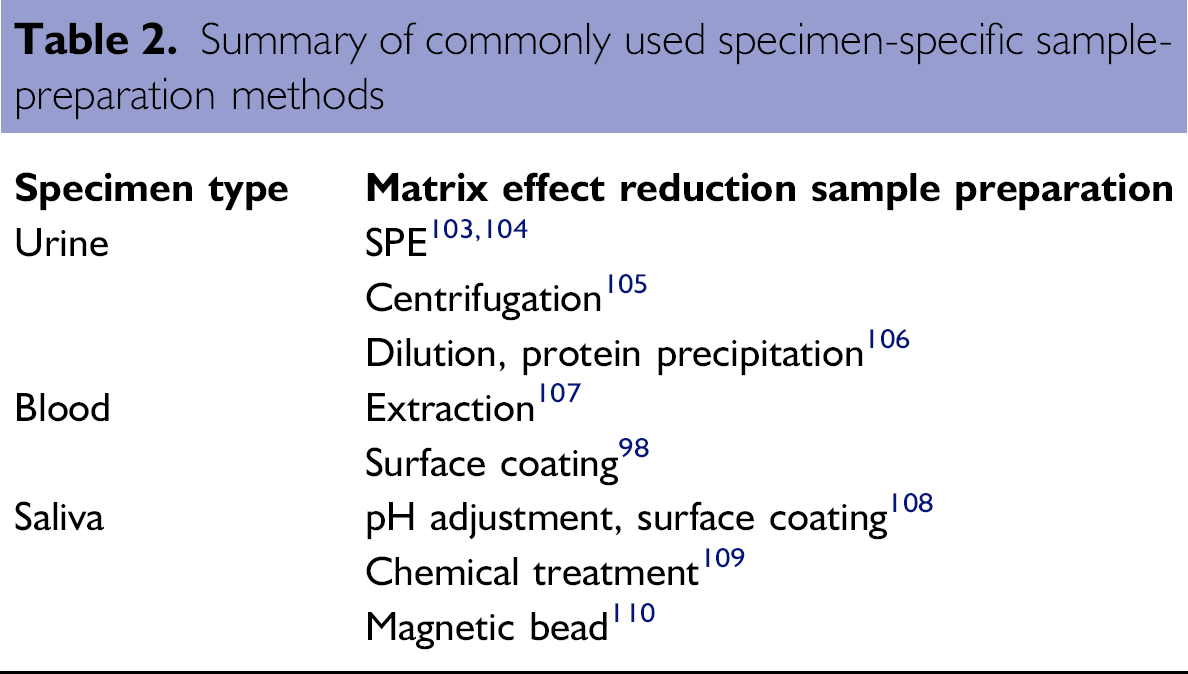
Appropriate sample preparation can help eliminate or minimize matrix effects. Several technical approaches, including optical, 27,28 magnetic, 29 mechanical, 30 and electrical 31 approaches, have been demonstrated to be effective for sample manipulation and matrix effect reduction. Matrix effects are system specific. Depending on the matrix type, detection method, characteristics of the analyte, and the limit of detection requirement, different sample-preparation methods are required. For some systems, simple dilution is sufficient for accurate analysis of the analyte. 32 –34 Perhaps, dilution, the most basic of preparatory methods, is effective in situations where matrix effects decrease at a rate higher than that of the analyte response as the sample is diluted. These are the systems that tend to have a less demanding requirement on detection limit and are often characterized by samples containing abundant analyte. For example, many small-molecule drug analyses involve high analyte concentrations in urine, which allow for a simple dilution of the sample before analysis. There are also systems with relatively low detection limits in the pico-or femto-molar range, where dilution was sufficient because of particularly robust detection methods. 33,35,36 For most systems, however, dilution is not suitable, because analyte concentrations in a diluted sample are too low for detection. Table 2 is a summary of the most commonly used sample-preparation methods to reduce the matrix effects of urine, whole blood, and saliva.
Summary of commonly used specimen-specific sample-preparation methods
Isolation and extraction are often used to remove or minimize matrix components and, thereby, eliminate or minimize matrix effects. For samples with insolubles (e.g., cells), such separation of a soluble material from an insoluble material is usually the first step in sample preparation. 37 Centrifugation is often used to achieve separation. For example, cell lysates can be centrifuged to remove cell debris, whereas DNA, RNA, and proteins can subsequently be collected from the supernatant for analysis or further purification. Centrifugation is frequently used for processing blood samples, because the removal of blood cells from whole blood is often necessary for analysis or further cleanup. Centrifugation is also used as an element in other sample-cleanup methods to achieve more efficient separation for small-volume samples. For example, various types of SPEs (e.g., size exclusion, reverse phase, ion exchange, and immunopre-cipitation) are available in spin (centrifuge) column format. Filtration with the context of centrifugation has also been a popular tool for cleaning proteins. 38 Although widely used, centrifugation is labor intensive and bulky. Implementing centrifugation in an automated microfluidic format or finding practical equivalent alternatives are ongoing challenges.
Precipitation is another straightforward technique and functions by creating insolubles. By subjecting the sample to a solvent with low solubility for select components, the insoluble components within the solvent precipitate and can be subsequently separated from the soluble phase, often by centrifugation. Protein precipitation (PPT) is a popular sample-preparation method for MS-based analysis 39 42 because of its simplicity. PPT in 96-well filter plate format also allows for high-throughput and automated sample preparation. 43 However, PPT does not always sufficiently remove salt and endogenous compounds, such as lipids, phospholipids, and fatty acids. 19 , which could cause ion suppression in LC-MS/MS analysis. Choice of solvent could improve extract purity. For instance, Chambers et al. demonstrated that acetonitrile is more efficient in removing phospholipids than methanol. 19 PPT has also been used in combination with other strategies to achieve the desired sample purity. 44
Liquid-liquid extraction (LLE) is also one of the most commonly used sample-preparation techniques. This method separates compounds based on differing solubilities in two immiscible or partially soluble contacting liquid phases, usually an aqueous and a nonpolar organic phase. LLE is widely used for cleanup of samples containing lower-molecular-weight analytes, such as drugs and hormones. 45 50 Although infrequent, LLE is sometimes used for extraction of proteins when two aqueous phases are used. 51 LLE usually yields rather clean extracts and gives high reproducibility. However, the process often necessitates preconcentration before analysis, requires large amounts of costly toxic solvents, and is time consuming. LLE is also difficult to automate. 52 There has been some progress in implementing LLE methods in the 96-well-plate format, but automating efficiently the mixing and phase separation steps remains a challenge. 4,53,54
SPE is another widely used sample-extraction method. It is faster and requires lesser solvent compared with LLE. SPE involves a partitioning of compounds between mobile (liquid) and stationary (solid) phases. 55 The analyte is first retained by the stationary phase through hydrophobic (reverse-phase SPE) or electrostatic (ion-exchanged SPE) interaction, whereas the matrix components are washed off. After the removal of the sample matrix, the retained analyte on the stationary phase is eluted with a solvent possessing a greater affinity for the analyte. It is widely used for extraction of both low-molecular-weight compounds and proteins and is effective in eliminating matrix effects for a variety of systems. 56 –60 In fact, Chambers et al. 19 conducted a study comparing cleanliness and matrix effects of samples extracted from plasma using PPT, LLE, and various types of SPE methods. The results demonstrated that mixed-mode SPE (both reverse phase and ion exchange) provided the cleanest extract, leading to considerable reduction in matrix effects. 19 Dams et al. 32 also found SPE to be a more extensive cleanup method compared with PPT in a study on LC-MS/MS analysis of illicit drugs. However, ion suppression was still observed in the sample extract when SPE was used; this was because of the preconcentration step in SPE, which raises the concentration of the nonremoved interfering substance along with the analyte. 32 Much progress has been made in automating SPE. SPE in 96-well-plate format has been commonly used. 61 Online SPE, often coupled with LC-MS/MS, is increasingly getting popular. 5 7 It is generally considered to be faster and more cost-effective compared with the 96-well-plate format. 4 Different extraction support materials have been developed to allow for direct injection of urine, plasma, serum, or extracts. However, for blood samples, isolation of blood cells is still required before performing SPE, because blood cells will inevitably clot the extraction column.
In the past two decades, there has been a growing interest in extracting analyte through antibody and antigen interaction. 62 Immunoaffinity SPE consists of a stationary phase of immobilized antibodies specific for the target analyte. There are a variety of stationary phase materials, including centrifugal filters, 63 magnetic beads, 64 polymer beads, 65 and silica. 66 The analyte is retained through its specific interaction with immobilized antibodies after other compounds are removed. Subsequently, a low-pH buffer, usually between pH 2 and 4, is used to disrupt the antibody-antigen interaction, thereby eluting the analyte. This approach has been successfully used in extracting drugs from plasma and urine, 67 –71 though in many cases, additional sample-preparation steps, such as PPT, were necessary before the immunoaffinity extraction step. The advantage of this approach is the ability to separate structurally similar analytes. However, the process is costly. This is especially true for high-throughput processes, because antibodies are expensive, require refrigeration, and degrade relatively quickly.
A powerful approach for matrix management is alternating current (AC) electrokinetics, which is the motion of bulk fluids or embedded particles induced by nonuniform AC electric fields. AC electrokinetics, which is especially effective in the micro and nano domains, is ideal for manipulating biological targets, such as nucleic acids, proteins, and cells, because of the proper length scale matching. 72 74 At a small scale, only a small voltage is required to generate a large electric field. Other advantages of AC electrokinetics include label-free manipulation (in contrast to magnetic particle-based manipulation), well-established techniques for fabricating microelectrodes (easy integration with other components), and low voltage requirement (which avoids electrolysis and facilitates portable applications). Examples of AC electrokinetic phenomena include dielectrophoresis (DEP), AC electrothermal flow (ACET), and AC electroosmosis (ACEO). 75 DEP is a result of the net force experienced by a dipole under nonuniform electric field. It can be applied for trapping biological objects, such as bacteria, DNA, and viral particles 70,71,76 – 79 (Fig. 2A). DEP is especially effective in short range because of the rapid decay of the electric field gradient. ACET arises from the temperature gradient in the fluid medium generated by Joule heating. The temperature gradient induces local changes in the conductivity and permittivity of the fluid medium. These gradients further interact with the electric field and generate bulk fluid forces (Fig. 2B). For example, a conductivity gradient produces Coulomb forces, whereas a permittivity gradient produces dielectric forces. This results in long-term fluid motion. ACEO is an electrokinetic phenomenon observed at frequency ranges below 1 MHz. 80 –82 When a potential is applied to the electrode, the electric field causes charges to accumulate on the electrode surface, which changes the charge density near the electrode surface and forms an electric double layer (EDL). The EDL interacts with the tangential component of the electric field to induce bulk fluid motion. In an alternating dielectric field, both sign of the charges in the EDL and direction of the tangential component of the electric field change (Fig. 2C). Therefore, the direction of the resultant force on the fluid remains the same and generates a net fluid movement. The bulk fluid flow allows long-range manipulations of bioparticles with low applied voltage (< 10 V). Each electrokinetic phenomenon has different effective range and optimal operating conditions. Recently, hybrid electrokinetics, the combination of long-range electrokinetic induced fluid motion (e.g., ACEO and ACET) and short-range electrokinetic trapping force (e.g., DEP), has been developed to take advantage of the effective regimes of different electrokinetic phenomena. 83 –85

AC electrokinetic phenomena for matrix management. (A) In dielectrophoresis, a target cell or molecule is polarized to induce a dipole. If the electric field is nonuniform, the dipole experiences a net force, which results in translational motion of the target. (B) In AC electrothermal flow, Joule heating induces gradients in temperature and electrical properties of the fluid, which results in bulk fluid motion. (C) In AC electroosmosis, the induced electric double layer on the electrode surface interacts with the electric field. The resulting force drives the motion of the fluid near the electrode surface.
Optimization of Analytical Method Parameters and Use of Sample Standards
In addition to proper sample preparation, a large amount of effort has been expended to optimize analytical methods and use appropriate standards toward eliminating or reducing matrix effects.
The ESI flow rate also has been found to influence the degree of ion suppression. Studies demonstrate a dramatic reduction of matrix effects with a decrease in ESI flow rate to nanoliter per minute. 89,90 Some researchers have suggested that this occurs because of the decrease in the initial charged droplet size resulting from the lower flow rate. Consequently, fewer uneven fission events and lesser solvent evaporation are required for ion release in the gas phase. 91 Because uneven fission process enhances the surface-activated matrix components to compete with analytes for a limited number of surface charges, less uneven fission will minimize competition and lead to a stronger analyte signal. 92
A straightforward means for correcting matrix effects is to use an appropriate internal standard. For the internal standard to be meaningful, the internal standard and the analyte need to co-eluted to ensure that they are ionized under the same conditions. Therefore, stable isotope-labeled (SIL) internal standard is the commonly used internal standard in LC-MS/MS detection methods. It has even been a common belief that the use of an isotopically labeled internal standard corrects for almost all matrix effects. However, this has been shown to be untrue. Wang et al. demonstrated that a difference in retention time between the analyte and the SIL internal standard, caused by the deuterium isotope effect, results in a differing degree of ion suppression between the sample and the internal standard. 93 Furthermore, the analyte and co-eluting SIL internal standard could also have mutual effects (suppression or enhancement) on each other's response. 94,95 Therefore, careful assessment should be made during method development. In addition, SIL internal standard is also costly for multicomponent analysis, because an SIL internal standard is required for each analyte.
Improved chromatography efficiency can also help to separate matrix components from the analyte more effectively. Matuszewski et al. demonstrated that, by providing longer chromatographic retention of the analyte, the plasma matrix components were well separated from the analyte, thereby eliminating ion suppression. 96 A prolonged highperformance liquid chromatography gradient separation was used to resolve interfering peaks, allowing for more reliable integration of both the internal standards and the analytes of interest. 88 Hydrophilic interaction chromatography has also been found to be more appropriate for polar analyte analysis. 97
Adequate washing is important in removing nonspecifically adsorbed components on a surface. Insufficient washing leads to high background. Therefore, homogeneous assays, which lack washing and separation steps, are often more susceptible to matrix effects. 101
In addition, appropriate choice of assay components is also essential in reducing matrix effects. For example, Meyer et al. demonstrated that, by using a highly specific antibody against urodilatin, matrix effects were not observed in the RIA for urinary and plasma urodilatin detection even without extraction. 33 It is also important to be mindful that the choice of assay components need to be tailored for different systems based on factors, such as analyte, matrix type, and detection method. For instance, lysozyme was a great reporter enzyme for urine samples in enzyme-multiplied immunoassay technique assays but ineffective for serum samples, because bacterial cells (substrates for lysozyme) agglutinate the serum. 102
To compensate for matrix effects, calibration curves spiked in sample matrix or prepared in phosphate buffer with addition of urea and creatinine have been used. However, lot-to-lot variation could still lead to inaccurate results, and need to be evaluated during method development and validation.
Conclusion
Appropriate matrix management is essential for the development of a sensitive and reliable bioanalytical method. This review focused on the management of urine, blood, and saliva for LC-MS/MS and binding assays. Reliable systems have been created using conventional sample-preparation methods, including dilution, centrifugation, precipitation, LLE, and SPE. However, these methods are either not sufficient for highly sensitive assays or are labor intensive and time consuming. Many are difficult to automate and integrate with other steps and hinder full automation. Online SPE has been coupled with LC-MS/MS to achieve full automation for urine, plasma, and serum matrices; however, processing of whole blood is still required to extract plasma and serum. Electrokinetic methods, which can be readily incorporated into microfluidic systems, have the capability to manipulate particles of different sizes and shapes, including cells, proteins, and DNA molecules. More effort should be expended on developing electrokinetic methods for matrix management.
Acknowledgments
This work was supported by National Institute of Allergy and Infectious Diseases (grants U01 AI075565–01 and U01 AI082457) and National Institute of Dental and Craniofacial Research (grant U01 DE17790).
Competing interests statement: The authors certify that all financial and material support for this research and work are clearly identified in the manuscript.