






Abstract
There are several advantages to using liquid-filled automated liquid-handling systems equipped with reusable fixed tips for sample handling of bioanalytical assays. However, liquid-handling parameters that have not been optimized can lead to sample dilution by the system liquid of the automated liquid handler causing possible inaccuracy of sample delivery. In this investigation, liquid-handling parameters involving sample delivery, such as aspiration speed, dispense speed, partition volume, excess volume, and air gaps, were closely examined to understand their roles in the accurate delivery of the sample. Consequently, two strategies for optimization of the parameters are presented that achieve accurate sample delivery while maintaining sample integrity.
Keywords
Introduction
Automated liquid-handling (ALH) systems are widely used for the delivery of liquid samples in a broad range of applications, such as high-throughput screening in drug discovery and development studies, and diagnostic assays of body fluids.1–4 ALH systems are also utilized for bioanalytical methods used in metabolism and pharmacokinetic studies to transfer biological samples, to prepare standard curves and quality control (QC) samples, and to perform serial dilutions of samples. For bioanalytical assays with strict quantitative requirements, both integrity and delivery accuracy of the sample are important. However, as reported previously, 5 our investigation of the performance of an ALH system operated with fixed tips by measuring the dispensed volumes photometrically and gravimetrically showed that there was a significant difference between the results obtained via the two volume measurement approaches. This difference was attributed to the dilution of the delivered volume of the sample by the ALH system liquid when the default liquid-handling parameter (LHP) settings are used.
The use of ALH equipped with fixed tips, instead of disposable tips, has significant benefits in bioanalytical laboratories. These include the ability of the fixed tips to pierce sample tube cap septa, which enables the direct transfer of biological samples from their capped storage tubes. This not only protects the analyst from biohazards and injuries resulting from repetitive hand motion during uncapping/recapping operations but also saves operation time. 6 Other advantages of using reusable fixed tips include sample volume delivery that is not limited by the volume of the disposable tip, being able to pipette a wide dynamic range of volumes; less demand of deck space for storage and loading of disposable tips and hence increased deck space availability for other activities; and cost saving and elimination of waste generation of the disposable tips. Nevertheless, strategies to define the proper adjustments of LHPs to minimize the sample dilution effect when using fixed tips have not been made widely available. Herein, we describe our work that led to two LHP optimization strategies to overcome this effect. Our investigation involved conducting a systematic comparison of the results of different volumes delivered by Tecan Genesis RSP 150 ALH system, operated with fixed tips, under different LHP settings, with volumes measured by dual-dye photometric and gravimetric techniques.5, 7 Additionally, we used a third technique based on directly measuring the introduction of a system liquid into samples. On the basis of the results of the investigation, two sets of optimized liquid class parameters have been defined, which overcome the dilution effect. Using the two proposed liquid-handling strategies, good accuracy and precision were achieved during multistep dilutions, thereby enabling accurate automated preparation of standard curves and QC samples and automated multistep dilution of study samples while maintaining the sample integrity at each step of sample delivery. We also examine the effect on sample integrity of the practice of reducing operating cost and space requirements by washing disposable tips used on air-filled pipettors.
Experimental
ALH System
Tecan Genesis RSP 150 ALH system, operated with fixed tips, was used for the evaluation of the liquid-handling parameters (Tecan, Männedorf, Switzerland). Washing experiments with disposable tips were carried out using Tecan EVO 100 MCA 96 air-filled, multichannel ALH.
Dual-Dye Photometric Approach
The Artel MVS Multichannel Verification System (Artel, Inc., Westbrook, ME) was used to photometrically measure the volume dispensed by ALH system. 7 The MVS system is composed of various components including MVS dye range solutions, characterized microtiter plates, and a microtiter plate reader. The operating principle of the MVS involves dispensing the target volume of a range solution (sample) containing both red and blue dyes into the wells of a characterized microtiter plate. A diluent containing the same concentration of blue dye as in the sample solution is used to fill the wells to a final volume for photometric measurement. The dispensed solutions are then mixed, and the absorbance ratio of the two dyes present in the solutions is measured. Because the blue dye concentration is common between the solutions, and because this concentration is known, the path length of light through the total solution volume can be determined from the measured absorbance of the blue dye. Using this path length, in addition to the known dimensions of the wells in the characterized microtiter plates, the total volume of both sample and diluent solutions is calculated. Finally, the sample volume is determined by the MVS system using the known concentrations of blue and red dyes present in the sample and diluent solutions and the measured absorbance ratio of each well. Thus, based on the measured ratiometric absorbance of the two dyes present in the mixed solutions and characterized dimensions of the microtiter wells, the MVS calculates the amount of sample solution that was dispensed into every well within the microtiter plate. A more detailed and complete discussion of the dual-dye MVS method for the evaluation of ALH devices is presented in References 5 and 7.
For the Tecan ALH, each tip aspirated the target volume of MVS sample solutions containing the two dyes (red and blue). This target volume was dispensed into each well of a full column, consisting of eight wells, in a microtiter plate. This process was repeated until sample solution had been dispensed into every well in the plate (i.e., each of the tips dispensed 12 times across the plate, resulting in 96 filled wells). The diluent solution containing blue dye was then used to back fill every well to a total volume of 200 μL. The absorbance of the red and blue dyes present in each sample was measured at 520 and 730 nm, respectively, and the volume of sample solution was automatically calculated by the MVS system.
Gravimetric Approach
The gravimetric approach used to measure volumes delivered by an ALH system has been described previously. 5 Briefly, the dye solution was deposited from each tip of the Tecan system individually onto an appropriately configured balance pan, and the weight of each sample was determined. The density of all samples was assumed to be equal to that of water (1 g/cm3) and used to calculate the volume dispensed from each tip. Unless indicated otherwise, each tip dispensed a total of 12 data points, and the average volume calculated from all dispenses (8 tips, with 12 dispenses per tip) was used to represent the overall performance. The tips were washed before each dispense.
Sample Serial Dilution Experiments
Serial dilution experiments were carried using MVS dye range solutions as samples. The samples were taken through serial dilutions with the MVS diluent solution using different Tecan ALH LHP settings. The following three dilution schemes were evaluated: (1) 100-fold dilution: use MVS range C solution, with a 2.0-μL target volume of the range C solution in the final diluted volume of 200 μL. The sequential pipetting process was as follows: first, 20 μL range C solution plus 180 μL MVS diluent solution; then 20 μL of the resulting solution from the first dilution step plus 180 μL MVS diluent solution. (2) Dilution (500-fold): use MVS range E solution, with a 0.4-μL target volume of the range E solution in the final diluted volume of 200 μL. The sequential pipetting process was as follows: first, 20 μL range E solution plus 180 μL MVS diluent solution; then, the preceding process was repeated using the resulting solution instead of the range E solution; finally, 40 μL of the resulting solution from the second dilution step plus 160 μL MVS dilution solution. (3) Dilution (1000-fold): use MVS range E solution, with a 0.2-μL target volume of the range E solution in the final diluted volume of 200 μL. The sequential pipetting process was as follows: first, 20 μL range E solution plus 180 μL MVS diluent solution; then, the preceding process was repeated using the resulting solution instead of the range E solution; finally, 20 μL of the resulting solution from the second dilution step plus 180 μL MVS diluent solution.
Direct Photometric Measurement of Dilution Effect
The direct photometric method, 8 with high sensitivity of detection limit, was used to examine the effect of different LHP settings, such as aspiration speeds, partition volumes, excess volumes, and air gaps, on the introduction of system liquid into the sample delivered. Briefly, a 5-g/L solution of Orange G (Sigma-Aldrich, Milwaukee, WI, USA) in sodium phosphate buffer (pH 11.2) was used as the system liquid for the ALH. A calibration curve of Orange G was prepared with which to compare unknown solutions. A solution of 0.1% at 100 nL/well gives a signal, which is 10-fold above background, indicating that the detection limit for the method is well below 100 nL/well.
Washing of Disposable Tips on a 96-Channel ALH
Washing experiments were performed on a Tecan EVO 100 MCA 96 multichannel ALH. The MCA is an air-filled pipettor, which can be used with fixed tips or disposable tips. In this experiment, disposable tips were mounted on the head and washed with the ALH wash station. This wash station pumps a cleaning solution into individual bowls where the ALH can aspirate and dispense, thus washing the tips by a series of mixes. The composition of the wash solution was the same as the Orange G solution described above. The washing procedure consisted of two steps. Step 1: liquid class MCA, wash station dip in, flow through 5 mL, preflush 5 s, soak 5 s; step 2: liquid class MCA, wash station tips wash, flow through 5 mL, preflush 10 s, soak time 5 s, volume 40 μL (for 50 μL tips) or 75 μL (for 100- and 200-μL tips) × 1 cycle, postflush 0 s.
Results and Discussion
Dilution Effect Obtained Using Default Water Liquid Class in Single Delivery and Serial Dilution Experiments
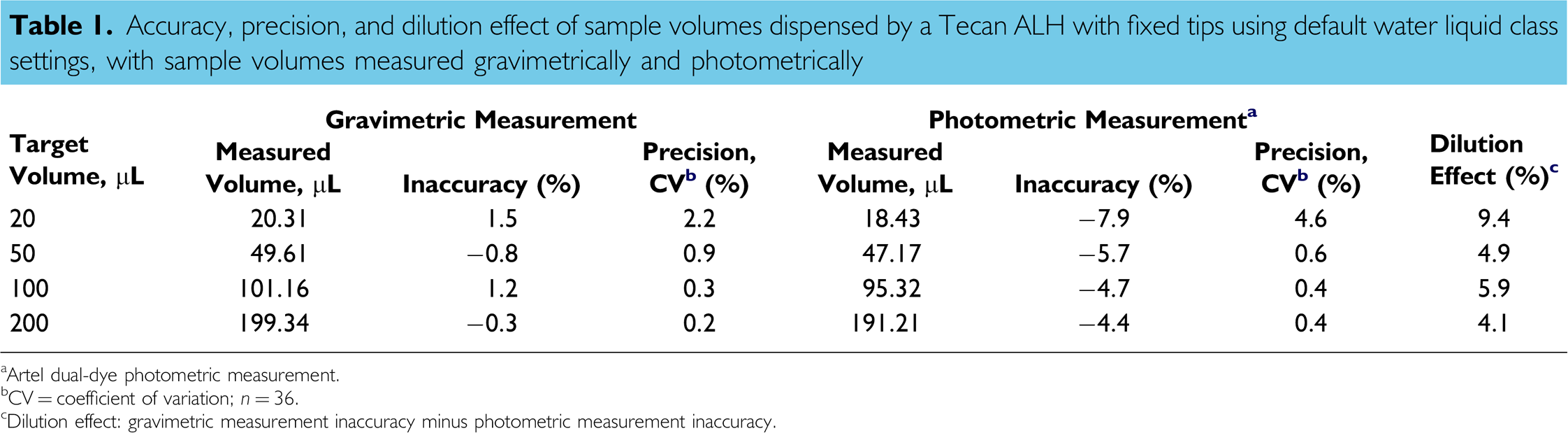
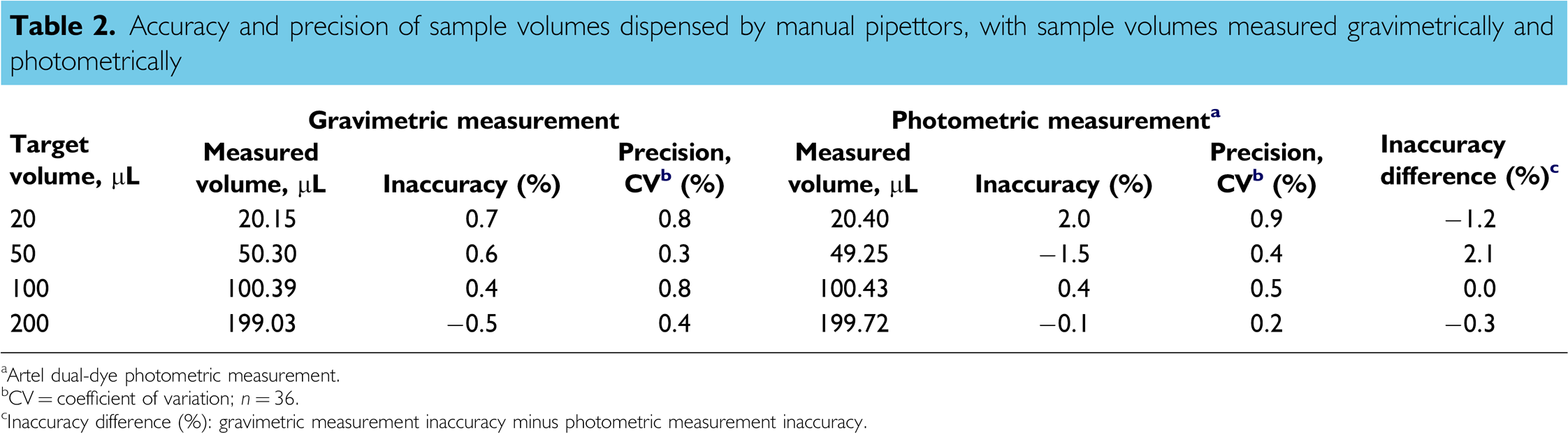
The results obtained with an ALH single-delivery experiment using MVS dye solutions as samples for volumes ranging from 20 to 200 μL show that the volumes measured by the dual-dye photometric method are consistently lower than those obtained gravimetrically (Table 1). The difference between the two sets of values ranged from 4.1 % at 200 μL to 9.4% at 20 μL (Table 1). This difference is attributed to the dilution of the dye with the ALH system liquid, and thus it is a measure of the dilution effect. In contrast, the gravimetrically and photometrically measured volumes obtained with the manual pipettors did not show such a consistent systematic bias (Table 2). The difference between the two sets of values ranged from –1.2% to 2.1%. Because there is no system liquid to dilute the sample in the manual pipettors, the differences in the measured volumes must represent the error in the two measurements.
Accuracy, precision, and dilution effect of sample volumes dispensed by a Tecan ALH with fixed tips using default water liquid class settings, with sample volumes measured gravimetrically and photometrically
Artel dual-dye photometric measurement.
CV = coefficient of variation; n = 36.
Dilution effect: gravimetric measurement inaccuracy minus photometric measurement inaccuracy.
Accuracy and precision of sample volumes dispensed by manual pipettors, with sample volumes measured gravimetrically and photometrically
Artel dual-dye photometric measurement.
CV = coefficient of variation; n = 36.
Inaccuracy difference (%): gravimetric measurement inaccuracy minus photometric measurement inaccuracy.
It is easy to understand that the dilution effect from an ALH delivery can be accumulated during serial dilutions as the number of pipetting steps is increased. As described under “Sample serial dilution experiments,” the serial dilution experiments were designed to result in 2.0, 0.4, and 0.2 μL of the MVS dye solutions in the final volume of 200 μL delivered following two- or three-step dilution schemes, resulting in 100-, 500-, and 1000-fold dilutions, respectively. As shown in Table 3, in each of the 100-, 500-, and 1000-fold dilution schemes, the volume of the sample (dye) was significantly lower than the target volume. The overall dilution effect ranged from 9.5% to 20%, which is not acceptable.
Measurements of dilution effect in sample serial dilution experiments using default liquid class settings, with volumes measured by Artel dual-dye photometric method
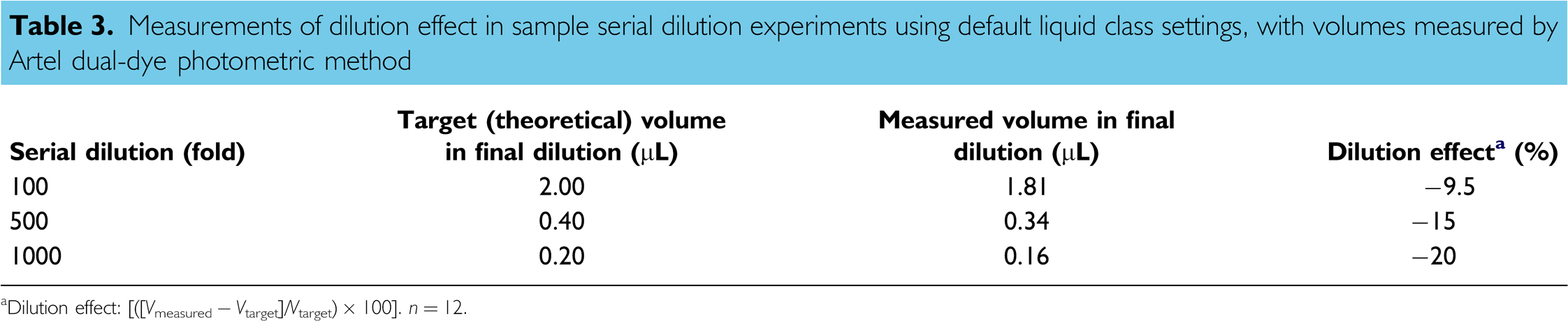
Dilution effect: [([Vmeasured – Vtarget]/Vtarget) × 100]. n = 12.
Dilution Effect as a Function of Aspiration Speed, Dispense Speed, and Partition Volume
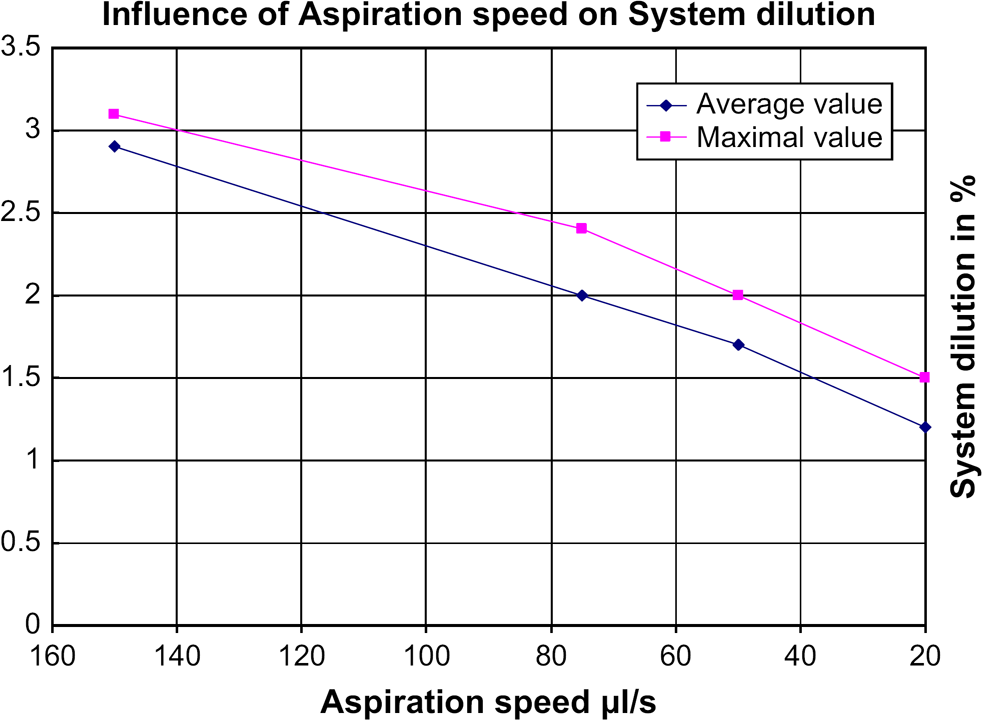
As shown in Figure 1, air gaps function as buffer zones to separate different liquids in the fixed tips and tubing. However, the air gaps may break down if pipetting speeds are too high. Therefore, it was desirable to study the effect of changing aspiration and dispense speeds on the dilution effect. As can be seen in Figure 2, for a 100-μL delivery, the dilution effect, as measured by the direct photometric method (described under “Direct Photometric Measurement of Dilution Effect”), decreased linearly with decreasing aspiration speed. The amount of dilution obtained using an aspiration speed of 20 μL/s was reduced to less than half of the amount of dilution at the default aspiration speed of 150 μL/s. In contrast, a similar experiment showed that varying the dispense speed did not cause change in the dilution effect (data not shown).
Illustration of liquid class setting configurations used for (a) default liquid class; (b) optimization strategy 1; and (c) optimization strategy 2. (d) Illustration of sample dilution in ALH fixed tip. Dilution effect as a function of aspiration speed. A 100 μL of sample was pipetted, using Orange G-containing system liquid. Liquid handling parameters, other than the aspiration speed, were identical to the default water liquid class.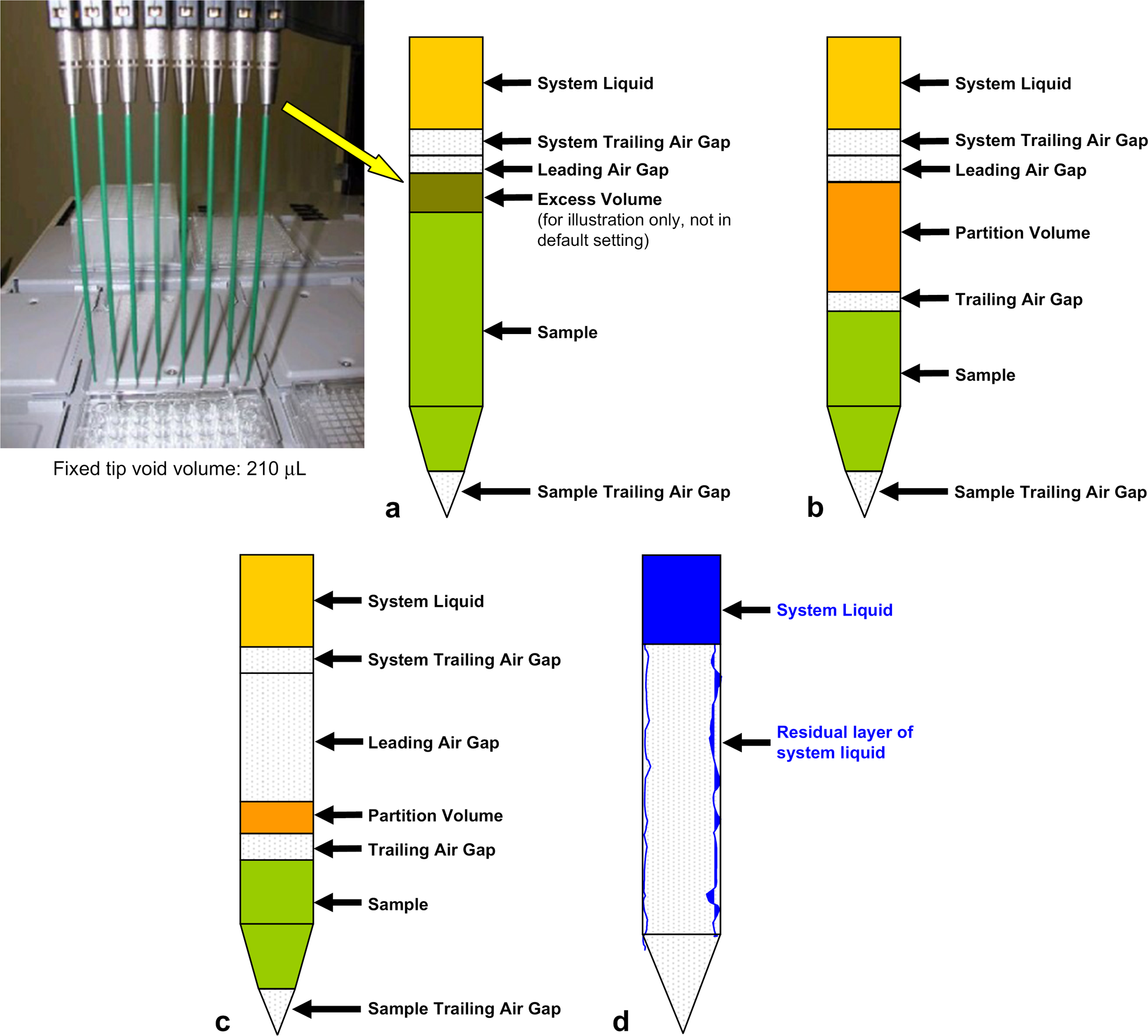
A partition volume, illustrated in Figure 1, is an extra preaspirated volume of the sample that is not delivered. The partition volume is not part of a contiguous column of a sample liquid because it is separated from the sample liquid column by an air gap. Thus, a partition volume provides additional separation of the sample from the system liquid and also coats the inside of the fixed tip that will come in contact with the target volume of the sample to be aspirated following the aspiration of the partition volume. Table 4 shows that addition of a partition volume drastically reduces the dilution effect, decreasing it to less than 0.3% with a partition volume of 150 μL.
Dilution effect as a function of partition volume using a 100-μL pipetting, with dilution effect determined by the direct photometric measurement
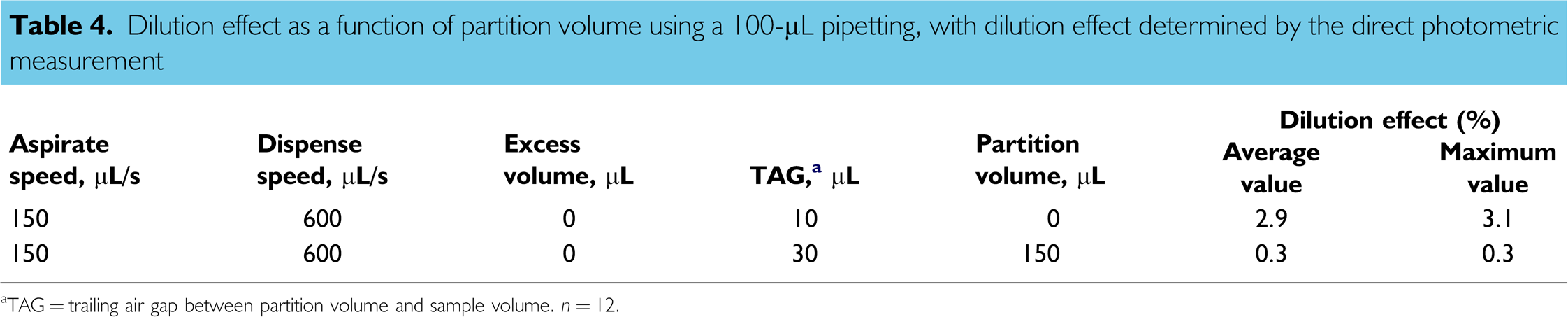
TAG = trailing air gap between partition volume and sample volume. n = 12.
Dilution Effect as a Function of Excess Volume
The addition of an excess volume to sample aspiration, as illustrated in Figure 1, has also been evaluated as a way of reducing the dilution effect. Theoretically, the excess volume acts as a buffer zone within the liquid column of the sample to absorb any droplets of system liquid left on the walls of the fixed tip as the sample volume is aspirated. This volume is then flushed out of the system during the washing of the tips subsequent to the delivery of the sample. Figure 3 shows that for a 100-μL target volume, the use of excess volume results in a reduction of the dilution effect, as measured by the direct photometric method. However, this reduction is accompanied by an increase in the amount of liquid dispensed. As shown in Table 5, a 10-μL excess volume setting with standard water liquid class results in 4.0% increase for a target volume of 200 μL.
Dilution effect as a function of excess volume in single pipetting mode using a 200-μL pipetting, with volumes measured gravimetrically
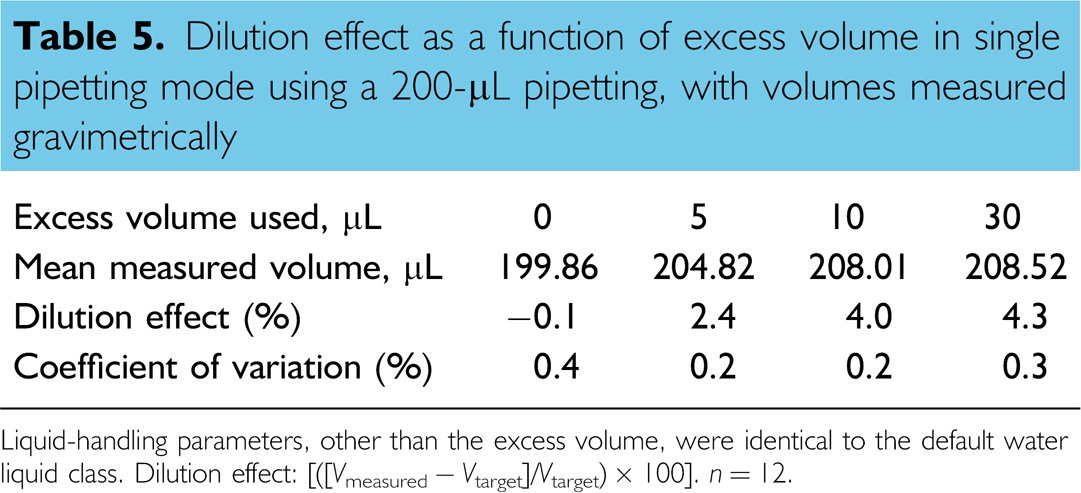
Liquid-handling parameters, other than the excess volume, were identical to the default water liquid class. Dilution effect: [([Vmeasured – Vtarget]/Vtarget) × 100]. n = 12.
Dilution effect as a function of excess volume. A 100 μL of sample was pipetted, using Orange G-containing system liquid. Liquid-handling parameters, other than the excess volume, were identical to the default water liquid class.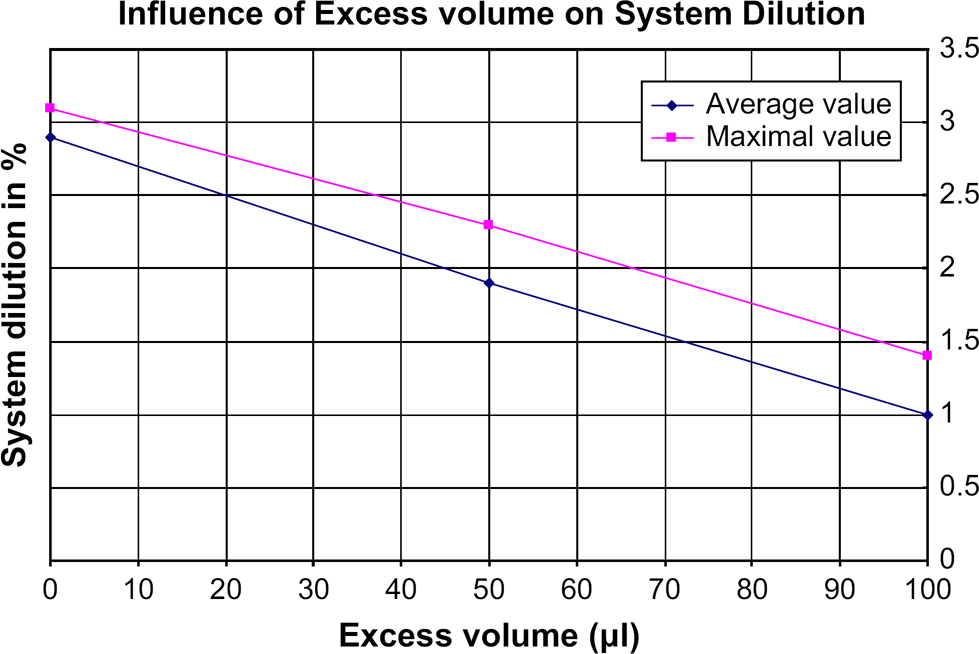
The over dispense obtained using the excess volume approach is due to the calibration factors not being appropriately adjusted for the use of the excess volume. The excess volume is designed for multipipetting mode and used to isolate the system liquid from sample at the end portion of last dispense. This volume can also be set for single pipetting mode; however, the calibration factors in the liquid class need to be adjusted to avoid delivery of a part of the excess volume with the sample. In the case of multipipetting, in which an excess volume is the part of the Gemini software default liquid-handling parameters, the calibration factors are indeed slightly lower than those for the equivalent parameters for single pipetting mode. Although excess volume is simpler to program (modification of a single liquid-handling parameter vs. an extra aspiration step for a partition volume) and involves fewer movements of the pipetting channel, and consequently requires less time to perform, it will lead to an over dispensing when used in the single pipetting mode without adjustment of the calibration factors. As shown in Figure 1, the excess volume is located immediately on top of the target sample and there is no air gap separating the two. Thus, when the target volume is dispensed, a part of the excess volume is also dispensed together with the sample due to the dispense movement momentum. Therefore, if an excess volume is used to reduce the dilution effect, the liquid class calibration curve requires recalibration and experiments need to be conducted to achieve accurate delivery of the target volume.
Optimization Strategy 1 for Reducing Dilution Effect
Because both lowering the aspiration speed and the introduction of a partition volume can effectively reduce the dilution effect, as illustrated above, different combinations of the two approaches were evaluated. As shown in Table 6, for a 100-μL target volume, a combination of a low aspiration speed (50 μL/s) and a partition volume of 50 μL reduced the dilution effect to 0.2%, compared to 1.7% with no partition volume and 0.1% with 150-μL partition volume.
Dilution effect obtained with optimization strategy 1 for a target volume of 100 μL using a low aspiration speed and different partition volumes, with dilution effect measured by the direct photometric method
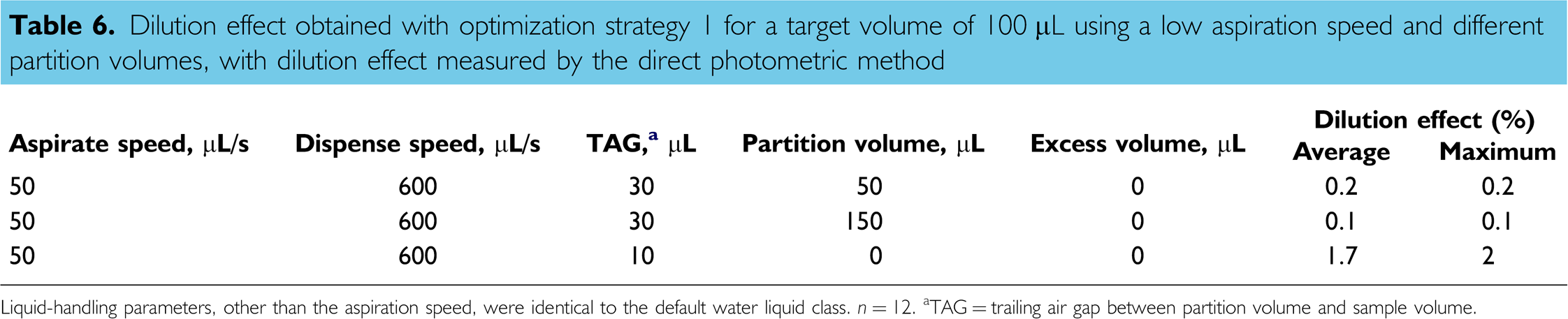
Liquid-handling parameters, other than the aspiration speed, were identical to the default water liquid class. n = 12.
TAG = trailing air gap between partition volume and sample volume.
Optimization Strategy 2 for Reducing Dilution Effect
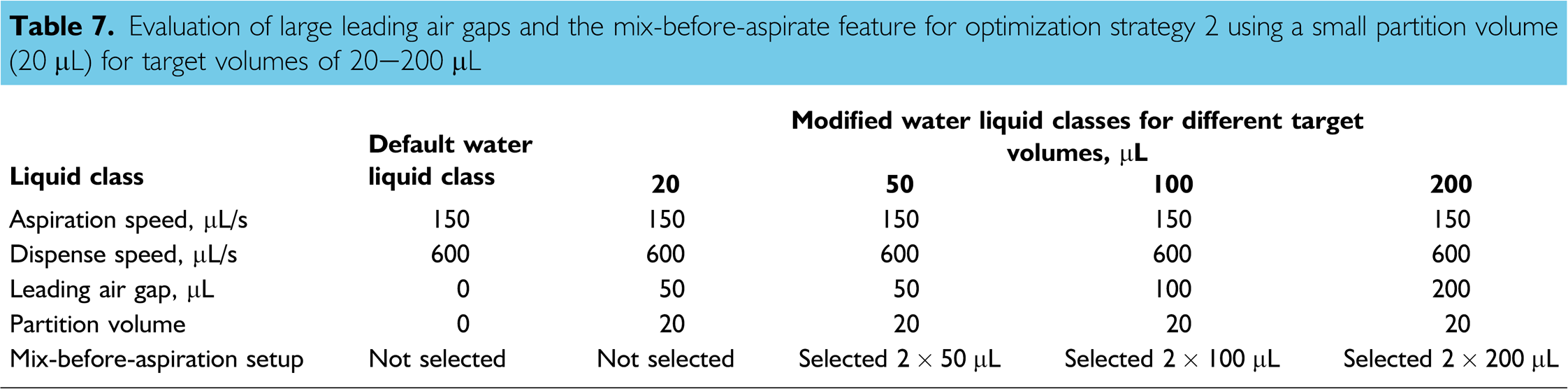
The second strategy is based on the use of a small partition volume and a large leading air gap. Accordingly, as shown in Table 7, the use of a small partition volume (20 μL) with different sizes of leading air gaps was evaluated. The air gaps ranged from 50 to 200 μL, which are equal to or larger than the sample target volumes. In addition, a mix-before-aspiration feature, which involves aspirating and dispensing back the sample before the final aspiration of the sample (volume and number of cycles for the mix-before-aspiration step can be varied) was also evaluated. When the leading air gap used is large enough to cover the tip distance that the sample mixing step will use, the system liquid is prevented from directly contacting the inner surface of the part of the tip during the “mix-before-aspiration” step. Thus, following the “mix-before-aspiration” step, the residual system liquid inside the tip is replaced with a layer of sample, hence, the subsequently aspirated sample will not be diluted.
Evaluation of large leading air gaps and the mix-before-aspirate feature for optimization strategy 2 using a small partition volume (20 μL) for target volumes of 20–200 μL
Comparison of Optimization Strategies 1 and 2 for Reducing Dilution Effect in Single-Delivery Experiments
A head-to-head comparison of the performance of the optimization strategies 1 and 2 was carried out using the same ALH and the same dilution effect measurement technique. As shown in Table 8, compared to the default liquid class setting, both strategies 1 and 2 achieved a significant reduction in dilution effect for all volumes examined, with strategy 1 performing better than strategy 2. As shown in Table 9, the precision obtained with both strategies is also good. Normally, leading air gaps larger than 30 μL are not recommended, as large air gaps tend to break down during pipetting. However, the good precision obtained with strategy 2 shows that the large leading air gap used is performing well.
Dilution effect for single delivery obtained using selected parameters for optimization strategies 1 and 2 and the default parameters, with volumes measured by Artel dual-dye photometric method
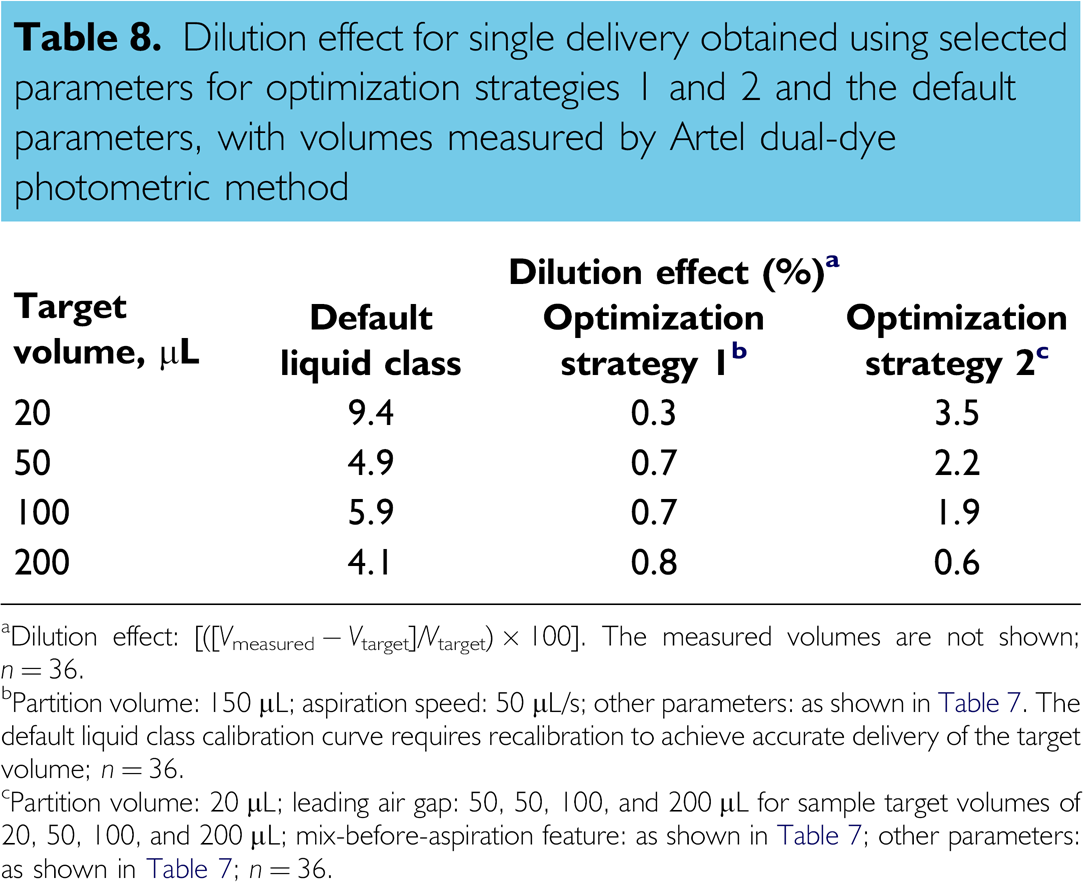
Dilution effect: [([Vmeasured – Vtarget]/Vtarget) × 100]. The measured volumes are not shown; n = 36.
Partition volume: 150 μL; aspiration speed: 50 μL/s; other parameters: as shown in Table 7. The default liquid class calibration curve requires recalibration to achieve accurate delivery of the target volume; n = 36.
Precision obtained for single delivery using selected parameters for optimization strategies 1 and 2 and the default parameters, with volumes measured by Artel dual-dye photometric method
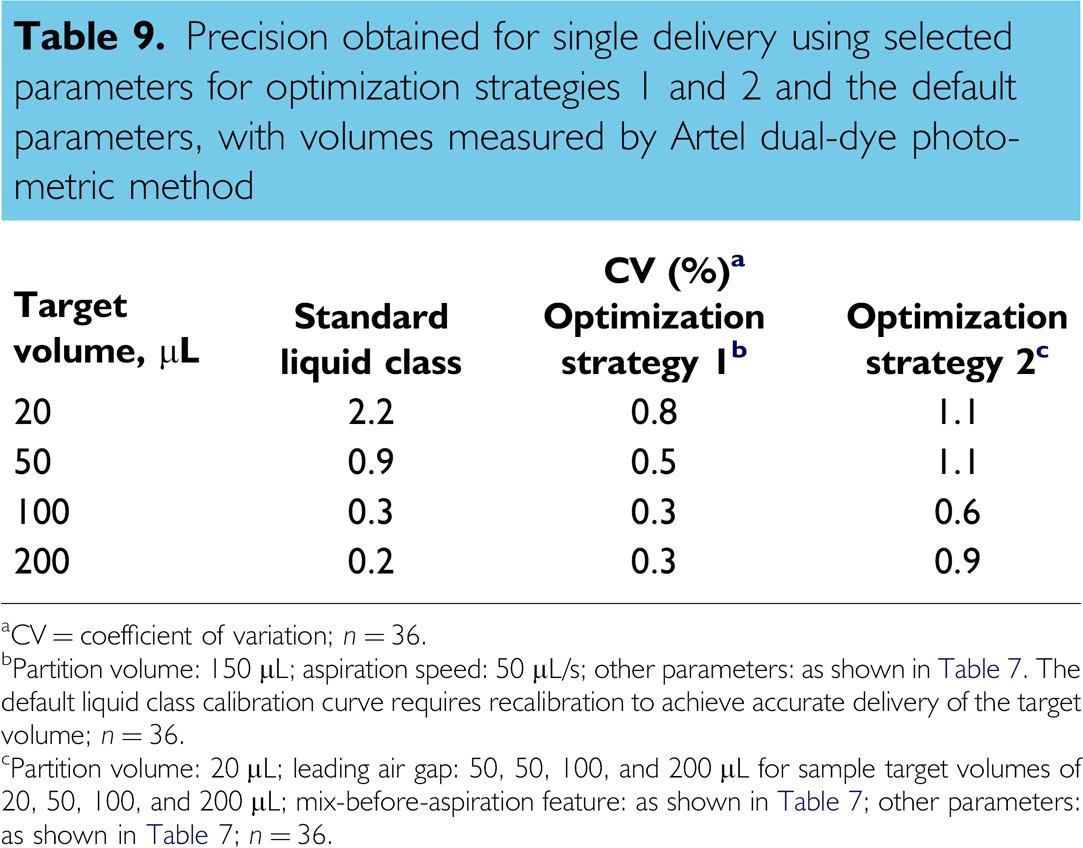
CV = coefficient of variation; n = 36.
Partition volume: 150 μL; aspiration speed: 50 μL/s; other parameters: as shown in Table 7. The default liquid class calibration curve requires recalibration to achieve accurate delivery of the target volume; n = 36.
Comparison of Optimization Strategies 1 and 2 for Reducing Dilution Effect in Serial Dilution Experiments
The head-to-head comparison of the performance of optimization strategies 1 and 2 in reducing dilution effect was also evaluated during serial dilution of samples. As described under “Sample Serial Dilution Experiments,” the serial dilution experiments were designed to result in 2.0, 0.4, and 0.2 μL of the MVS dye solutions in the final volume of 200 μL delivered following two- or three-step dilution schemes, resulting in 100-, 500-, and 1000-fold dilutions. As shown in Table 10 in each of the 100-, 500-, and 1000-fold dilution schemes, the measured volume of the sample (dye) was close to the target volume for both strategies 1 and 2. Strategy 1 exhibited an apparent dilution effect of +1.9%, –2.4%, and –3.6% for the 100-fold, 500-fold, and 1000-fold dilutions, respectively. The positive apparent dilution effect (1.9%) for the lower dilution suggests that the apparent dilution effects observed are not caused by the dilution with system liquid, but rather represents error in the overall measurement. These results indicate a dramatic improvement over the results obtained with the default liquid class settings, namely –9.5%, –15%, and –20% for the 100-fold, 500-fold, and 1000-fold dilutions, respectively (Table 3). Optimization strategy 2 also led to a significant reduction of dilution effect, although not as good as the one obtained with strategy 1.
Dilution effect obtained for serial dilution experiments using appropriate parameters for optimization strategies 1 and 2, with volumes measured by Artel dual-dye photometric method
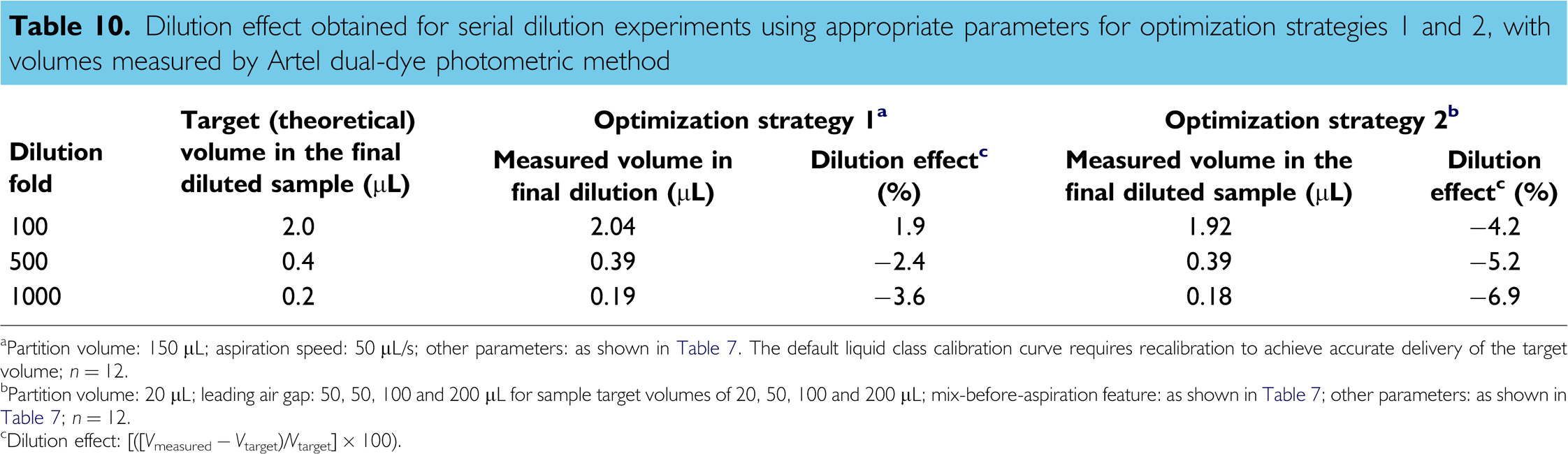
Partition volume: 150 μL; aspiration speed: 50 μL/s; other parameters: as shown in Table 7. The default liquid class calibration curve requires recalibration to achieve accurate delivery of the target volume; n = 12.
Partition volume: 20 μL; leading air gap: 50, 50, 100 and 200 μL for sample target volumes of 20, 50, 100 and 200 μL; mix-before-aspiration feature: as shown in Table 7; other parameters: as shown in Table 7; n = 12.
Dilution effect: [([Vmeasured – Vtarget)/Vtarget] × 100).
Choosing between Optimization Strategies 1 and 2
As discussed above, optimization strategy 1 is based on using a slow aspiration speed and a relatively large partition volume. On the basis of the above results (Tables 6 and 8–10), the following parameters are recommended for strategy 1: an aspiration speed of 50 μL/s and a partition volume of ≥ 50 μL. The default liquid class settings (listed in Table 7) are used for the other parameters. It should be noted that the default liquid class calibration curve should be recalibrated to achieve accurate delivery of the target volume with the slower aspiration speed used. Optimization strategy 2 is based on using a large leading air gap, a small partition volume, and a mix-before-aspiration feature. On the basis of the above results (Tables 8–10), the following parameters are recommended for strategy 2: a leading air gap equal to the sample target volume (except for samples less than 50 μL, for which 50-μL leading air gap would be used), a partition volume of 20 μL, and a mix-before-aspiration step specified in Table 7. The default liquid class settings (listed in Table 7) are used for the other parameters. As discussed above (Tables 8–10), strategy 1 performs better than strategy 2 in reducing the dilution effect caused by the ALH system liquid and hence it should be considered as the first choice. However, the large partition volume required for strategy 1, which is wasted, could be a concern if there is a problem of adequate sample availability, in which case strategy 2 would be more appropriate.
Sample Dilution When Washing Disposable Tips on an Air-Filled Liquid-Handling System
The above experiments were performed entirely on a Tecan 8-channel liquid-filled ALH, using fixed pipetting tips. This ALH can also be used with disposable pipetting tips; in this case the system liquid does not enter the disposable tips, and as there is a large air gap within the tip, the system functions similarly to an air-filled system. Automated liquid handlers with larger arrays of tips, such as 96-tip instruments, also usually use disposable tips. For 8- or 96-channel instruments, tips may be used more than once to reduce the operating costs of running the equipment, and to relieve the logistical burdens of supplying disposable tips as they are consumed. We investigated whether washing of disposable tips could also lead to sample dilution.
The 96-channel air-filled ALH used for the experiment includes an optional wash station that can supply one or two wash solutions. Introduction of a wash solution containing dye into sample was measured by the direct photometric method. A 100-μL “sample,” containing buffer but no dye, was pipetted into each well of a 96-well microplate, using 100- and 200-μL disposable tips. The same tips were then washed with a solution containing Orange G in the wash station, using standard wash procedures. The washed tips were then used to mix the sample solution in the same microplate. Any residual wash solution remaining in the tips would be introduced into the microplate. The microplate was then read photometrically to determine any Orange G present. The average volume of wash solution transferred to the microplate was 0.11, 0.08, and 0.04 μL, with 50, 100, and 200-μL tips (Table 11), respectively. This method clearly indicates retention (contamination) of wash solution on or within the disposable tips after washing. Because the size of retained droplets has considerable variability, it is also useful to look at the maximum observed volumes retained, which were 0.86, 0.68, and 0.75 μL, respectively. Although these absolute volumes are smaller than the volumes of system liquid introduced into samples by the fixed tip liquid handling in the previous experiments (compare these values with the difference between the photometrically measured values and the target values in Table 1), they still may affect the data quality. The residual volume of the Orange G-containing wash solution is independent of the sample volume to be aspirated, as it results from the washing step. Thus, even in an air-filled pipetting system, residual wash solution introduced by washing disposable tips could represent a substantial dilution of a sample volume. It should be noted that reuse of disposable tips may also result in disparate results in consecutive pipetting steps, as the volume of liquid aspirated into a wetted tip may be different than that aspirated into a dry tip using identical LHPs. 9
Sample dilution in disposable tip washing experiment, with volumes measured by the direct photometric method
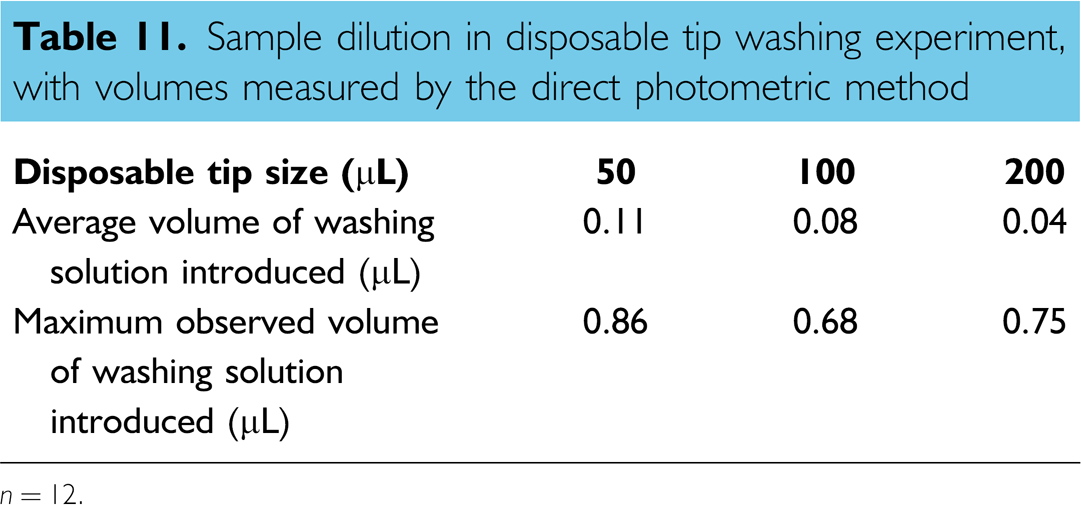
n = 12.
Conclusions
Samples delivered by reusable fixed tips can be diluted by an ALH system liquid if there is no appropriate adjustment of LHPs. The dilution effect can be determined by comparing the volumes obtained using dual-dye photometric and gravimetric methods for volume measurement. The inaccuracy caused by such dilution effect increases with the number of pipetting steps involved in serial dilutions. The two optimization strategies developed in this investigation allow liquid-filled pipetting systems operated with fixed tips to be used for quantitative assays with acceptable results in both sample accuracy and precision. When accuracy is of paramount importance and the availability of sufficient sample volume is not an issue, optimization strategy 1 should be used because this strategy achieves better accuracy (less dilution effect) compared to strategy 2. However, if neither strategy is functionally feasible, the use of disposable tips on a fluid-filled system eliminates all possibility of dilution of sample, as long as tips are not washed.
Footnotes
Acknowledgments
We are grateful to Peter Siesel and Kim Campbell of Tecan U.S., and Dr. John Thomas Bradshaw of Artel, Inc. for their invaluable contributions. We have worked closely with them during the design of some of the experiments and during the writing of the manuscript.