






Abstract
In the mid-1990s, HTS labs were built with high-end automation for screening 10,000s of compounds. Compound Management labs continued to manually pick samples and invest in standalone equipment. The bottleneck for screening shifted from testing samples to the distribution of compounds. To solve this problem, Merck & Co., Inc. developed an automated compound distribution center. The facility uses automation from The Automation Partnership and a Merck-developed compound ordering system to provide solid and solution samples to Merck scientists worldwide.
In the mid-1990s, HTS was the buzz word. Pharmaceutical companies spent millions of dollars outfitting HTS facilities with state-of-the-art automation for replicating and screening 10,000s of compounds per day. This infusion of money and automation led to a decrease in the timeline for finding novel leads in new biological targets. As
Project Timeline
The compound distribution center project included two large subprojects. The first project was the design, construction, testing, and installation of the compound distribution center automation. In the third quarter of 1999, The Automation Partnership (TAP) was selected as the automation vendor. Over the subsequent 3.5 years, the automation was specified, designed, built, tested, and installed. The system was fully qualified in August 2003.
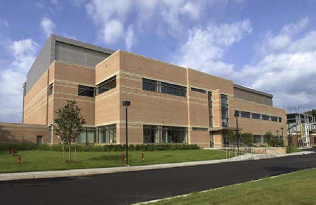
The second project was the design, construction, and testing of the building to house the automation and associated support functions. Because there was insufficient existing space for the compound distribution center, a new building was built. We were able to achieve a superior facility by designing the building around the system, rather than trying to fit the facility into the existing space. Timelines for these two projects are shown in Figure 1. Figure 2 shows the enclosed building.
Project timeline. The compound collection building.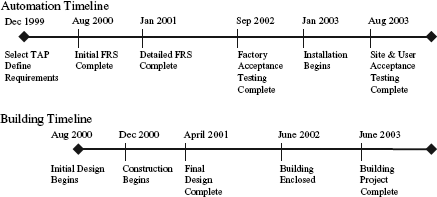
The Great Transfer
During the design and development period, MRL implemented a project plan to transfer all dry compounds to robot-friendly vials and solution samples to 1.4 ml tubes. The goal was to transfer 450,000 dry samples to TAP 1 dram vials, 50,000 bulk compounds to standard bottles, and 550,000 solution samples to Matrix TrakMate Tubes (Hudson, NH). The plan included hiring five contractors to assist the Compound Management Group's logistics staff with the dry compound transfer, and the purchasing of TAP'SHaywain (The Automation Partnership Royston, UK) to accurately weigh the transferred compounds. In addition,
Initial Load
Initial Load ran from September 2003 through mid-November 2003.
It Architecture
The Merck Haystack system is a three-tier system. At the top level is a Merck-developed Web-based ordering system called Basic Research Compound Ordering System (BRCOS). The middle tier is a TAP-developed repository management system called Ordering System for Compounds and Reagents (Oscar). The third level is the TAP-developed automation control suite called PinPoint (IT Flow Diagram - Fig. 3).
IT flow.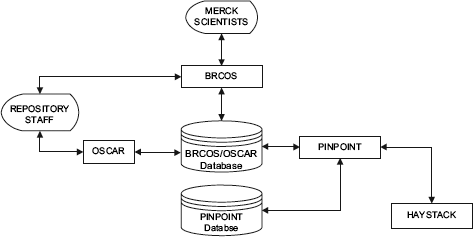
BRCOS is a Web-based system used by Merck scientists worldwide to request compounds from the Compound Management Group in
BRCOS interfaces with the Oscar system through a shared Oracle database. After the user has completed order entry, BRCOS places the order information into the shared Oracle database. Then, the order is retrieved and processed by Oscar, and subsequently by Pinpoint. Once the compounds have been picked and shipped, Oscar updates the BRCOS database with the type of containers the compounds were shipped in, boxes for dry compounds and plates for solubiUzed compounds. This information includes the identifier assigned to the box or plate, the location of the compound within the container, the amount shipped, and the concentration. For plate shipments, the locations are the well positions in the plate. The box/plate identifier is printed on a barcode label and attached to the box or plate.
Oscar manages orders within the Haystack (The Automation Partnership Royston, UK) system. It retrieves orders sent by BRCOS through the Oracle database. It also accepts orders placed directly by the repository staff. Oscar also provides many supervisory functions such as order tracking, inventory reports, and audit trails. Orders received by Oscar are approved before being sent down to PinPoint, which controls the automation.
PinPoint is the third tier of the system. It manages order execution on the automation and operator workstations. PinPoint uses a Sybase database to maintain a record of orders and their status throughout the system. PinPoint sends boluses of work down to individual workstations that control automated components of the system. The PinPoint database is transaction based. The database is updated after every physical action within the system is completed. This allows the system to recover from power failures or equipment failures without losing the state of the system.
The IT infrastructure for the system is substantial. At the Haystack level, it was designed for performance and data integrity. Because the data represent over 8 million physical inventory locations, loss of these data could be catastrophic. There are 63 PinPoint workstations that control automation or act as operator consoles. The Oscar application, PinPoint application, and PinPoint database reside on separate servers that reside in the compound distribution center building. The workstations and servers are protected by Powerware UPSs. The PinPoint database is protected by a live transaction log server that resides in a separate building. The Oscar/BRCOS database runs on a corporate enterprise database server. The
Haystack System Components
Haywain
The Haywain is used to tare weigh empty 1 dram vials used for neat compounds and gross weigh 1 dram vials with compound in them. The Haywain has a Fanuc LR-Mate robot with a TAP designed wrist. The wrist provides multiturn rotation for screwing and unscrewing 1 dram vial caps. Two Mettler AT200 balances provide weighing capability. The deck can hold six 96-vial racks. The Fanuc robot operates while the Mettler balances are weighing. Each balance is isolated from the frame. The Haywain can weigh a rack of 96 vials in approximately 1 h.
Weigh Booths
There are 15 manual weigh booths in the system. The weigh booths contain Mettler AX204 analytic balances that are controlled by an ELO touch screen operator interface. Weigh booths are enclosed in a NuAir HEPA enclosure.
Automated Dry Store
Neat compound samples are stored in 1 dram borosilicate glass vials, each having a lD linear barcode on its side. Vials are stored in stainless steel trays with ABS vial inserts. Trays of vials are stored on the shelves of a vertical carousel manufactured by Kardex AG. There are 98 levels in each carousel, with three trays on each level. Our ADS is composed of two Kardex carousels, with a total capacity of approximately 1.3 miliion vials (Fig. 4). Vials are stored at +72°F, with a target humidity of 45% The ADS has two 12 foot × 6 foot × 20 foot Kardex AG carousels, one rack picking robot, two vial picking robots, and two input/output buffers.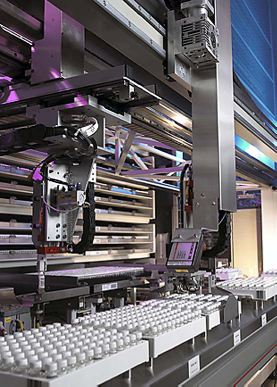
All vials are scanned when they are placed into the store and when they are picked out of the store. This helps guarantee the integrity of the store.
The entire process of picking and placing vials is automated. The carousels rotate under computer control to the specified shelf. A pneumatic tray puller pulls the specified tray of vials out. Then, a three-axis, Anorad, pick-place robot picks the specified vial out of the carousel tray and places it into a vial rack. Vial racks are moved between the two carousels and the input/output turntables by a rack transfer robot. This is a 27-foot long two-axis rack and pinion robot.
Operators place racks of new vials onto an input turntable. The turntable rotates and presents the rack to the rack transfer robot. Racks of compounds leaving the store are withdrawn via the output turntable. Each carousel's pick-place robot is capable of picking or placing one vial every 15 s. This is an average time and includes time for carousel rotation.
Manual Dry Stores
In addition to our 1 dram vial collection, large bottles of dry compound are stored in four manually controlled Kardex carousels. These carousels hold approximately 14,000 50-ml bottles, 14,000 120-ml bottles, and 121,000 40-ml bottles. Wire shelving units can hold an additional 5280 1-1 bottles. Bottles in the carousels are accessed by entering the desired shelf number into a membrane keypad. The carousel rotates. The appropriate tray of bottles is manually pulled from the carousel. All bottles and trays are barcoded.
Solubilization/Replication
Solution copies of compounds are created in Solubilization/Replication (Sol/Rep). Sol/Rep is composed of three Tecan Genesis RSP 200 (Research Triangle Park, NC) units with modified ROMA arms. The Tecans are used to add DMSO to vials of dry compound. The vials are sonicated. Then, the Tecan Genesis RSP 200 units transfer solution from the vials to Matrix TrakMate Tubes.
After the racks of tubes are created, they are “associated” with a “Haywagon”. Up to six racks of tubes are loaded onto an aluminum tray called a “Haytray”. Up to 27 Haytrays, which is enough capacity for one day's ad hoc production, can be loaded into an enclosed cart called a Haywagon. Haywagons provide a way of moving a large amount of tubes between the tube stores and other processing elements of the system. In addition, they provide an accurate way of mechanically registering the Haytrays to the automation. The barcodes of the tube racks, Haytrays, and Haywagon are scanned during loading. This links each tube rack to a specific position, on a specific Haytray, within a specific Haywagon. The Haywagon is then docked at the appropriate tube store, where the tubes are automatically placed into storage.
Tube Stores
Solution samples are stored in Matrix TrakMate Tube Racks that hold 80, 2D barcoded, 1.4-ml tubes, with columns 1 and 12 empty. This allows us to create 384-well plates with two empty columns on each side. Tube racks are stored in stainless steel trays with ABS rack inserts. These trays of tube racks are stored on the shelves of a vertical carousel manufactured by Kardex AG. There are 99 levels on the carousels, with three trays on each level (Fig. 5). Each carousel can store approximately 1 million tubes.
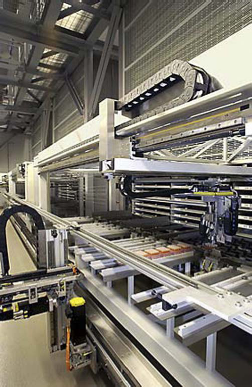
The ASS has three carousels, three high-speed tube and rack picking robots, and a TTR measuring 46 feet long.
Tubes are stored at +4°C, with a target humidity of 35%RH. Storage areas have seven air changes per hour. An FM-200 fire suppression system protects the store rooms.
There are two tube storage rooms. The Working Solution Store (WSS) holds tubes for ad hoc requests. The ASS holds a copy of the screening set. The Working Store has four carousels with an approximate capacity of 4 million tubes. The ASS has three carousels with an approximate capacity of 3 miliion tubes.
Both tube stores are equipped with an RVSI (Nashua, NH) 2D barcode scanner. All tubes are scanned when they are placed into the store and when they are picked out of the store. This helps guarantee the integrity of the store.
The entire process of picking and placing tubes is automated. Tubes are picked out of carousels and are placed into empty tube racks that sit on a Haytray. There are 12 Haytray positions in front of each carousel. Haytrays are moved between carousels, the 2D barcode scanner, and eventually back to Haywagons. The carousels are controlled by an Allen-Bradley PLC. The carousels rotate under computer control to the specified shelf. A pneumatic tray puller pulls the specified tray of tube racks out. Then, a three-axis, Anorad, pick-place robot picks the specified tube out of the carousel tray and places it into the Haytray. The pick-place robot uses a high-speed tube gripper that TAP developed for Merck. It is capable of completing a tube pick-place move every 5.5 s. Haytrays are moved between carousels, the 2D barcode reader, and eventually to Haywagons via a tray transfer robot (TTR). This is a long three-axis rack and pinion robot. The Working Solution Store TTR is 56-feet long, while the ASS TTR is 46-feet long.
All the components of the tube store work independently. Tubes can be picked simultaneously at multiple carousels. The carousels can rotate while tubes are being picked. The TTR can move trays while tube picking occurs. This results in a high-throughput system that has resiliency if one component experiences a failure.
Plate Production Module
Plate Production Modules (PPMs) are used to create daughter plates from mother tubes held in tube racks. The tube racks come, in Haywagons, from either the ASS or Working Solution store. The PPM (Fig. 6) is composed of six modules: the Haywagon docking station, Capper/Decapper, Tip Transfer Module (TTM), Baseplate, Plate Interface Module (PIM), and Tray Transfer Module (TTR).
The PPM is 15 foot wide and 25 foot long. The PPM is made up of six individual modules linked by a TTR.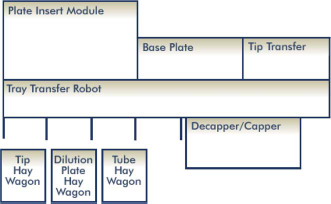
The Haywagon docking station consists of bays where four Haywagons can be docked. Typically, one or two Haywagons are loaded with mother tube racks. One Haywagon is loaded with clean tips. If needed, one Haywagon can be loaded with deep well dilution blocks. The docking station mechanically mates the Haywagon to the PPM, precisely aligning it so that the TTR can withdraw Haytrays. The TTR moves Haytrays between the different PPM modules.
The Capper/Decapper consists of two functions sharing one physical module (Fig. 7). The decapper portion takes caps off tubes. It consists of eight expanding collets mounted on a three-axis head. Each collet has four sets of steel teeth that bite into the surface of the cap. After the collets expand, the head, holding the collets, raises, while a separate plate holds the tubes from rising. This pulls the caps out of the tubes. Since the process of decapping can cause aerosolization of liquid near the cap, the decapper incorporates a shroud that surrounds each tube while decapping. The shroud and collets are washed and dried after each decapping operation. Dirty caps are dropped into a disposal chute, which leads to a waste container. The capper portion of the module consists of a vibratory bowl feeder, a linear feeder, and a three-axis capping head. New caps are loaded into the vibratory bowl feeder. The bowl feeder feeds them into the top end of the linear feeder. As the caps traverse the linear feeder, they are oriented so that their flat surface is down. At the end of the linear feeder are eight lanes. Caps populate the lanes. When the lanes are filled, the caps are removed and inverted by a vacuum flipper head. Then the three-axis vacuum capping head picks them up, checks that eight caps are present, and caps a row of tubes.
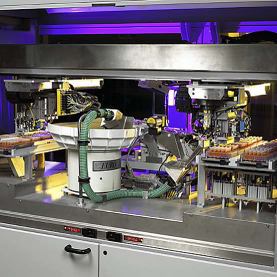
The Capper/Decapper unit design is Haytray based. It can cap or uncap 12 filled tube racks in 20 min.
Disposable tips are used to minimize cross contamination of samples. We use Matrix 5503 disposable tips supplied in plastic Matrix D.A.R.T. (Disposable Automated Research Tips) holders. These plastic D.A.R.T. holders hold 96 tips, but are not rigid enough to hold tips on the Baseplate liquid handler head. So, the TTM is used to transfer clean tips from Matrix plastic D.A.R.T. holders to rigid TAP steel tip holders (Fig. 8). The TTM accepts Haytrays of new Matrix dart holders and Haytrays of empty TAP tip holders. A three-axis 16-pin head then picks up clean tips from the Matrix dart holder and transfers the tips to the TAP tip holder. Vacuum sensors on each pin detect the presence or absence of a tip. The head makes five trips to insert 80 clean tips into a TAP tip holder. Dirty tips are taken out of TAP tip holders with an 80-pin head. The dirty tips are dropped into a disposal chute, which leads to a waste container.
The TTM on the PPM.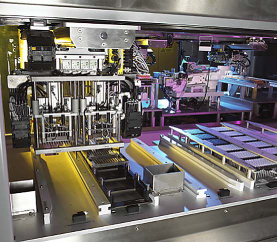
The Baseplate is the liquid-handling part of the system (Fig. 9). The Baseplate is composed of two three-axis, 96 tip, pippetting heads. One head is used to perform liquid transfers. The second head is used to perform dilutions. Typically, a Haytray of uncapped tubes, a Haytray of TAP tip holders, and a Haytray of microtiter plates are on the deck of the Baseplate. If dilutions are being performed, a Haytray of deep well dilution blocks is also on the deck. The Base-Plate head uses a stepper motor and lead screw to drive pistons in the pippetting head. The seal between the tips and head is a face seal with a removal gasket. The system has been tested to provide a 3% CV on a 1 μl dry dispense.
The last module on the PPM is the PIM. The PIM has a number of functions. The PIM holds one hundred rectangular tubes called PlateSafes. Each PlateSafe can hold up to 25 empty plates or completed plates. The PIM also has an ABgene ALPS-300 (Rochester, NY) sealer for sealing completed plates, with foil seal. A Beckman Coulter (Fullerton, CA) Microplate Print and Apply labeler is used for applying barcoded user labels to completed plates. There are also five Haytray positions on the deck of the PIM. These Haytrays hold empty or filled microtiter plates. A three-axis plate mover robot moves plates between the different stations on the PIM.
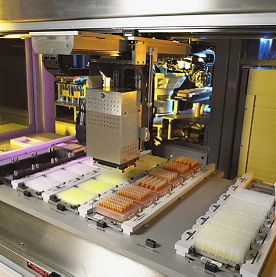
The BasePlate aspirates and dispenses 80 samples at a time, performing plate-based dilutions on the fly.
All the modules in the PPM work independently. The modules can be thought of as a pipeline. In the beginning, the pipeline is not efficient, but as the pipeline fills up, the efficiency of the system increases. The PPM is able to make 14, 384-well plate copies, of 48 mother tube racks in about 3.5 h.
At capacity, the Merck Haystack System is designed to have three PPMs. At present, we have two PPMs (Fig. 10).
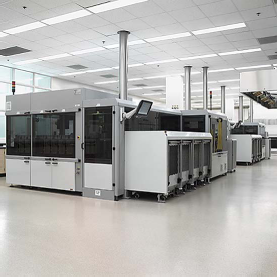
Two PPMs in the core of the building.
Shipping
Completed microtiter plates and completed dry samples are brought to the shipping workstation. Shipping provides a mechanism of collating items to be shipped into shipping boxes. Completed orders are presented to the shipping personnel. Items for each order are picked and placed into barcoded boxes, and items going into the box are scanned. Boxes are scanned as they leave the building, providing a record of when boxes are picked up by dedicated carriers. Therefore, all vessels in the system are tracked by PinPoint, from the time they are created, until they leave the building.
Sample Flow
Ad hoc solution orders received from BRCOS are validated and approved in Oscar. Although, 99.9% of the dry compound collection is represented in the solution collection, some solution orders require the MRL CMG to weigh and solvate some compounds. These compounds are newly deposited samples in the ADS. The Oscar software automatically places a BUILD Order, pulling the dry samples from the ADS into a TAP Rack. The Build Order is taken to a weigh station, where a technician weighs an exact amount into a High Recovery Vial (HRV). The HRV is capped, placed into an automation-friendly rack designed to mimic a 96-well plate. The TAP vials are returned to the ADS, and the completed Build Order is taken to the Sol/Rep area. The rack is scanned on a Tecan Genesis RSP 200 liquid handler. The Haystack software retrieves the volume files for the initial solubilization. After the addition of DMSO, the rack of samples is capped and taken to a sonicator or shaker table, this process ensures that all dry residues are completely sol-vated before the replication process takes place. The CMG makes multiple copies of each solution sample. These samples are used for the initial ad hoc order, and the additional copies are used for future screening collections. The registered filled tube racks are capped on a standalone Capper/ Decapper station before being taken to the Haywagon Association Station. Samples for ad hoc orders are located in a separate Haywagon to be docked at the Working Solution Store. Samples for future screening collections are located in another Haywagon and docked at the ASS.
Once the Build Order is complete and all the ad hoc solution samples are placed into the WSS, the initial solution order is approved. An empty Haywagon, containing empty tube racks is docked at the WSS. Then, individual tubes are picked into a tube rack on a Haytray. Each filled Haytray is taken to the 2D barcode scanner for verification. After the verification step, filled Haytrays are returned to the Haywagon. The filled Haywagon is undocked. Samples are thawed by pulling ambient air across the samples.
The thawed Haywagon is docked at a PPM. Haywagons filled with clean Matrix D.A.R.T. tips and Biosciences (Billercia, MA) Deep Well Blocks are docked alongside the thawed Haywagon. These Deep Well blocks are used as intermediates to dilute sample requests on the fly. Once all three Haywagons are docked, the PPM software is initialized. The Tray Transfer Robot (TTR) pulls a Tube Haytray and transports the tray to the integrated Capper/Decapper. As the tubes are being decapped, the TTR accesses a Tip Haytray. The Tip Haytray is taken to the Tip Transfer Unit, where the tips are transferred from the D.A.R.T. holder to a metal tip holder that is designed to work with the TAP Baseplate. The PIM picks a selected plate from a PlateSafe, and places the plate on a Haytray. The TTR moves this Haytray to the deck of the Baseplate. At this point in time, the Baseplate has already been loaded with Haytrays of uncapped tubes from the Capper/Decapper, clean tips in metal holders from the TTM, and a Haytray of Deep Well blocks.
The clean tips are picked up by the Baseplate head, and are used to mix the samples creating a homogeneous solution. After the mixing step, a known aliquot size is aspirated and dispensed into a 96- or 384-well plate.
The PIM transfers the samples to the Beckman Plate Labeler for the application of a label with the plate's unique identifier, the SET_ID. This identifier is used by scientists to identify the plate and its contents: compound_id, volume, and concentration. The plate is then shuttled to the AbGene Plate Sealer where a pealable foil seal is applied. The PIM then collates plates based on order type or final destination.
Conclusion
The MRL Project Team set very high acceptance criteria, including accelerated pick and place rates, multiprocessing components, minimum errors, and the ability to run the system with minimal human intervention. The Haystack system has been fully operational for 2 full years. During the first year of operation, the Working Solution Store picked and placed over 1 million tubes for ad hoc requests. The first screening collection included picking and placing 500,000 samples and making 10 copies in less than 4 months. During this 2-year period the system has either met or exceeded our expectations for processing samples. That does not mean the system has not had hardware or software problems. It means the Compound Management and Engineering teams work together to keep the downtime minimal, fixing small problems and being proactive on future problems.