






Abstract
This paper empirically tests several hypotheses about the nexus of corruption-institutional trust in Post-Soviet transitional countries of the former Soviet Union and Mongolia. We use two different indices of institutional trust to check the robustness of our analysis and estimate OLS and instrumental variable models with and without interaction terms. All things considered, our findings reject “greases the wheels” and “trust begets an honest political system” hypotheses. Instead, our findings support the “sand the wheels” hypothesis. Furthermore, a multiplicative interaction model suggests that the negative marginal effects of experienced corruption are higher in the environments where satisfaction with services is low. In addition, we found that increases in corruption erode trust at all levels of the societal institutions including political parties, government and financial institutions, international investors, non-profit organizations, and trade unions. This finding is important since it highlights the negative consequences of corruption on the development of broader level economic institutions and on civil society.
Introduction
The objective of this paper to test the effects of corruption on institutional trust in the transitional countries of the former Soviet Union and Mongolia. The growing consensus is that efficient institutions are important for economic growth and social development (Acemoglu & Johnson, 2005; Green, 2011; Paldam & Gundlach, 2008). However, institutions do not emerge and function in a vacuum. In order to operate effectively, institutions need to be trusted by the people they serve (Mishler & Rose, 2005; Putnam, 2000). Institutional trust indicates citizens’ assessment of institutional performance. It can be defined as a “summary judgement that the system [of institutions in society] is responsive and will do what is right even in the absence of constant scrutiny” (Miller & Listhaug, 1990, p. 358).
Recent trends in the social science literature have identified multiple normatively desirable effects of institutional trust. Recent trends in the social science literature have identified multiple normatively desirable effects of institutional trust. In the literature related to economics, higher levels of institutional trust are associated with economic growth (Easterly, Ritzen, & Woolcock, 2006; Green, 2011; Zak & Knack, 2001), support for small and medium sized enterprise developments (Rus & Iglič, 2005), and the promotion of the enforcement of contracts, respect for property rights, innovations, and investments in human and physical capitals (Andriani & Sabatini, 2015; Latusek & Cook, 2012). In the literature regarding social policy, higher levels of institutional trust are associated with higher levels of equality, more inclusive welfare programs, and the higher likelihood of a successful reformation of the welfare state (Gabriel & Trüdinger, 2011; Habibov, 2014; Rothstein & Uslaner, 2005). The political science literature highlights the importance of institutional trust in the reduction of tax evasion and for greater levels of political participation (Frey & Torgler, 2007; Orviska & Hudson, 2003), while low levels of trust have been found to undermine the legitimacy of political regimes and even threaten their very existence (Mishler & Rose, 2001; Seligson, 2002). Finally, health and sociological studies associate higher levels of institutional trust with positive outcomes in health and subjective well-being (Abbott, Wallace, & Sapsford, 2011; Hudson, 2006; Lindstrom & Mohseni, 2009).
In light of the positive consequences of nurturing institutional trust discussed above, developing an understanding of the factors that influence institutional trust is of critical importance. One of the most important factors affecting trust is corruption. The classic definition of Nye (1967, p. 416) states that corruption is “behaviour that deviates from the formal duties of a public role (elective or appointive) because of private-regarding (personal, close family, private clique) wealth or status gains”, while more recent definition of Sandholtz and Koetzle (2000, p. 32) describes corruption as “the misuse of public office for private gain”.
On the one hand, it is intuitive that corruption undermines institutional trust. This theory that corruption has a negative effect on trust is articulated in the so-called “sand the wheels” hypothesis that is supported by most scholars and international organizations such as the World Bank and the International Monetary Fund (Aidt, 2009). Della Porta (2000) has reported a negative effect of corruption on institutional trust in Western Europe. With respect to the developing world, the corrosive effects of corruption have been reported in several African, Latin American, and South Asian countries (Chang & Chu, 2006; Lavallée, Razafindrakoto, & Roubaud, 2008; Seligson, 2002). Furthermore, corruption undermines trust in institutions and hence increases tolerance for the offer and acceptance of bribes in public institutions, which in turn further undermine trust – thus creating a vicious circle (Cho & Kirwin, 2007). A number of other studies that relied on either country aggregated statistics or household level data have also documented a negative correlation between corruption and trust (Mishler & Rose, 2001; Pharr & Putnam, 2000).
On the other hand, some hold the view that corruption provides an efficient mechanism through which to alleviate the distortions produced by bureaucratic procedures. This view, often articulated as the “grease the wheels hypothesis”, was advanced by Leff (1964) and Leys (1965). Méon and Weill explain that “in a nutshell, the grease the wheels hypothesis states that, in a second best world, graft [i.e. corruption] may act as a trouble-saving device, thereby improving efficiency” (2010, p. 244). Thus, corruption can accelerate bureaucratic procedures through the introduction of competition for scarce government resources in the form of bribes or gifts (Aidt, 2009). Consequently, this allows for a more efficient distribution of scarce resources. Indeed, Méon and Weill (2010) and Lavallée et al. (2008) have demonstrated that the negative effects of corruption are less detrimental in countries where institutions are less effective. Turex (2011) has found that in Nepal, petty corruption and gift acceptance are tolerated, whereas large-scale corruption is usually viewed as unacceptable. Green (2011) noted that in Africa, petty corruption has been found to help bypass oppressive policies, and Anderson and Tverdova (2003) observed that corruption does not always reduce trust in institutions, especially in transitional countries with weak institutions.
Furthermore, it is plausible to assume the opposite causal effect – higher levels of institutional trust lead to lower levels of corruption. As such, trustworthy institutions may foster prosocial behaviors, and deter corruption by raising the confidence among citizens that incidents of corruption will be discovered, investigated, and punished (Andriani & Sabatini, 2015; Irwin, 2009). Uslaner has referred to this hypothesis as the “Trust begets an honest political system” hypothesis (Uslaner, 2004, p. 3). By investigating survey data from 33 European countries, Marien and Hooghe (2011) have found that lower levels of institutional trust are associated with the acceptance of illegal behaviors. In addition, nations with higher levels of trust usually enjoy higher levels of economic growth and living standards, which in turn may lead to less crime, including corruption (Kubbe, 2014).
With this theoretical background in mind, we investigate the relationship between corruption and institutional trust in the transitional countries of the former Soviet Union and Mongolia (henceforth FSU). The research question of this study is: What is the relationship between corruption and institutional trust in the transitional countries? Three specific testable hypotheses about such relationship are articulated after the literature review in section 2.
Our study compliments and expands upon earlier literature in several ways. First, to the best of our knowledge, this is the first attempt to empirically investigate the nexus of corruption and institutional trust across a large set of post-Soviet countries. So far, the countries that have been investigated within the empirical literature have been limited to various geographical contexts (i.e., Africa, Asia, Central Europe, or Latin America), and it is not clear to what extent these findings can be generalized to all FSU countries. Geographical context is also important because of the current existence of widespread corruption in many FSU countries. Additionally, previous studies that examined transitional countries did not include the transitional countries of Central Asia, where higher levels of corruption are likely (Clausen, Kraay, & Nyiri, 2011).
Secondly, we use an instrumental variable approach to address endogeneity. Addressing endogeneity allows us to rule out reverse causality and identify the direct effects of corruption on institutional trust. In addition, addressing endogeneity allows us to reduce measurement error and omitted variable bias. Previous studies conducted with respect to this region used cross-sectional designs and were not able to address endogeneity. In particular, they were not able to establish a direction regarding the relationship between institutional trust and corruption.
Finally, we also account for potential differences between a narrow definition of trust (e.g. trust in various levels of government and political parties) and a broader one (e.g. trust in non-governmental organizations, trade unions, and religious organizations). Using a broader index of trust, we are able to evaluate the impact of institutions that are responsible for a wider range of political and economic outcomes including human rights, economic liberties, and the freedom of religion and association. These outcomes are especially important for transitional countries, which do not have a legacy of established democracy.
Literature review: The context of transitional countries
Institutional trust in transitional countries
There is no unified definition of institutions, albeit for analytical purposes, a narrow definition of “institutions” which exclude dimensions such as political culture and class structure should be preferred, inasmuch as broader definitions erode the analytical usefulness of the concept (Edlund, 1999; Habibov & Afandi, 2017; Hall & Taylor, 1996). Thus, for the purpose of this paper, “institutions” can be defined as “formal arrangements for aggregating individuals and regulating their behavior through the use of explicit rules and decision processes enforced by an actor or set of actors formally recognized as possessing such power” (Levi, 1990, p. 405).
There is a considerable gap in the levels of institutional trust found in established democracies and transitional countries (Helliwell, Huang, & Wang, 2014; Kubbe, 2014; Pellegata & Memoli, 2016). Compared to established democracies, the FSU countries experience considerably lower levels of trust. The width of this gap can be attributed to two main factors. First, the development of institutional trust in transitional countries occurred under very different circumstances than it did in established democracies. The “theory of missing social capital” postulates that authoritarian regimes, including Communist ones, have systematically destroyed all facets of trust that existed within society (Paldam & Svendsen, 2000). In Communist societies, socialization promoted an atmosphere of mistrust (Marková, 2004), and this mistrust was reciprocal in that neither the government nor the people had trust in each other (Bowser, 2001). Consequently, lack of trust has become one of the most pernicious legacies of Communism, and it has become deeply embedded in the cultures of the citizens of these countries (Gati, 1996).
Second, the processes of transition have further weakened institutional trust in the FSU. Although the degree of the decrease in institutional trust has not been equal across the transitional countries, a downward trend has been found to be consistent among almost all FSU countries (Bowser, 2001; Fidrmuc & Gërxhani, 2008; Kubbe, 2014). Within most FSU countries, the development of new institutions has been concurrent with a period of political instability and economic uncertainty. In the Caucasus and Central Asia, the process of transition has been accompanied by political and ethnic unrest, which has served to further undermine existing institutions (Habibov & Afandi, 2015; Sapsford & Abbott, 2006).
Corruption in transition
Despite cultural and structural differences at the national levels, widespread corruption existed in FSU countries long before transition commenced (Becker, Boeckh, Hainz, & Woessmann, 2016; Rose-Ackerman, 2004; Schofer & Fourcade-Gourinchas, 2001). People living in the FSU often refer to corruption as something that is unavoidable and even necessary – “if you are not stealing from the state, you are stealing from your family” (McCarthy, Puffer, & Shekshnia, 2004, p. 328). Perceptions regarding the nature of widespread corruption, for example the belief that “everyone engages in it”, have become deeply ingrained culturally since the majority of the population has tolerated and accepted it as an inevitable component of daily life (Bowser, 2001; Libman & Obydenkova, 2013). In comparison, un-corrupted public officials are often considered to be naive, irrational, and incapable of providing for their families.
Furthermore, corruption is often mis-conceptualized in the FSU (Bowser, 2001). The public perception typically attributes the term “corruption” to large-scale corruption schemes engaged in at the top levels of government. Such corruption is almost universally condemned. In contrast, everyday petty corruption, such as unofficially paying medical personnel for treatment, is not considered to be true corruption and is readily accepted. For instance, the percentage of Russians who are willing to pay bribes to get necessary medical treatment is much higher than the percentage of those who would officially buy private treatment (Rose, 1998). Moreover, corruption has often been viewed as central to the functioning of the system inasmuch as it can help circumvent bureaucratic inefficiencies (Holmes, 2000). It has also been claimed that corruption was responsible for adding to the efficiency of the central planning system in the Soviet Union (Nye, 1967). Transition, which was accompanied in the FSU by poverty, inequality, economic recession, inadequate compensations within the public sector, and a lack of clear separation between the public and private spheres, led to the increases in corruption (Radaev, 2005; Suhrcke, 2000; Svend-Erik, 2009; Walker, 2011). Surveys studying corruption generally place the FSU countries as having higher corruption levels than those of Central and Eastern European countries (Transparency International, 2014).
Testable hypotheses about the nexus of corruption-trust in transitional countries
The above-discussed evidence allows us to articulate three formal hypotheses regarding the link between corruption and institutional trust in transitional countries.
H1 Corruption has statistically significant negative effect on institutional trust (“Sands the wheels” hypothesis);
H2 Corruption has statistically significant positive effect on institutional trust (“Greases the wheels” hypothesis);
H3 There is no significant effect of corruption on institutional trust (Because “trust begets an honest political system” hypothesis).
Data and empirical strategy
Data
Our study makes use of the data set of the Life in Transition Survey (LITS), which was conducted in 2010 by the European Bank of Reconstruction and Development, in collaboration with the World Bank. The LITS is nationally representative survey which was conducted by trained interviewers through face-to-face interviews with approximately 1000 respondents per country. The survey gathers information on various factors ranging from socio-demographics to attitudes, and includes questions on attitudes with respect to institutional trust, and both perceptions of and actual experience with corruption. The FSU countries are Armenia, Azerbaijan, Belarus, Georgia, Kazakhstan, Kyrgyzstan, Moldova, Russia, Tajikistan, Ukraine, and Uzbekistan. Mongolia is also included in the FSU region.
Outcome and predictor
Our outcome variable, institutional trust, is based on the LITS questionnaire that asks respondents, “To what extent do you trust the following institutions?” Using the answers to this question, we compute a composite index of trust with respect to the country's central government, regional government, local government, parliament, political parties, court, and police. The index varies from 0 to 7, where 0 indicates the lowest trust and 7 denotes the greatest trust in institutions. The Cronbach Alpha for the index is 0.88, signaling a high degree of internal consistency.
The measure of corruption is based on the question which asked whether unofficial payments or gifts had actually been made during the last 12 months while interacting with public officials? The possible scenarios included providing unofficial payments or gifts to officials within (1) road police, (2) the courts, (3) primary and secondary education, (4) vocational education, (5) public health care, and (6) unemployment office, (7) social security office, and (8) to receive official documents (e.g. passport, birth or marriage certificate, and land registration). Adding up the answers “usually” and “always”, we compute a composite index of the perception of corruption that ranges from 0 to 8, where higher values denote higher perceptions of corruption. The Cronbach Alpha for the index is 0.85, signaling a high degree of internal consistency.
Covariates
We controlled for several blocks of covariates which could potentially influence trust. Since Lavallée et al. (2008) have pointed out that the quality of public services rather than corruption may determine trust, we begin by controlling for the quality of the public services with which respondents interacted. The LITS asks how satisfied the respondent is with the quality and the efficiency of the service they obtained, including procuring official documents and interacting with the courts, public education, health care, and social welfare. Adding up the answers which suggested “satisfied” and “very satisfied”, we compute a continuous variable of public service satisfaction that ranges from 0 to 7, where higher values denote higher levels of satisfaction.
The second block of covariates examines the effects of the demographic variables. Age may have an important influence over trust. As such, younger people may have higher levels of trust since their experiences with political life are limited and they have not yet accumulated years of disappointment (Finifter & Mickiewicz, 1992; Seligson, 2002). In contrast, the levels of disappointment may be particularly high for the older generations who were alive during totalitarian Soviet regimes. Gender may also have an important influence on trust. On the one hand, as a rule, women express less confidence in political institutions than do men (Chang & Chu, 2006). Women, in particular, may experience marginalization in patriarchal societies such as in the transitional countries of the Caucasus and Central Asia. On the other hand, employing data from several African countries, Lavallée et al. (2008) have found that women reported the same levels of trust as men. Education is another important factor in explaining variation in trust inasmuch as people with higher levels of education may be more likely to have a better understanding of the functioning of political institutions, and hence have more trust in them (Lavallée et al., 2008; Seligson, 2002). At the same time, people with higher education may also be more likely to critically analyze the political system and the political process, and may be more critical, or even cynical about it (Chang & Chu, 2006).
The third block of covariates focuses on economic and political evaluations. The “economic vote” theory postulates that the perception of changes in the economic situation often influences people's levels of trust (Lavallée et al., 2008; Lewis-Beck & Stegmaier, 2000). Rational voters have more trust in government and political institutions, which they perceive as being able to deliver better economic outcomes. Similarly, trust may depend on people's perceptions about their government's political performance (Bratton & Mattes, 2001). Indeed, a set of political goods, for instance, freedom to exercise political rights and satisfaction with democracy, can be very important for citizens of transitional countries, many of whom continue to live under authoritarian regimes. To control for citizens’ subjective evaluations of the changes that have taken place in their countries and their satisfaction with democracy, we use three dummy variables, “Economic situation improved”, “Political situation improved”, and “Support for democracy”. We expect that trust will be higher when citizens perceive improvements in their country's political and economic situations.
Finally, the fourth block of covariates focuses on the objective living standards of the population (Chang & Chu, 2006). On the one hand, those who are better-off may display higher levels of trust due to their higher living standards and their generally higher socio-demographic status. On the other hand, they may have a better understanding of the functioning political institutions, and thus may be more highly critical of them. The LITS asks questions about household assets such as car and cell phone, and access to public utilities including electricity, pipe water, and gas. By applying principal component analysis to these answers, we create a wealth index that places individual households on a continuous scale of relative wealth in every country. Next, we separate all households in each country into three equal groups according to their wealth, namely, poorer, middle, and wealthier. Thus, we can directly compare households in the same groups across countries.
Descriptive statistics for all variables are reported in Appendix A.
Addressing endogeneity bias
Testing the above-posted hypothesis about direction and significance of relationship between corruption and institutional trust is challenging due to the endogeneity bias. The endogeneity bias that leads to underestimation or overestimation of corruption effect on trust by classic single-stage regression models, such as OLS, can be caused by three main factors (Wooldridge, 2002). The first factor is simultaneity that causes reverse causality. It is not clear whether the increase in corruption leads to the reduction in institutional trust (recall the “Sand the wheels” hypothesis) or the increase in institutional trust leads to the reduction in corruption (recall the “Trust begets an honest political system” hypothesis). Individuals may change their trust in institutions in response to changes in corruption level or vice versa. At the same time, individuals may change corruption behaviors in response to a variation in institutional trust. It is plausible to suggest that both processes may go simultaneously creating a loop of causality between corruption and institutional trust.
The second factor is the problem of omitted variables which are not observable but which may directly influence the predictor and the outcome simultaneously (Jæger, 2008). For instance, the amount of paid bribes is likely to affect both trust in institutions and corruption. It is conceivable to assume that higher amounts of paid bribes may be associated with more reduction in institutional trust than relatively lower amounts of paid bribes. At the same time, lower amounts of paid bribes may reduce perception of corruption. In the extreme case, individuals who paid a very low amount of bribes may not even consider it as bribes. Likewise, the reason for paying bribes may affect how people understand corruption.
The third factor is measurement error. In our case, the predictor, institutional trust may be mis-measured. Indeed, it is reasonable to assume that answers about institutional trust in government institutions can be skewed with considerable amount of error in authoritarian transitional countries. A certain amount of measurement error should also be expected since independent variables such as perceived assessment of economic and political situations, and support for the democracy are subjective in nature. In this case, single-stage models may underestimate effect of the predictor on outcome variable (Baten & Mumme, 2013; Jæger, 2008; Nunn, 2007).
Thus, taken together, simultaneity, omitted variable problem, and measurement
error lead to endogeneity that single-stage OLS cannot address. Therefore, the
results of OLS are likely to suffer from the endogeneity bias. The direction and
magnitude of such bias are not known in advance (Cameron & Trivedi, 2010).
To address the endogeneity, we use IV model that addresses problems of reverse
causality, omitted variable, and measurement error (Cameron & Trivedi,
2010). Such IV model can be presented in a simplified form as


Estimating IV requires a good instrument. To better explain the instrument, let us focus on questions in the LITS that are concerned with corruption. Figure 1 illustrates the process of asking corruption questions in the LITS using the example of interactions with the office of social security. The same process was used to ask questions about all eight public services mentioned in the LITS.
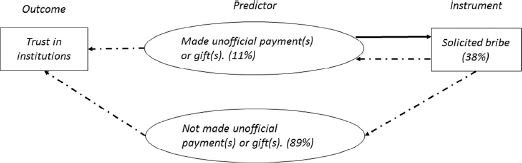
Asking corruption question in LITS on an example of interaction with social security office.
As shown, the LITS began with asking a question about corruption. Approximately 11% of respondents reported paying bribes in social security offices, while about 89% did not pay them. This binomial variable serves as a predictor, corruption. Next, respondents were asked whether the reason they had paid the bribe was because a public official had directly asked them to pay one. As highlighted by the solid line, this question was asked only of the respondents who had reported paying a bribe. Approximately 38% of these respondents had been asked to pay bribes by public officials within the offices of social security. We chose to use the binomial variable “Solicited bribe” as an instrument in our study. We were guided by theoretical and empirical considerations when choosing this variable.
On the one hand, our instrument is unlikely to have a direct effect on the outcome other than through the predictor for three theoretical reasons. First, a strong association between the instrument and the outcome is unlikely since the decision to solicit the bribes originated not from a respondent, but from a public official who is unlikely to be aware of the respondent's level of institutional trust (Clausen et al., 2011). Second, the chances that a public official makes a decision to solicit a bribe based on the respondent's level of institutional trust are even lower. Third, as shown in Figure 1, all respondents (38%) who were solicited for bribes by public officials actually paid them. Thus, as shown by the dotted line, there is no independent effect of having been solicited for a bribe on institutional trust since the effect of being solicited for a bribe inevitably goes via the predictor, corruption (Habibov & Cheung, 2016). Fourth, if a respondent was solicited for a bribe but declined, then no incident of bribery occurred. The reduction in trust that was caused by a solicited bribe that was not paid will still be captured by the predictor, and incorporated into the 89% of responses, and then go to the outcome variable.
In order to empirically test the above-discussed theoretical consideration that the instrument, a bribe solicited by a public official, has no direct influence on the outcome, institutional trust, we correlate the instrument and the outcome. Since LITS focuses on corruption in eight public services, we take the above-mentioned binomial variable, a bribe solicited by a public official, and summarize it over the eight public services examined in the LITS. The summative index of “Solicited bribe” varies between 0 (was never asked) and 6 (was solicited a bribe in 6 public services). Then, we correlate the index of “Solicited bribe” with the outcome variable, “index of institutional trust”. The correlation is negligible, namely, −0.01 confirming the lack of the instrument's influence on the outcome variable. Consequently, we can conclude that our instrument is not correlated with the outcome other than through the predictor.
On the other hand, our instrument is strongly correlated with the predictor, as suggested by the results of several tests. First, the first-stage F statistic in all models is higher than 10, confirming that the instrument has significant explanatory power (Cameron & Trivedi, 2010). Second, to test whether our instrument is weak, we compared the minimum eigenvalue statistic with Stock and Yogo's critical value (Stock & Yogo, 2005). In all our estimations, computed minimum eigenvalue statistics are higher than Stock and Yogo's critical value, signaling that the instrument is not weak. Third, our instrument is significantly associated with more corruption in all first-stage regressions. Finally, we computed robust regression F statistics, which are an equivalent to the Durbin-Wu-Hausman test when data are clustered, to see whether corruption is exogenous (Wooldridge, 2002). In all our estimations, a significant robust F statistic indicates that corruption is endogenous, and so IV estimates should be preferred over OLS ones.
We considered two additional threats to our estimation strategy. First, theoretically, individuals with lower trust could intentionally choose to avoid interactions with public institutions, and hence may be less likely to report having been solicited for bribes. However, LITS also asked about interactions with public offices that would be difficult for respondents to avoid, for instance, that of mandatory public education. In many cases, for instance, avoiding interactions with law enforcement, road police, courts, and services issuing land and property titles may have costlier consequences for the individual than interacting with them and paying bribes. To empirically test the notion that individuals with lower trust could intentionally choose to avoid interactions with public institutions, we correlated institutional trust and the frequency of use of public services. The correlation is negligible, specifically, 0.007.
Second, respondents with lower level of trust may more likely interpret an ambiguous interaction with a public official as a request for paying a bribe, than would respondents with higher levels of trust. However, even in this case, it would still be up to the public official to accept or decline the bribe that he or she did not actually solicit from the respondent (Habibov & Cheung, 2016). To empirically test the notion that respondents with lower trust may more likely interpret an ambiguous interaction with a public official as a request for paying a bribe, we correlated institutional trust and being solicited for a bribe. The correlation is low, namely, −0.02.
Finally, as discussed, our main model is IV. However, we also report OLS results. Comparing IV and OLS results allows us to highlight the impact of endogeneity.
Main results
The results of OLS are reported in model 1, while the results of IV are reported in model 2. The results of OLS suggest that increase in corruption reduced institutional trust by the factors of −0.22. In comparison, the results of IV suggest that increase in corruption reduced institutional trust by the factors of −0.31. In terms of endogeneity bias, our IV estimation for the effect of corruption is approximately 1.4 times higher than the OLS estimated effect. We can also observe similarities regarding covariates. Thus, satisfaction with public services has a positive effect on trust in all our estimations. Favorable economic and political evaluations of the political and economic situation also have a positive impact on trust inasmuch as the variables “Economic situation improved”, “Political situation improved”, and “Support for democracy” are positively associated with higher levels of trust. Women express less trust than men. Age has significant positive effects on trust. Living in the middle wealth and the wealthiest households is associated with lower levels of trust. All other covariates are not significant.
Sensitivity to the extended index of trust
We test the sensitivity of our analysis to the definition of trust by creating a broader index of trust. Specifically, in addition to the items in our original index of trust, we add trust with respect to the army, financial institutions, foreign investors, non-governmental organizations, trade unions and religious organizations (Habibov & Afandi, 2015). Using a broader index of trust has theoretical and empirical justification.
Theoretically, there is difference in how citizens of established democracies and transitional countries tend to assess the performance of institutions in society (Rainer & Siedler, 2009). Institutional trust in established democracies is primarily associated with socio-economic outcomes, for example, access to social benefits and the level of unemployment. By sharp contrast, institutional trust in transitional and developed countries is primarily associated not only with purely socio-economic outcomes but also with a wider range of outcomes, such as individual and economic liberties, and freedoms of religion and association (Abbott et al., 2011; Chang & Chu, 2006; Habibov & Afandi, 2015; Sapsford & Abbott, 2006). Thus, there is the need for incorporating the wide range of institutional trust indicators such as law enforcement, judiciary, military, as well as business, religious, and trade-unions organizations into the institutional trust index. Interestingly, there is also a recent trend to incorporate a wider range of institutions into the index of institutional trust in developed countries. For instance, Edlund and Lindh (2013) incorporate trust in market organizations (i.e. business enterprises) in their analysis of institutional trust in Sweden.
Another argument for using the extended index of trust is empirical. The Cronbach Alpha among all the items of the extended index is 0.89. This value is very similar to the Cronbach Alpha for the original trust index that is 0.88. Besides, our value of the Cronbach Alpha is similar to those reported by previous studies in transitional countries which used alternative surveys (Abbott et al., 2011; Sapsford & Abbott, 2006). The authors reported that Alpha varies from 0.7 to 0.8.
All in all, this evidence corroborates that our extended index serves as a good measure of institutional trust in transitional countries. Consequently, the new index extends the concept of trust from trust to political institutions to trust in a broader range of institutions in society. In accordance, we re-estimate the OLS and the IV models by using the extended index of trust. The results of OLS are reported in model 3 of Table 1, while the results of IV are reported in model 4. The effects of corruption on trust are negative according to all specifications. The results of OLS suggest that the increase in corruption weakened institutional trust by the factor −0.32. In comparison, the results of IV suggest that the increase in corruption reduced institutional trust by the factor −0.51. These results are similar to the results reported in Table 1 in terms of direction and significance of corruption effect on institutional trust. The effect of the covariates is also very similar.
OLS and IV main estimates and sensitivity to the extended index of
trust.
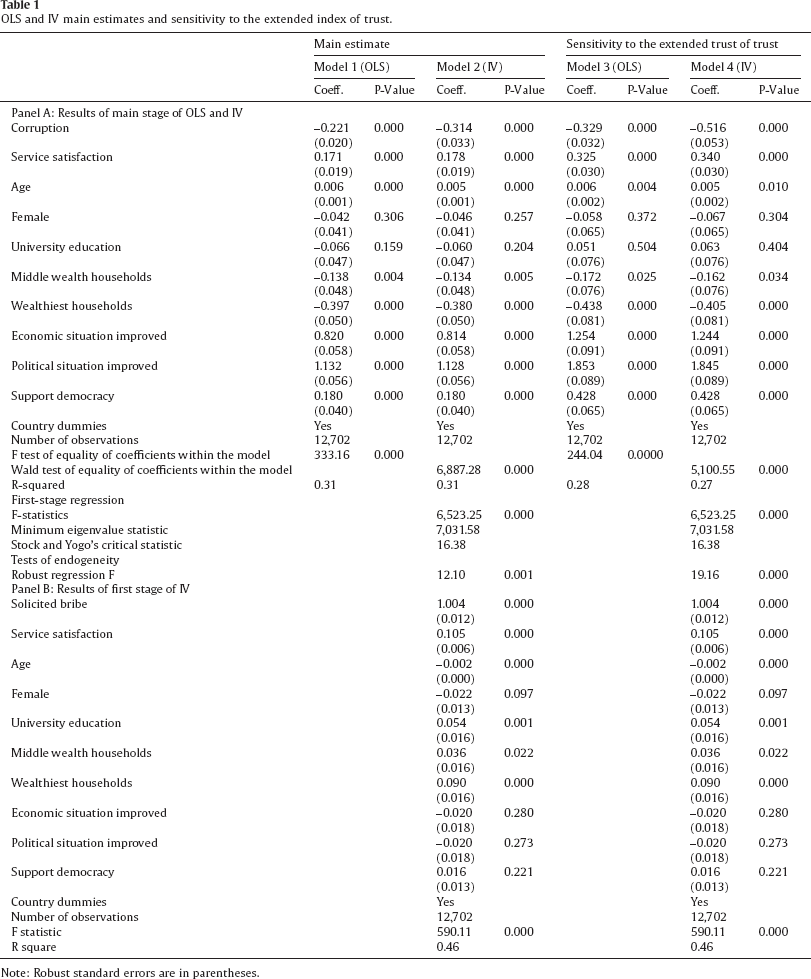
OLS and IV main estimates and sensitivity to the extended index of trust.
Note: Robust standard errors are in parentheses.
In the last step of our analysis, we employ a multiplicative interaction model to further explore the trust–corruption relationship. The “grease the wheels” hypothesis postulates that relationship between will vary according to their levels of satisfaction with services rendered. We add the “corruption × service satisfaction” interaction term variable to our regression models (Murnane & Willett, 2010, pp. 247–9). Detailed descriptions of the estimated IV model with interaction terms can be found in Appendix B.
Lavallée et al. (2008) used similar specifications on a sample of African countries. When estimating the corruption effect, Lavallée et al. (2008) found that the corruption coefficient was negative, while the value of the interaction term was positive. Consequently, the negative effects of corruption on institutional trust fell as the levels of satisfaction increased. Furthermore, the negative effects were rendered insignificant in environments where satisfaction with the quality of services was high. This finding can be viewed as evidence for a rejection of the “grease the wheels” hypothesis. Taking into consideration the results of these previous studies, let us now focus on our own findings.
The results of OLS are reported in model 5 of Table 2, while the results of IV are reported in model 6. As shown, the values for the corruption coefficients are always negative and significant. The values of the interaction terms are positive and significant. To facilitate the interpretation of the regression results, we plot the effects of corruption and satisfaction with services in Figure 2 (Brambor, Clark, & Golder, 2006). As shown, the negative effects of corruption fall as satisfaction with services increases.
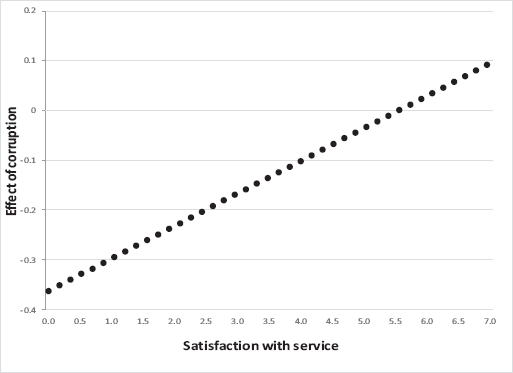
Marginal effects of corruption on institutional trust as satisfaction with service increases. Note: Based on the IV estimation in model 6
Results with interaction terms with OLS and IV.
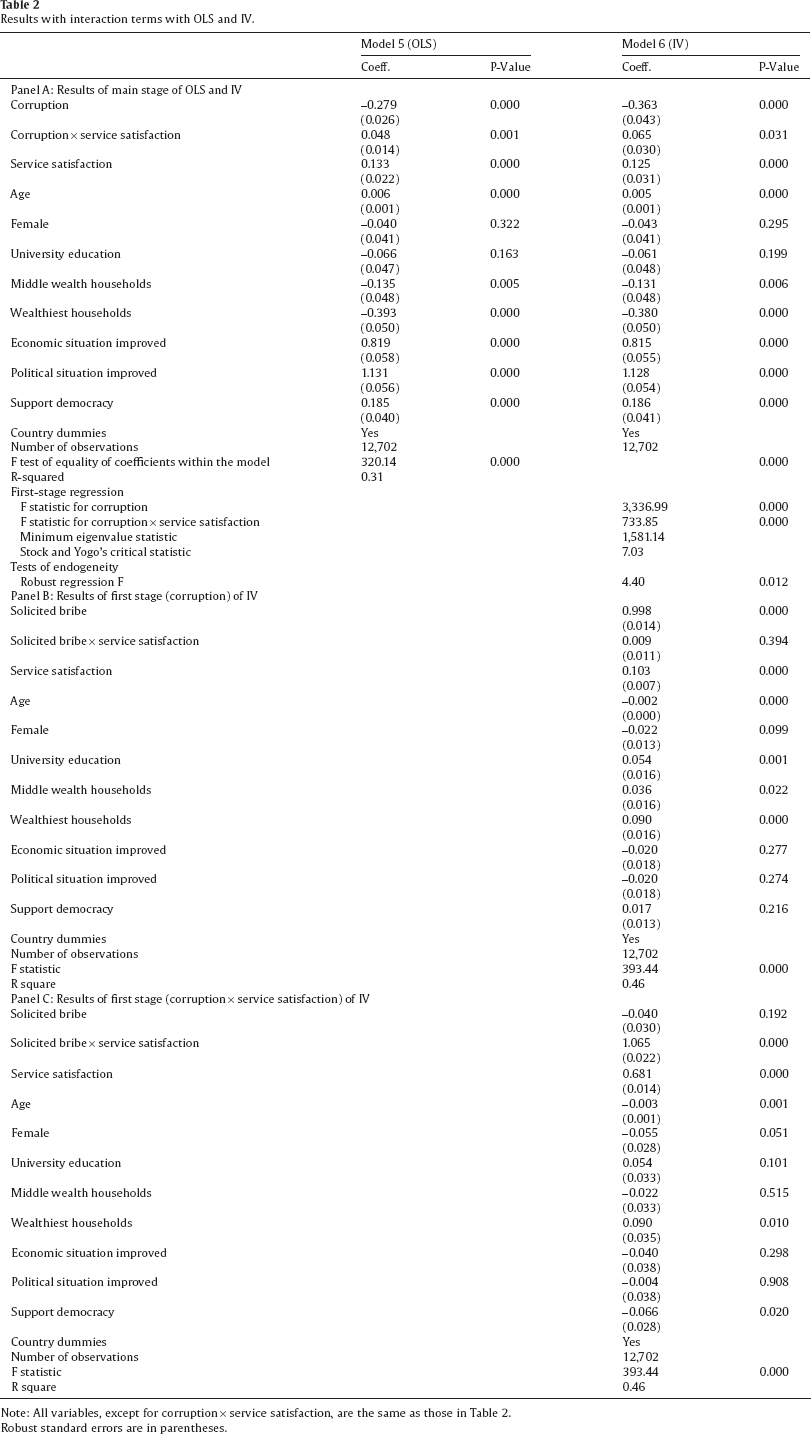
Note: All variables, except for corruption × service satisfaction, are the same as those in Table 2.
Robust standard errors are in parentheses.
The finding that the values of the corruption coefficients are negative, while the values of the interaction terms are either positive or non-significant, contradicts the “grease the wheels” hypothesis. This finding also suggests that the negative marginal effects of corruption are higher in the environments where satisfaction with services is low.
In this study we test several hypotheses regarding the nexus of corruption and institutional trust in FSU countries. More specifically, we evaluate the “sand the wheels”, “grease the wheels”, and “trust begets an honest political system” hypotheses regarding possible relationships between corruption and institutional trust. We use single-stage and instrumental variable regression models and two different indices of institutional trust to check the sensitivity of our analysis.
All things considered, our findings reject the “greases the wheels”, “trust begets an honest political system” and “corruption is so routine that there is no significant effect of corruption on trust” hypotheses. Instead, our findings support the “sand the wheels” hypothesis. This conclusion is supported by the IV that rules out reverse causality and highlights the direction of the effect from corruption to trust, and two different indices of institutional trust.
We also investigate the degree to which the effects of corruption on trust depend on satisfaction with services. According to our estimations, the negative effects of corruption increase as the levels of satisfaction with services decrease. In addition, our findings reveal the negative effects of corruption on both a more narrowly defined trust in political institutions and a more broadly defined trust in societal institutions. Increases in corruption erode trust at all levels of the political spectrum including trust in political parties and in government institutions. However, corruption also reduces trust in other societal institutions such as financial institutions, international investors, non-profit organizations, and trade unions. This finding is important since it highlights the negative consequences of corruption on the development of broader level economic institutions and on civil society.
We would be remiss if we did not mention the limitations of this study. First of all, the data set we used was not specifically designed to capture corruption and institutional trust. In particular, corruption is defined, according to our data set, as petty corruption only. As such, different definitions of corruption could potentially lead to different findings. Second, while we found no empirical evidence for the direct effect of our instrument on outcome variable, the possibility of such effect cannot be completely ruled out. Third, although instrumental variable regression reduces endogeneity as compared with the single-stage regression, it cannot fully eliminate influence of endogeneity.
Finally, this study has implications on theory and practice. From theoretical perspective establishing causal negative effect of corruption on institutional trust suggests that corruption may reduce citizens’ confidence in the capacity of government and other institutions of society (e.g. non-governmental organizations and political parties) to reduce corruption (Morris & Klesner, 2010; Vadlamannati, 2015). As a result, even genuine attempts to fight corruption by politicians may be considered as insincere by the citizenry. In turn, it may significantly lessen citizens’ willingness to be an ally and actively participate in efforts to report and prosecute corruption.
Another theoretical implication is related to the estimation of causal effect of corruption on institutional trust. As hypothesized by this study, endogeneity could be an important factor which leads to biased estimation of true effect of corruption on institutional trust due to reverse causality, omitted variables, and measurement error problems. As demonstrated by this study, if not taken into account, endogeneity leads to considerable underestimation of the negative effect of corruption on institutional trust. Consequently, caution should be exercised in discussing the result of studies which used single-stage regressions to identify the effect of corruption on institutional trust. Given that panel micro-data on institutional trust and corruption are presently lacking, especially in transitional and developing countries, researchers should focus on quasi-experimental techniques which allow reduction of endogeneity, for instance, instrumental variables and propensity score matching.
From perspective of practice, results of our study highlight the importance of accountability. The recent literature demonstrates two key venues for increasing accountability. One of them is promoting transparency. For instance, public rights to information legislations have been adopted by governments in the Americas and Africa (Ackerman & Sandoval-Ballesteros, 2006). Non-profit organization such as the Soros Foundation's and Transparency International developed initiatives to promote transparency in various branches of government and businesses (Fenster, 2015).
Another venue to improve accountability is to foster citizen engagement. Multinational organizations are currently involved in promoting the number of initiatives aimed at promoting citizen engagement. As an illustration, World Bank (2006) highlights the importance of Participatory Policy Making (e.g. local issue forums and consensus conferences) and Evaluation of Public Services and Goods (e.g. citizens’ report cards and community scorecards). Similar initiatives are currently being implemented by UN agencies (United Nations Development Programme, 2014).
Conflict of interest
The authors confirm that there are no known conflicts of interest associated with this publication and there has been no significant financial support for this work that could have influenced its outcome.
Footnotes
Appendix A
Descriptive statistics
Outcome
Mean
%
Std. dev.
Institutional trust
2.70
2.62
Predictors
Corruption
0.57
0.97
Corruption × service satisfaction
0.64
1.96
Covariates
Service satisfaction
0.96
1.05
Age
43.40
17.05
Female
64.60%
0.48
University education
24.95%
0.43
Middle wealth households
30.11%
0.46
Wealthiest households
30.97%
0.46
Economic situation improved
38.05%
0.49
Political situation improved
36.67%
0.48
Support democracy
49.20%
0.50
Instruments
Solicited bribe
0.18
0.56
Solicited bribe × service satisfaction
0.15
0.76
Appendix B
Since we are interested in the complementary effects between corruption and
service satisfaction, we include the interaction term (Corruption × Service
satisfaction) into the second stage of the IV regression model. In order to
satisfy rank condition requirements, we add two additional potential interaction
term instruments into the first stage of the IV regression models as suggested
by Murnane and Willett (2010, 247–249). Due to the difficulty of finding an
additional instrument, Murnane and Willett (2010) suggested using the
corresponding interaction between the original instruments and their
interactions with the same exogenous covariates as instruments. Since solicited
bribes by an official for corruption are viable instruments for corruption, the
interaction of solicited bribe by an official for corruption and service
satisfaction is viable instrument for measuring the interaction of corruption
and service satisfaction. Consequently, the IV model presented in Equations
1 and 2 will be rewritten as