




Abstract
Compared to the scholarship on general political trust, relatively little attention has been paid to institutional trust. Research on the subject tends to treat political institutions as single entities, ignoring the fact that different institutions can enjoy, in the long term, very different levels of trust. This paper builds on the assumption that institutional trust may be formed differently depending on the institution type, and thus aims to explain how trust is formed in different types of democratic institutions. Moreover, it explains how the relationship between trust in a political institution and voter turnout can change depending on how trust is formed. The study is based on the content analysis of thirty semi-structured interviews from the Czech Republic. The study shows that respondents tend to develop trust in a political institution based on their assessment of the institution’s current performance and outcomes rather than their assessment of the institution itself. The study argues that an integral part of the concept of trust in a political institution is the popularity of the politicians who represent the institution. However, how trust is formed depends on the type of institution, which has important implications for measuring this concept. The relationship between institutional trust and turnout may also vary depending on how trust in an institution is formed. Thus, a potential correlation between trust in an institution and electoral participation may exist depending on the type of an institution.
Introduction
A central aspect of contemporary democratic representative regimes is the elections through which positions in political institutions are filled. Although elections are not the only way for the public to participate in political power, public participation in elections is a necessary condition for a functioning democracy. Low voter turnout is therefore a problematic phenomenon. Low voter turnout has been traditionally understood as a threat to the legitimacy of elections, and thus the entire elected institution, and considered a potential threat to democracy in this regard. 1 Some authors describe extremely low voter turnout as an indicator of socio-economic problems and warn of the erosion of equal representation that they believe occurs along with declining turnout. 2
However, low turnout affects institutions within political systems differently. The legitimacy of specific institutions facing low turnout seems to be undermined rather than the legitimacy of the democratic system of governance as a whole. This applies, for example, to the European Parliament, where we have seen extremely low turnout in some countries, or to upper chambers or some regional bodies. Nevertheless, most studies examining voter turnout have not addressed differences in turnout between various types of elections in a single system. The pioneering work in this regard was the study by Reif and Schmitt, which laid the foundations for the theory of second-tier elections, subsequently elaborated by other authors. 3 , 4 However, even the theory of second-order elections cannot explain the differences between elections that are all considered to be second order. Although there have been attempts to rank elections into multiple categories according to how much is at stake in them, this is complicated to measure. 5 Moreover, how much is at stake in various types of elections may differ significantly in different contexts. 6
This paper builds on the assumption that the effect of people’s trust in particular institutions may be a complement to the theory of second-order elections in explaining variation in turnout in one system. A positive relationship between trust in a particular institution and turnout in elections to that institution has been demonstrated in several studies, but little has been done to develop a deeper understanding of this concept. 7 As Grönlund and Setälä concluded, “in order to deepen the understanding of the interplay between political trust and turnout, a more thorough empirical analysis of the origins of political trust would be essential.” 8 However, research to date has tended to focus on overall trust in politics, political regimes, current governments, or rule of law. 9 Research examining trust in political institutions usually does not consider the different natures of various institutions (with rare exceptions such as the work of Fitzgerald and Wolak and Muñoz) and the fact that how trust is built in particular elected institutions may differ depending on the type of institution. 10 , 11
Therefore, our research focuses on what it means to trust a particular political institution and considers the differences between various elected institutions. How exactly is trust in specific political institutions formed within a system? Does it vary across various types of institutions? Moreover, how exactly does trust in a specific institution affect voter turnout? Answering these questions is the aim of this qualitative study, which utilizes semi-structured interviews with two groups of Czech voters. The context of the Czech Republic is convenient for this research as six types of elections are held within this political system, more than one election per year on average. 12 At the same time, there are large differences in turnout for different types of elections. The lowest voter turnout has been observed in Senate elections (usually below 20 percent in the second round), followed by the European Parliament elections. Also, previous research has shown that at the individual level of analysis, voting in Senate elections is strongly influenced by one’s level of trust in the Senate. 13 The Czech upper chamber also faces the low legitimacy problem described earlier, although it probably cannot be said that low turnout is its only cause.
For this reason, the primary focus of this research is on how trust in the Czech Senate is constituted. However, this is examined in the context of trust in other representative institutions with officeholders that Czech citizens can vote for. This approach enables us to assess whether trust in different political institutions is created in the same way and whether it affects voter turnout in the same manner. The contribution of this paper is not only in elaborating the concept of trust in particular political institutions but also in responding to the problem of measuring the concept of trust in political institutions generally, which often relies (especially in various quantitative studies and surveys) on only one direct question and whose problematic nature has been addressed by several researchers. 14 Another practical significance of this research is to assist in addressing the abovementioned problem of extremely low voter turnout in Czech Senate elections. Understanding the creation of trust in this type of institution could help to address this negative phenomenon in the future.
Trust in Political Institutions
Political scientists have been studying the concept of trust and its impact on voter turnout for a long time. The importance of trust in the political system was recognized by David Easton in his pioneering work introducing the system theory of political science in the 1950s and 1960s. 15 Easton understood trust as a factor that influences one of the political system’s inputs, particularly support, while trust also closely relates to the system’s legitimacy. 16 Since then, we have witnessed much follow-up research on the topic with mixed results. Some authors have argued that political trust is one of the basic preconditions for any form of political participation, and thus there is a positive relationship between political trust and political participation. 17 , 18 In contrast, Citrin and later Hetherington denied the existence of this relationship. According to other authors, political distrust may motivate citizens to engage only in rather unconventional and non-institutionalized forms of political participation.19-21 At the same time, Hooghe, with other authors, showed that a lack of political trust can have a negative effect on institutionalized forms of political participation, including electoral participation. 22
Political trust or institutional trust is often considered a dimension of social capital. 23 In addition to institutional trust, interpersonal trust is also often referred to as part of this concept. As Cox points out, there is no agreement among scholars on how to measure social capital or what generates it. 24 Importantly, however, institutional trust in this context often refers to trust in political institutions in general, i.e., in the sense of the credibility of the state apparatus, the quality of governance. 25
This approach, which considers political institutions together as a whole system, usually do not take into account the fact that different political institutions, both elected (chambers of parliaments, presidents, regional councils, local councils, the European Parliament, and so on) and unelected (the government, courts, police, other public authorities), can separately enjoy, in the long term, very different levels of trust, as shown by the Eurobarometer and national surveys. Less attention has been paid to the development of trust in particular institutions, which are understood as distinct parts within a political system. 26 This is how our study approaches the concept of trust in institutions, as this approach has the potential to explain variation in turnout between elections within a single system.
The positive relationship between trust in a particular political institution and voter turnout in elections to that institution was pointed out by Cox, who showed a strong positive correlation between the two phenomena using the example of elections to the European Parliament. 27 The negative effect of distrust in a particular institution on turnout was then demonstrated by Grönlund and Setälä, both at the aggregate and individual levels. 28 More recently, Hruška showed that one’s level of trust in the upper house of the Czech Parliament significantly affects the likelihood that a citizen will at least sometimes participate in these elections. 29
According to Hardin, trust presupposes that the truster (in this case, a citizen) knows the interests and motivations behind the behavior of the trusted (in this case, a particular political institution). 30 To grow the citizen’s trust in institutions, the institution should behave in the citizen’s interests. According to Hardin, however, this knowledge is at present not attainable because of the great distance between citizens and political institutions, and thus, it is not possible to speak of trust or distrust in particular political institutions. Other authors respect Hardin’s assumption but formulate an explanation according to which citizens are able to assess the interests and motivations behind the behavior of the trusted (particular institution). 31 According to Patterson, individuals’ judgements about a particular institution can spread through social networks to reach a large number of people. 32 Normativity also plays an important role here since, as Offe points out, constitutive rules of institutions always have a normative content. 33 This means that a citizen does not need to know the actual interests and motivations of a particular institution but must have a constructed idea about them that he or she believes corresponds to reality. Therefore, Grönlund and Setälä, in direct continuation of Warren’s reasoning, define trust in an institution as a state in which “an agreement of the norms that constitute an institution and institutions are actually perceived to work according to these norms.34,35 In other words, institutional trust refers to the fulfilment of an individual’s normative expectations towards institutions.” 36
Apart from being normative, the public’s expectations of an institution consist of two parts, which essentially create two dimensions of the concept of trust in a particular political institution. The first part presupposes agreement on the rules and norms on which the institution is based; in other words, what citizens expect from the institution itself. This refers to the constitutional definition of the role of the institution. It also includes agreement to the very existence of the institution. These normative expectations for democratic institutions may differ from institution to institution, as people hold conflicting views on the roles of different democratic, elected institutions.37,38 Therefore, Grönlund and Setälä conclude in this regard that “the basis of trust in democratic institutions seems to be particularly ambiguous.” 39
Since incumbents can be replaced in a democratic system, the definition also has a second dimension. 40 This is again a normative assessment of whether the institution follows the rules as expected. This second part of the definition refers to the real-world performance of the institution and therefore involves assessment of the performance of the political actors that occupy the institution. Trust in the institution can thus be closely linked to the outcomes of particular elected politicians and political parties, although as mentioned earlier, Grönlund and Setälä distinguish satisfaction with outcomes from the concept of trust.41,42 In this dimension, however, satisfaction may be a direct source of trust or even part of it, since “people tend to trust things they perceive to be working effectively.” 43 Outcomes and their perceived quality are thus factors expected to influence institutional trust. 44 Grönlund and Setälä also point out that the relationships between citizens and institutional actors are personal, so familiarity and personal characteristics can also play roles in the concept. 45
As explained earlier, institutional trust depends on agreement with the rules and norms on which the institution is based and also on the perceptions of an institution’s performance and the political actors that occupy the institution. However, different types of political institutions are based on different rules and norms and play substantially different roles in the political system. They are also responsible for different policy areas. Their performance may also vary significantly in nature, as can the type of politicians that occupy different institutions. This expectation is supported by Muñoz, who argues that even though institutional trust has a connection with a general attitude towards politics and its institutions, there is some autonomy in the formation of institutional trust. Even though Muñoz’s work is based only on a comparison of different levels of government, there is also an obvious difference, for example, in the roles of the two chambers of parliaments. 46
For these reasons, we presume that trust in different types of political institutions, and the formation of trust, can differ. We have already mentioned Hardin’s point about the great distance between citizens and political institutions affecting knowledge about the institutions. 47 This distance may vary for different types of institutions, as some institutions are closer to citizens than others (not only in the sense of physical distance, but also in the sense of familiarity), which can influence trust formation. 48 Patterson and Offe have offered explanations as to how this distance can be overcome, among others, by using social networks sharing or heuristic shortcuts.49-51 However, the means of overcoming this distance may also differ for different types of institutions. For example, different types of institutions may have different visibility or communication reach, which can also influence trust formation.
This research thus builds on the multidimensionality of the concept of institutional trust and seeks to explain the influence of the described two dimensions on forming trust in particular political institutions—whether citizens take both dimensions into account or whether one dimension is emphasized at the expense of the other, whether this differs across different types of institutions, and whether this influences the effect of this variable on voter turnout.
Methods and Data
Given the general aim of this paper, to explain how people form trust in an institution, the research follows a qualitative research logic. 52 In November and December 2021, thirty semi-structured, individual interviews were conducted with respondents. Each interview lasted between twenty-five and sixty minutes and followed a list of core questions, but follow-up questions were allowed. The interviews included questions asking directly about trust in elected institutions (referring to public opinion surveys). Inspired by the theory, as explained earlier, the interviews also included questions examining trust indirectly: “What are citizens’ normative expectations of a given institution?” and “Does the institution fulfil such expectations?” The interview structure reflected the multidimensional nature of the institutional trust concept. Other questions asked about the significance of incumbents. Based on the answers, it was possible to assess, at least approximately, the respondent’s level of political sophistication. 53
Two groups of fifteen respondents were interviewed. Half the respondents (15) were citizens who said they were less willing to participate in Senate elections than in other elections. This could mean that they do not vote in Senate elections and vote at least occasionally in all other elections (or most of them), or that they always vote in other elections and only occasionally in Senate elections. Another fifteen respondents said they voted in all elections, including Senate elections. This sampling approach enabled comparison of trust formation and its impact on voter turnout for both groups—voters and non-voters. People who do not vote in any elections were not included in the sample, as their trust in political institutions is likely to be strongly influenced by distrust and disinterest in politics as such. Explaining the views and behavior of these people was not the aim of the research, which instead focused on explaining the difference in trust and turnout for various institutions.
The call for respondents was first disseminated in two ways. The first was to disseminate the call on the internet and social media. Those interested had to fill out a short online questionnaire, providing their socio-economic details and information about their voting habits. To guarantee the sample included people not active online (e.g., older people), the researchers asked acquaintances to spread the call among their contacts. More than 500 respondents volunteered to participate in the research as a result. Among these volunteers, fifteen respondents were randomly selected for both research groups for the first round of interviews. This was estimated to be a sufficient number to achieve saturation. If saturation was not achieved, the project budget allowed for another round of interviews. However, this proved to be unnecessary as saturation was achieved. We aimed to create a sample that was diverse in terms of basic socio-economic characteristics, but otherwise respondents were selected randomly. Given the small sample size and qualitative logic of the study, the goal was not to create a representative sample but to ensure sample heterogeneity in variables such as gender, age, size of place of residence, highest educational attainment, and personal income. At the same time, the two groups were similar in these characteristics. 54
All respondents signed an informed consent form prior to the interview. 55 Respondents were motivated to participate in the research by a high financial reward (1,000 CZK) to prevent only people interested in politics from applying. As the interviews revealed, this was achieved. The interviews were primarily conducted in person at a location of the respondent’s choice, but some interviews were conducted online due to the worsened Covid-19 epidemiological situation at the time. In such cases, a webcam was always used. All interviews were recorded and subsequently transcribed.
The interview transcripts were subjected to content analysis. The analysis strategy can be described as abductive. First, passages concerning the formation of trust in political institutions were sought in the respondents’ statements. This provided a first group of codes. These codes are based on existing theories, although new unanticipated codes were also identified. Specific codes were originally divided into two categories corresponding to the dimensions of the institutional trust concept, but a third category (referring to the officeholders) was established during the coding process (see Table 1). In the following section, we describe the meaning of these codes and their occurrence in more depth.
Main Codes and Their Categories
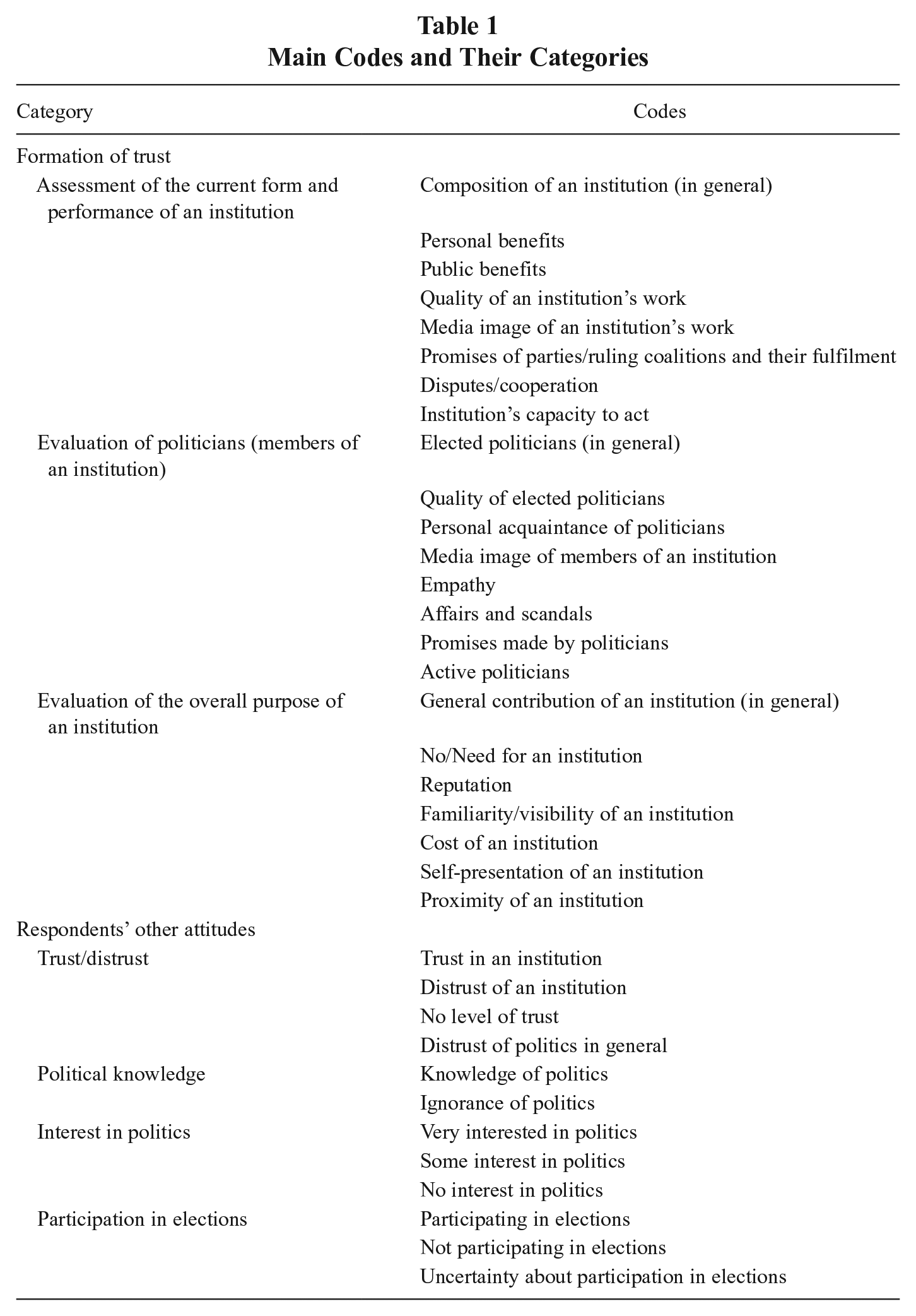
Codes within a second group referring to respondents’ other attitudes (e.g., political sophistication, voter behavior, level of trust in institutions) were then identified (see Table 1). Relationships of codes from both groups were then analyzed. Furthermore, we observed which codes occurred in statements relating to different political institutions and how the pattern of these appearances varied in relation to different institutions. In order to strengthen the reliability of the analysis results, coding was performed independently by both authors. The value of intercoder agreement is 89 percent.
Results
How Is Trust in an Institution Formed?
The analysis of the interviews shows that the perception of trust in political institutions varies among citizens. Indeed, trust in a particular political institution is a highly ambiguous concept that each citizen may understand differently. Therefore, trust can have different sources. When asked what influences their trust in a particular political institution, the most common response was whether the institution “does something for the people,” “solves people’s problems,” “does something for the state,” or “does something for the republic.” If citizens perceive that an institution is beneficial in some way, their trust in it increases. This assessment of the benefits of the institution relates both to the usefulness of the very existence of the institution according to particular norms (that the existence and designation of the institution are beneficial) and to the performance of the institution at a particular time (the institution acts according to its design, which is beneficial, and thus its current actions are beneficial). It thus covers both dimensions of the concept.
In general, respondents tended to attribute more importance to the current form and functioning of the elected institution. Thus, trust in a particular institution is based to a great degree on evaluations of political actors and their performance. In contrast, trust in the political institution itself was often too abstract a concept for the respondents; the institution’s reputation can play at least some role, which may be co-created by politicians themselves commenting on the role of institutions. The interviews revealed that some respondents with less political knowledge generally found it difficult to distinguish at all between different political institutions, their roles, and defined powers. Some respondents could not even name the basic constitutional institutions correctly, or mixed their names in various ways. For such people, it is much easier to navigate through politics according to political parties and their distinctive faces, especially the leadership. Therefore, many respondents tended to slip into evaluating specific politicians and political parties, even when they were clearly asked to evaluate political institutions. On the other hand, only a minority of respondents, usually those who demonstrated greater political sophistication, were able to distinguish between trust in the institution itself and its current performance.
However, the evaluation of political institutions on the basis of their current form and performance is not the sole factor. It appears that what influences trust in a particular political institution can vary significantly across different types of institutions. Familiarity with the institution, the visibility of its members, and the society-wide consensus on the existence and general functioning of the institution play are important as well. If the institution is relatively well known, as are its members, and if there is no debate in the public space about the very existence or role of the institution, citizens resort to the evaluation of the current officeholders and their performance.
In the Czech context, this is especially applicable to the lower house of Parliament and the government, as well as to local councils. In such cases, citizens often associate trust with satisfaction, which is strongly influenced by specific tangible outcomes. Outcomes that are perceived as positive and the result of the work of an institution increase trust in that institution. Most often, these are outputs that directly affect the citizen, especially their socio-economic situation. For example, the trust of people of retirement age in the Chamber of Deputies may be affected by the increase in their pensions, as illustrated by respondent 16’s answer to the question of whether people’s trust in political institutions is influenced more by the incumbents or the institution itself: “If it’s for the pensions, yeah, the pensions go up, then people are satisfied, yeah.” A respondent working as a teacher similarly pointed to the increase in teachers’ salaries. At the same time, this assessment of personal benefits is still normative. Thus, it is not necessary that the actions of the incumbents objectively lead to benefits for the citizen, but that the citizen thinks so. Respondent 1, for example, said that if “someone does something for the republic, they have my trust.” In this respect, she positively evaluated the Chamber of Deputies based on the actions of the Prime Minister, which, according to her, secured (among other things) an increase in the salaries of sales assistants in one particular chain of shops by comparing salaries in other stores. “Just yes, he (A. Babiš, ex-prime minister) did a lot. Even to ordinary sales assistants and . . ., they fought for them to simply get a raise. I remember when Albert (name of the shop) was the worst in terms of pay. And now Albert is ranked third!”
Beyond personal benefit, trust in a political institution grows when citizens believe that the institution has been responsible for advancing the public interest, in other words, if citizens believe that the institution brings some public benefits. In this respect, for example, the construction of key infrastructure such as highways or bypasses around urban areas was mentioned several times. “Well, the bypass has been closed for thirteen years. The only reason was that (. . .), and then the mayor came directly from that Skalice (name of the municipality), which I welcomed, and within a year, it was solved at once,” said respondent 12. The institution’s capacity for action in general is for that reason also perceived positively.
According to the respondents, trust is also generally strongly influenced by the fulfilment of promises made by the politicians and political parties that occupy the institution. Similarly, the current political composition in a given institution plays a significant role. If the institution is controlled and therefore represented by parties with which the citizen identifies, trust in the political institution increases, and vice versa. This is especially true for the government but also for the Chamber of Deputies.
As predicted by Grönlund and Setälä, in addition to the outcomes achieved by the institution, trust is strongly influenced by the characteristics of the incumbents, which are easier for citizens to evaluate. 56 The incumbents represent their institution to a large extent, thus influencing trust in the institution. This applies to both groups of survey respondents. This is, of course, extremely important for institutions with individual membership, such as the presidential office; however, it also applies to the Chamber of Deputies, the government, and local or regional councils. Personal characteristics include whether the politician, in the view of citizens, understands the problems of “ordinary people,” i.e., that they are sufficiently empathetic to the citizenry and show that they are, in fact, one of the people. Respondent 3, in regard to trust in political institutions, said: “(It depends) how good a politician is in presenting himself in public and how he lets those people know or how he shows them that he understands them, that he knows their problems. And what he does for them.” In this context, there is a recurring demand for the humanity of politicians. “They just have some humanity in them and understanding for the people, and they do not just go there to get rich or to make themselves visible, but that they just want to help improve the standard of the citizens,” said respondent 21.
Furthermore, affairs, scandals, and corruption are important in the evaluation of politicians as representatives of political institutions. According to many respondents, such often highly publicized stories negatively affect trust in politicians, which is then transferred to the institution, as was previously shown by Uslaner. 57 Similarly, respondents perceived cooperation among politicians (and institutions) positively, while quarrels and disputes lower their trust. And just as the capacity for action is important for trust in institutions, the impression of high activity and diligence increases trust in specific officeholders, while lack of demonstrated activity reduces trust.
Knowing incumbents plays an important role as well, where knowing a politician more closely increases trust in the entire institution. This is most important for local councils, which are generally closer to the people. This effect is illustrated by the statement of respondent 3: “So, like, to simplify it, there is a broken sidewalk, it’s addressed at the municipal level, and people immediately see that it’s fixed. When something is being solved by the Parliament, pension reform, COVID, health care financing, then people just don’t see in detail whether it’s solved well or badly.” Respondent 18 explained similarly, “If we talk about municipal politics, I think maybe people have more trust in it because there are people they know, people they meet, people who are maybe neighbors somewhere. And they’re addressing issues that seem to affect them more since they are dealing with their immediate surroundings, what’s going to be built etc.” Thus, we observe a certain analogy to the neighborhood effect. However, such proximity can also have a negative effect on trust in the institution. As several respondents pointed out, it is easier to see the downsides, whether it be disappointing outcomes or unpopular politics in the office.
In contrast to personal familiarity or experience stands the media. When asked “what influences people’s trust in political institutions,” several respondents answered “the media” in the first place. The media is more of a form or a channel. However, respondents associated media coverage of politicians primarily with negative reporting. According to them, the aforementioned scandals, affairs, verbal fights, and so on are covered in the media. 58 In this respect, respondents pointed to the power of the media, which, in their view, basically decide how and about whom to report on, which subsequently affects people’s trust.
If an institution is not well known, it is difficult to assess its specific outcomes, the political parties that control it, or specific politicians. This was most of the time the case for the Czech Senate. Trust in the Senate usually cannot be built on the basis of an assessment of the institution’s performance or outcomes, nor on the characteristics of incumbents. Widespread ignorance of the Senate means people form trust in the institution in particular ways. An overwhelming majority of respondents said that they did not have enough information about the Senate and that the Senate was not very visible in the media. This is consistent with the work of Hruška who found citizens possess an extremely low level of knowledge of the Senate compared to the level of general political knowledge. 59
It could be argued that given the high personalization of Senate elections, people should at least know the senator elected in their district. 60 However, the vast majority of respondents did not know who their senator was. This was so not only for non-voters but also for the majority of people who regularly vote in Senate elections. Only a few respondents with a high level of political knowledge could name their senator. This can be explained, among other things, by the fact that some respondents said that even in this personalized type of election, they vote according to political party, not according to the individual candidate. A few respondents also said that the lack of knowledge of candidates was the reason, or one of the reasons, why they did not participate in Senate elections. The exception is when a locally well-known personality is running—in this case, the aforementioned neighborhood effect may be activated.
Another reason for the difference in formation of trust in the institution of the Senate may be the gradual rotation of seats in the upper chamber. 61 This makes it hard for citizens to follow the current composition of the Senate, such as which political forces are represented there and which ones have the majority. For the same reason, the leadership of the Senate, which represents the institution, changes frequently. Moreover, the leaders of the Senate are usually not the leaders or most visible figures of their political parties. Another situation can arise when the composition of the Senate is in opposition to other institutions such as the government, the lower chamber, and the president. In such a case, for citizens who disagree with these actors, the Senate becomes the only institution whose activity corresponds to their interests. This then makes the Senate’s contribution more visible from the citizen’s point of view, and this may affect trust in the institution. Respondent 17 stated, “I just feel like in the Chamber of Deputies . . . When I put it this way . . . for the last, well . . . it’s been like the last six years or five years . . . so they’re coming up with things that I just don’t like most of the time, and I like the Senate for returning a lot of things to them, but I don’t know how to describe it exactly.” However, this view was rather exceptional in the sample, despite the fact that several respondents declared their disapproval of the actions of the government, the lower chamber, and the president.
This underlying characterization of the institution of the Senate has several implications for how trust in the Senate is formed as well as for the overall level of trust in the institution. One positive effect may be that the Senate, compared to the lower house, is not too affected by affairs, scandals, or unflattering arguments at the speaker’s desk. In the context of the Senate, these problems do not diminish its trustworthiness. However, if an affair involving a Senator occurs and becomes publicly visible, it can still reduce the trust in the Senate in the eyes of the citizens, which is harder to regain in comparison to the Chamber of Deputies. 62
Due to the public’s lack of knowledge about incumbents, trust in the Senate is often (but not exclusively) formed on the basis of a normative evaluation of the institution as such (the first dimension of the concept). However, ignorance of the Senate in this respect also means that its contribution, i.e., what it does for the people, is less visible. The Senate’s contribution lies in its oversight function, which is the opposite of the capacity for action that is often associated with trust in an institution. On this basis, then, many respondents did not trust the Senate since they did not see its contribution. Several respondents even preferred to abolish this “useless institution.” People with low trust in the Senate often do not have high trust in political institutions and politics generally but understand that some institutions (with a clear purpose) are needed. However, they find the Senate redundant and expendable. In this respect, respondents often mentioned the context of a small country of ten million people where there is no need for more institutions and additional politicians. This is illustrated by respondent 2 who also said she did not know what the job of senators was: “I feel like the Senate . . . that the Senate is like an extra, that it doesn’t need to be here. That in our small number population . . . I can’t express myself right now . . . just that there’s not enough of us here to need like as many political associations or . . . organizations.” Several respondents also noted that others (including politicians) pointed out the uselessness of the Senate as well.
A minority of respondents appreciated the Senate’s oversight role and described it as trustworthy. These were generally respondents with higher political sophistication. The interviews also revealed that a significant number of respondents had unrealistic expectations of the Senate due to their low knowledge of the institution, as they assigned to the Senate a normative role that it does not actually have (“an apolitical independent institution belonging rather to the judiciary,” “representative of the regions”). Therefore, some respondents stated that in their view, the Senate does not function according to its defining principles, which negatively affected their trust in the institution. However, trust in the Senate was unaffected for respondents unaware of the unrealistic nature of their own normative expectations.
As a consequence of ignorance of the Senate, several respondents (usually non-voters) were unable to determine their level of trust in the Senate. To a limited extent, this is in line with Hardin’s warning that citizens are commonly unfamiliar with the interests and motivations of institutions and therefore cannot have any degree of trust in them. 63
How Trust in an Institution Affects Voter Turnout
As explained earlier in the theoretical part, research has shown that trust in an institution has a significant impact on turnout in elections to that institution. 64 Analysis of the interviews shows that the logic of this effect seems to be primarily related to the visibility of the institution’s specific contributions to society. If citizens believe that an institution is beneficial, their trust in that institution increases, which has an impact on voter turnout. Thus, in this respect, the effect of trust is partly linked to the importance of elections, which refers to the theory of second-order elections. On the other hand, as we have already explained, trust in a particular institution is a multidimensional concept and is influenced by more than just the institution’s perceived contribution.
In first-order elections, we can assume that from the citizens’ perspective, it is crucial that the institution “does something for the people.” In other words, positive outputs that are visible to citizens can overcome the possible effect of distrust in the incumbents. However, a precondition is the ability to distinguish, at least partially, between trust in the institution itself (agreeing with the existence and role of the institution) and distrust in the incumbents. Then even citizens with low trust in a given institution (since they primarily assess incumbents) may still take part in the election. But if the performance of incumbents, or the institution’s otherwise inadequate outcomes, produce distrust, this distrust may be transferred to the institution as a whole, and citizens may decide not to vote in a given election.
Shifting the focus to local councils, our analysis suggests that trust is often positively influenced by the proximity of these institutions to citizens. It is not only easier to evaluate the benefits of such an institution (I see a repaired sidewalk), but the familiarity of candidates helps people have trust in politicians they know. The analysis shows that if citizens know a candidate, they tend to have more trust in that candidate (although, according to several respondents, the greater visibility of local politicians may also be harmful for trust since potential negative aspects are also more visible) and in an institution filled with such candidates, and thus are more likely to vote in these elections. This effect is expected to transfer to elections for other institutions, but there, the probability that the citizen knows the candidates decreases.
As explained earlier, citizens’ trust in the Senate is mostly trust in the institution itself. Our analysis clearly shows that citizens are less likely to evaluate its output and current composition because they are less likely to know about it. Thus, if people distrust the Senate, it is more often due to their general opinion of the existence or norms of the institution. In such a case, this distrust then seems to have a negative impact on the likelihood that such a citizen will participate in Senate elections. If, on the other hand, the existence of the Senate and its role is perceived as beneficial (even if this is based on a lack of information or misconceptions), trust in the institution and the likelihood of participating in Senate elections are higher. 65 In other words, the relationship between trust and participation in elections is more straightforward for Senate elections than, for example, the Chamber of Deputies, where trust is influenced by multiple factors, especially satisfaction with incumbents, and where the effect of trust on electoral participation may not apply. This could explain why we regularly observe higher turnout in Chamber of Deputies elections than in Senate elections, despite the fact that in the long run, both institutions enjoy similar trustworthiness at the aggregate level.
There are also exceptions to the relationship between trust in a particular institution and participation in elections. The interviews showed that some citizens participate in all elections because they see it as their civic duty. This conviction may overcome strong distrust in a particular institution. This is illustrated by respondent 20: “Personally, I tend to think that voting is simply a de facto civic duty, okay? Even though I don’t agree with them, for example, the election to the Senate, or the Senate itself, it is just a completely unnecessary institution.” A very similar approach was taken by respondent 16.
As previously mentioned, some respondents expressed no level of trust in the Senate. They were more likely not to participate in elections as they saw no benefits. Some stated that they did not even notice the Senate elections. Thus, expressing no level of trust and not participating in elections were, in this case, linked to ignorance. However, these respondents suggested (with varying levels of certainty) that if they had enough information about the Senate and learned “what it does,” they might participate in elections.
Conclusions and Discussion
Trust in a particular political institution is an ambiguous concept that is understood in various ways. In fact, it is not possible to talk about just one way that trust in a political institution is built. Previous research suggested that the concept has two main dimensions: trust in the institution itself (the existence and norms of the institution) and trust in the current performance of the institution and its outcomes; this second dimension is closely related to trust in incumbents. 66
However, this research suggests that these two dimensions are not of the same importance—respondents were much more likely to consider the current form and performance of the institution when assessing trust (both self-interest considerations and sociotropic considerations play a role, which contradicts some previous research that recognized sociotropic considerations as more significant for political behavior). 67 In contrast, they often found assessing trust in the institution as a whole very abstract and difficult. In addition to form and performance, the specific politicians that hold office in the institution and their characteristics are also very important. One of the main lessons of our study is that the evaluation of politicians is often easier for citizens and is used as a kind of heuristic to determine trust in the institution. Thus, trust in politicians representing the institution proved to be an integral part of the concept of trust in the institution. At the same time, however, there is a clear difference between trust in the institution’s current performance (and outcomes) and trust in the specific politicians who represent the institution. In fact, citizens may place trust in the institution based on politicians who have no influence on the outcomes that matter to them, including opposition politicians. This may especially be the case when politicians resort to some kind of exhibiting behavior (e.g., protests, as showed by Whitmore). 68 The considerable influence of individual politicians on institutional trust may be a consequence of the slow but increasing personalization of politics. 69 It is thus worth considering whether trust in the specific politicians who make up the institution should be considered as a third dimension of the concept.
The general lesson of our paper is that the way trust is created in a particular political institution depends on the type and nature of the institution in question; this insight is in line with the conclusions of Fitzgerald and Wolak and Muñoz and applies beyond the Czech context. 70 Our explanation is that the different dimensions of the concept of trust in a political institution may take on different levels of importance. The government and the lower chamber of parliament are institutions visible to citizens. They can thus evaluate the specific outcomes of these institutions. Their incumbents are also highly visible, thereby significantly helping to shape the individual’s trust in the institution. Trust in local councils is formed in a different manner, where the proximity of the institution is very important, as was previously suggested by Muñoz. 71 People are usually more familiar with this type of institution, and the outcomes at this level are less abstract. This finding potentially explains Müller’s result, which shows that trust in municipalities is negatively correlated with municipal size. 72 It is also consistent with the findings of Cole and Kincaid and Denters that citizens tend to have more trust in smaller institutions.73,74 Incumbents are also usually well known, but this knowledge is of a different nature compared to that of the government or parliament. This proximity can, however, also have a negative effect on trust in the institution since it is also easier to see the downsides (whether these are disappointing outcomes or unpopular officeholders).
Trust in the Senate is another matter, since the Senate is not very familiar to citizens, and it is hard for them to judge its performance or incumbents. In this case, the respondents were much more likely to evaluate the institution as such even though they usually did not have enough or correct information about it. In this case, to overcome this familiarity distance, respondents often tended to use different heuristics related to the institution as described by Steenbergen and Colombo, for example. 75
Different perceptions of trust, then, can also have different effects on voter turnout. Especially in the case of first-order elections, the relationship between trust in the institution and turnout is more complicated and may not even exist. This is because people’s trust in such institutions is often formed by their evaluations of the current performance and outcomes or by the popularity of incumbents. But turnout does seem to have a positive relationship with trust in the institution itself; this dimension of the concept was not often mentioned by respondents in describing their trust in the lower house of parliament. In a quantitative study with a simple question measuring trust in the institution, the relationship might not be demonstrated at all under such conditions. On the contrary, it can be assumed that the effect of trust in a political institution on voter turnout will more likely be observed for institutions where the trust of citizens is formed on the basis of an evaluation of the institution itself, i.e., the legitimacy of its very existence or the constitutional definition of the institution (not on the basis of incumbent popularity or current performance). This is in line with some previous studies, where the positive relationship between trust in a particular institution and turnout has been confirmed for second-order elections, in which, due to distance or unfamiliarity with specific outcomes, trust is based on evaluation of the institution itself. 76 This also explains why satisfaction with the incumbent government does not correlate strongly with voter turnout, as was pointed out by Grönlund and Setälä, and why research investigating the effect of trust on turnout has produced mixed results in general.77,78 Thus, when considering the relationship between trust in an institution and voter turnout, the type of institution should be taken into account.
Our findings also have implications for measuring political trust and complement the observations of Bauer and Freitag, who suggested a new approach to measuring trust emphasizing the importance of context. 79 The complexity of the concept of trust in political institutions and its variability depending on the type of institution should be considered when measuring and interpreting this concept. Quantitative studies are often limited to one question directly asking about the level of trust in the institution. This operationalization does not seem sufficient in light of the findings of this study. Not only can respondents interpret the question in different ways, but at the same time, they may answer it differently when assessing trust in different types of institutions. With some institutions, then, it may be difficult for respondents to answer at all because they may not have any level of trust. Thus, the respondent should definitely have the option not to answer. It is advisable to ask more questions when measuring trust in an institution and to focus on two or possibly three dimensions of the concept. However, it may be difficult for many respondents to distinguish between assessing trust in the institution itself, assessing trust in the current form and performance of the institution, and trust in the politicians representing the institution. The various modes of forming trust in political institutions should also be considered when interpreting or comparing trust in different institutions.
For some citizens with an extremely low level of political knowledge, it may be too hard to distinguish between institutions at all, which is in line with previous research showing that less knowledgeable individuals are less able to evaluate different institutions independently—even though previous studies have focused mainly on EU institutions. 80 In such extreme cases, then, the argument that trust in different institutions is closely interlinked and that citizens do not differentiate between the institutions when assessing trust may hold. 81 On the other hand, even in the context of high levels of political ignorance, people often use various heuristics to overcome their ignorance, as we have already mentioned. 82 Moreover, based on our findings, we perceive ignorance more as a factor that affects the way institutional trust is built, since knowledge of different institutions also often varies. 83
The significance of this study’s findings exceeds the Czech context; there is no reason to assume that the general principles described are significantly different outside the Czech Republic. On the contrary, a system of numerous elected political institutions, some more visible or closer to the citizens than others, is typical of many democratic regimes. Therefore, it is not surprising that many of our findings are consistent with previous research in different countries. In addition, the Czech case is not unique in that some institutions face a legitimacy problem—whether it be the European Parliament, the upper chamber, or head of state, for example. The relevance (but not presence) of each dimension of the concept then may vary depending on local conditions, e.g., the degree of personalization of politics in a given country. Nevertheless, this research is a qualitative case study with its natural limitations. In the future, the findings should ideally be confirmed using a larger sample and a more sophisticated measure of trust, as this paper implies.
Supplemental Material
sj-pdf-1-eep-10.1177_08883254241229730 – Supplemental material for Outcomes, Politicians, or the Institution Itself? Using a Czech Case to Explain Trust Formation in Different Political Institutions and the Implications for Voter Turnout
Supplemental material, sj-pdf-1-eep-10.1177_08883254241229730 for Outcomes, Politicians, or the Institution Itself? Using a Czech Case to Explain Trust Formation in Different Political Institutions and the Implications for Voter Turnout by Jan Hruška and Stanislav Balík in East European Politics and Societies
Supplemental Material
sj-pdf-2-eep-10.1177_08883254241229730 – Supplemental material for Outcomes, Politicians, or the Institution Itself? Using a Czech Case to Explain Trust Formation in Different Political Institutions and the Implications for Voter Turnout
Supplemental material, sj-pdf-2-eep-10.1177_08883254241229730 for Outcomes, Politicians, or the Institution Itself? Using a Czech Case to Explain Trust Formation in Different Political Institutions and the Implications for Voter Turnout by Jan Hruška and Stanislav Balík in East European Politics and Societies
Footnotes
Funding
This research was written at the Department of Political Science, Faculty of Social Studies, Masaryk University, Jostova 10, Brno and was supported by the Operational Programme Research, Development and Education (OP VVV) project of the “Internal Grant Agency of Masaryk University” (reg. no. CZ.02.2.69/0.0/0.0/19_073/0016943) and by a Specific University Research Grant provided by the Ministry of Education, Youth and Sports of the Czech Republic.
Ethical Approval
The Masaryk University Research Ethics Committee confirmed that the research is not subject to ethical approval.
Informed Consent
Respondents interviewed by the authors signed informed consent.

Supplemental Material
Supplemental material for this article is available online.
Notes
Supplementary Material
Please find the following supplemental material available below.
For Open Access articles published under a Creative Commons License, all supplemental material carries the same license as the article it is associated with.
For non-Open Access articles published, all supplemental material carries a non-exclusive license, and permission requests for re-use of supplemental material or any part of supplemental material shall be sent directly to the copyright owner as specified in the copyright notice associated with the article.
