






Abstract
The purpose of this paper is to identify success factors in human resource management during the transition process to Lean Production. Using case study research in the aeronautics industry, the results show a series of explanatory factors that are then grouped into main factors depending on the phase of the transition process. Thus, in the pre-adoption phase, the setting up of joint management-trade unions committees is the main factor. Five main factors are found in the other three phases of the adoption and implementation process: training, communication, rewards, job design, and work organization. Moreover, a variety of explanatory elements are identified in each of the main factors found in each phase of the transition process to Lean Production. Finally, a model is developed to understand the sequence that leads to the cultural change associated with Lean Production.
Introduction
Lean Production (LP) has been adopted by companies in various service and industrial sectors in recent decades and these companies have subsequently moved forward in its implementation. In many cases this has enabled them to improve their results and competitiveness (Moyano-Fuentes and Sacristán-Díaz, 2012). However, empirical evidence shows that the transition to LP is a complex task that generally has to contend with a large number of obstacles (Scherrer-Rathje et al., 2009).
LP adoption entails significant organizational change which requires companies to properly manage the key factors that might influence on the success of the adoption process. Although the literature highlights the crucial role of people (e.g., Sawhney and Chason, 2005; de Treville and Antonakis, 2006), there is a lack of studies that examine the changes that take place in Human Resource (HR) management during the adoption process (Needy et al., 2002).
As far as the implementation of LP is concerned, a number of recent studies state that not enough research has been conducted into the human aspects associated with this phase (Angelis et al., 2011; Bonavía and Marín-García, 2011). Despite LP involving significant changes in HR practices and policies (Biazzo and Panizzolo, 2000), there is no consensus in the literature on the way that LP might affect people (Conti et al., 2006; de Treville and Antonakis, 2006), or the role of HR policies and practices during the LP implementation process (Liker and Hoseus, 2010; Bonavía and Marín-García, 2011).
Consequently, it is important to address in depth the role that people play during the different phases of the transition process to LP, including both LP adoption and implementation. Therefore, our main research question is:
To identify the HR explanatory success factors during the different phases of the transition process to LP.
To group the explanatory success factors associated with HR management into main factors linked to human resource management during each of the transition process phases to LP.
To propose a model that includes these main factors and the relationships among them during the various phases of the transition process to LP in order to gain a better understanding of the cultural change associated with the transition to LP.
Lean Production
LP is a management system focused on eliminating the types of waste identified by Ohno (1988) and other wastes related with internal variability and external variability produced by relationships in the supply chain (de Treville and Antonakis, 2006; Shah and Ward, 2007). As such, LP can be defined as “an integrated socio-technical system whose main objective is to eliminate waste by concurrently reducing or minimizing supplier, customer, and internal variability” (Shah and Ward, 2007, p. 791). The main objective of this management system is, therefore, to achieve maximum efficiency, carrying out operations at a minimum cost and with zero waste.
LP is a management philosophy based on continuous improvement, which requires the involvement and commitment of everyone in the organization and provides an opportunity to improve the results in terms of quality, costs and lead times (Womack and Jones, 1996; Moyano-Fuentes et al., 2012). Since it was first disseminated, LP adoption has therefore spread to companies in a range of industrial and service sectors and has, in many cases, enabled these firms to improve their results (Moyano-Fuentes and Sacristán-Díaz, 2012). However, although numerous companies have implemented LP successfully, others have not achieved the results that they anticipated, and failed implementations are common (Staats et al., 2011), as is the inability to maintain results over the medium and long term (Lucey et al., 2005). This is a consequence of the LP implementation process’ inherent complexity (Scherrer-Rathje et al., 2009).
This has driven research interest in the factors that facilitate and inhibit the LP adoption and implementation processes. Prior research has identified a series of factors that facilitate theses processes and there is a broad consensus that HR and cultural change are critical factors for the success of Lean initiatives (Emiliani, 2006) and their sustainability over time (Bateman, 2005).
There is also a broad consensus that the success of a Lean transformation not only depends on the application of tools and techniques (
Lean Production and Human Resource Management
There are various lines of research in the literature that links LP and HR management that focus on describing the HR policies and practices associated with LP (e.g., Forza, 1996; Niepce and Molleman, 1996; Pil and MacDuffie, 1996; Biazzo and Panizzolo, 2000; Olivella et al., 2008), the impact that LP implementation has on people (e.g., Forrester, 1995; Niepce and Molleman, 1996; Conti et al., 2006; de Treville and Antonakis, 2006) and the influence that LP-associated HR practices have on performance (e.g., Shah and Ward, 2003; Bonavía and Marín-García, 2011).
However, despite the importance of managing HR for LP, a greater emphasis has been detected in the literature on technical aspects than on the roles of people and cultural change in the transition process to LP. Thus, while a range of studies have analyzed the general success factors in LP adoption and implementation (e.g., Worley and Doolen, 2006; Turesky and Connell, 2010; Pedersen and Huniche, 2011), there are few that analyze the success factors of HR management in detail.
There is no consensus on what the main success factors are in these studies, although certain factors are suggested by different authors. Olivella et al. (2008), for example, identify LP-oriented work organization strategies, including standardization, ongoing training, teamwork, participation and empowerment, versatility, commitment to company values, and contingent rewards. Meanwhile, Bonavía and Marín-García (2011) point to LP-oriented companies promoting flexibility and versatility, investing in training and committing to variable compensation. The literature on advanced human resource practices (Huselid, 1995; MacDuffie, 1995; Pil and MacDuffie, 1996) identifies HR factors that have a good fit with LP, including teamwork, job rotation, ongoing training, contingent rewards, job security, versatility and participation.
LP adoption entails significant organizational change, which means that companies should manage people at the beginning of a Lean transformation (Sawhney and Chason, 2005; de Treville and Antonakis, 2006). LP can be especially complex in this respect due to the high degree of worker participation required to organize the work (Pil and MacDuffie, 1996). In addition, cultural change and the commitment and support of company management are some of the greatest challenges to Lean being accepted by people (Sawhney and Chason, 2005; Beauvallet and Houy, 2010), and might slow the adoption process down (Emiliani, 2006). Addressing in depth the changes that take place in HR management during the LP adoption process is therefore a major issue.
Similarly, there is no consensus with regard to the way that LP could affect personnel (Conti et al., 2006; de Treville and Antonakis, 2006), or to the role that HR practices and policies play during the LP implementation process (Liker and Hoseus, 2010; Bonavía and Marín-García, 2011).
In other respects, current researches consider the transition to LP as a single process and throughout which people are assumed to play a uniform role. This paper therefore focuses on identifying the success factors in HR management during the LP transition process distinguishing between the adoption and implementation phases, with the goal of establishing a road-map that facilitates this process and enables improvements to be made to it.
Research methodology
Research design
LP adoption and implementation in the aeronautics industry is an emerging research area, which means that the case study is a suitable research method. Specifically, this method is especially suitable for exploratory studies such as this (Benbasat et al., 1987; Voss et al., 2002; Yin, 2003). Benbasat et al. (1987, p. 370) state that “the case method lends itself to early, exploratory investigations where the variables are still unknown and the phenomenon not at all understood”. These are the conditions found in this research as the key factors have still not been identified that enable the role of human resource management to be understood in the transition process to LP.
Case studies are also especially applicable for the analysis of longitudinal change processes (Eisenhardt, 1989), for gaining a holistic perspective of a phenomenon (Gummesson, 2000), when the phenomenon being studied cannot be understood separately from its context, and for explaining relationships that are too complex to be studied using quantitative research methods (McCutcheon and Meredith, 1993; Yin, 2003). The case study is also more appropriate for responding to “why?” and “how?” type questions than other research strategies (Yin, 2003).
For all these reasons we consider that the case study provides the depth required for exploring why and how companies have successfully managed human resources during the LP adoption and implementation processes. We use a multicase study to explore these questions and build theory, as this method is suitable for observing and describing a complex research phenomenon and improving its understanding (Meredith, 1998; Eisenhardt and Graebner, 2007). This method also helps to reinforce internal validity and enables the findings to be replicated, thus increasing the external validity of the research (Eisenhardt, 1989). At the same time it helps to avoid observer bias (Handfield and Melnyk, 1998), aids triangulation and improves the generality of findings (Voss et al., 2002; Yin, 2003), making the research more robust overall (Herriot and Firestone, 1983).
Case selection
The first decision that had to be taken to guarantee the validity of the findings involved selecting the case studies and unit of analysis (Stuart et al., 2002). A theoretical sampling model was used for this (Eisenhardt, 1989; Yin, 2003) with the aim of obtaining companies that provided an optimum ‘chance to learn’ (Stake, 1995) and, consequently, that the resulting case studies could provide relevant and significant findings. Our strategy was based on enabling literal replication, using information-rich cases distributed in such a way as to achieve maximum variation (Miles and Huberman, 1994; Stuart et al., 2002).
The unit of analysis chosen was Lean adoption and implementation in plants belonging to prime contractors in the aeronautics industry. There were a number of reasons for the choice of this unit of analysis. On the one hand, it is a unit of analysis that is especially suitable for case studies and even more so when the aim is to explain the cultural change that is inherent in the transition process to LP. On the other hand, it also enables LP adoption and implementation to be investigated as a sequential process in plants where both have taken place in recent times.
The case studies investigated were LP adoption and implementation at five production plants. Two of these were aircraft final assembly lines (FALs) and the other three were prime contractors devoted to manufacturing and assembling parts, subassemblies and large aerostructures, primarily for the FALs.
Data collection
Before beginning the field work, a case study protocol was designed that contained the data collection instruments and the procedures and general rules for carrying out the multi-case study. This protocol was updated and enhanced with each visit that took place (de Weerd-Nederhof, 2001), affording the research greater reliability (Yin, 2003).
A tentative script was designed for the in-depth semi-structured interview based on a review of the literature on LP in general and on LP in the aeronautics industry in particular. A preliminary version of the interview script was pretested with two prestigious researchers in Operations Management and two widely acknowledged experts in the aeronautics industry. Finally, a pilot study was conducted in a manufacturing plant in said industry. New questions were included as a result of this process and some changes were made to the wording of the questions to prevent any misunderstandings in the interviews (the final interview script is provided in Appendix 3).
Both primary and secondary information sources were used in order to triangulate the data. This helped to ensure construct validity (Easterby-Smith et al., 2002). In-depth semi-structured interviews, surveys, plant visits/factory tours and, in some cases, managers’ statements and conversations with blue-collar workers were used as the primary sources of information. The secondary sources used were company documentation, reports and annual reports, websites, published interviews and similar sources.
The same
To ensure validity, a number of senior managers were interviewed in all cases (between two and three key informants). A total of twelve senior managers were interviewed. When visiting some facilities we also had the opportunity to talk to plant employees about a number of aspects of LP. This contributed to our understanding of the changes that occurred in the role of people during the LP adoption and implementation process.
Two researchers were always present at the interviews. This enabled us to take independent explanatory field notes, clarify any ambiguous issues and identify any questions of interest during the data collection process. It also helped to limit observer bias (Eisenhardt, 1989).
The data collection process took place from October 2010 to March 2011. Each interview lasted between 75 and 105 mins and each tour of the facilities took an average of 60 mins. All the interviews were recorded and transcribed immediately afterwards. A database was created with the transcriptions of the interviews, questionnaires, documents and explanatory field notes. This also helped to make the research more reliable as it provided easy audible trace-ability of the events.
Data analysis
A number of measures were adopted to ensure the validity of the analysis and interpretation process. The analysis was done on a case-by-case basis and a cross-case analysis was subsequently done of the various case studies. The within-case analysis helped us to begin to progressively make sense of the large quantity of data collected and interpret them (Eisenhardt, 1989). The emerging topics for exploration and explanation were identified from the analysis of the interviews and data, and the relationships found among the variables were explored and defined in the subsequent interviews (Miles and Huberman, 1994).
Within-case (e.g., by comparing primary and secondary data) and cross-case (e.g., by comparing the data collected at the different production plants) triangulation was thus done. Confirming the findings in each of the cases in subsequent cases controlled both internal and external research validity.
The data analysis followed a number of steps based on the Grounded Theory coding paradigm proposed by Strauss and Corbin (1998). This comprises open, axial and selective coding stages to ensure conceptual development and density (these stages are illustrated graphically in Appendix 1). The core idea of using this paradigm is to use a structured method to establish a connection between unformatted text and the research objectives (Binder and Edwards, 2010).
In the open coding phase the data were coded, analyzed and conceptualized. As a basis for this we used the transcriptions of the interviews and statements made by senior management (56,925 words). The first step was to work on each interview individually, using the phrase-by-phrase coding tactic to forge a strong link with the data collected.
We were mindful of the two phases of the transition to LP (adoption and implementation, that had initially been defined in the interview script – theoretical sampling–) during the coding, and the coding was different for each of the phases. However, as the field study and analysis moved on, four different phases were identified within the adoption and implementation processes.
Codes with the same meaning were grouped together in more abstract concepts. Similarly, the concepts and their corresponding properties and dimensions were identified and defined as the process moved forward. A number of memos were also generated depending on how the coding was interpreted and the data from the field notes. The concepts were compared to other terms to check similarities and differences (Figs. 2.1 and 2.2 in Appendix 2 show some examples of the open coding process and a memo, respectively).
During the axial coding phase we continued to compare within- and cross-case codes, and the relationships among them became clearer, leading us to group codes with a similar meaning in more abstract initial (
In this way, the subcategories and categories were simultaneously interconnected with each of the four phases identified. This process therefore enabled us to see how the subcategories were related to the categories in each phase of the LP transition process.
The category that represents the core research theme was identified in the selective coding phase for integrating and refining theory: the human resource management process during the transition to LP. Subsequently, the four phases that are part of the core category were linked. Choosing the “process” as the core category of a theory and broken down this into “subprocesses” is supported by Strauss and Corbin (1998, p. 179).
The categories and subcategories that emerged from the open and axial coding were refined and interconnected with the goal of creating a theoretical framework that would help to explain the core phenomenon under study. Subsequently, a more advanced theoretical framework was constructed by making a comparison with the prior literature and the researchers’ experience in the area of study. The process ended when a point of theoretical saturation was reached.
The results of the open, axial and selective coding were constantly compared as they are mutually independent and iterative phases.
It should be highlighted that conceptual maps were used to link the codes, subcategories and categories conceptually (Novak, 1998). The use of this “visual representation” tool is very useful for progressively developing both the concepts and their interrelationships (Miles and Huberman, 1994; Maxwell, 2005). By way of example, Fig. 2.3 in Appendix 2 shows a coding tree for a specific factor.
To ensure the consistency of the findings, the authors analyzed the data independently and later met on a number of separate occasions to compare their results. Some details also required confirmation by the interviewees after the interviews (e.g., in telephone conversations held with them or by email to clarify some issues). This helped to control the research construct validity. It should be stated that a qualitative research software package (Atlas.ti) was used to code the data. The use of this software facilitated coding by linking text segments to codes, creating memos, and providing a visual representation of the data and findings.
Results
The findings enabled us to distinguish four phases closely linked to the role of HR in the transition process to LP: (1) Management of the labor relations framework prior to LP adoption; (2) LP adoption in pilot areas; (3) LP adoption deployed throughout the whole plant; and (4) LP implementation. We found various explanatory success factors in each phase that, in the case of the adoption and implementation phases (phases 2, 3 and 4), were grouped into five main factors: training, communication, rewards, job design and work organization.
Table 1 shows the main factors (categories), the explanatory success factors (subcategories) and the key concepts that were identified. All the explanatory factors are also illustrated with one or more quotations from the interviews to comply with the principles of consistency and transparency by providing examples of coded text that enable other researchers to understand how the analysis was done.
Main and explanatory success factors of human resource management in LP adoption and implementation.
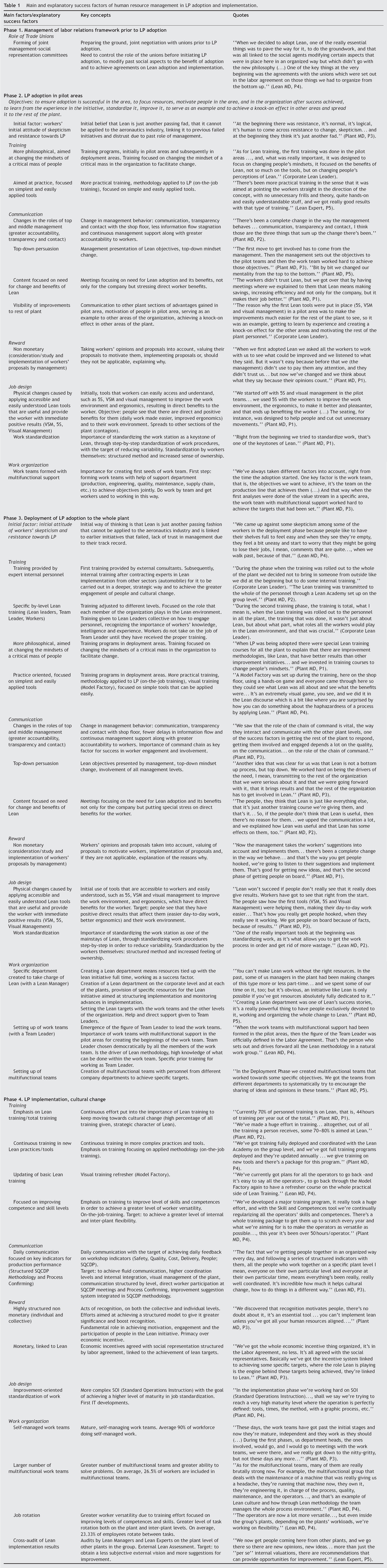
Main and explanatory success factors of human resource management in LP adoption and implementation.
It was possible to deduce a model from the analysis that includes both the main factors and the explanatory factors that were identified and the relationships among them depending on the phase under analysis.
The factors that were identified in each of the phases and in all the cases analyzed are discussed below and quotations are given to support the findings.
Phase 1: Management of the labor relations framework prior to LP adoption
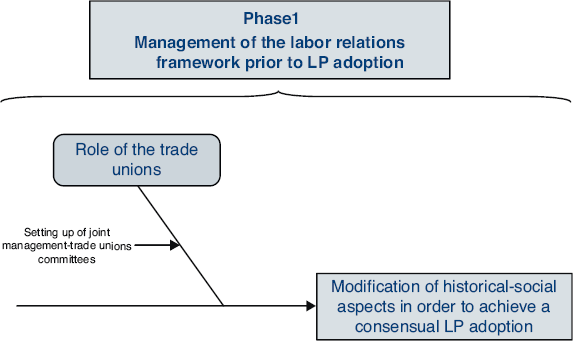
A prior requisite to LP adoption was the setting up of joint committees between management and social representation. This was done to modify some past social aspects that might later become obstacles to the adoption and implementation process. If negotiations on the Lean transformation are held with unions at the beginning, this might smooth the way and remove some of the obstacles to the organizational cultural change required by this management system and, ultimately, enable LP to be implemented successfully.
This finding sheds some light on prior research into the role that the unions play in LP that has not provided conclusive evidence (Kochan et al., 1997; Shah and Ward, 2003). We found that managing the role of the unions is crucial for guaranteeing that LP adoption and implementation are undertaken successfully and at the same time could result in less worker resistance to change. Our results are in line with the findings of Kim and Bae (2005), who state that a crucial factor in LP adoption is knowing whether the organization is unionized or not, as the innovative practices of Lean in the workplace strongly depend on the strength of the trade union and the strategy should consequently be focused differently depending on the state of unionization.
Phase 2: LP adoption in pilot areas
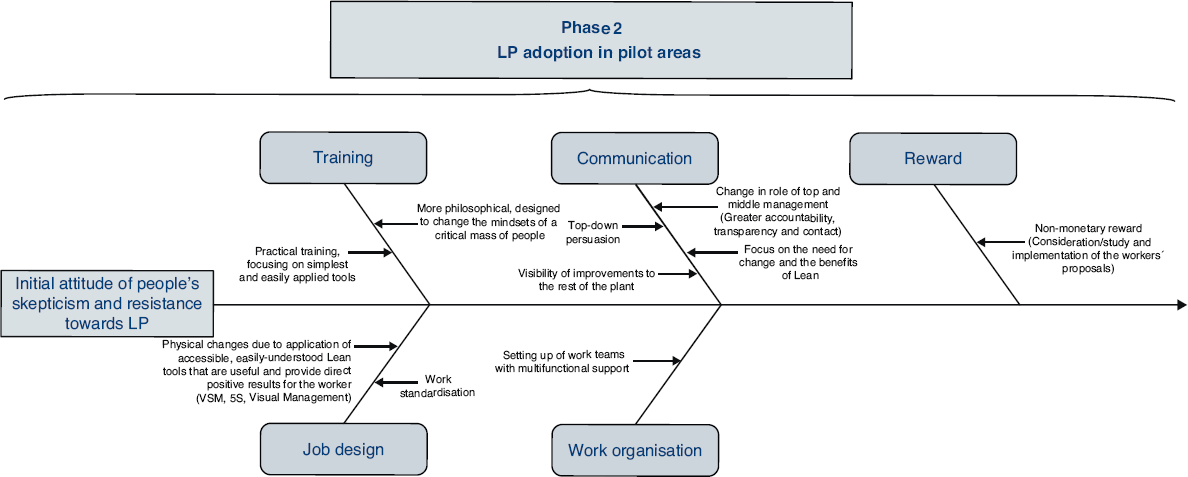
Targeting a pilot area as an LP adoption strategy is a success factor in itself. Targeting resources to a pilot area principally helps build motivation among the people involved in the project, and serves as an example to other areas, triggering the roll out of the LP initiative to the rest of the plant. This finding is in line with the gradual implementation of events approach (Wilson, 2009).
However, we identified an initial attitude of skepticism and resistance to LP among blue-collar workers which, despite being tempered by the joint negotiations with the unions, had to be managed using a number of mechanisms, specifically the following five main factors.
Training
Training focused on changing the mindsets of the people in the area, both the line workers’ and the managers'. This first explanatory factor has been the object of little attention in the literature, although a number of authors state that a change in mentality is crucial for achieving success in Lean (Niepce and Molleman, 1996; Sawhney et al., 2010).
A second explanatory success factor was practical training in the use of basic and easily applied tools through what is known as on-the-job-training or learning-by-doing. This finding supports what is stated in the prior literature about how important applied training is for people to better assimilate and learn the first Lean tools (Barton and Delbridge, 2001; Stewart et al., 2010).
Communication
Communication has been widely recognized in the literature as a vital component of LP (Womack et al., 1990; Spear and Bowen, 1999). The first explanatory success factor was the change in the role of senior and middle-management, with these being the first to encourage greater contact with shop floor personnel and more transparent feedback.
This reinforces the importance that the literature places on the change in managers’ roles and functions within the context of the adoption of Lean tools (e.g., Power and Sohal, 2000). This was the very beginning of participatory management and the delegation of responsibilities to workers, as well as greater support being given to them (Beauvallet and Houy, 2010; Turesky and Connell, 2010).
A second explanatory success factor was communication aimed at winning people over from the top down and focusing on the need for change and the benefits of Lean so as to overcome people's initial skepticism and resistance to LP. Thus, a number of authors found that failing to create and communicate a sense of urgency in Lean transformations and a lack of information about the initiative and need for change might cause the Lean initiative to fail (Womack and Jones, 1996; Lucey et al., 2005; Worley and Doolen, 2006; Scherrer-Rathje et al., 2009). In this same respect, Gagnon et al. (2008) find that if workers are well-informed about the Lean strategy, this could be a prior step to them committing to it.
Finally, we found that the visibility of the improvements achieved by the workers in the pilot area was the key to recognizing the efforts made by the team and to acting as an example to the other areas of the company. Scherrer-Rathje et al. (2009) state that communicating the success of Lean to the rest of the organization from the very beginning is critical for giving workers a better understanding of the Lean benefits and creating a positive perception of LP among the rest of the members of the organization.
Rewards
During the adoption phase rewards were linked exclusively with management considering and implementing workers’ proposals.
This issue was a key feature in getting workers to trust managers, to overcome the inertia of the past and align workers with the Lean initiative, and to boost motivation (MacDuffie, 1995; Worley and Doolen, 2006). In support of this idea, Boudreau et al. (2003) state that rewarding people's “good work” in a non-monetary way may contribute to improving results in production plants that are already making headway in a Lean initiative.
Job design
One first explanatory success factor was the physical changes that came from implementing basic, easy-to-understand Lean tools. The objective of starting with tools like VSM, 5S and Visual Management was to improve the work station and its ergonomics, which was of direct benefit to the workers. This resulted in the personnel becoming more engaged with the initiative and helped it to spread to other sections of the plant. These findings are similar to those of Abdulmalek et al. (2006), who state that there are tools that can be easily applied in any industry and which can be an excellent starting-point for identifying sources of waste, and also to those of Antony (2011), for whom these tools help to organize the work place, motivating employees to forge ahead with adoption and the early involvement of the rest of the plant. A second explanatory success factor was work standardization, and, specifically, that this was done by the workers themselves with the help of the support departments in order to enhance the feeling of ownership, tracking and continuous improvement. The literature highlights the role of standardization as a key tool for coordinating work in a Lean environment (e.g., Parker, 2003; Olivella et al., 2008) as it facilitates the implementation of different techniques and task rotation (Niepce and Molleman, 1996; Olivella et al., 2008).
Work organization
The explanatory success factor that we found here was the setting up of work teams with multifunctional support. The setting up of work teams with support on the production line was crucial for creating the beginnings of the work teams of the next phase, for getting the workers used to the way that people have to work in a Lean environment and for implementing the principles of participatory management and delegation of responsibilities. Little analyzed in the prior literature, our finding nonetheless corroborates the findings of Åhlström (1998), who states that the first work teams in LP adoption must receive support if they are to be successful.
Phase 3: LP adoption deployed to the rest of the plant
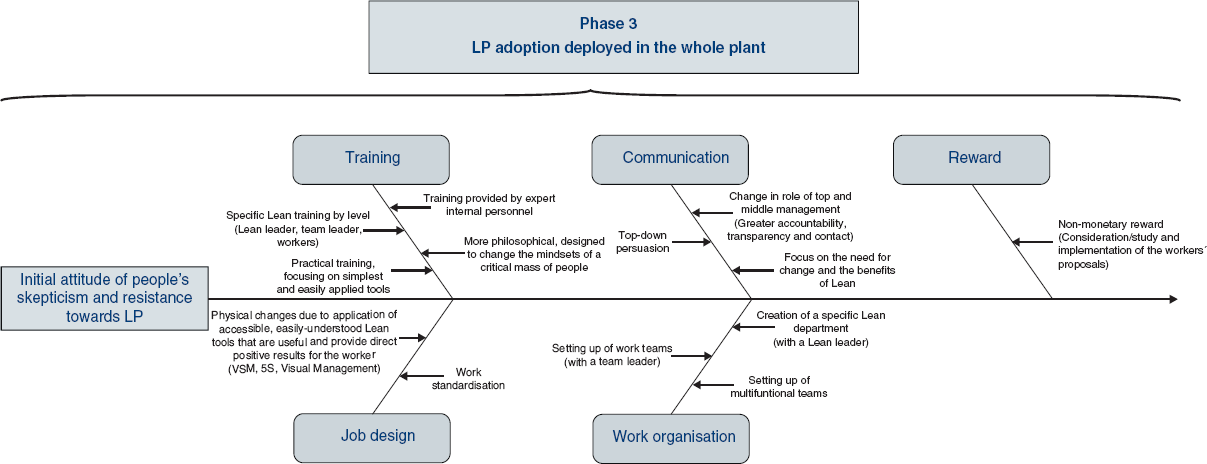
The initial skepticism and resistance of people towards Lean was also detected during this stage. However, our analysis shows that the joint negotiation with trade unions and displaying the improvements in the pilot area to the rest of the plant made it possible to moderate this attitude. Various factors also contributed to success.
Training
Training did not only focus on changing the mindsets of the people in the organization and was not only oriented towards practice, as in the previous phase, but was provided by internal experts. This was an explanatory success factor as it enabled training to be implemented more strategically and engaged people more in the objective of making advances towards the cultural change. Well-trained workers are likely to adapt to changes because they use their knowledge and experience to facilitate the process of new technology adoption (Lee et al., 2011). The use of internal expert personnel for training helped to speed up the Lean adaptation process. A second factor was the provision of specific Lean training by level:
In this respect, deploying different training depending on the level (Lean Leaders, Team Leaders or workers) was the key to each member of the organization getting to know what role s/he had to play in the Lean environment (Turesky and Connell, 2010). Thus, the appearance of Team Leaders in the work teams meant that these received the specific training that they required to carry out their functions. Similarly, the Lean Leaders received training in Lean leadership in order to get the plant personnel engaged and aligned with the initiative.
Communication
The key difference that we found compared to the preceding phase was the leadership of the whole chain of command as a crucial aspect for achieving worker participation and the roll out of LP to the rest of the plant. Here we found that the response of line workers to Lean and their engagement were closely connected with the command chain's leadership, findings in line with Groebner and Merz (1994) and Forza (1996).
Rewards and Job design
The same explanatory success factors were found as in the preceding phase.
Work organization
We found three explanatory success factors linked to this factor. The first of these was the creation of a Lean Department, which facilitated the success of the adoption by providing the initiative with full-time personnel devoted to the initiative (
Phase 4: LP implementation
We found the five main factors in this fourth phase, albeit with different explanatory success factors.
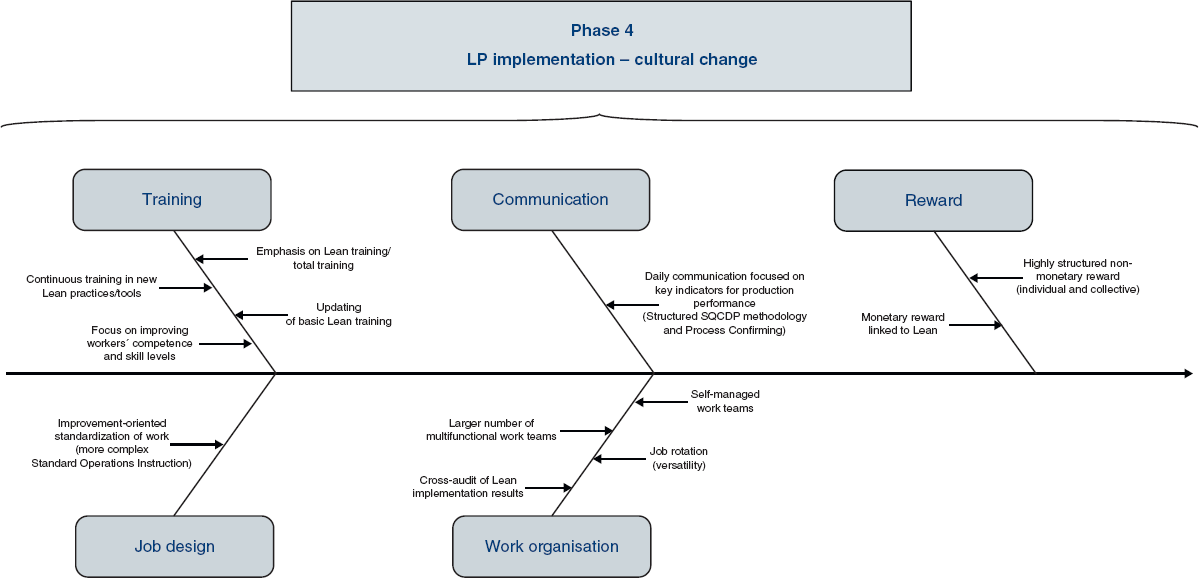
Training
First we found the major importance given to Lean training as part of the total amount of training.
Secondly, continuous training in new Lean tools and practices. Our findings demonstrate the strategic importance of ongoing training in the use of new Lean tools and practices for moving forward in the culture change and upgrading employees’ skills and knowledge (Birdi et al., 2008). A third explanatory success factor was training focused on updating basic Lean tools and techniques in order to keep workers engaged with LP as a key aspect for keeping up worker commitment to the Lean initiative, an aspect which has been less analyzed in the prior literature.
Lastly, training focusing on improving workers’ competence and skill levels in order to increase their versatility and, in the final instance, to achieve a greater level of flexibility and adaptability in the organization (Ritzman and Safizadeh, 1999). This was initially possible due to a high level of standardization being achieved at the work stations throughout the whole of the plant. Once this level of work station standardization had been achieved throughout the plant, workers were trained to carry out different types of tasks in the production process, mainly through theory classes and at the work stations themselves (
“(…) For example, with the skill & competences matrix tool we can see if people are properly trained or not, what I mean is, if there's a skills and competences gap and if a person needs more training.” (Lean MD, P4).
Communication
The explanatory success factor was the development of structured communication methodology based around daily meetings and key indicators of the results of LP implementation. Implementing SQCDP (
Rewards
In this phase we found that rewards in connection with the Lean objectives came in the form of both monetary incentives and non-monetary recognition. However, non-monetary individual and collective rewards predominate over monetary incentives. This finding sheds light on prior research into the role of rewards and economic incentives as facilitating and inhibiting factors in the transition process to LP. Our findings complement the findings of Karlsson and Åhlström (1996) who maintain that there is a trend for a monetary incentive system to act more as an inhibitor in the adoption phase, but that with time it tends to facilitate the implementation process. Our findings show that whereas in the initial phases of LP adoption there is no monetary incentive, only management recognition of the improvements achieved, both monetary incentive and non-monetary recognition systems are put in place subsequently, in the implementation phase. Lean-related rewards can acknowledge versatility and teamwork, and increase worker participation and commitment (Olivella et al., 2008).
Job design
We found that continuous improvement-oriented work standardization was an explanatory success factor. A key factor, therefore, is improving the
Work organization
We found several explanatory success factors. With regard to work teams, these matured and became more self-managing. It should be noted that approximately 90% of the plant personnel was organized into work teams. Greater consolidation of the multifunctional teams was also detected. These had grown in number and now involved an average of about 27% of the personnel in all the plants. These results corroborate the findings of Forza (1996) and Martínez-Sánchez and Pérez-Pérez (2001), who found that the work teams and multifunctional teams become more and more consolidated as LP implementation progresses further. We also found increased task rotation between work stations as a direct result of the training to improve workers’ competences and skills and work stations now being standardized to a high degree. This not only meant that a high level of internal flexibility had now been achieved, but that the workers were now becoming much more versatile and that there was greater inter-plant flexibility, all of which are aspects stated in the literature (e.g., MacDuffie, 1995; Forza, 1996; Pil and MacDuffie, 1996; Power and Sohal, 1997, 2000; Angelis et al., 2011).
Finally, we found one important factor that has not been analyzed in the literature to any great extent is the setting up of teams to carry out inter-plant lean audits to assess the results of Lean implementation. With this “
Conclusions
Our study contributes to connecting the Operations Management and Human Resources areas which have traditionally been analyzed individually but which, as Boudreau et al. (2003) state, have significant links. This connection is especially important for explaining the transition process to LP as, despite the major role that people play in this management system, prior research has not looked in depth at the role of human resource management and the cultural change required for the process to be executed successfully. With respect to people, research has focused on the characteristics of work organization in Lean environments (Forza, 1996; Biazzo and Panizzolo, 2000), on analyzing LP-associated advanced human resource management practices (Huselid, 1995; Bonavía and Marín-García, 2011) and on examining how LP affects workers (Niepce and Molleman, 1996; de Treville and Antonakis, 2006). However, this paper addresses a prior step relating to the role that people play before and during the LP adoption process and tries to discover which aspects favor workers’ adaptation to this management system. It also gives the success factors in human resource management once the adoption process has concluded and while advances are being made in LP implementation. This study therefore considers that it is necessary to investigate the underlying success factors, during both the adoption process and the implementation process, for the cultural change that LP requires to be understood.
In this way, this paper contributes to understand the complexity associated with the transition to LP (Scherrer-Rathje et al., 2009) by focusing on the key role that people play in this process (Sawhney and Chason, 2005; de Treville and Antonakis, 2006), but shifting the focus by trying to understand the aspects of human resource management that contribute to overcoming workers’ negative attitudes and initial resistance to LP and to successfully adapting to this management system.
By digging deeper in the results, our analysis has enabled us to differentiate among four phases closely linked to the role of human resources in the LP transition process. These phases complement other authors who propose the sequential implementation of LP through the foundation, planning, implementation and continuous improvement phases (Turesky and Connell, 2010; Pedersen and Huniche, 2011).
As for the implications of these findings for management, it should be stated that they can be used as guidelines for companies proposing to adopt LP and for managers responsible for the LP implementation process, and act as an aid for defining aligned and sequenced action plans for attaining and maintaining the results that LP affords.
It is necessary to stress that the factors identified should not be considered in an isolated way in each of these phases, but from a holistic focus, where each of the factors interacts with the others in each of the phases. This is the only way to understand the sequence that leads to the cultural change associated with LP.
To conclude, it should be stated that although the main factors and the explanatory factors were found in all the cases that were analyzed, there is some variation in the frequency with which some tools/human resource management techniques appear (explanatory factors). The information obtained from the interviews does not allow us to explain this variation. This paper is also a qualitative and exploratory study undertaken in a specific industry, which means that the generalization of our findings is limited. It would be useful to do further research to overcome these limitations by testing the proposed model in other contexts. Meanwhile, although the paper recognizes the relationships between the explanatory factors and their main factors it does not allow their intensity or strength to be measured. Bearing these limitations in mind we suggest some lines of future research. It is suggested that the models that have been developed are validated in other industrial and geographical contexts, in keeping with logical replication. It would also be interesting to examine whether the proposed models could be applicable to or should be adapted to other levels of the aeronautics industry supply chain. We also propose further research be done to try to measure the intensity of the relationships that have been identified. Finally, it is proposed that qualitative and quantitative methodologies are combined in order to overcome the previously mentioned generalization issues and thus allow further conceptual development.
Footnotes
Acknowledgments
This study was funded by Andalusian Regional Government and Spanish Ministry of Economy and Competitiveness research projects P08-SEJ3607 and ECO2010-22105-C03-02. Pilar Jerez acknowledges the financial support from Spanish Ministry of Economy and Competitiveness research project ECO2011-24921.
Appendix 1. Coding process
See Fig. 1.1.
Appendix 3. Final semi-structured in-depth interview script
This script is a guide only as the interviews will be semi-structured and in-depth. There is a number of questions directly related to the research goals. However, the interviewee will be allowed to answer the issues as fully as s/he wishes and stress will be put on any interesting aspects that arise at any given moment in order to find out about both the aspects targeted by the questions and any other determining factors connected with Lean Production. Instructions and/or tips for interviewers are given in italics in the script, while the questions to be put to the interviewee/s are numbered and in bold.