




Abstract
In the highly complex world of human resource management (HRM), organizations need to maintain both an inward and an outward approach in times of crisis. To adequately manage human resources, it is necessary to consider the environment and the literature on turnaround strategy. This study combines the literature on both turnaround and HRM to focus on problem antecedents/causes and their impact on companies. A case study of an airline was conducted, enriched with a rhetorical signal analysis of managerial communications and stakeholder responses. The objective was to explore the company’s turnaround strategies, human resource strategies, and institutional pressures during the COVID-19 pandemic. It was found that to overcome the crisis, it is necessary to recognize antecedents of decline, turnaround strategies, human resource (HR) strategies and practices, institutional pressures on HRM, the emotional tone and temporal focus of managerial communications as well as stakeholder responses.
Introduction
Airlines have been devastated by the COVID-19 pandemic. Industry revenues in 2020 amounted to 40% of that of previous financial years and 2019 levels are not expected to recover before 2024 (Bouwer et al., 2021). In this context, companies have been forced to adopt drastic corporate and human resource measures. Most importantly, companies need to implement the turnaround strategies required to overcome the situation in a timely manner. To adopt the most appropriate human resource decisions to manage the crisis, it is necessary to consider the literature on organizational decline and on turnaround strategy.
Numerous studies have focused on human resource practices in times of crisis (Cascio, 2002; Cascio et al., 2021; Chu & Siu, 2001; Collings et al., 2021; Hitt et al., 1994). Yet human resource strategies and practices have scarcely been considered in the literature on turnaround (Santana et al., 2017). As stated by Carnevale and Hatak (2020), looking across different disciplines for solutions to this COVID-19 pandemic is an opportunity for scholars. In addition, Farndale et al. (2019) encourage authors to study how human resource management (HRM) can respond to challenging environmental pressures by adding value to the firm in contexts of crisis. In this sense, this study combines the literature on turnaround strategies and the literature on HRM, paying special attention to the antecedents of problems/causes and their impact on the company, particularly the influence of the COVID-19 pandemic.
In addition, employees have been affected by workplace and employment changes due to the global crisis. It is thus the right moment to explore and clarify existing knowledge about the nature and extent of managerial communications and stakeholder responses. It is important to emphasize that during the global COVID-19 pandemic, airlines have had the critical task of communicating their company’s strategic vision to stakeholders to reduce concerns about the company’s prospects in an uncertain post-pandemic environment. In light of this, the success of the measures taken to emerge stronger from this crisis is largely determined by how stakeholders assess the signals reflecting the quality of the company during the pandemic. In the absence of concrete metrics of company achievements in overcoming such dramatic events beforehand, stakeholders rely on observable signals, such as the turnaround responses, HR strategies and practices, and the employment relationships (Santana et al., 2019b).
However, the way companies signal their drastic corporate and human resource measures is inevitably fraught with inherent biases related to cognition (Nylund & Raelin, 2015; Zacharakis & Shepherd, 2001). In particular, rhetorical signals—that is, relevant language-based information used by business managers to attract the attention of different audiences (Giorgi & Weber, 2015) and convey relevant messages (Garud et al., 2014)—have recently been found to complement how observable signals impact audiences (Steigenberger & Wilhelm, 2018). Therefore, stakeholders’ perceptions of such signals can notably influence the momentum built up by the firm in the market and in the competitive arena. Ultimately, they have an impact on the effectiveness of turnaround responses, the HR strategies and practices as well as the employment relationships designed to emerge stronger from the crisis.
Consequently, this study suggests that emotional tone namely the underlying affective attributes of communication (Williams et al., 2012)—which gathers both the positive and negative emotion dimensions into a single summary variable—(see Fisch & Block, 2021; Knight et al., 2018) plays an important role. Indeed, emotions can signal the need for action, focus the attention on problems to be addressed or avoided, and guide thinking and strategic behaviors during the COVID-19 crisis. In addition, this work also suggests that temporal focus—which captures the degree of attention devoted to the past, present, and future—(see Bluedorn, 2002; Nadkarni & Chen, 2014; Shipp et al., 2009) serves as a temporal filter that shapes expectations and evaluations in decision-making situations and forms the basis of strategic behaviors (Crossan et al., 2005; Das, 2004). However, despite the repercussions of such a crisis, a fundamental question is how managers should address the wide range of communication challenges created by the COVID-19 global health pandemic with different stakeholders. Such a question has in fact been little explored (Knowles et al., 2020; Sanders et al., 2020).
In this line, a case study of an airline, Iberia, was conducted. It was enriched with a rhetorical signal analysis—emotional tone and temporal focus—of the management, employees, and stakeholder responses. The aim was to explore the turnaround strategies, human resource strategies, and institutional pressures that affected this process during the COVID-19 pandemic. The questions addressed in this article were as follow: (1) What are the antecedents of the decline? (2) What turnaround strategies have been followed? (3) What HR strategies and practices have been adopted? (4) What institutional pressures affect HRM? and (5) What emotional tone and temporal focus are found in the managerial communications and stakeholder responses during the crisis? All these questions applied to the Iberia airlines company. Indeed, as early as April 2020, more than 95% of operations were canceled. The impact on flight programs was huge, with all ground and flight crews as well as travelers demanding changes, vouchers, and refunds (Iberia, 2020). For this reason, an analysis of how this airline company reacted to these challenges can help to build an understanding of turnaround and HR strategies during this COVID-19 pandemic.
Thus, two important aspects were introduced in the analysis of these antecedents-turnaround-HR-institutional pressures on HRM relationship: the influence of the COVID-19 pandemic (as an antecedent of decline) and a rhetorical signal analysis (as a complement to the case study methodology). These aspects will help to further comprehend this complex antecedents-turnaround-HR-institutional pressures relationship, in line with Santana et al.’s (2017) recommendations. Indeed, identifying the emotional tone and temporal focus of management, employees, and stakeholders in the company turnaround and HR strategies and practices will increase the chances of successfully overcoming the crisis (Lopez-Cabrales & DeNisi, 2021). Social support plays an important role, especially during the current pandemic (Bhumika, 2020; Madero Gómez et al., 2020). Emotions and tensions at the workplace have intensified during the COVID-19 crisis, as individuals seek to conciliate their work and personal issues, such as illness or the death of loved ones (Williams, 2020). This leads to acknowledging that the emotional tone of company stakeholders—especially employees—is a key turnaround factor. The effect of the current pandemic crisis on HRM was analyzed through the lens of the co-evolutionary strategic human resource management (SHRM) model for periods of crisis proposed by (Santana et al., 2019b).
The expected contributions of this article notably included the fact that in the context of a temporary external decline such as that originated by COVID-19, the following factors will contribute to a company turnaround: a combination of retrenchment and recovery strategies; an initial maintenance-oriented human resource strategy followed by an efficiency-oriented human resource strategy; and an inevitable forcing strategy of employment relations followed by a fostering strategy of employment relations. In addition, under this temporary external decline, based on industry contraction due to the global COVID-19 health pandemic, management must pay attention to possible emotional tone deviations with stakeholders—especially employees—to achieve a successful turnaround. It is also important to emphasize that management must pay attention to possible temporal focus deviations with stakeholders and adopt the present and future temporal focus to achieve a successful turnaround.
The following sections present an analysis of the literature on the antecedents (or causes) of decline, turnaround responses, HRM in times of crisis and institutional pressures on HRM, managerial communication, and stakeholder responses. The method section describes the case study and the rhetoric analysis study. The results and the discussion section the follows, ending with some conclusions as well as the theoretical and practical implications of the study.
Theoretical framework
There has been a rising interest in HRM in times of crisis, justified by multiple critical periods (e.g., financial crises, health crises, technological irruptions, etc.) (Cascio, 2002; Chu & Siu, 2001; Hitt et al., 1994; Huffman et al., 2022; Luan et al., 2013; Santana et al., 2017, 2019b; Tsai & Yen, 2008). The academic literature on the effects of crises on HRM, however, needs to be further developed (Kwong et al., 2021; Santana et al., 2017).
The study of HRM in times of crisis implies analyzing the co-evolution of the causes of decline, an organization’s turnaround responses, HR strategies, practices and internal employment relationships (Santana et al., 2019b). These latter authors proposed a co-evolutionary model of the antecedents of decline, turnaround and HR responses, and employment relations strategies. The model implies that crisis responses must constantly evolve and that SHRM decisions are dynamic rather than static, especially in periods of crisis. This article focuses on the dynamic co-evolution of diverse variables and their mutual impact, and how the interactions between the firm and its environment influence the timing and inclusion of HR practices (Paauwe & Boselie, 2009). For instance, labor policies will influence a company’s ability to hire. They will thus have an impact on HR choices. Moreover, high rates of firm hiring will favor the labor market, bringing down unemployment rates. To apply this co-evolutionary SHRM model for times of crisis to the current pandemic situation, we describe in this section the concepts of antecedents (or causes) of decline, turnaround responses, HRM in times of crisis, institutional pressures on HRM, managerial communication, and stakeholder responses.
Antecedents of decline
Different terms are used in the study of organizational crises, such as organizational decline, business failure, mortality, or bankruptcy (Mellahi & Wilkinson, 2004). However, as the present work centers on how organizations manage the crisis, organizational decline is considered as a focal term. Indeed, decline cannot be directly associated with company death, while the other concepts (i.e., business failures, mortality, or bankruptcy) refer to a company’s exit, death, or mortality (Mellahi & Wilkinson, 2004). Organizational decline thus refers to the deterioration of the company resources and performance over a particular period of time (Cameron et al., 1987; D’aveni, 1989; Francis & Desai, 2005; Ribeiro Serra et al., 2017; Teixeira et al., 2019). Two main antecedents of decline have been distinguished, namely internal causes and external causes (Weitzel & Jonsson, 1989). In this sense, organizations need to predict and identify the root of a problem and whether internal or external problems—or both—predominate (Barker, 2005), as these antecedents will determine the organizational response to the crisis (Ford, 1985). Management needs to identify both the root and timing of the decline in terms of awareness of the decline (Santana et al., 2017). External antecedents or industry contraction–based decline are grounded in the company’s exogenous interactions (Arogyaswamy et al., 1995; Bodolica & Spraggon, 2020; Whetten, 1987) and are related to technological, competitive, economic, political, cultural, legal or industry changes, and, most recently, the COVID-19 pandemic (Bodolica & Spraggon, 2020; Brown & Kline, 2020; Datta et al., 2010; Mellahi & Wilkinson, 2004; Scherrer, 2003; Trahms et al., 2013). Arogyaswamy et al. (1995) divided the external or industry contraction–based decline into cyclical or long-term decline. For the purpose of this research, we will refer to this type of cyclical industry contraction–based decline as a temporary external decline. The COVID-19 pandemic represents undoubtedly an external disruption that has impacted organizations abruptly (Brown & Kline, 2020) within a short period of time. And this upheaval will determine the future evolution (Amankwah-Amoah et al., 2020) of many industries (e.g.: airlines and hospitality).
Whether the COVID-19 crisis should be considered as a “black swan” is currently under debate (Brown & Kline, 2020; Gudmundsson et al., 2021). “Black swans” are events that are almost impossible to predict as they occur very rarely (Brown & Kline, 2020). According to Brown and Kline (2020), the COVID-19 crisis cannot be considered as a “black swan,” since pandemic events occur regularly: despite the fact that managers had some previous health crisis experience (e.g., severe acute respiratory syndrome [SARS], Swine Flu), they preferred to focus priority strategic plans on other less-serious problems. This caused airlines to be unprepared for such a challenge and highlights the importance of understanding and being aware of organizational decline indicators. Conversely, internal sources or firm-based causes are those that managers can control (e.g.: employees, resources, and activities), such as financial or operational problems, lack of innovation, employee attributes, governance, and leadership dysfunctionalities (Arogyaswamy et al., 1995; Bodolica & Spraggon, 2020; Scherrer, 2003; Trahms et al., 2013).
Turnaround strategy
To respond to the decline situation, organizations need to implement turnaround responses, usually in a context of lack of resources and intense stakeholder pressures (Trahms et al., 2013). The term turnaround strategy seems to be inconclusive (Kumalo & Scheepers, 2018) but five turnaround stages are typically considered: analysis of the situation, turnaround plan, turnaround implementation, stabilization, and return to growth (Scherrer, 2003). For their part, Balgobin and Pandit (2001) as well as Pretorius (2008) define turnaround as the recovery of an organization’s performance after harsh deterioration. This acceptation implies surviving the threat, though other definitions also consider the possibility of failure following turnaround responses (Kumalo & Scheepers, 2018). In this sense, a turnaround strategy refers to a dynamic and sequential process that leads organizations to successful or unsuccessful performance (Boyne & Meier, 2009; Schmitt & Raisch, 2013). Organizational failure or survival has always been at the center of organizational research (Josefy et al., 2017). Two main turnaround responses have traditionally been recognized: retrenchment and recovery (Pearce & Robbins, 1993). For his part, Boyne (2004) considers three main turnaround strategies: reorganization, repositioning, and retrenchment while Albers and Rundshagen (2020) highlighted the following retrenchment strategies: persevering, innovating, and exit. This study adopted the retrenchment and recovery classification. Retrenchment or operating responses aim to reduce costs and assets (Pearce & Robbins, 1993), while recovery responses are based on adjusting the organization’s areas of competition (Ndofor et al., 2013). For some authors, turnaround strategies should be consistent with the antecedents of decline (Arogyaswamy et al., 1995; Hofer, 1980; Ndofor et al., 2013; Santana et al., 2017), while others consider that the retrenchment strategies are universal, overlooking the underlying antecedents (Pearce & Robbins, 1993). According to Ndofor et al. (2013), if the decline was caused by a debilitated strategic position, then retrenchment will not solve the situation. We agree with Schmitt and Raisch (2013) according to whom a combination of retrenchment and recovery responses helps firms to consolidate turnaround performance. Firms should adopt focused strategic responses, even in the retrenchment phase (Barbero et al., 2017). In conclusion, identifying the antecedents of the decline, timing, and prediction are crucial factors in the turnaround process (Barbero et al., 2017, 2020; Barker, 2005; Santana et al., 2017, 2019b). We will now explore the role of HRM in this context.
HRM in times of crisis
Given the impact of COVID-19 crisis, a number of seminal works—some of which are recent—have appeared on SHMR in times of crisis. We will briefly review them here. Schuler (1988) identified the employee characteristics required and HR choices in a turnaround strategy but without considering the antecedents of the decline. The author insisted on the need for flexible, task-oriented, and long-term vision employees to adapt to changes in uncertain times. Arogyaswamy et al. (1995) emphasized the importance of acknowledging human resources as a source of strategic advantage when adopting responses to decline. Terms such as rightsizing, downsizing, and responsible restructuring (Cascio, 2002; Chu & Siu, 2001; Hitt et al., 1994; Luan et al., 2013; Muñoz-Bullón & Sánchez-Bueno, 2011) then emerged as recurrent concepts to refer to HRM in times of crisis. According to Chu and Siu (2001), rightsizing is a downsizing choice and entails the obtention of adequate organizational size, rather than defining the scale of reduction. Downsizing is defined as managerial responses to adapt to environmental issues, resolve organizational complications, and recover efficiency to pursue productivity and competitiveness (Tsai & Yen, 2008). The contribution of Cascio (2002), for its part, is highly relevant, as it invokes the responsible restructuring concept, which is highly determinant in the case of HRM in times of crisis. In responsible restructuring, people are regarded as resources to be developed rather than mere costs to be reduced (Cascio, 2002). The author insists that even headcounts should be conducted responsibly. Examples of responsible restructuring in non-core areas include: employees’ early retirement packages; offering outplacement services and layoff notices in advance; transparent layoff criteria; and selective voluntary resignation plans with severance packages (Cascio, 2002; Zatzick et al., 2009). Responsible HR practices are needed, especially considering that high pay can lead to high employee productivity (Lopez-Cabrales & DeNisi, 2021; Rahmandad & Ton, 2020).
Recently, Cascio et al. (2021) reviewed the antecedents and consequences of employee downsizing, thereby extending and refining institutional theory, which is of particular interest to the present work. Also relevant is the proposal of Santana et al. (2017), linking antecedents of decline, turnaround strategies, and the SHRM discipline. The authors set out four HR strategy configurations for companies in times of crisis, namely: flexibility-oriented HRS, efficiency-oriented HRS, niche-oriented HRS and maintenance-oriented HRS, with their respective sets of HR practices. The authors addressed HR practices in the most dramatic situations, adopting a responsible restructuring approach throughout. The new external challenge brought about by the COVID-19 pandemic justifies an exploration of how the crisis-period SHRM model (Santana et al., 2019b) functions in the context of this new antecedent or challenge.
In addition, Collings et al. (2021) acknowledge that as a consequence of the pandemic, fresh literature on HRM in times of crisis is emerging and that a balance needs to be reached among multiple stakeholder requirements. In this line, Carnevale and Hatak (2020) highlighted that organizations face a huge challenge regarding employee adjustment and well-being: companies need to support their workforce to adjust to new working conditions, such as shifting to remote working, new HR planning, and less physical human interaction. Moreover, one of the most recurrent HR responses in times of crisis is the cutback decision (Huffman et al., 2022; Santana et al., 2017). In this sense, Huffman et al. (2022) focused on furlough decisions, such as unpaid leave over certain periods, for example, days or weeks, or temporary reductions in working hours. Huffman et al. (2022) found that controlling (reducing) furlough durations and implementing and communicating fair and transparent furlough policies could strengthen overall HR management in times of uncertainty. Despite the interest in crisis HRM, further research is needed due to the complexity of the situation for managers and the workforce.
Institutional pressures on HRM, managerial communication, and stakeholder responses
Institutional pressures on HRM
Johnstone et al. (2019) highlighted the crucial role of national institutions in designing policy actions at the country level, especially during crisis periods. They also emphasized the organizational impact of external challenges and internal actors, such as trade unions, managers, and workers. Indeed, in difficult times, national institutions, regulations, and trade unions exercise significant pressures that shape the HR measures adopted by organizations (Santana et al., 2019a; Sarina & Wright, 2015; Wilkinson et al., 2014) according to different national contexts.
However, according to Martínez Lucio and Stuart (2011), the role of states in HRM is still under-researched. Its role will become even more crucial as nation states push to boost their post-COVID-19 economies (Cooke et al., 2020). For instance, the Chinese Government has issued measures and policies to regulate employment, such as social insurance and employment protection (Zhang, 2020). Furthermore, a number of national institutions are strengthening the role of worker representatives, and this may thus affect the responses of firms (Lange et al., 2015).
Nevertheless, employers can choose how to alter their employment relation responses in uncertain times. In this sense, Walton et al. (1994) presented a seminal work, describing three negotiation strategies that can be applied to HR strategies, namely: forcing, fostering, or escape. The forcing strategy consists of persuading workers to agree to undesired and significant terms while reducing, in parallel, the influence of trade unions in the workplace. This strategy can present serious disadvantages, such as intergroup distrust, for example, when forcing employees to accept labor reduction plans in times of crisis. The fostering response aims to build responses to common obstacles and to build stakeholder trust, although inconveniences or complex problems may be postponed so as to avoid forcing relationships. For instance, enhancing bi-directional communication, the management informs unions about crucial company data, while employees communicate ideas to improve daily operations. Both parties thus obtain mutual gains. The escape strategy corresponds to the end of the bargaining relation through the physical displacement of activities to a different location. It represents a loss–loss situation. An illustration is when a company abandons operations in an intensely labor-regulated country with high dismissal costs.
In line with these strategies, Boon et al. (2009) defined three HRM strategies to react to institutional pressures: deviant (active resistance, such as challenging predetermined rules), conformist (neutral response, such as the acceptance of institutional pressures), and innovative (the pursuit of new behaviors in response to institutional pressures). It is worth noting that the organizational workforce structure will also determine the managerial choice of employment relation strategy, distinguishing commitment, low-investment, or hybrid perspectives (Sarina & Wright, 2015): a commitment perspective is more appropriate for core employees, and a low-investment perspective is more suitable for “ancillary-knowledge” employees.
Managerial communication and stakeholder responses
The crisis-management literature considers that a key factor when navigating a public health crisis is the adoption of appropriate corporate response strategies (Malet & Korbitz, 2015; Page et al., 2006; Volo, 2007). In this sense, corporate responsiveness is defined as the ability to react to emerging risks by reconfiguring resources and implementing appropriate communication strategies in the face of such situations (Ritchie, 2008).
Our analysis of managerial communications and stakeholder responses is based on signaling theory (Connelly et al., 2011), as it centers on building communication relationships and reducing information asymmetries between two parties (a sender and a receiver). Indeed, in the crisis-management literature, signaling theory has been widely used to study approaches to relationship recovery (Kharouf et al., 2020) and to explain the effectiveness of corporate announcements (Ni et al., 2016).
For their part, Knowles et al. (2020) have warned of the need to review and update existing models, strategies, and theories of public health crisis communication to cope with the uniqueness, complexity, and unpredictability of this global COVID-19 pandemic. The literature suggests that during a crisis, stakeholders are likely to pay close attention to corporate response strategies, especially actions that reduce the negative impact of the crisis on stakeholders (Tse et al., 2016).
However, the way in which corporations signal their drastic corporate and human resource measures is inevitably fraught with inherent biases related to cognition (Nylund & Raelin, 2015; Zacharakis & Shepherd, 2001). Rhetorical signals, in particular, are a form of language-based relevant information used by corporate managers to attract the attention of different audiences (Giorgi & Weber, 2015) and convey relevant messages (Garud et al., 2014).
In the context of crisis management, the use of emotional framing can be an effective addition to a defensive crisis response strategy, as stakeholders tend to have a better understanding of the company’s situation (Coombs, 2007). Previous studies have examined the effects of language framing by exploring the influence of emotional corporate responses on stakeholder behavior (Sela et al., 2012). In this regard, the results of the study conducted by Wang et al. (2021) suggest that corporations should produce crisis responses that extensively utilize an emotional strategy to enhance stakeholder responses during public health crises. Emotional responses appeal to the use of subjective and valuational properties in communication messages to persuade stakeholders (Claeys & Cauberghe, 2014; Orth et al., 2007). In addition, previous research has also shown that high levels of positive emotional responses are associated with more favorable stakeholder perceptions of a corporation (Frank et al., 2014; Schoefer & Diamantopoulos, 2009).
Furthermore, the emerging literature on subjective viewpoints, in the strategy domain, suggests that the interpretation of time serves as a temporal filter that shapes expectations and evaluations in decision-making situations and forms the basis for strategic behaviors (Crossan et al., 2005; Das, 2004). Therefore, knowing how business managers think and feel about time can have a great influence on their firms’ strategies (Chen & Nadkarni, 2017) and stakeholder responses. In this regard, managers with a strong focus on the past serve as mental archivists of the successes and failures they have had throughout their lives (Gibson et al., 2007; Mohammed & Harrison, 2013). According to Bluedorn (2002), a strong focus on the past can lead to a generalization bias because business managers may see situational similarities but fail to see the differences between different events. Managers with a strong focus on the present may have up-to-date views of the environment and provide better information about a company’s different opportunities and risks (Chen & Nadkarni, 2017). By emphasizing the present moment to find solutions, managers with a strong focus on the present can use real-time information to validate new opportunities and swiftly avoid risks, with the goal of continuously adjusting development (Nadkarni & Chen, 2014). Managers with a strong focus on the future tend to imagine what is to come, both to detect new opportunities and to anticipate future risks; they are particularly able to identify and meet the demands of dynamic environments (Gibson et al., 2007). Moreover, a forward-looking perspective can drive central strategic changes (Ocasio, 2011).
Methodology
Turnaround management and related responses to the COVID-19 crisis have to face uncertain circumstances. We chose to conduct a case study to build an in-depth understanding of how organizations react to such unpredictable conditions. According to Eisenhardt and Graebner (2007), case studies are an optimal choice of methodology to build theory inductively. Our aim was to better comprehend patterns of relationships among constructs, that is, turnaround responses, human resource strategies and practices, as well as institutional pressures on HRM. Case studies have been found to be suitable to identify these relationships as they allow studying the analyzed phenomena in the real-world context, connecting case data, detected theory and extant theoretical literature (Eisenhardt and Graebner, 2007).
Case study selection and description
The airline industry has a great impact on an economy as it creates jobs, facilitates geographical connections (e.g., city pairs, etc.) and enables the flows of trade, tourism, and investment (IATA Economics, 2019). However, due to the COVID-19 pandemic, the airline industry net losses are forecast to amount to some $118 billion in 2020, and to decrease to $38 billion in 2021 (IATA Economics, 2020). According to Brian Pierce, IATA chief economist, the airline industry has experienced the biggest blow since the Second World War, with a catastrophic drop in demand, much greater than in previous crises, such as the 2008 financial crisis, or the one caused by the terrorist attacks of September 11, 2001, in New York. (Muñoz, 2021).
The Spanish airline market is highly relevant to the Spanish economy (IATA, 2018, 2021) and it offers important domestic and international connections and tourism volume. Spanish tourism accounts for 12% of the country’s GDP and 82% of tourists arrive by air. Within this market, Iberia is Spain’s major airline (Iberia, 2020) and an Iberia case study is highly pertinent from the perspective of turnaround and HR strategies. Indeed, by April 2020, more than 95% of operations had already been canceled. This had a tremendous impact on flight programs, with all ground and flight crews and clients demanding changes, vouchers, and refunds (Iberia, 2020). Therefore, observing how this airline company reacts to these challenges will help to understand turnaround and HR strategies during this COVID-19 pandemic.
Iberia was founded in 1927 and initially linked cities in the Spanish mainland, the Canary Islands, and North Africa. Iberia is Spain’s largest airline and has three main businesses: passenger and freight transport, aircraft maintenance, and airport handling services. With its 16,000 employees, 146 aircrafts, and flights to 116 destinations in Europe, America, Africa, Middle East, and Asia, Iberia is the leader of the European and Latin American markets, offering 290 additional airport flight connections with partner airlines. The company’s business milestones include: its market listing in 2001; its merging with British Airways under the International Airlines Group (IAG) in 2011; and the creation of the low-cost carrier Iberia Express. Indeed, in 2011, Iberia joined the IAG along with other companies such as British Airways, Aer Lingus, and Vueling. In 2020, according to the IAG annual report, IAG presented an operating loss of 7.426 billion euros, while Iberia’s operating losses reached 1.411 billion euros. The restrictions arising from the pandemic have created an exceptional situation in which Iberia’s flexibility has been crucial to adapt to such an uncertain context.
Data collection
Data for this case study were gathered from multiple sources, combining primary and secondary data with internal and external information. Archival data were collected from company statements, financial reports, newspapers, specialized web pages, and television. In addition, interviews were conducted with management, employees, and industry stakeholders. It should be noted, however, that most interviews with management were obtained mainly from videos in specialized press and television interviews. The harshness of the situation is generating much uncertainty within the managerial team regarding the communication of the decisions to be adopted. Nevertheless, throughout summer 2021, there was greater optimism about future decision-making and strategies.
Interviews
To triangulate information, the case study was enriched with insights via multiple company sources and levels (Smith, 2014). First, we drew upon 18 interviews with pilots and flight attendants (8 Iberia and 10 non-Iberia) conducted in the spring of 2021. These interviews were approached in two steps: (1) we conducted a survey with 15 open and closed questions related to the antecedents of the decline, the turnaround strategy, the human resource strategy, and institutional pressures (see Appendix) and (2) we directly interviewed each of the eighteen respondents via telephone conversation.
Second, we obtained insights from videos of specialized press and television interviews with eight Iberia executives and managers (four executives and four managers). Two full-detailed interviews about the responses to the COVID-19 pandemic from Iberia’s former and current CEO were extracted from the media, which consisted of a video and detailed news. In addition, we also communicated directly with one of them via email.
Third, two trade unionists briefly exchanged their opinions about the antecedents, the turnaround strategy, the human resource strategy, and institutional pressures at Iberia via email and telephone conversation, respectively. In addition, we complement this study with insights from videos of specialized press and television interviews with three aviation experts: Spain’s former Secretary of State for Trade and former President of AENA (Spanish Airports and Air Navigation), the General Manager of the European Regions Airline Association, and a university professor with expertise in the airlines sector (Table 1).
Interviews for case study.
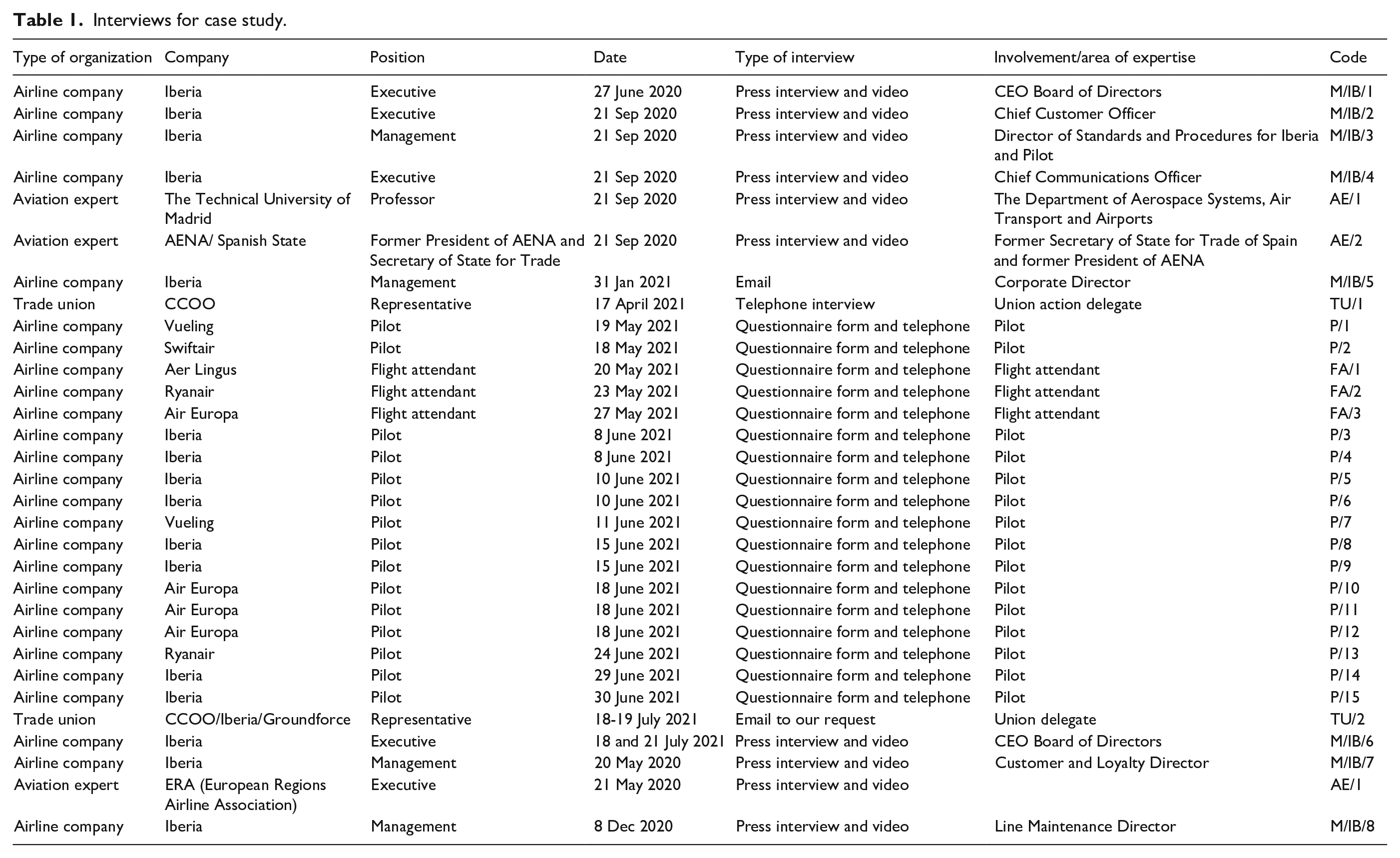
All these responses were noted and classified according to our analyzed variables: antecedents, turnaround strategy, human resource strategy, and institutional pressures. Therefore, considering the strategic sensitivity of the issues, these combined interviews and insights from multiple sources offered insightful information about the strategic responses to the COVID-19 pandemic.
Archival data
We analyzed the 2020 IAG and Iberia annual reports and sustainability reports, as well as collective bargaining trade union documents, labor mediation agreements, and temporary labor reduction plans. Archival data were also collected from the company statements, reports, and news, encompassing both internal and external company information. Regarding the internal information, issued directly by the company, the statements analyzed were subdivided into five thematic areas relating to the company turnaround strategy and HR during 2020 and 2021 (business, HR, operations, sustainability, and technology), and reports (sustainability reports and annual reports). With respect to the company’s external information, published by infomediaries, we used Google News and Orbis (which collects information from the following infomediaries: Dow Jones, Thomson Reuters, Bureau van Dijk, Economist Intelligence Unit, Syndigate, Acquire Media, and Informa). News items from the official start date of the coronavirus (01/12/2019) was filtered and ordered according to their relevance (from highest to lowest). In addition, the news items were classified into different thematic areas referring to the antecedents of decline, the turnaround strategy and HR (Decline, Turnaround strategies, HR strategies, Competitive, Cultural-Social, Finances, Governance, Legal-Political, and Technological).
Rhetorical signal: computer-assisted content analysis
Within this case study, an analysis of the emotional tone and temporal focus of management, employees, and stakeholders was conducted. The aim was to further enrich the results and comprehend how emotional tone and temporal focus can influence the attitudes and behaviors of stakeholders through the different cognitive interpretations they make (Ashkanasy et al., 2017).
To analyze the emotional tone and temporal focus, we conducted a computer-assisted content analysis. This technique offers an interesting way for researchers to address new, important research questions and systematically evaluate a large number of archival data and interviews. Media content, company statements, reports, and interviews were analyzed using the Linguistic Inquiry and Word Count (LIWC) software (Pennebaker et al., 2001, 2007). LIWC contains pre-designed and validated dictionaries of words that measure attentional focus, emotionality, social relationships, thinking styles, and individual differences within text (Ireland & Pennebaker, 2010). It is frequently used by management scholars to assess the content of media coverage, company statements, reports, and interviews (e.g., Akinola et al., 2018; Crilly & Hansen, 2016; Gamache & McNamara, 2019; Hubbard et al., 2018; Nadkarni & Chen, 2014).
The LIWC emotion dictionary includes 620 positive emotion words (e.g., “love,” “nice,” “sweet”) and 744 negative emotion words (e.g., “hurt,” “ugly,” “nasty”), and has been used in previous studies that have demonstrated the reliability and predictive validity of such measures (e.g., Akinola et al., 2018; Gamache & McNamara, 2019; Hubbard et al., 2018). The emotional tone variable gathers both positive emotion and negative emotion dimensions into a single summary variable (Cohn et al., 2004). The algorithm suggests that when emotional tone scores are greater than 50, emotional tone is positive, and when scores are less than 50, emotional tone is negative. In this way, we created a classification in which scores between 0 and 25 were considered as “Very negative,” scores between 25 and 50 as “Negative,” between 50 and 75 as “Positive,” and between 75 and 100 as “Very positive.”
The LIWC temporal focus dictionaries include: a set of 341 words that reflect past focus (e.g., “ago,” “did,” “talked”); a set of 424 words that indicate present focus (e.g., “today,” “is,” “now”); and a set of 97 words that reflect future focus (e.g., “may,” “will,” “soon”). These dictionaries have also been validated in previous studies (e.g., Crilly & Hansen, 2016; Gamache & McNamara, 2019; Nadkarni & Chen, 2014). Interpreting the results of the temporal focus variable is very simple. LIWC scores are basically percentages of the total number of words in the media content, company statements, reports, and interviews. For example, when analyzing an interview, a LIWC score for the present focus of 5.74 means that 5.74% of all words in the interview are words referring to the present time horizon.
Data analysis
This systematic study of primary and secondary data, which encompassed both internal and external company information, followed a series of steps that enabled theoretical interpretations of the data (Gioia et al., 2012; Smith, 2014). The stages were as follow: (1) the development of a rich case study of Iberia in the “case description” section; (2) the identification of patterns of sources of decline, selected turnaround strategy, HR strategy and practices and institutional pressures and managerial communication in the “results” section; and (3) integration of the findings to develop a theory on the sources of decline, turnaround, HR strategies, institutional pressures, and managerial communication in the “discussion” section. The process was iterative to enhance insights and generalizability (Locke et al., 2008). The data and literature allowed us to further develop the co-evolutionary SHRM model for periods of crisis (Santana et al., 2019b) under the COVID-19 pandemic conditions.
Results
Antecedents of decline
The COVID-19 pandemic has constituted a dramatic external shock for companies. Luis Gallego, former CEO of Iberia Airlines, referred to the COVID-19 pandemic as a “Tsunami” (Jimenez, 2020). The company’s employees themselves defined this crisis as ‘‘catastrophic and devastating’’ (P/3, P/4), and they clearly highlighted that this crisis was motivated by health and economic causes. Gallego stated that the crisis generated by the COVID-19 pandemic went further (e.g., months without income, with high costs), and added that all airlines have liquidity problems. According to the annual IAG report, IAG showed an operating loss of 7.426 billion euros, and Iberia’s operating losses reached 1.411 billion euros. Javier Sánchez-Prieto, newly appointed CEO of Iberia from September 2020, also mentioned the shock of witnessing all airplanes grounded at airports, all employees idle, and incomes reduced to zero (El Español, 2021). In the same terms, Luis Gallego stated “it is impactful to see all the planes on the ground” (Jimenez, 2020). The crisis, however, has affected airline companies differently. At Iberia in particular, according to former CEO Luis Gallego, “we have been fortunate enough to enter this crisis in a stronger position than other airlines. Indeed, we have been restructuring since 2013 and have invested in designing a new Iberia, with a liquidity position and adequate costs.” Indeed, though this COVID-19 external disruption has had a fierce impact on corporate finance, Iberia was relatively well prepared compared to other companies, after a restructuring process followed by 7 years of positive figures (El Español, 2021). In addition, IAG membership gives access to further financing pathways, such as capital increase and bond issuing. The COVID-19 shock has naturally also affected operations and demand. “In April 2020, over 95 percent of operations were cancelled, which impacted the flight programme, all ground and flight crews and, most importantly, our customers, with millions of booking changes, vouchers and refunds” (IAG, 2020, p. 37). The flight schedule was partially recovered over the year, operating at only 20% of 2019 capacity in the summer, although reaching 40% of 2019 capacity in December 2020 (M/IB/1) (Jimenez, 2020). ‘‘The demand levels of 2019 will not recover until 2023 or 2024, and they will do so gradually and in different sectors. Family trips will begin first, then tourism, but above all, the short and medium radius will arrive followed by the long radius. We are not expecting a demand similar to 2019 until 2023 or 2024’’ (M/IB/1). (Jimenez, 2020).
Turnaround strategies
Iberia faced this COVID-19 crisis in a solid cash position due to the Plan de Futuro measures and their recent strong performance. However, the prolonged situation of revenue scarcity and the high level of fixed costs forced Iberia to adopt further initiatives. These responses rested on three pillars: cost reduction, liquidity improvement, and new financing sources (IAG, 2020). The company implemented cost reduction measures from the outset, such as the freezing of all outsourcing and consulting services, the cancelation of discretionary expenses, the postponement of corporate training, the elimination of all non-essential expenses, and a capacity reduction to adapt to the reduced operation, among others (Iberia, 2020). Indeed, given the exceptional situation created by the pandemic and the passenger traffic restrictions adopted by most countries, Iberia implemented different measures in the operational, labor, and health protection areas. The goal was to ensure sustainability and to maximize its contribution to the fight against COVID-19 (TU/1; M/IB/1; Jimenez, 2020). According to Luis Gallego, Iberia adopted the following strategies in spring 2020: cost reductions; the obtention of financing; short-term survival; and adapting its size to future demand, which was expected to be much lower than that of 2019. In addition, to be more efficient regarding fleet size, Iberia removed Airbus A340-600, and renewed them with the new generation 350 aircraft, which is less polluting (M/IB/3; Jimenez, 2020). Moreover, the company is opening new markets that were not relevant before (P/4). Indeed, the company’s priorities include the development of the Madrid hub, not only by re-launching connections with the Americas, but also by launching other destinations (M/IB/5; Reportur, 2021).
In January 2021, Iberia bought Air Europa for 500 million euros, to be paid over 6 years upon completion of the operation. The agreement is currently subject to further negotiations (Iberia, 2021a) but will allow both airlines to emerge faster and stronger from the current COVID-19 crisis. It will increase their capacity to meet the financial commitments acquired during the pandemic (such as the Official Credit Institute’s [ICO] credits and aid granted by the State to Air Europa). Moreover, the agreement will strengthen the Madrid hub, so that it can expand and better compete with its European equivalents, whose main airlines have received billion-dollar subsidies from their respective governments to recover from the COVID-19 shock (M/IB/6;Iberia, 2021b). This operation helps to consolidate Madrid as a first-rate European hub, reinforcing Spain’s position as the leading tourist power and a gateway between Europe and Latin America (M/IB/6; El Español, 2021).
In May 2021, Iberia presented the Next Chapter plan, which focuses on customer trust, the Madrid hub, and connectivity for recovery. The Next Chapter is based on four pillars—clients, hub and connectivity, sustainability and employees—and a dual, short-, and long-term vision: ‘‘1) Customers: regain customer trust and position itself as an excellent airline in terms of COVID-19 safety and services; 2) Madrid hub: recover connectivity and reposition T4 with respect to other European hubs, becoming a stronger operator, boosting the cargo business, and developing inter-modality with the arrival of the AVE to T4; 3) Sustainability: improve the current operative efficiency and promote the development of sustainable fuels through the Iberia Chair; and 4) Employees: encourage them to become brand ambassadors for customers.’’ (Iberia, 2021b).
Therefore, Iberia Airlines is conducting different initiatives to face this COVID-19 pandemic, and Iberia’s CEO, Javier Sánchez-Prieto, is optimistic. He has mentioned emerging green shoots of recovery, although the capacity remains much reduced (M/IB/6). In July, Iberia was operating at 60% of its 2019 capacity (Iberia, 2021b).
HRM in times of crisis at Iberia
According to the company (Iberia, 2020b), Iberia made use of the temporary, force majeure labor reduction plan (or ERTE, by its Spanish acronym) approved by the government in all business areas directly related to operations, proportionally to the monthly capacity reductions. Until the month of November 2020 (extended to January 2021, and set to last until March or September 2021), Iberia paid a supplement to all employees affected by the ERTE, which was inversely proportional to the worker salaries: the higher the salary, the greater the sacrifice and vice versa. In parallel, during all these months, the activity was distributed proportionally within each group. The personnel unaffected by the ERTE and thus not included in the agreement underwent a salary cut. This way, the temporary labor reduction plan enabled Iberia to maintain the bulk of the workforce, which has only been reduced by the non-renewal of temporary contracts (Semprún, 2020). In relation to these HRM measures, Luis Gallego stated: ‘‘we have also implemented the temporary labour reduction plan (ERTE) because we have had to ground more than 90% of our fleet. However, we wish to be sustainable not only economically and environmentally, but also socially. In this sense, Iberia has complemented the ERTE in force, so that we can all navigate this crisis in the best possible way.’’ (M/IB/1)
The employees value the company’s efforts to maintain the workforce with the ERTEs: “we all came out of this crisis together” (P/3).
In relation to its HR practices, Iberia clearly distinguishes three employee categories, each with their HR management particularities: passenger and freight transport (including pilots and flight attendants), aircraft maintenance (mechanics and technicians), and airport handling services (ground workforce). The company continued to implement ordinary training linked to risk-reduction associated with the stoppage owing to the pandemic. The compensation consisted of an initial salary supplement and its progressive elimination. Concerning staffing practices, no one was hired. The evaluation continued as usual, with a more constructive approach. Moreover, the communication consisted of telematic meetings, corporate letters, and internal communication, although “in general, I found communication to be scarce” (P/3, P/4).
Institutional pressures on HRM, managerial communication, and stakeholder responses
Iberia and Vueling are two of the few European airlines not to have implemented collective dismissal, despite not having benefited from state bailouts (El Preferente, 2021). According to Gallego, ‘‘in Spain, the IAG holding company includes Iberia and Vueling, and Iberia has fortunately been able to apply the temporary labor reduction plan (ERTE). The plan has made it possible to adjust to the reduced capacity and to avoid anyone having to leave the company. In the case of British Airways, the system was different and there was no other choice but to reduce the workforce, in addition to a cost-reduction program’’ (El Preferente, 2021; M/IB/1). In the United Kingdom and Ireland, the holding company has already implemented a large collective layoff after 10,000 workers agreed to leave (Semprún, 2020). In this sense, Luis Gallego stated that ‘‘this temporary labor reduction plan has allowed maintaining the workforce, but if there continues to be a lack of income, and this temporary reduction plan comes to an end, Iberia will have to adopt more measures because the company cannot die’’ (El Preferente, 2021; M/IB/1).
In the same line, Javier Sánchez-Prieto, Iberia’s current CEO, stated that ‘‘the ERTEs have enabled the company to adapt costs to the volume of work and have allowed employees to receive some level of income; Iberia has been able to supplement its workers’ ERTEs for a while, and this aid has thus mitigated the essential aspects, in times of reduced work’’ (El Español, 2021; M/IB/6). Furthermore, Vueling has signed an agreement with the unions to guarantee continuity of employment, although the commitments are linked to maintaining the ERTEs; with a reduced operation capacity, the airlines cannot maintain the labor structure (Semprún, 2020). These ERTEs were extended during 2021 and until 31 May (Reportur, 2021), employees could re-join the company voluntarily. In June 2021, a new mediation request was conducted to unblock negotiations around the partial modification of the handling sectoral collective agreement to adapt it to the COVID-19 pandemic situation. The aim was to contribute to the objective of favoring the stability and quality of employment in the sector. In the case of a collective dismissal, the number of dismissed employees must be negotiated with the unions. Any employee with any type of permanent contract who is forcibly affected by the labor reduction plan would become part of the company’s preferred outplacement exchange, divided by company, work center and work group and, in each of them, by type of permanent contract (TU/2).
Rhetorical signal analysis: emotional tone and temporal focus in the COVID-19 pandemic
Emotions play an important role, as they can signal the need to act, focus attention on issues to address or to avoid, and to guide thinking and behavior. In that sense, how we feel about something is informative, as it provides information that we consciously and/or unconsciously use in our judgments, decisions, and behaviors (Van Knippenberg & Van Kleef, 2016; Table 2). The emotional tone of pilots and flight attendants in the interviews conducted was generally negative (45.56) and in the specific case of Iberia pilots and flight attendants, the score was even lower (40.57), with phrases such as: “The situation is devastating” (P3); “The consequences of this crisis have been catastrophic” (P4); “The situation is very bad” (P5); “The information available to us is still sensitive, as we have not yet emerged from the pandemic and its consequences” (P6); “We do not have sufficient information on the measures taken by the company” (P8); “I sadly remember flying to Bilbao (Spain) with a single passenger in a 120 million Euro Airbus A320 Neo, which consumes five tons of fuel per hour. And coming back empty-handed” (P14). However, Iberia employees seem to be convinced that the measures are effective and that the company will emerge stronger from this crisis, as can be detected from sentences such as: “We will all make it through together” (P3); “We are doing the best we can” (P5); and “I believe Iberia’s workforce will grow in the coming years” (P8). In addition, this negative position is highlighted by the fact that the pilots’ union (SEPLA) has denounced that “Iberia and Vueling are keeping their pilots under ERTE to save costs at the expense of the State” (Muñoz, 2021).
Results for rhetorical signal analysis: interviews, internal information, and external information.
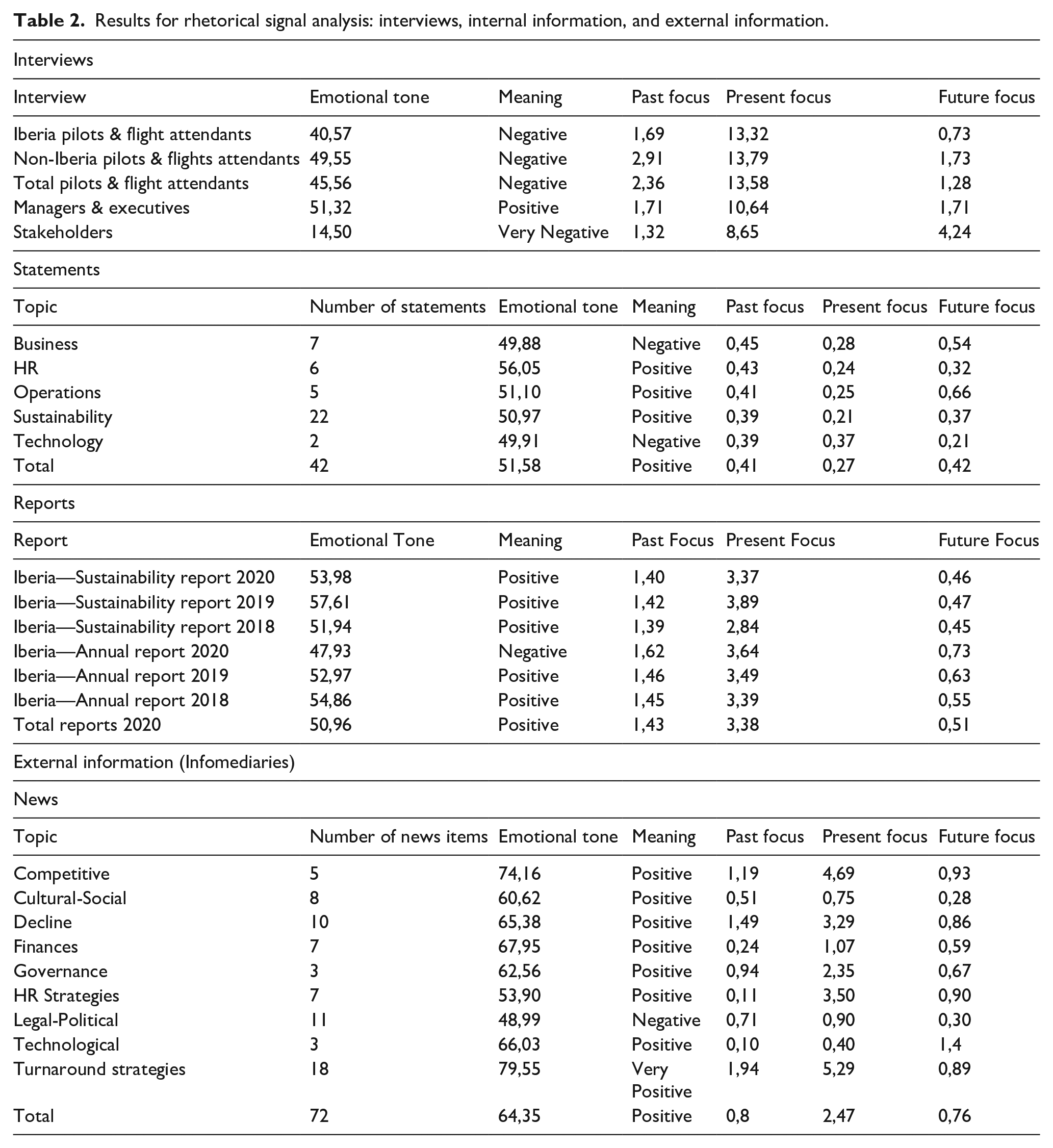
In contrast, the emotional tone of the executives and managers interviewed was positive (51.32). This fact is significant because positive emotions create positive company expectations (Isen & Shalker, 1982), which can lead stakeholders to estimate the probability of a greater number of positive events and reduce estimates of the probability of negative events. They made statements such as: “Airlines are used to going through crises, managing them and, when they are well managed, getting out of them” (M/IB/1); “In aviation, nothing is ever improvised. The sector is a great source of knowledge and technological advances. The business is based on standards and protocols. No company goes it alone or invents anything. Everything is written down. And it has to be complied with” (M/IB/3); “I see Iberia as an even more efficient company in five years’ time, offering its customers an agile and flexible service” (M/IB/4); “We are prepared. If there is one thing that is common in the aviation world, it is crises, unfortunately. And if there is one thing we know how to do at Iberia, it is to manage crises, and we have proven this throughout our 93 year history. We have always known how to adapt to circumstances, no matter how harsh, by reinventing ourselves, as we have done since 2013. We initially made ourselves smaller to become stronger and bigger in the long term and continue to be the leading Spanish airline in the world” (M/IB/6); “We are all aware that many things are going to change in the way we travel, at least until this epidemic is over. But airlines have often had to adapt to new situations. And now we will too. In this new reality, safety also means protecting people’s health and well-being: that of our customers and, of course, that of our employees” (M/IB/2).
However, the emotional tone of the stakeholders interviewed was negative (14.50), as clearly illustrated by sentences such as: “When one point of GDP falls, air traffic loses twice as much” (AE1); “This is a truly crazy situation” (AE1); “This sector suffers a crisis every decade. The previous ones lasted around three years. In the case of the coronavirus, it is difficult to predict” (AE1); “I think we will see a smaller sector, with more state intervention, more concerned about the environment, and cleaner; where flights will be cheaper and closer; where there will be no need for giant planes as was expected, but an increase in the number of destinations and frequency. And where people will buy their tickets later to avoid bad surprises. We will no longer book our trips a year in advance, but at the last minute. Just in case” (AE1); “The problem in aviation is that psychological turbulence is harder to solve than financial turbulence. The burden on the airline industry will continue even if the economy gets back on track” (AE2); “The situation could not be worse. Never before in history have we seen such a sharp drop in passengers and flights, reaching a situation of almost total unemployment and with almost all airlines in a situation of technical bankruptcy due to a lack of cash flow” (AE3).
In terms of internal information, the statements generally presented a positive tone (51.58), including topics such as Human Resources (56.05), Operations (51.10), and Sustainability (50.97). However, negative scores were found for Business (49.88) and Technology (49.91). Regarding the 2020 reports, the emotional tone was positive (50.96), although a decrease in positivity was detected compared to the reports published in the two previous years, the 2020 annual report obtaining a negative score (47.93).
In terms of the external information, the general emotional tone of the news published by the infomediaries was positive (64.35), including Decline (65.38), HR strategies (53.90), Finances (67.95), Competitive (74.16), Cultural-Social (60.62), Governance (62.56) and Technological (66.03). Turnaround Strategies (79.55) stood out for their highly positive emotional tone, while Legal-Political (48.99) was notable for its negative emotional tone.
Regarding the temporal focus, continuous changes in the company’s environment, accelerating changes in competition, technological advances, and customer preferences have forced companies to think about time, bringing this issue to the forefront of strategic management research (Chen & Nadkarni, 2017). Business strategy experts suggest that time interpretation serves as a temporal filter that shapes expectations and evaluations in decision-making situations and forms the basis of strategic behaviors (Crossan et al., 2005). Generally, the analysis of the temporal focus (past, present, and future) of the media content, company statements, reports, and interviews revealed a strong focus on the present. Interviews with pilots and flight attendants produced a score of 13.58, with managers and executives, of 10.64, and with stakeholders, of 8.65. In terms of internal information in statements, it was 0.27, and in reports it was 3.38. Regarding the external information from infomediaries, the present focus score was 2.47.
A strong focus on the present can generate up-to-date perspectives on the environment and better information about a company’s different opportunities and risks (Chen & Nadkarni, 2017). Business manager awareness of the current emerging environment can facilitate the detection of new opportunities and prevent risks. Greater reliance on real-time information results in rapid and direct feedback on the use of opportunities and supports the development of systems to address different risks. By emphasizing the present moment to find solutions, managers with a strong focus on the present can use real-time information to validate new opportunities and react quickly to prevent risks, thus continually adjusting development (Nadkarni & Chen, 2014).
It is worth noting that in the case of internal statement information, the temporal focus analysis showed a higher future focus (0.42). In this case, a strong focus on the future leads to imagining what is to come, to both detect new opportunities, and to anticipate future risks. Such a future focus is particularly well-suited for the recognition and meeting of the demands of dynamic environments (Gibson et al., 2007). Business managers with a strong future orientation can be highly aware of and anticipate futuristic technologies, potential new competitors, as well as customer needs, and thus detect opportunities and risks in advance (Chandy & Tellis, 1998). In dynamic environments, future contingency anticipation and preparation are essential to ensure a well-timed company development (Brown & Eisenhardt, 1997).
Discussion
The COVID-19 pandemic is unprecedented and no instructions came with the upheaval. The severity and duration of the COVID-19 global health pandemic bears no resemblance to any other recent crisis, and the high infection rates are not comparable to that of other disease outbreaks, such as SARS, Middle East Respiratory Syndrome (MERS), Ebola, or Zika. Therefore, in the face of this new global crisis scenario, it is necessary to review and update existing models, strategies, and theories to address the uniqueness, complexity, and unpredictability of this global crisis (Knowles et al., 2020).
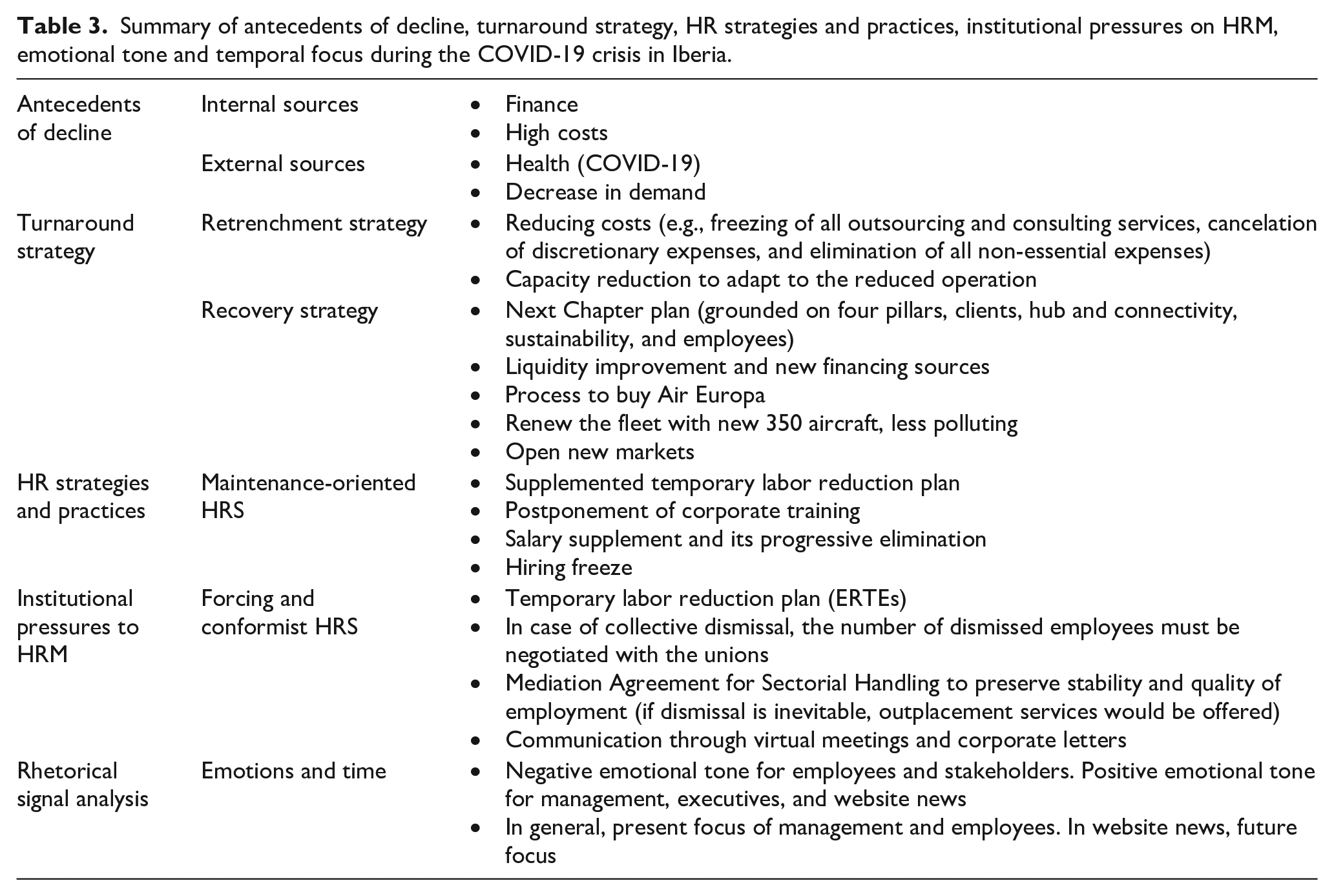
The COVID-19 pandemic has represented an external antecedent or a temporary external decline that has led airlines to ground their fleets for health reasons and due to falls in demand (Table 3). Companies usually adopt retrenchment measures in the face of such severe situations. Iberia, however, has wisely implemented a combination of recovery strategies. The latter include the purchase of Air Europa and the development of a new hub in Madrid to increase connectivity and to open new markets in a strong position. Therefore, the first proposition of our study was:
P1. In a temporary external decline context (COVID-19), a combination of retrenchment and recovery strategies will contribute to the company’s turnaround.
Summary of antecedents of decline, turnaround strategy, HR strategies and practices, institutional pressures on HRM, emotional tone and temporal focus during the COVID-19 crisis in Iberia.
Indeed, as the nature of the problem is temporary, companies should not only heavily rely on retrenchment measures to cut costs for a long period, but they should also visualize a short- or medium-term recovery and adopt more strategic responses to face the crisis.
In relation to the HR strategies and practices, to face this external upheaval (COVID-19 and the drop in demand), the company initially adopted a maintenance-oriented Human Resources Strategy (hereinafter HRS) combined, as of spring 2021, with an efficiency-oriented HRS (Santana et al., 2017), assigning resources to the most productive departments. According to these authors, a maintenance-oriented HRS pursues the temporary preservation of the company’s industry position via provisional HR practices such as reducing working hours, mandatory short weeks, sabbatical leaves, or part-time conversions, among others. An efficiency-oriented HRS is recommended in circumstances in which the firm is performing adequately but faces external pressures and seeks efficient responses to extend the industry position. HR practices that exploit current resources and capabilities include intensive training, to improve present job-related skills, or incentive systems, which focus on individual performance in current jobs. These HRM Systems are related to the contrasting views of Roche and Teague (2014), that is, when firms attempt to radically transform existing employment models rather than to adjust to immediate or short-term recession pressures while maintaining the established way of organizing the employment relationship. Consequently, we can expect the following:
P2. In a temporary external decline context (COVID-19), an initial maintenance-oriented HRS followed by an efficiency-oriented HRS will contribute to the company’s turnaround.
The maintenance-oriented HRS consisted of a supplemented temporary labor reduction plan, the postponement of corporate training, a salary supplement and its progressive elimination, as well as a hiring freeze. However, this HRS cannot be implemented for an extended period because of its potential impact on employee trust and morale. Thus, an efficiency-oriented HRS with intensive training that enhances current job-related skills, stimulates systems that target individual performance and that reincorporates the experienced workforce, will contribute to the exploiting of existing resources and capabilities.
In terms of institutional pressures on HRM, the severity of the situation allowed employees to understand the measures imposed. All parties made a common effort and accepted the reduction of operations, with a grounded fleet and workless staff. Initially, it was a forced situation for everyone, but such a forcing strategy is unsustainable. Thus, once an initial shock has passed, companies must turn toward fostering strategies to avoid defeat or intergroup distrust (Walton et al., 1994). Therefore, our third proposition is as follows:
P3. In a temporary external decline context (COVID-19), a forcing strategy followed by a fostering strategy will contribute to the company’s turnaround.
Under this temporary external decline (COVID-19 pandemic), the forcing strategy was mandatory as there was no production at all. The workforce was therefore subject to a temporary labor reduction plan. Nevertheless, as soon as conditions slightly evolve, the management and the employees must foster fluid and transparent communication to overcome the situation, acknowledging demands from both sides.
Along this whole turnaround process, the management maintained a positive tone in communications with its employees and the media. This positive tone, however, contrasted with the negative feelings of employees and stakeholders. Such a dichotomy can represent a serious risk: companies must pay attention to emotional tone deviances, particularly in times of crisis. To ensure a successful turnaround—especially during a temporary external decline that is about to disappear—stakeholders, and employees in particular, must properly understand the turnaround strategy aligned with the HR strategy to face the COVID-19 situation. In fact, Budhwar and Cumming (2020) suggest adopting a multi-stakeholder crisis-management approach to generate sustainable solutions of recovery from the COVID-19 global health crisis. In this line, we propose the following:
P4a. In a temporary external decline context (COVID-19), management needs to pay attention to possible emotional tone management deviances with respect to stakeholders, especially employees—to achieve a successful turnaround.
Regarding the temporal focus, Iberia presents a strong focus on the present. Managers with a strong focus on the present can have an up-to-date view of the environment and provide better information regarding the company’s different opportunities and risks (Chen & Nadkarni, 2017). This awareness of the current emerging environment can facilitate the detection of new opportunities and prevent risks. A greater reliance on real-time information results in rapid and direct feedback on the use of opportunities and facilitates the development of systems to address different risks. By emphasizing the present moment to find solutions, managers with a strong focus on the present can use real-time information to validate new opportunities and swiftly avoid risks, with the goal of continuously adjusting development (Nadkarni & Chen, 2014). However, a temporal focus balance must be reached between present and future focus. Thus, managers with a strong focus on the future will be able to identify new opportunities and to anticipate future risks (Gibson et al., 2007), demonstrating to stakeholders that the company is prepared to deal with them. Managers with a strong future orientation can be highly aware of and anticipate futuristic technologies, potential new competitors, and customer needs (Chandy & Tellis, 1998). In fact, in dynamic environments, anticipation and preparedness with respect to future contingencies are essential for the company’s timely development (Brown & Eisenhardt, 1997). Therefore, our last proposition is:
P4b. In a temporary external decline context (COVID-19), management must pay attention to possible deviances in the temporal focus of the management and stakeholders—especially employees—and adopt both a present and future time focus to achieve a successful turnaround.
In the present crisis, managers must quickly adopt drastic decisions. To ensure a successful turnaround, it is crucial to implement mechanisms that allow understanding employee morale and to communicate transparently and effectively. Communication and the establishment of mechanisms to know employee morale, either via meetings with unions or more fluid internal dialogue, are key. These alternatives are often overlooked in critical situations. In fact, Budhwar and Cumming (2020) pointed to the importance of good communication and collaboration with key internal and external stakeholders, learning from such communication and collaboration, investing in employee well-being, and senior management resilience as critical elements of a recovery plan for the COVID-19 global health pandemic. The maintenance-oriented HRS—consisting of a supplemented temporary labor reduction plan, the postponement of corporate training, a salary supplement as well as its progressive elimination and hiring freeze—cannot be sustained for long without undermining employee morale. Indeed, the causes of the crisis are cyclical or temporary. In addition, managers must move away from a command-and-control mentality and support as well as engage employees who are subject to burnout, social isolation, and negative emotions (Malik & Sanders, 2021). These managers must develop behaviors that portray them more as facilitators. They must show empathy and positive emotions to deal with psychosocial issues in these emotionally distressing times. Therefore, it is very important to create mechanisms that support fluid and bi-directional communication on a day-to-day basis.
Conclusion
This work presented the case study of an airline and its responses to the recent COVID-19 pandemic. It examined the consequent fall in passenger demand, the turnaround strategies, the human resource strategies and the practices adopted by the company to reverse the situation, as well as institutional pressures on HRM. The study was complemented with an analysis of the emotional tone and temporal focus of the management, employees, and stakeholders to the responses adopted by the organization.
The main contribution of this article is the description of a sequence of several strategies (retrenchment and recovery strategies, maintenance vs. efficiency-oriented strategies; forcing and fostering strategies) that help to ensure the company’s turnaround in a context of temporary external decline. A rhetorical signals analysis of the emotional tone and temporal focus of managerial communications as well as the responses of different stakeholders enriched our results. It is recommended that managers and stakeholders adopt both a present and future focus to achieve a successful turnaround in the present context of temporary external decline. On this point, managers and executives adopted a positive emotional tone regarding the management and expectations of the company during the COVID-19 crisis, while stakeholders and employees presented a negative emotional tone. In relation to the temporal focus, Iberia’s managers are showing a focus on the present, implying an up-to-date view of the environment. Such a perspective enables them to utilize current information to detect various risks and opportunities.
Theoretical implications
A temporary external decline (e.g., the COVID-19 pandemic) implies that the turnaround and HRM strategies and practices cannot be sustained over a long period: problems and responses are temporary, so they must both be reviewed frequently. Therefore, in a context of temporary external decline, the requisite maintenance-oriented HRS also needs to be cyclical. In addition, institutional pressures from governments and stakeholders (employees, unions, or other companies) need to be acknowledged within the companies to update procedures and measures. In a situation of temporary external decline, communication plays a crucial role in the implementation of measures and their rectification. Communication allows taking the pulse of how the measures are being received by employees and stakeholders and thus, management can quickly react to environmental changes. This study introduced the need to acknowledge antecedents of the decline, turnaround strategies, HR strategies and practices, institutional pressures on HRM and the emotional tone and temporal focus of managerial communications and stakeholder responses to manage the crisis. A crisis is a dramatic situation, and, as such, many variables need to be considered to achieve the turnaround.
Therefore, with this work, we have extended and updated the co-evolutionary model of the antecedents of decline, turnaround and HR responses, and labor relations strategies proposed by Santana et al. (2019b). In doing so, we have considered the dynamic co-evolution of several variables and their mutual impact, and how the interaction between the firm and its environment influences the timing and inclusiveness of HR practices (Paauwe & Boselie, 2009). Moreover, this study advances that management needs to pay attention to possible deviances in the emotional tone and temporal focus of management, employees and stakeholders in situations of crisis. To attain a successful turnaround, a synchronization of positive emotional tone and temporal focus leads the company to row in the same direction, and this facilitates recovery.
Practical implications
The airline’s response to the current COVID-19 crisis followed the criteria defined by Santana et al., (2017) for temporary external decline crises. In this sense, retrenchment strategies have been adopted to address the critical situation and cut costs, while recovery strategies were taking place, such as the strengthening of the Madrid hub or the acquisition of Air Europa. In line with this turnaround strategy, a maintenance-oriented HRS has been adopted. It is essential to analyze the problem antecedents, as they quickly evolve, and management needs to acknowledge the latest antecedents to implement new measures. Managers must consider that HR strategies and practices evolve especially in times of crisis, and they need to update HR strategies and practices to the new antecedents of the decline. Given the dizzying speed with which decisions, which largely affect employees, must be made, communication is crucial. Communication and the implementation of mechanisms to understand employee morale, either via meetings with unions or more fluid internal dialogues, are key to manage the crisis. The COVID-19 pandemic is a temporary or cyclical external issue that directly impacts other company problems, such as the fall in passenger demand. However, since the problem is temporary, more restrictive HR measures, such as the temporary labor reduction plan or a hiring freeze, are not sustainable over a long period, and this must be properly acknowledged by management. For that reason, it is essential to create fluid communication mechanisms between management, employees, and stakeholders to attain a successful turnaround. Managers should not overlook the negative emotional tone of employees and on the contrary, ask themselves what they can do to address this negative approach.
Future research
A future line of research is the observation of the impact of this temporary external decline generated by the COVID-19 Global Health Pandemic on other industries. Another line of study is the analysis of how different airlines have reacted from an HR standpoint to this COVID-19 pandemic. In addition, further research should focus on how effectively communication tools can manage the negative emotional tone of employees and other stakeholders in crisis situations. Moreover, according to Arogyaswamy et al.’s (1995) seminal research, the COVID-19 crisis is a temporary external decline, but there are other types of crises depending on the cause of the decline and the firm’s competitive position. Examples include long-term industry-contraction or firm-based decline. Thus, future research lines could approach HRM practices and institutional pressures in these kinds of crises.
Limitations
The study presented a number of limitations. A larger number of direct interviews with company management would have been desirable as well as a broader multilevel perspective. The reasons for these limitations, however, are understandable: the COVID-19 crisis has had a dramatic impact at all company levels and many airlines are still in shock, striving to navigate the fallout from this global health crisis. In addition, the wide range of archival data available, such as company statements, financial reports, news reports, specialized websites, and videos of executive interviews, made it easy to access the information needed to conduct this study. As a result, we obtained archival data from multiple sources, combining primary and secondary data with internal and external company information. In addition, rhetorical signal analysis complemented this qualitative study, providing rich insights into the antecedents (or causes) of decline, turnaround responses, HRM in times of crisis and institutional pressures on HRM, managerial communication and stakeholder responses in times of crisis.
Supplemental Material
sj-docx-1-brq-10.1177_23409444221120053 – Supplemental material for Turnaround and human resource strategies during the COVID-19 crisis
Supplemental material, sj-docx-1-brq-10.1177_23409444221120053 for Turnaround and human resource strategies during the COVID-19 crisis by Juan Carlos Rivera-Prieto, Monica Santana and Álvaro López-Cabrales in Business Research Quarterly
Footnotes
Declaration of conflicting interests
The author(s) declared no potential conflicts of interest with respect to the research, authorship, and/or publication of this article.
Funding
The author(s) disclosed receipt of the following financial support for the research, authorship, and/or publication of this article: Financial support for this research was provided by Proyecto PID2020-112599GB-I00 funded by MCI/AEI/10.13039/501100011033

Supplemental material
Supplemental material for this article is available online.
References
Supplementary Material
Please find the following supplemental material available below.
For Open Access articles published under a Creative Commons License, all supplemental material carries the same license as the article it is associated with.
For non-Open Access articles published, all supplemental material carries a non-exclusive license, and permission requests for re-use of supplemental material or any part of supplemental material shall be sent directly to the copyright owner as specified in the copyright notice associated with the article.
