



Abstract
Low output impedance composite pH sensors were constructed by direct attachment of an impedance converter to laboratory purpose combined pH glass electrodes. The signal was transmitted in analog form by unshielded electric cable. The performance of new and aged composite pH sensors was determined by the multiple-point calibration method. In case of new electrodes, the slope and the response time, as well as the reproducibility, were insignificantly influenced by the converter attached (the mean slope values calculated for the six electrode group studied were 57.80 mV/pH for unmodified electrodes and 57.97 mV/pH for modified electrodes). The electrode response was not affected by the presence of various electromagnetic noise sources or by the input impedance value of the measuring instrument. The slope and the response time of aged sensors were considerably improved using the impedance converter. The response time decreased from about 150–180 sec to about 30 sec and the average slope value increased from 54.94 mV/pH, calculated for unmodified electrodes, to 56.96 mV/pH, for modified electrodes.
INTRODUCTION
Modern analytical practice frequently requires automation of pH determination and control with signal transmission over long distances. Classical pH glass electrodes (so far the best pH sensors) used for this purpose usually present considerable noise effects caused by their high output impedance even if the imposed severe electric insulation and electromagnetic shielding demands are rigorously respected.
This disadvantage is virtually suppressed when the sensor is combined with a signal-modifying electronic circuit transmitting a low impedance signal to the connecting line. The signal modifier consists of a built-in impedance converter, which should have the highest possible input impedance and the lowest possible output impedance, drift and noise 1,2 .
In this paper we present a possibility for the realization of such a composite sensor as well as its measuring performances in different experimental conditions, in comparison with similar unmodified glass electrodes.
EXPERIMENTAL
The composite pH sensors were constructed starting from HC-Li-3 type general-purpose low resistance combined pH glass electrodes 3 produced at ICRR Cluj.
The electronic circuit, constructed and tested for use in the body of glass electrodes, and designed to convert the high-impedance output signal to a low-impedance one (in order to improve the signal-to-noise ratio), was with the analog output and with the floating source in the negative feedback 1 . The impedance converter, working as a voltage follower in the circuit, was based on an operational amplifier (OA), of type OPA 627 (Burr-Brown), characterized by extremely high input impedance (1013 Ω), input bias current of 5 pA and temperature drift of 0.8 μVK-1. The constant voltage offset of max. 100 μV was not compensated. The output of the composite sensor consisted of the low impedance signal output of the voltage follower, and the grounding lead was the reference electrode output.
A random selection of six new glass electrodes and six aged glass electrodes (continuously used for 15 months), were tested with and without an impedance converter in order to assess the influence of electrode type on the precision and accuracy of the pH measurements.
Measurements made in order to establish the performance of glass electrodes of different types were carried out according to IUPAC recommendation 4 .
The solutions used were NIST pH buffers prepared according to the instructions of Bates 5 , from pH reference substances (Merck, Darmstadt), and distilled water whose conductivity was less than 10-6 S. Buffer solutions of pH greater than 5.0 were prepared with distilled water free of CO2, purged by boiling. All the solutions were certified to within pH< ± 0.005 using the following electrochemical cell with transference:

Measurements on glass electrodes were carried out using a transference cell of the form:

The reference electrode used in cell (I), was of the ceramic porous plug junction type (model RB, ICRR Cluj). The reference junction of the combined glass electrodes was a ceramic porous plug also.
The multiple-point calibration method proposed by Baucke et al. 6 , was used both for the certification of the buffer solutions and for the determinations performed on the glass electrodes.
Emf values of cell (I), were measured with 0.1mV accuracy using a precision voltmeter (5.5 digit, model E-0303, IEMI Bucuresti). The potential of glass electrodes without the impedance converter was determined within ±1 mV using a high-input-impedance digital pH/mV meter (model pH-200, IAMC Otopeni). The connection to the measuring instrument was assured by pH cable, as usual. Composite glass electrodes were measured with 1mV accuracy, using an E-0304 model multimeter on the voltmeter function (4.5 digit, IEMI Bucuresti). The sensors were connected to the measuring instrument through an unshielded electric cable of 20m length. In order to evaluate the possible noise effects, all measurements performed on the composite glass electrodes were repeated using the pH cable connection and the pH-200 model pH meter as a measuring instrument.
Electrical resistance of the unmodified glass electrodes was determined with an E 6 13A model teraohmmeter (precision 2.5%). Polarization effects were avoided calculating the mean values obtained in 4 consecutive readings carried out changing the polarity of the electrode.
For all measurements the cell temperature was maintained at 20±0.1° C.
RESULTS AND DISCUSSION
In the case of cell (I), emfs, E, were measured five times for each of the standard buffer solutions and referred to a H2 pressure of 1013.25 Pa according to 5 . From each set of potential values obtained, the calibration line, Eq.(1),

was calculated by linear regression (where E0' is the standard potential of cell (I) and k is the average practical slope). Deviations _E of the emfs, E, from those calculated accordig to Eq. (1), were also obtained. _E values were then transformed into pH.
Average values of the measured emfs, E, (normalized with respect to the H2 pressure), and their standard deviations are given in

Buffer solutions used, their composition and experimentally determined pH values.
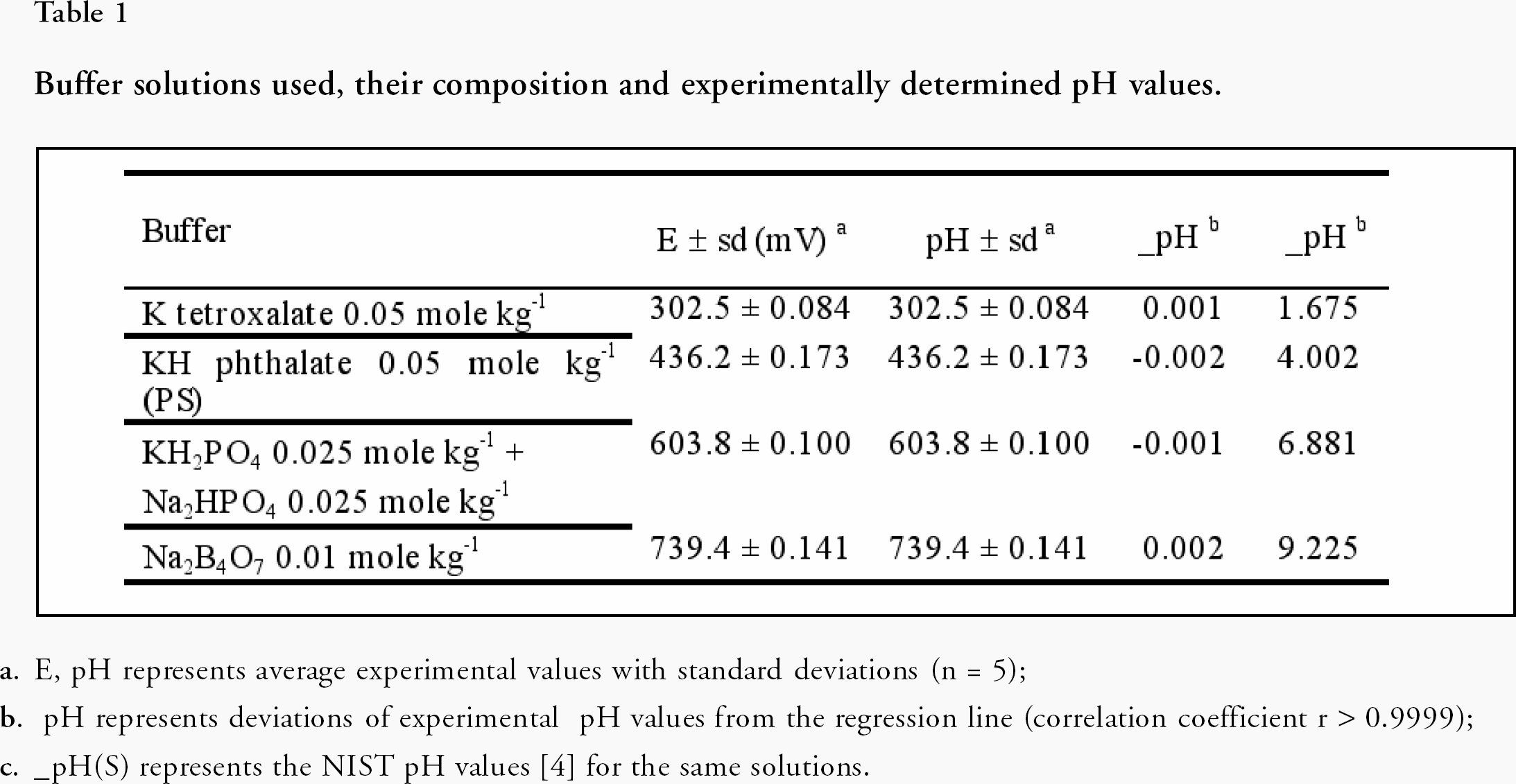
E, pH represents average experimental values with standard deviations (n = 5);
pH represents deviations of experimental pH values from the regression line (correlation coefficient r > 0.9999);
_pH(S) represents the NIST pH values [4] for the same solutions.
The emfs of the unmodified glass electrodes and composite sensors were measured five times in each of the certified standard buffer solutions, then the calibration lines were calculated by linear regression as before.
Mean values of asymmetry potential Ea and of average practical slope k' and their standard deviations (sd), for new electrodes are presented in
Metrological parameters of the electrode function for new glass electrodes with and without impedance converter
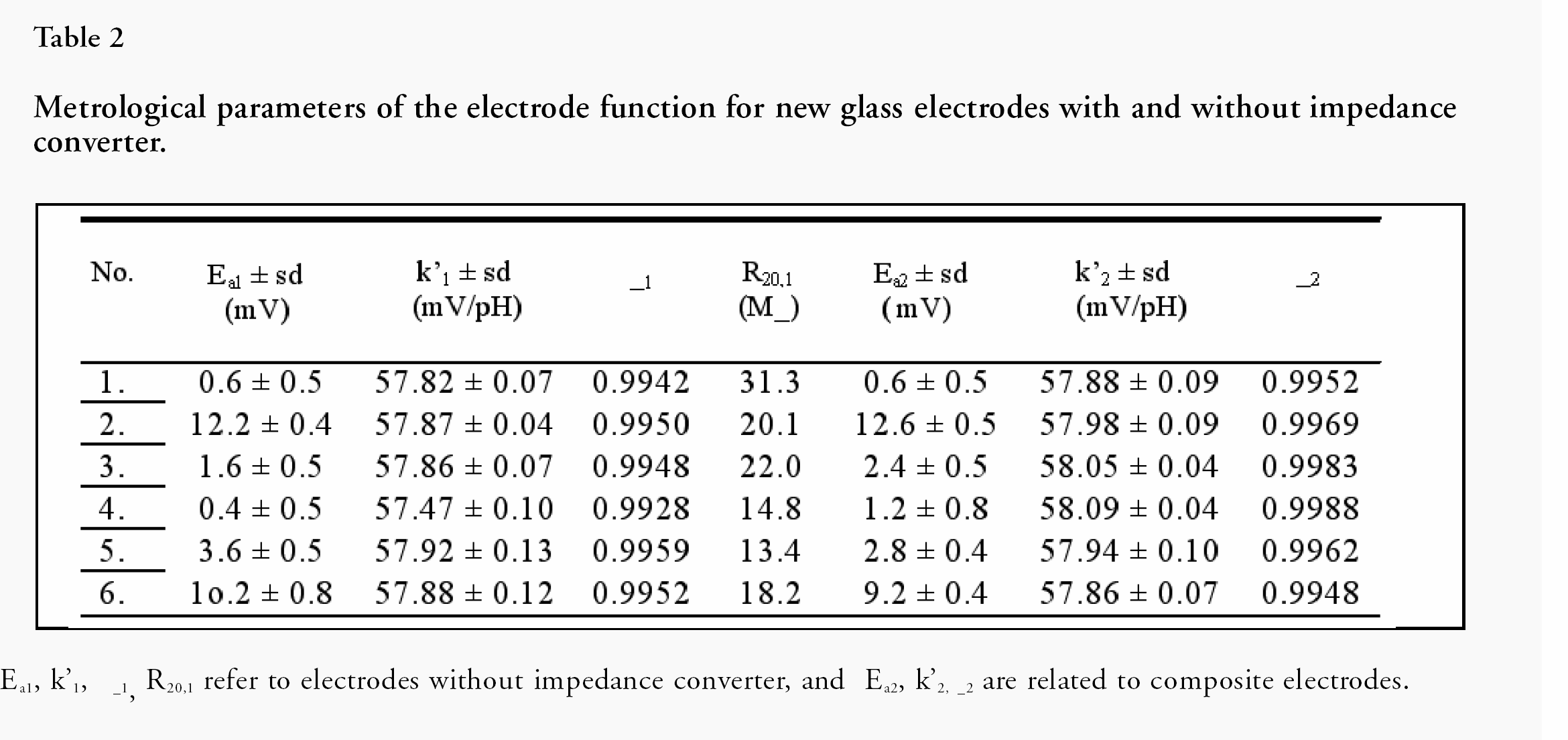
Ea1, k'1, _1, R20,1 refer to electrodes without impedance converter, and Ea2, k'2, _2 are related to composite electrodes.
The experimental pH values calculated from emf data, as well as deviations from the regression line, pH, are given in
pH values calculated for new glass electrodes with and without impedance converter.
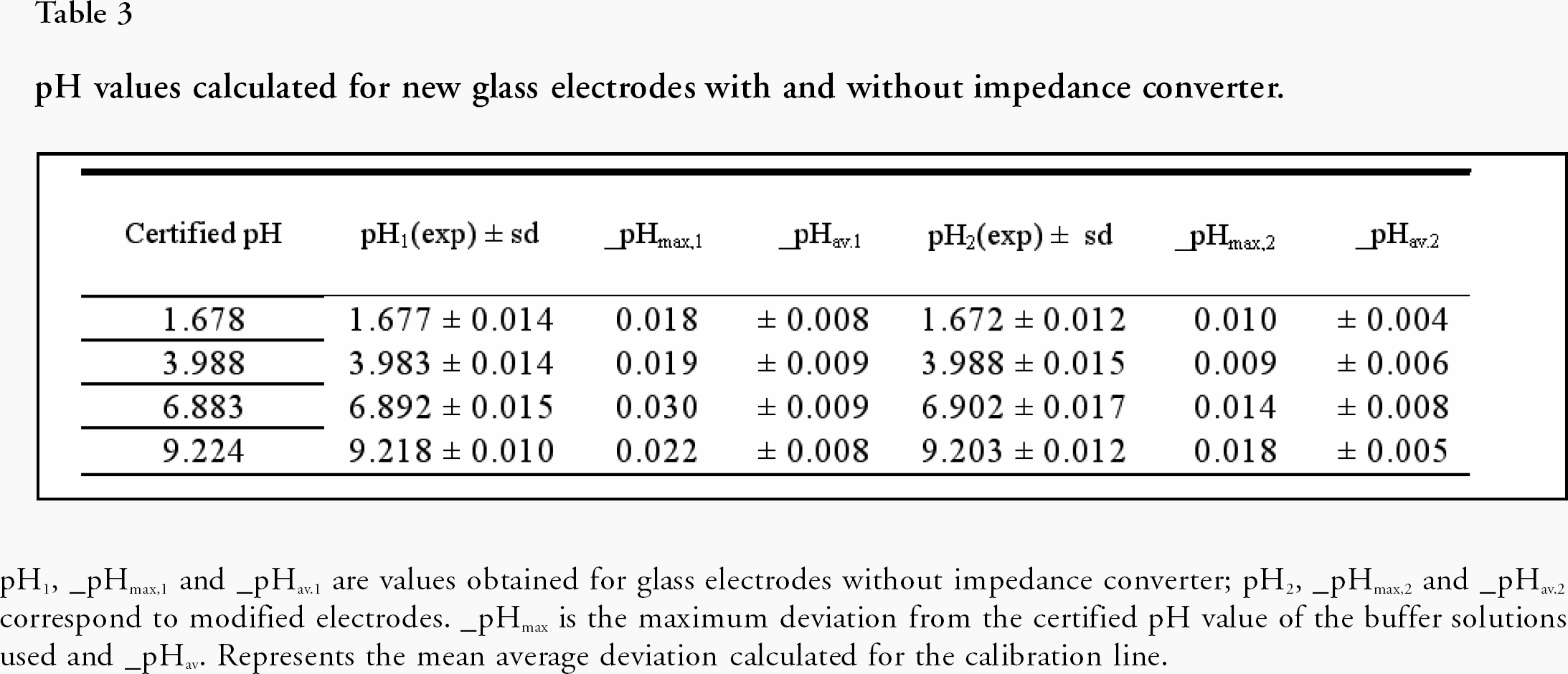
pH1, _pHmax,1 and _pHav.1 are values obtained for glass electrodes without impedance converter; pH2, _pHmax,2 and _pHav.2 correspond to modified electrodes. _pHmax is the maximum deviation from the certified pH value of the buffer solutions used and _pHav. Represents the mean average deviation calculated for the calibration line.
It can be seen from the results that the impedance converter tested allows measurements with high-impedance voltage sources, such as pH glass electrodes, without deterioration of the information content of the signal, even when it is transmitted over long distances. The precision of the determinations as well as the response time of the electrodes are practically unaffected by the electronic circuitry attached. The signal transmission line is not influenced by the electrical noise.
The aged glass electrodes were characterized in the same way as the new ones. Mean values of the asymmetry potential and the average practical slope, as well as the electromotive efficiency and the DC resistance, are presented in
Metrological parameters of the electrode function for aged glass electrodes with and without impedance converter.
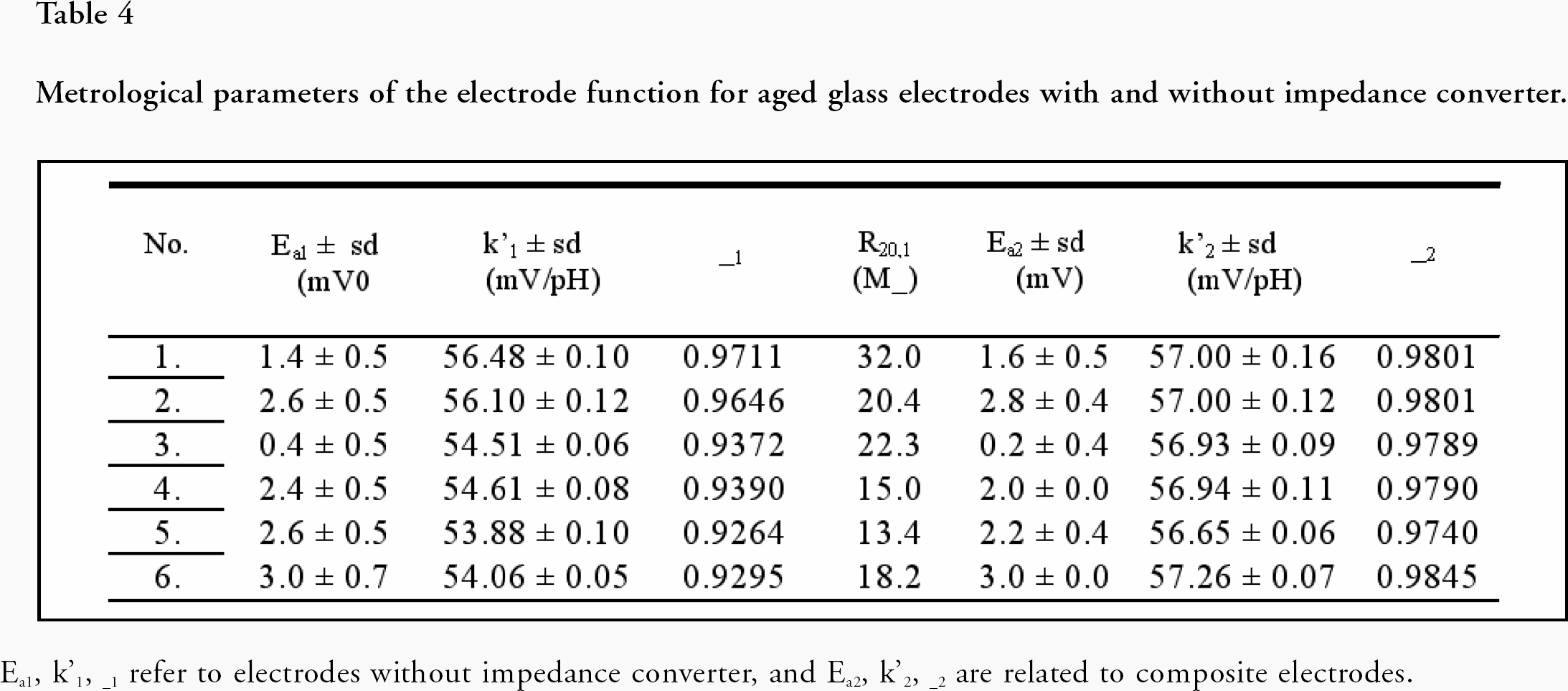
Ea1, k'1, _1 refer to electrodes without impedance converter, and Ea2, k'2, _2 are related to composite electrodes.
As expected, after 15 months of continuous service the functional parameters of unmodified glass electrodes are generally deteriorated, so they usually don't comply with metrological requirements. It is to be noted that this is not related to a significant increase of the electrical DC resistance of the glass membrane (due to alkali leaching), as would be expected according to the most accepted theories. The attachment of the impedance converter to these functionally broken electrodes results in their recovery, extending their lifetime. The elucidation of this mechanism could yield new information about the origin of the potential of the glass electrode. It registered a significant decrease of the response time also. The time necessary to reach the equilibrium potential value changed from about 150–180 sec (corresponding to unmodified electrodes), to about 30 sec in the case of the modified electrodes.
Experimental pH values calculated from emf data and the deviations from the regression line, respectively from the certified pH values, are given in
pH values calculated for aged glass electrodes with and without impedance converter.
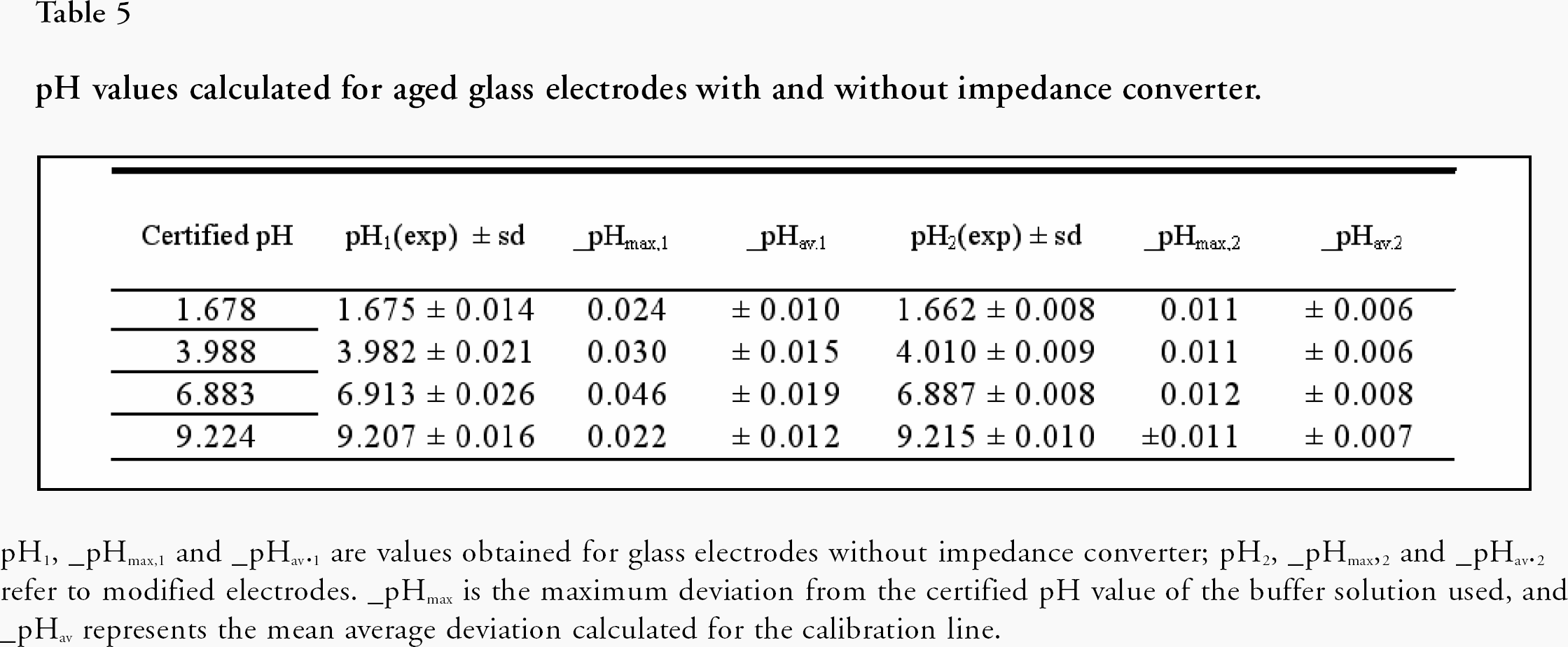
pH1, _pHmax,1 and _pHav.1 are values obtained for glass electrodes without impedance converter; pH2, _pHmax,2 and _pHav.2 refer to modified electrodes. _pHmax is the maximum deviation from the certified pH value of the buffer solution used, and _pHav represents the mean average deviation calculated for the calibration line.
In the case of the composite sensors, an improvement of precision can also be observed, as shown by the slightly greater errors of the unmodified aged electrodes.
CONCLUSIONS
Low output impedance composite pH sensors were constructed by direct attachment of an impedance converter to laboratory purpose combined pH electrodes. The signal was transmitted in analog form by unshielded electric cable. The performance of new and aged composite pH sensors was determined by the multiple-point calibration method. In case of new electrodes, the slope and the response time as well as precision were insignificantly influenced by the converter. The electrode response was not affected by the presence of various electromagnetic noise sources or by the input impedance value of the measuring instrument.
The slope and the response time of aged sensors were considerably improved using the impedance converter.
ACKNOWLEDGEMENTS
The authors would like to express their gratitude to the “Raluca Ripan” Institute of Chemistry, especially to Dr. E. Hopârtean for supplying the glass electrodes studied.
Footnotes
Acknowledgements
If you are interested in seeing more articles like this in JALA, please email