
Abstract
 Restricted accessAbstractFirst published December, 2021pp. A-1-A-23

Select search scope: search across all journals or within the current journal


 Restricted accessAbstractFirst published December, 2021pp. A-1-A-23Restricted accessAbstractFirst published December, 2021pp. A-24-A-26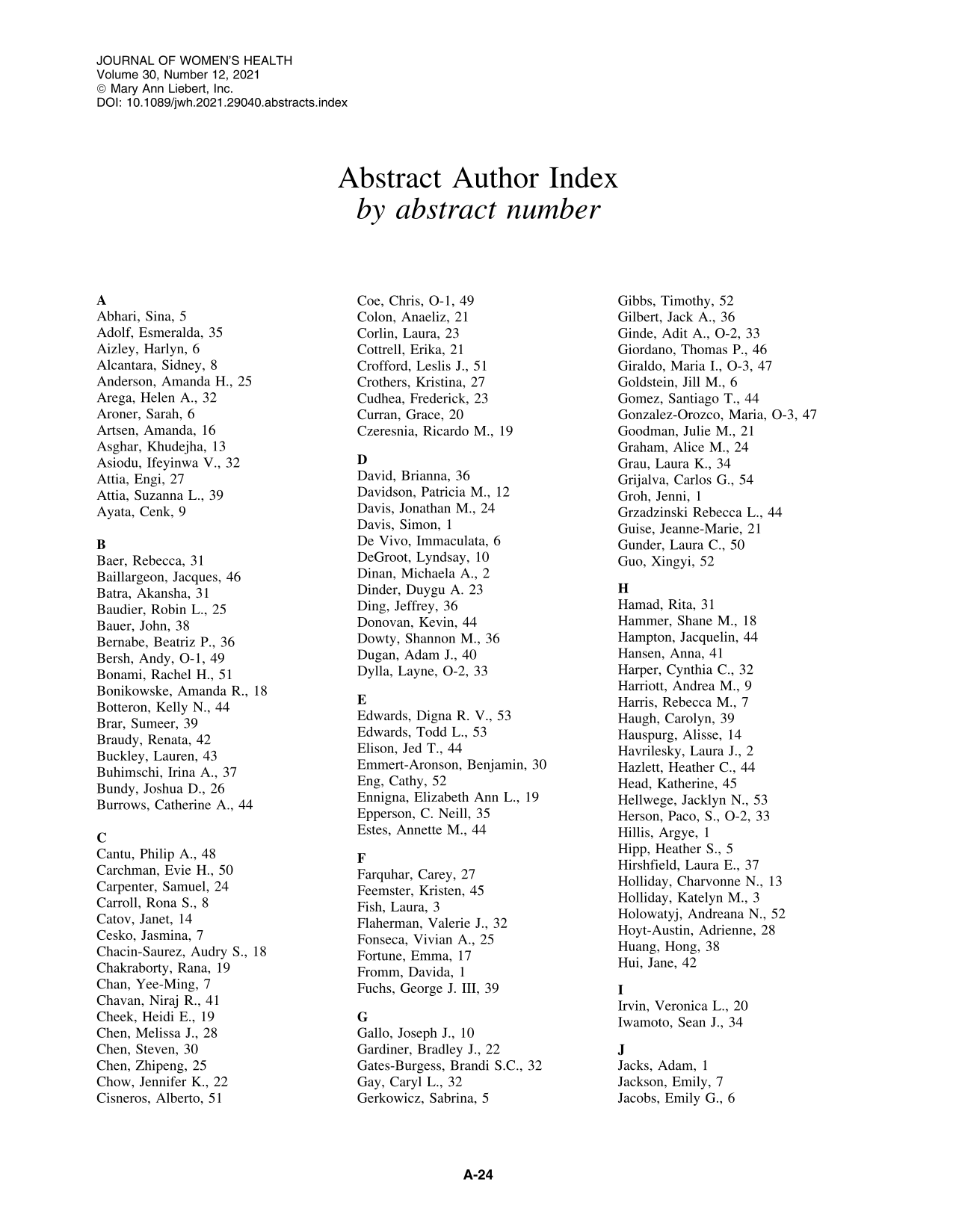
 Open accessResearch articleFirst published December, 2021pp. 1667-1672
 , J. Michael Berry-Lawhorn, Paul Blumenthal , [...]
Human papillomavirus (HPV) infections cause more than 35,900 cancers annually in the United States. Although cervical cancer is the most prevalent HPV-related malignancy in women, the virus is also responsible for a significant percentage of anal, vaginal, and vulvar cancers. A comprehensive approach to mitigating cervical cancer includes HPV vaccination (primary prevention), screening and treatment of precancerous lesions (secondary prevention), and diagnosis and treatment of invasive cancer (tertiary prevention). Although a successful strategy, there are opportunities to innovate and increase access that can also be adapted to address the unique clinical care gaps that exist with the other anogenital cancers. The Society for Women's Health Research held a series of interdisciplinary meetings and events, during which expert researchers, clinicians, patient advocates, and health care policy leaders evaluated the current landscape of HPV-related cancers and their effects on women's health. This report summarizes the discussions of this working group and areas it identified in which to address gaps in primary and secondary prevention approaches to improve access and health outcomes for women with HPV-related anogenital cancers.
Restricted accessResearch articleFirst published December, 2021pp. 1673-1680This report provides historical context and rationale for coordinated, systematic, and evidence-based public health emergency preparedness and response (EPR) activities to address the needs of women of reproductive age. Needs of pregnant and postpartum women, and infants—before, during, and after public health emergencies—are highlighted. Four focus areas and related activities are described: (1) public health science; (2) clinical guidance; (3) partnerships, communication, and outreach; and (4) workforce development. Finally, the report summarizes major activities of the Division of Reproductive Health's EPR Team at the Centers for Disease Control and Prevention.
Restricted accessResearch articleFirst published December, 2021pp. 1681-1685 Open accessResearch articleFirst published December, 2021pp. 1686-1692, Sabine Oertelt-Prigione, Lifelines Corona Research Initiative , [...]
Although sex differences are described in Coronavirus Disease 2019 (COVID-19) diagnoses and testing, many studies neglect possible gender-related influences. Additionally, research is often performed in clinical populations, while most COVID-19 patients are not hospitalized. Therefore, we investigated associations between sex and gender-related variables, and COVID-19 diagnoses and testing practices in a large general population cohort during the first wave of the pandemic when testing capacity was limited.
We used data from the Lifelines COVID-19 Cohort (
In bivariate analyses female sex was significantly associated with COVID-19 diagnoses and testing, but significance did not persist in multiple logistic regression analyses. However, a gender-related variable, being a health care worker, was significantly associated with COVID-19 diagnoses (OR = 1.68; 95%CI = 1.30–2.17) and testing (OR = 12.5; 95%CI = 8.55–18.3). Female health care workers were less often diagnosed and tested than male health care workers (ORinteraction = 0.54; 95%CI = 0.32–0.92, ORinteraction = 0.53; 95%CI = 0.29–0.97, respectively).
We found no sex differences in COVID-19 diagnoses and testing in the general population. Among health care workers, a male preponderance in COVID-19 diagnoses and testing was observed. This could be explained by more pronounced COVID-19 symptoms in males or by gender inequities.
Open accessResearch articleFirst published December, 2021pp. 1693-1707, Bianca Wollenhaupt-Aguiar, Katrina N. Kidd , [...]Women with premenstrual dysphoric disorder (PMDD) and premenstrual syndrome (PMS) experience substantial functional impairment and decreased quality of life. While previous research has highlighted a relationship between premenstrual disturbances and suicide risk, no meta-analysis has been conducted to quantitatively assess the findings.
A systematic review and meta-analysis was conducted by searching the literature in three databases (Pubmed, PsycINFO, and EMBASE) on July 15, 2020. Studies that assessed the relationship between suicidality (attempt, ideation, and/or plan) and premenstrual disturbance (PMDD, PMS, and/or premenstrual symptoms) were included.
Thirteen studies were included in the qualitative review (
Women with PMDD and PMS are at higher risk of suicidality compared with women without premenstrual disturbances. These findings support routine suicidal risk assessments for women who suffer from moderate-to-severe premenstrual disturbance. Furthermore, psychosocial treatments for women diagnosed with PMS/PMDD should consider and target suicidality to minimize risk and improve well-being.
Restricted accessResearch articleFirst published December, 2021pp. 1708-1712, Emily A. Eckert, Jamie R. DawThe objective of this study is to understand the proportion of Maternal Mortality Review Committees (MMRCs) that investigate insurance status at the time of maternal deaths occurring during three time periods: pregnancy, childbirth, and up to 12 months postpartum.
We conducted a national survey of MMRCs between July and September of 2020. Jurisdictions were e-mailed a 17-item questionnaire that addressed whether the MMRCs document insurance status for each of the three time periods as well as facilitators and barriers to doing so. Descriptive statistics were performed. Follow-up interviews were conducted with five MMRCs between November and December of 2020 to assess unique strategies and challenges discovered in their survey responses.
Among 46 eligible jurisdictions, 37 completed the survey (80.4%). The vast majority of MMRCs reported documenting insurance status during pregnancy (97.3%, 36/37) and childbirth (88.4%, 30/34). Fewer MMRCs reported documenting insurance status at the time of death for deaths that occur postpartum (59.4%, 19/32). Barriers to doing so included limited access to postpartum insurance data and a historic focus on deaths occurring during pregnancy and in association with childbirth.
MMRCs primarily focus on identifying insurance status during pregnancy and at childbirth. Information on insurance status in the postpartum period is more difficult to ascertain and less often determined. The findings from this work should inform efforts for MMRCs to improve data collection on insurance status and ultimately improve the capacity of MMRCs to identify targeted insurance policy reforms that could help reduce maternal mortality.
Restricted accessResearch articleFirst published December, 2021pp. 1713-1719Our aim was to evaluate trends of childbearing during medical training, evaluate issues of infertility, and measure institutionalized barriers to childbearing among women physicians.
Attendees of a national women physician's leadership conference (Brave Enough Women Physicians Continuing Medical Education Conference) were surveyed during the conference using Qualtrics© (2019 Qualtrics, Provo, UT), in September 2019. Survey data included demographics, training level, and medical specialty. Data related to reproductive health factors, pregnancy status and history, current number of children, medical history related to pregnancy, breastfeeding history, institutional family planning support, and use of previous fertility treatments were collected. Descriptive analyses were done using IBM SPSS v26.0.
Three hundred seventy-seven survey participants were included in the study. 10.6% of respondents reported at least one pregnancy during medical school, versus 78.8% as a practicing physician. Of the participants, 25.8% reported having taken off 1 month or less of clinical duties after giving birth, 39.4% reported that their job prevented breastfeeding for the desired length of time, and 52.2% reported significant workplace limitations to breastfeeding. Of them, 25.5% reported having had fertility issues in the past. Fertility drugs (72.9%) was the most common fertility treatment method used, followed by fertility tracking (54.2%). Demands of training (72.9%) and long work hours (61.5%) were the most cited factors in delaying having children as reported by women physicians.
This study reported several barriers related to fertility, family planning, and reproductive health among women physicians. Our results highlight the need for a paradigm shift in fertility awareness and institutional support for childbearing during medical training, postgraduate training programs, and in practice for women in medicine.
Restricted accessResearch articleFirst published December, 2021pp. 1720-1728The U.S. Preventive Services Task Force (USPSTF) modified breast cancer screening guidelines in November 2009. The impact has been studied among privately and Medicare insured populations, but not among universally insured women.
This study compared the proportion of TRICARE beneficiaries aged 40–64 receiving mammograms from fiscal years 2006 to 2015 using an interrupted time series analysis to determine the impact of the 2009 USPSTF guideline changes. Stratified analyses evaluated differences by age (ages 40–49, 50–64), race, care setting, beneficiary type, and military status.
The proportion of women receiving mammograms increased from October 2005 through September 2009. A small, but significant decrease of 65–66 fewer women screened per 10,000 occurred in the first quarter of 2010 (October 1 to December 31) following the screening guideline update publication. The proportion screened then remained unchanged through 2015. Comparative analysis revealed no differences in impact between age groups, blacks and whites, or military dependents and active-duty/retirees.
This study determined that the USPSTF guideline updates had a small, but immediate and lasting impact that was not different across age groups, beneficiary type, or race. No racial disparities in the proportion screened or in the impact of the guideline change were noted in our universally insured population.
Restricted accessResearch articleFirst published December, 2021pp. 1729-1735Black women are at an increased risk of developing fibroids, but the cause is unclear. Douching and perineal talc use are common lifestyle exposures among Black women, and may be risk factors for fibroid development.
This cross-sectional study consisted of Black women 23–35 years of age in the metropolitan Detroit area (
Fibroid prevalence was 23%. Forty-three percent of women reported ever douching and 15% reported ever using perineal talc. We did not observe an association between ever douching and fibroid prevalence [PR (95% CI):1.05 (0.89–1.23)] or total fibroid volume [OR (95% CI) ≤2:00 cm3: 1.04 (0.66–1.42)] and [OR (95% CI) ≥2:00 cm3: 1.06 (0.77–1.44)]. Women who ever used perineal talc had an increased prevalence of fibroids [PR (95% CI): 1.19 (0.97–1.46)]. This association was seen with both large and small total fibroid volume [OR (95% CI) volume ≤2:00 cm3: 1.23 (0.81–1.86)] and [OR (95% CI) volume ≥2:00 cm3: 1.39 (0.93–2.09)].
Our results suggest that perineal talc use is associated with increased fibroid prevalence. Additional research is warranted to investigate perineal talc in relation to fibroid risk in a prospective setting and to conduct laboratory work on potential tumorigenic effects of talc in the myometrium.
Restricted accessResearch articleFirst published December, 2021pp. 1736-1743, Kimberly K. Vesco, Vinay Mehta , [...]The relationship between severe maternal morbidity (SMM) events during inpatient delivery and subsequent hospital readmission is not well understood.
This was a retrospective cohort study of women with a live inpatient delivery during 2016 recorded in MarketScan® databases for commercially insured and Medicaid populations. Live inpatient births were identified by the International Classification of Diseases, 10th Revision diagnostic and procedural codes, Current Procedural Terminology, and Diagnosis-Related Group codes. The incidence of hospital readmission within 30 days following a delivery discharge, and primary discharge diagnoses, were determined by SMM status. The association with hospital readmission of SMM status, delivery type, gestation type, and maternal age was determined in multivariable logistic regression analyses, adjusted for pregnancy-related complications and preexisting comorbidities.
In the Commercial population there were 1,927 hospital readmissions, for an incidence rate of 11.7 per 1,000 discharges. The readmission rate was 12 times greater for women with SMM than for women without SMM during delivery. The most frequent discharge diagnoses among women readmitted were other complications of the puerperium, endometritis, and infection of obstetric surgical wound of women without SMM during delivery. In multivariable analysis, SMM during delivery was strongly associated with readmission in the Commercial population. Results for the Medicaid population were similar.
SMM during delivery hospitalization increased the risk of readmission more than 10 times. The most frequent discharge diagnoses following readmission included obstetric infection and endometritis in women without SMM, and eclampsia in women with SMM during delivery. Awareness of these findings could help health care providers prevent future episodes.
Restricted accessResearch articleFirst published December, 2021pp. 1744-1750Intimate partner violence (IPV) is increasingly recognized as a social factor impacting health, and health care providers are encouraged to routinely screen and refer patients for needs related to IPV. Health care settings are often challenged, however, in their ability to connect patients with community-based IPV services. Some organizations have invested in on-site programs to facilitate identification and connection.
The goal of this study was to understand IPV survivors' experiences with and perspectives on health care-connected IPV services. Semistructured in-depth interviews were conducted in-person by a trained and experienced interviewer and were audio-recorded and transcribed verbatim. Interview transcripts were analyzed using team-based qualitative thematic content analysis. Participants included 68 individuals who had experienced IPV, recruited through one of two settings: (1) a health care organization with embedded IPV services or (2) a community-based IPV service organization that partners with health care settings.
Interviews revealed benefits of having health care-connected IPV services, including that the health care setting can be critical for providing information about IPV programs and that survivors may need assistance with navigation of community services. Survivors further highlighted recommendations for trauma-sensitive care that includes providing clarification about the role and scope of IPV services, following-up with but not forcing intervention, and ensuring privacy, confidentiality, and trust in interactions.
Findings support health care settings having in-house or close partnership with IPV advocates to adequately support patients' needs in connecting with and navigating community based IPV-related services.
Restricted accessResearch articleFirst published December, 2021pp. 1751-1760Women differ in how they psychologically respond to the end of menstruation and onset of menopause; however, little empirical evidence exists for understanding how sexual orientation and gendered dynamics contribute to menstrual experiences in middle-to-late adulthood. We investigated if women's attitudes toward the cessation of menstruation vary by their sexual orientation.
Using data from the Midlife in the United States Study (MIDUS,
Sexual minority (SM) women, compared with their heterosexual counterparts, expressed less regret of their menstrual periods ending. SM women also expressed lower concerns about femininity compared with heterosexual women, and concerns about femininity mediated the relationship between sexual orientation and regret. That is, SM women felt less regret about menstrual periods ending than heterosexual women, and this finding was partially explained through SM women's lower concerns about femininity (attractiveness and fertility).
Our results contribute to a growing body of research on the psychological strengths of sexual minorities by highlighting SM women's potential strengths in an aging context. We propose implications for understanding aging stigma and women's health, and we discuss how menopause may be differently experienced by women based on sexual orientation.
Restricted accessResearch articleFirst published December, 2021pp. 1761-1768Pathological worry is a major feature of anxiety in the peripartum, and we sought to examine the factor structure, validity, and reliability in the peripartum of a scale used to measure worry in the general population (the Penn State Worry Questionnaire, PSWQ).
Pregnant/postpartum women (
Most participants (63%) reported a history of a mood disorder, 40% an anxiety disorder, and 18% both. Mean PSWQ score at entry was 47.19 (of a possible 80). PSWQ scores were positively correlated with conceptually related measures (correlations 0.55–0.76, all
The PSWQ correlated well with all psychological scales, especially TRAIT anxiety. Worry appears to be a major component of perinatal anxiety, and the PSWQ may be a valuable tool for more precise specification of the clinical phenotypes of perinatal anxiety. Limitations include a study population that was largely Caucasian and well educated, so study results require replication in a more diverse population.
Restricted accessResearch articleFirst published December, 2021pp. 1769-1777Cardiovascular disease (CVD) continues to be a leading cause of death for U.S. adults, especially African Americans (AA). Yet, few studies have examined a comprehensive set of metabolic health and health behavior factors related to CVD risk in this population. This study investigated the relationship between serum leptin and anthropometries (body mass index [BMI], circumferences [waist-WC, hip-HC, and waist/hip ratio W/H]), metabolic health (systolic and diastolic blood pressure [BP], serum lipids, glucose, and C-reactive protein [CRP]), and health behaviors (hours of sleep, physical activity) in midlife and older AAs.
Participants (
Serum leptin was positively correlated with gender (being female) (
Findings more specifically delineate the variables associated with serum leptin in AAs, particularly WC and HC, and suggest greater attention to possible risk for leptin resistance in AA females. Clinical Trial Registration: This study is registered at
Restricted accessResearch articleFirst published December, 2021pp. 1778-1787Intimate partner violence (IPV) is common, yet physicians do not routinely screen patients for IPV. There are no clear recommendations for best educational practices for physician trainees that improve screening rates.
We implemented an IPV curriculum combining didactics and communication skills training for internal medicine residents. Didactics included definitions, risk factors, screening recommendations, and documentation; communication skills training included developing unique screening and response phrases; and two simulated patient exercises. The primary outcome was screening documentation rates as measured through pre- and postcurriculum chart review. Secondary outcomes included knowledge, comfort, and attitudes measured through pre- and postcurriculum administration of an adapted Physician Readiness to Manage Intimate partner violence Survey (PREMIS). Postcurriculum semistructured interviews provided further details regarding behaviors and attitudes.
Forty residents completed the curriculum. 29/40 (73%) completed both pre- and postsurveys. Fifteen participated in semistructured interviews. Residents demonstrated increased screening documentation postcurriculum (
A multifaceted IPV curriculum for residents significantly improved documentation rates, knowledge, comfort, and attitudes. Residents reported increased comfort with screening and strengthened patient relationships but acknowledged ongoing barriers to screening.
Restricted accessResearch articleFirst published December, 2021pp. 1788-1794Black and Latinx women have higher rates of trial of labor after cesarean (TOLAC) compared with White women, but lower rates of vaginal birth after cesarean (VBAC). This study examined potential racial/ethnic differences in correlates of TOLAC and VBAC.
The analytic sample includes term, singleton hospital births to women with one prior cesarean in birth certificate data for 2016. We estimated associations between medical factors (diabetes, hypertension, and prepregnancy obesity) and socioeconomic status (education level and insurance type) and TOLAC and VBAC using logistic regression, stratifying by race/ethnicity and testing whether coefficients differed across models.
Hypertension and obesity were more strongly related to reduced chances of TOLAC among White women than among women of color. For example, having a body mass index (BMI) between 30 and 39 (vs. normal BMI) was associated with a 6.3 percentage-point (pp) lower probability of TOLAC for White women, a 5.9 pp lower probability for Black women, and 2.9 pp lower probability for Latinx women. Paying out-of-pocket for birth was associated with a 5.5 pp increase in the probability of TOLAC among White women, versus a 3.2 pp decrease among Black women. Overweight and obesity were associated with lower probability of VBAC, but the magnitude of this association was smaller for Black and Latinx women than for White women.
More research is needed to elucidate the underlying decision-making processes that lead to these associations. Future work should focus on ensuring equity in access to VBAC-supportive providers and hospitals and fostering informed decision-making after a prior cesarean.
Restricted accessResearch articleFirst published December, 2021pp. 1795-1803Exposure to adverse childhood experiences (ACEs) is a risk factor for maternal substance use in pregnancy, however, mechanisms by which maternal ACEs may influence substance use in pregnancy have not been fully explored. The current study examines the association between maternal ACEs and substance use in pregnancy (
A community sample of 1,994 women as part of the All Our Families Cohort were recruited in pregnancy in Calgary, Canada, between 2008 and 2011. Women provided retrospective reports of ACE exposure before age 18 as well as reports of demographic information, substance use (
There were significant indirect associations between maternal ACEs and maternal substance use in pregnancy
Exposure to adversity in childhood can lead to socioeconomic and mental health difficulties that increase risk for substance use in pregnancy. Addressing these difficulties before pregnancy may help to reduce the potential for substance use in pregnancy.
Restricted accessResearch articleFirst published December, 2021pp. 1804-1811A substantial number of women have postpartum lumbopelvic pain (LBPP). Additionally, many postpartum women stay for long inactivity. Therefore, we examined the impact of sedentary behavior on persistent postpartum LBPP and the difference in this impact due to parity.
This cohort study followed up women who had reported LBPP at 4 months postpartum and divided them into the presence or absence of LBPP at 10 months postpartum. Sedentary time and physical activity were assessed at 4 months postpartum using the International Physical Activity Questionnaire short form. Univariate and multivariate logistic regression analysis was used to calculate persistent LBPP odds ratios (ORs) according to sedentary times, followed by stratification analysis by parity. The institutional review board approval was obtained.
A total of 182 women (32.1 ± 5.1 years old) were included for analysis and 112 (61.5%) participants had persistent LBPP at 10 months postpartum. Those with persistent LBPP at 10 months postpartum had increased sedentary time (5.0 [3.0–7.0] hours vs. 3.5 [2.0–6.0] hours,
Sedentary behavior after childbirth is associated with persistent postpartum LBPP in primiparas, but not multiparas. Reducing sedentary time might be beneficial to prevent persistent postpartum LBPP for primiparas.
Restricted accessResearch articleFirst published December, 2021pp. 1812-1823, Orr Shauly, Daniel J. GouldNipple inversion is a common condition seen in 10% of females. Patients often present with physical insecurities and difficulty breastfeeding and would be best counseled initially by a primary care provider. We examined the body of literature and public perception of nipple inversion to provide a patient-centered perspective of the condition and its repair.
We conducted a prospective cross-sectional study surveying random volunteers using internet crowdsourcing. Studies examining the correction of nipple inversion reporting posttreatment recurrence rates were considered for systematic review.
Five-hundred three people were surveyed, and 398 (mean age 35.6 years, 57.9% female) were included in final analysis. Seventy-one (17.8%) have or once had nipple inversion, and 18 (31.6% of females with nipple inversion) reported resultant difficulty breastfeeding. One-hundred thirty-five (33.9%) would advise repair, and 283 (71.1%) would advise repair if unable to breastfeed. Two-hundred eighteen (54.8%) would search online for more information about nipple inversion. Forty-four studies, including 1,940 patients and 3,361 nipples, were examined for systematic review. Seven techniques severed lactiferous ducts, and 31.8% reported breastfeeding outcomes, but as a number of patients. Studies were inconsistent in the reporting of baseline patient data and outcomes.
Nipple inversion may be more common than previously reported. The majority of people would consider surgical correction, advice someone with nipple inversion to undergo repair for breastfeeding, and consult online resources for more information. Methodological and reporting limitations of existing evidence limit conclusions regarding the superiority of operative techniques with regard to patient satisfaction and breastfeeding outcomes.
Restricted accessLetterFirst published December, 2021pp. 1824-1825 Restricted accessLetterFirst published December, 2021pp. 1825-1826