




Abstract
This research is aimed to the development of a dynamic control to enhance the performance of the existing dynamic controllers for mobile robots. System dynamics of the car-like robot with nonholonomic constraints were employed. A Backstepping approach for the design of discontinuous state feedback controller is used for the design of the controller. It is shown that the origin of the closed loop system can be made stable in the sense of Lyapunov. The control design is made on the basis of a suitable Lyapunov function candidate. The effectiveness of the proposed approach is tested through simulation on a car-like vehicle mobile robot.
1. Introduction
Wheeled mobile robots (WMRs) are increasingly present in industrial and service robotics, particularly when flexible motion capabilities are required on reasonably smooth ground and surfaces (Scraft & Schmier, 1998). Several mobility configurations can be found in these applications. The most common are the tricycle and the car-like drive. Kinematics study of several configurations of WMRs can be found in (Alexander & Maddocks, 1989).
Beside the relevance in industrial applications, the problem of autonomous motion planning and control of WMRs has attracted the interest of researchers in view of its theoretical challenges. In particular, these systems are typically examples of nonholonomic mechanical systems (Neimark & Fufaev, 1992).
In the absence of workspace obstacles, the basic motion tasks assigned to a WMR may be reduced to moving between two postures and following a given trajectory. From a control viewpoint, the peculiar nature of nonholonomic kinematics makes the control problem easier than the first; in fact, it is known (Campion et al. 1991), that feedback stabilization at a given posture cannot be achieved via smooth time invariant control. This indicates that the problem is really nonlinear; linear control is ineffective, even locally, and innovative design is required.
The trajectory tracking problem of WMRs was globally solved in (Samson & Ait Abderrahim, 1991) by using nonlinear feedback control, and independently in (De Luca & Benedetto, 1993) and (D'arendra & Bastin, 1995) through the use of dynamic feedback linearization. Recursive backstepping control schemes for chained forms of WMRs have been also addressed by several authors (Jiang & Nijimar, 1999), (Tayebi et al. 1997). It can be shown that the dynamic equations of a car-like vehicle mobile robot can be written in chained form as:
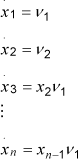
In this paper we propose a systematic backstepping based procedure for the design of a discontinuous time-invariant controller for nonholonomic chained forms with application to nonholonomic mobile robot systems. It is shown that backstepping control for chained form systems can guarantee the boundedness of the whole state and makes the origin of the closed-loop system exponentially attractive provided that the initial states belong to the set defined by:

The proposed control scheme is applied to the dynamics of a car-like vehicle mobile robot which investigation and reduction are presented exhaustively in section 2.
2. Dynamic Model and Reduction of Nonholonomic Mechanical Systems
Consider a Lagrangian system with n-dimensional configuration vector q, a force matrix F (q) and m (m < n) nonholonomic first order constraints defined by:



Where L(q, q̇) is the system Lagrangian, u ∈ ℛl is the control input, such that l = rank(F(q)), and Λ ∈ ℛ m is the vector of Lagrange multipliers. Since m ≥ 1 then we have necessarily l ≤ n – 1. The term WT Λ represents the effect of the constrained forces. This is based on the principle of virtual forces which states that the constraint forces do not work on motions allowed by constraints.
The system (4)–(5) is called a mechanical system with first order nonholonomic constraints. Nonholonomic systems in the form (4)–(5) with F(q) = 0 are called Caplygin systems.
Assumption 1
Assume W (q) has full row rank. Then q can be partitioned as (q1, q2)T such that W (q) = (W1(q), W2(q))T where W1(q) is an invertible matrix. Therefore the constraint equation (3) can be rewritten as

Assumption 2
We assume that the system generalized mass matrix M(q), F(q) and W(q) are all independent of q1.
Note that M (q) can be directly obtained from the relation
Assumption 3
Assume the potential energy of the system V(q) is in the form

Under the above assumptions, the dynamics of the underactuated nonholonomic system (4)–(5) can be expressed as


To eliminate Λ from (8), one can multiply both sides of the forced Euler-Lagrange equation in (5) by a matrix A(q) that annihilates WT(q), i.e. A(q)WT(q) = 0. For doing so, let us define


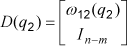
Theorem 1
Consider the underactuated mechanical control system with nonholonomic constraints and symmetry in (8)–(9). Then (8)–(9) with (2n + m) first-order equations can be reduced to a system of (2n - m) first-order equations in the following cascade form.


Moreover, if V(q) = U(q2) i.e. kv = 0 in (7), the reduced system is a well defined Lagrangian system with configuration vector qr = q2 and the Lagrangian function


In addition, if l + m < n or l + m = n, then the reduced system with configuration vector qr is an underactuated (or fully actuated) mechanical system.









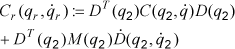
To establish that (20) is in fact equivalent to the forced Euler-Lagrange equation for the reduced system with the Lagrangian function Lr(qr, q̇r) and the force matrix Fr(qr), we need to prove that Cr(qr, q̇r) satisfies Ṁr = Cr + CTr. By direct calculation we have

3. The Car-like Vehicle
In this section, we address reduction of the dynamic model of a car-like vehicle as shown in Figure 1. The dynamic model of a car is an example of underactuated nonholonomic systems with five degrees of freedom, two control inputs and two velocity constraints. Let q = (x, y, θ, Ψ, ϕ) denote the configuration vector of the system. (x, y) denote the position of the center of the axle between the two rear wheels, θ is the orientation of the car body with respect to x-axis, ψ is the angle of rotation of each wheel and ϕ is the steering angle with respect the car body. The distance between the rear and front wheels axles is denoted by l and r denotes the radius of the wheels

A car-like vehicle
The velocity constraints of the front and rear wheels are given by


These two constraints can be rewritten as W(q)q̇ = 0 where W = (W1, W2) is partitioned according to q
x
= (x, y) and qr = (θ, ψ, ϕ). The matrices W1 and W2 are given by


Note that W1 is not invertible at ϕ = 0.
Define now


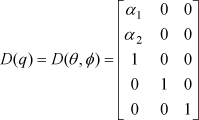
The Lagrangian of the dynamic car is given by
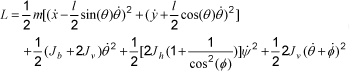

The differential-algebraic equations of motion of the dynamic car are such as


By direct calculation and after simplification we get


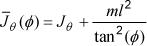
Clearly, the reduced Lagrangian is itself underactuated with three degrees of freedom (θ, ϕ, ψ) and two controls. In addition, (θ, ψ) are the external variables and ϕ is the shape variable of the car. The dynamics of the actuated variables (ϕ, ψ) of the reduced system can be linearized as


From the first constraint equation, we can solve for θ to get


After normalization of the units of (x, y) by r, and taking



Applying the change of coordinates and control as:


4. Backstepping control of the car-like vehicle
In order to apply the backstepping approach procedure, let us consider the following change of coordinates zi = xn–i+1, 1 ≤ i ≤ 4. System (39) becomes

To guarantee the exponential convergence of z4, we use a state feedback such that


Now the problem consists of finding a control law v2 such that, if the initial state belongs to the set
Step1
Consider the first equation of the system (41), where z2 is viewed as a virtual control variable, and consider the Lyapunov function candidate


Using the following virtual control


Step 2
We introduce a new variable ε2 = z2 – η1, which represents the deviation between y2 and the virtual control η1 and consider the first two equations of (41) where z2 is substituted by ε2 + η1 and z3 is viewed as a virtual control variable, then

Using the Lyapunov function candidate

The time derivative of (41) yields


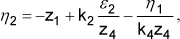
By choosing the virtual control law η2 which substitutes Z3 as

Step 3
Likewise in step 2 we introduce a new variable ε3 such that:


Evaluating the time derivative of (52), gives

Under the following control law v2 in (41), defined over Ω, as


Now one can easily conclude that conclude that (z1, ε2, ε3)
T
is bounded and tends to zero when t approaches the infinity. Therefore zi → ηi–1, i = 2,3 when t → ∞. To guarantee the boundedness and the convergence to zero of (z2, z3)
T
, one must ensure the boundedness and convergence to zero of (η1, η2)T. Since

Finally we conclude that if z4 (0) = x1 (0) ≠ 0 then
The whole state remains in Ω since z4 and then x1 decays to zero The state trajectory of the closed loop system is bounded and converges to zero
Now we can summarize the previous procedure in the following theorem
Theorem 1
Consider the system (39) with the control law


then
the whole state z = (z1, …, z4)T and equivalently x = (x1, …, x4)T is bounded and decays to zero when t → ∞, the control law is well defined for all t ≥ 0.
5. Simulation Results
The technique presented in this paper is tested on the system

Results are depicted in Figures 2–6. The Initial conditions are taken as



Path to the origin of the mobile robot

Time history of the variable x.

Time history of the variable y.

Time history of the variable θ

Time history of the variable ϕ.
Figure 2 shows the path traversed by the mobile robot. Figures 3–6 show the time behavior of the variable, x, y, θ and ϕ. It is clear that the discontinuous backstepping approach presented in this paper guarantees the convergence and the stabilization of all the states of the system.
6. Conclusions
This paper presents a novel technique for backstepping discontinuous control with application to the stabilization of a nonholonomic mobile robot. The methodology is not restricted, though to nonholonomic systems but can be applied to a broad class of strictly feedback discontinuous systems. The proposed control scheme is smooth everywhere except at x1 = 0. The discontinuity involved in the control is not very restrictive since it occurs just for x1(0) = 0. The simulation results made on a car-like mobile robot demonstrate the validity of the proposed control.