




Abstract
This study describes an empirical investigation revealing the critical obstacles to the adoption of a uniform pricing mechanism for building services from the perspective of industry practitioners. A total of 157 questionnaires conducted on quantity surveyors (N=75), mechanical engineers (N=39) and electrical engineers (N=43) were collected and used for the study. T –test statistics was run to identify ten significant factors from a list of fourteen factors identified. Relative importance indices were computed for each factor from the perspectives of the practitioners so as to determine the most critical obstructive factors. The result shows that the five most important obstructive factors in order of significance are: (1) difficulty in the interpretation of the Standard Method of Measurement by design consultants (2) the late involvement of building services design consultants (3) quantity surveyors' insufficient skill in mechanical and electrical services technology (4) drawings of services are often not ready for billing at the tender stage and (5) the lack of a generally accepted Standard Method of Measurement for mechanical and electrical services.
Keywords
1. Introduction
The value and complexity of building services in modern buildings are increasing and more service installations are being developed. It is postulated that this trend will continue in modern buildings in the light of the global call for the consideration of environmental issues in design; the need for fuel conservation; integration of M&E services with ICT and building energy efficiency [1]; the reduction of carbon emissions; workplace productivity, health and well being, as well as planning and sustainability [2, 3].
In traditional practice, quantity surveyors only allow prime cost and provisional sums for building services while a detailed breakdown of costs is carried out by services consultants. Moreover, in determining early budget estimates for building services, consultant services engineers often adopt single rate deterministic models, historical cost information and provisional sums to predict the price of building services at an early stage of building projects [4–7].
It has been observed that the methods adopted by various parties in forecasting building services contract prices would not provide the desired results with regards to the clients' value criteria [2, 3]. This is partly because the cost of M&E services has changed from 15 – 30 percent (for the traditional type of buildings) to between 15 – 70 percent of the total building costs (in modern buildings) depending on the sophistication of the services, the type of air – conditioning system and inclusion of systems such as sprinkler systems, fire detection devices, evacuation aids, access control, security, CCTV, building management systems, lifts and escalators [3]. Moreover, [1] considering that if there is no history of uniform billing for M&E services for this type of project, then the cost control of that 15% to 70% of the work will be more difficult to achieve and the client will be exposed to greater financial risk.
The Malaysian construction industry is an important sector of the economy and the activities of the industry are championed by the Construction Industry Development Board (CIDB). In pursuance of continuous improvement and the adoption of best practices, CIDB developed a comprehensive master plan spanning 2006 – 2015 aimed at refocusing the strategic position of the industry through the identification of eight Critical Success Factors (8-CSF) and seven Strategic Thrusts (7-ST), which, upon complete implementation, are expected to meet the dual challenges of an open market and greater global competition and transform the sector so as to be among the best globally [4, 5]. CIDB observed that, non-adoption of the detailed rules of the Standard Method of Measurement (SMM) in the preparation of building services bills of Quantities (BoQ) in the country would not produce good long-term results. Similarly [6] stated that, because of the absence of a uniform methodology for breaking down cost information for building services projects, practitioners often adopt lump sums, drawings with performance specifications and schedules of rates to invite tenders for building services contract.
The focus of this study therefore is to identify the factors preventing QS from using the detailed rules of SMM for building services BoQ as has been adopted by building fabrics and finishes. This study is part of a larger body of research investigating the need to improve the reliability of building service cost estimations through the adoption of detailed rules of measurement. Findings from the study are intended to inform the formulation of measurements to encourage practitioners to adopt common standards as the basis for forecasting building services contract prices at the early stage of building services projects.
Uniform pricing mechanism (UPM) for the purpose of this study is the use of the detailed rules of the industry – wide accepted standard method of measurement (SMM) as the basis for preparing BoQ for the procurement and cost management of building services projects. It is considered that there is a need for a change from traditional practices, where SMM are only adopted for building structures and finishes, and lump sums for building services, to the adoption of UPM for building services so as to enable the production of more reliable bills at the early stage of building projects.
2. Literature Review
Generally, the nature of building services and their design development has a significant impact on their cost management. This is because building services design activities may be undertaken by different types of organization, such as consultants who only do the systems design; manufacturers who design and manufacture; and installers who design and install [7]. In essence, the final design comes from a specialist designers/ contractors/manufacturers and they are not usually involved in the design development. Building services specialist contractors receive information from the main contractor, process client requirements at their individual organisation level without input from the client and even the designers [3]. In most cases good ideas are held back by specialist contractors in order to gain a competitive advantage during the tender [8]. This leads to difficulties for design consultants in optimising design solutions. It is considered by [9] that architects' training in building services is limited and the building services consultants are always appointed at a late stage in the design. Moreover, little or no emphasis is given to the problems of services integration and co-ordination in the structural engineer's training.
On the adoption of the conventional cost modelling tool used by quantity surveyors, [10] opined that quantity surveyors are not involved in active cost planning and control of building services because building services have a much shorter history than the quantity surveying profession, as most building services components are not part of traditional buildings with the exception of rainwater disposal and land drainage. Other reasons identified by Murray are:
Detailed design work on service installations are not sufficiently complete for billing at the tendering stage Some services engineers are hostile to quantity surveyors being involved in their work Contractor's design aspect are often incorporated into building services projects Quantity surveyors are not sufficiently skilled in the technology of building services.
Incomplete design is one of the major factors inhibiting the measurement of building services by quantity surveyors [11, 10, 12]. As the preparation of BoQ can only begin when certainty is established in the design process, and estimates produced from incomplete project information that does not give all the details are liable to inaccuracy [8]. Therefore a window of opportunity is missed by the QS at this early stage to actively contribute to the determination of the cost of building services because of the lack of an appropriate cost planning model to aid in the value and financial analysis of building services design.
However, cost information generated from this fragmented process of design development is kept in the consultant engineers' and quantity surveyors' in – house cost library for use in forecasting building services contract prices [13]. Meanwhile, the accuracy and reliability of the early cost estimate according to [14] is as good as the quality information upon which the estimate is based at the time the estimate is required. According to [12] the quality and quantity of available information on building services projects include services drawings, specifications and the historical data used to prepare the estimate. The reliability of historical information measures the confidence that can be assigned to it as a result of previous collection efforts, possible errors and inaccuracies [15]. Similarly, the relevance of this topic was highlighted by [16], when they suggested that the formulation of pre – contract price advice by practitioners requires the assessment of project related information, selection of an appropriate price model, consideration of its results and the application of the forecasters' judgment so as to arrive at a forecast of the overall project contract price that is then communicated to their clients for use in their value for money decisions.
In addition, [17] developed cost benchmarks for building services in the UK and considered that building services installations are unique in nature and their cost drivers vary from one project to another, therefore their components need to be separated into smaller segments in such a manner that their costs and cost significant attributes can be easily identified. They pointed out that an early budget estimate for M&E services installations is therefore unrealistic, unless the component design, quality and market place attributes, as well as the manufacturers, are somehow fixed. Similarly, [18] observed that historic cost information held in quantity surveyors and M&E services engineers' in–house libraries are not suitable for M&E budget estimations as they are not necessarily based on projects with similar performance and aesthetic standards. They suggested that detailed M&E services cost information is required to enable relationships to be identified between M&E services cost and the quality of installations as well as to establish a good basis for the collection of historical cost information for forecasting M&E services cost. [19], cited in [18], identified that the lack of useful cost parameters for building services was a result of the prevalence of contracts based on drawings and specifications, and the associated absence of a detailed analysis of the M&E services cost. The availability of detailed cost information for this important component of buildings will enable relationships to be established between M&E services costs and the quality of installations.
In another study, [20] investigated the capital cost of HVAC systems in South Africa and found that cost per floor area or cost per unit capacity factors are used for predicting the cost of HVAC components, they considered that the approach is not sufficiently accurate and do not allow for the differences between concept designs, buildings, climates and specifications. They observed that, each subsystem of HVAC (e.g., design methods, building layout and reticulation route) contributed significantly to the installation cost and none of them can be ignored, therefore, a uniform system is required to break down each subsystem so it can be priced individually.
Further, [12] appraised factors affecting the production of cost estimations for electrical services in Nigeria and found that: estimators' competence, project technicality, economic requirement and contract requirements are the four factors affecting the production of cost estimates for electrical services in Nigeria. They further described estimators' competence to include the extent of the completion of the pre-contract design, the complexity of the design, the scale and scope of the installation, estimator's expertise, the quality of information and the estimating method used.
3. Methodology
3.1 Questionnaire Design
A standard questionnaire survey was conducted among industry practitioners, specifically quantity surveyors, mechanical engineers and electrical engineers working in client, contracting and consulting organizations, as shown in Table 1. The questionnaire was designed on the basis of 14 generic factors, identified in the first phase of this research [21], thought to inhibit the adoption of UPM for building services projects.
Barriers restricting the use of UPM for M&E services

A pilot study was conducted among eight experienced key project participants (4 quantity surveyors, 2 mechanical engineers and 2 electrical engineers) and the results were used to fine tune the questions posed. The revised questionnaire was again sent to three quantity surveyors and one academic in light of the corrections suggested in the first round of the pilot study. This process was to ensure that the questionnaire is a valid survey instrument that can elicit the desired opinions from industry experts [22, 23].
The questionnaire contained nine items such as the qualifications of the respondents, their discipline, the type of organizations they work for and their years of experience. Respondents were also requested to respond to questions about their perceptions of the hypothesized factors contributing to the barriers restricting the adoption of UPM for building services. They were asked to express their views on a five point scale (from ‘not at all’ -to - ‘to a very large extent’) where ‘5’ represented ‘to a very large extent’ ‘4’ ‘to a large extent’; ‘3’ ‘moderate extent’; ‘2’ ‘seldom’ and ‘1’ ‘not at all’. A factor rated 4 or 5 would be interpreted as significant factor restricting the use of UPM, those rated ‘1 or 2’ would be interpreted as insignificant obstacles, those rated ‘3’ would be regarded as uncertain.
3.2 Sample Selection
The questionnaire was sent by mail to 478 clients, contracting and consultancy organizations in August 2011 in Malaysia with the specific request that responses were required from quantity surveyors, mechanical engineers and electrical engineers. Their perspective is important because the first phase of the study revealed that cost management of building services is the responsibility of this trio in the Malaysian construction industry. The names of practicing quantity surveying firms were obtained from the website of the Board of Quantity Surveyors of Malaysia. Questionnaires were then emailed to two hundred and seventy eight (278) out of the three hundred and thirty six (336) quantity surveying firms registered with the Board. A reminder letter was then sent four weeks after the initial email. A follow up telephone call, visits to the respondents' offices in Johor and Selangor, coupled with meetings with practitioners at conferences and workshops resulted in the return of eighty eight (88) duly completed questionnaires after four months. For the building services engineers, lists of registered contractors and consultants were obtained from selected client organisations in the southern Peninsular of Malaysia, who had participated in the first phase of the study. A total of one hundred and seventy questionnaires (170) were sent through the clients' organizations to the contractors, and consultant services engineers. A follow – up communication was sent through the client organization which led to the return of sixty nine (69) duly completed questionnaires. Thirty (30) copies of the questionnaire were sent to clients' organization and thirteen (13) completed copies were returned. The stratification approach was based on the assumption that consultant quantity surveyors are professionals who had had formal training in the use of SMM for the preparation of BoQ.
3.3 Profile of the Respondents
A total of 170 questionnaires were returned of which five were returned blank and eight were not properly completed and therefore could not be analyzed. This represents 28% of the total number of questionnaires sent out. This is considered appropriate for this study because researchers over the years have observed that the response rate to questionnaire surveys in the construction industry is usually between 20 – 30% [24, 25]. Therefore, 157 questionnaires were analyzed, 48% of which were completed by quantity surveyors, 25% by mechanical engineers and 28% by electrical engineers. 13% of the quantity surveyors worked in client organizations, 10% were employed in contracting organizations and 77% in consultancy and multidisciplinary firms. A total of 28% of the mechanical engineers were engaged in clients' organizations, 33% in contracting and 39% in consultancy organizations. 30% of the electrical engineers worked in clients' organizations, 28% also worked for contractors and the remaining 42% were employed in consultancy organizations.
Further, 9% have 6 – 10 years experience, 29% have between 11 – 15 years, 32% fall between 16 – 20 years while 31% have more than 20 years of experience in construction and cost management of M&E services in buildings. None of the respondents have less than 5 years of construction experience. This indicates that the respondents had considerable experience in cost management of M&E services. In addition, 64% of the respondents are registered professionals while 24% were degree holders.
4. Results and Discussions
4.1 Obstacles to the use of SMM for M&E Services Projects
This section of the survey collected information on the respondents' perspectives on the factors contributing to the obstacles inhibiting the adoption of UPM for M&E services. The data collected was analyzed from the different perspectives of quantity surveyors, mechanical and electrical services engineers. The statistical package for social sciences (SPSS) and Microsoft excel were used to analyze the survey results. A one-way sample t-test was used to determine whether the mean rating of a sample was significantly different from the population mean μx = 0 [26]. For each factor identified, the null and alternative hypotheses are set out as detailed below.
To test the null hypothesis H0: μ = μ0 against the alternative hypothesis H1: μ < μ0, where μ is the population mean and μ0 is the critical rating above which the factor is considered statistically insignificant and of no practical implication [22]. In this analysis μ0 was fixed at 3 because on the rating scale adopted, 3 is neutral.
From the table of critical values of t-distribution, when the degrees of freedom = 156 (157 -1), and the level of significance for 2-tailed t-test is set at 0.05, the t value is - 1.960 meaning that if the calculated t- value is smaller than -1.960, the null hypothesis is rejected and the alternative hypothesis is accepted [27]. The result of the t- test is shown on Table 1. It can be inferred from the t- test result on Table 1 that ten (10) out of 14 factors identified contributed to the obstacles inhibiting the use of UPM for M&E services. The important variables identified are discussed under the appropriate category in the following section.
4.1.1 Level of available information
The t test revealed the four most important variables in the category of level of available information with a t – value of more than – 1.960 and (p<0.000) as shown in Table 1. The four most important variables are:
Services drawings are often not ready at the tender stage Specialist designers are often not involved at the design stage Late involvement of M&E services consultants The lack of generally accepted SMM for M&E services
However, practitioners considered that the quality and quantity of information available at the early stage is not adequate to allow the use of the detailed rules of SMM. For instance, services drawings are usually not completed because of the late involvement of M&E consultants and mostly, part of the design is scheduled to be completed by specialist designers who are not usually engaged until the awarding of contract. This result supports the work of [10] who observed that communication between the client, architect and services engineers is not always adequate for the early clarification of the clients' requirements for billing purposes, leading to the inclusion of provisional sums in the BoQ by quantity surveyors and the awarding of contracts based on lump sums, drawings and schedules of rates.
This results in wide discrepancies between the highest and lowest tender and difficulties in agreeing on variations as well as settling final accounts on a basis which would ensure the absolute value for clients' money [28]. In addition, there is no generally accepted SMM that could be used for building services BoQ. Earlier observations also revealed that, sections ‘Q’ (Plumbing and Mechanical installations) and ‘R’ (Electrical installations) of the current SMM2 in Malaysia include detailed rules for measuring M&E services. However, the rules are not used by practitioners in preparing M&E services BoQ as different parties adopt different methods of measurement.
4.1.2 Estimators' competence
The t test results showed that the three variables under the category estimators' competence are important contributors to the obstacles to the use of UPM for M&E services with a t – value of more than -1,960 and (p<0.05) as shown in Table 1. These variables are:
Quantity surveyors' insufficient skill in the technology of M&E services Difficulty in interpretation of SMM by M&E consultants Slow learning curve by practitioners
The total cost management of buildings should be the responsibility of quantity surveyors, however, the study reveals that quantity surveyors lack knowledge and ability concerning M&E, as little knowledge is obtained by quantity surveyors about building services from a typical degree and therefore they lack confidence in controlling the costs of building services. M&E services design consultants also have limited knowledge of cost management and find it difficult to interpret the rules of SMM.
4.1.3 Culture and traditional practices
Quantity surveyors' responses and ranking of the significance of factors inhibiting the use of UPM for M&E services.

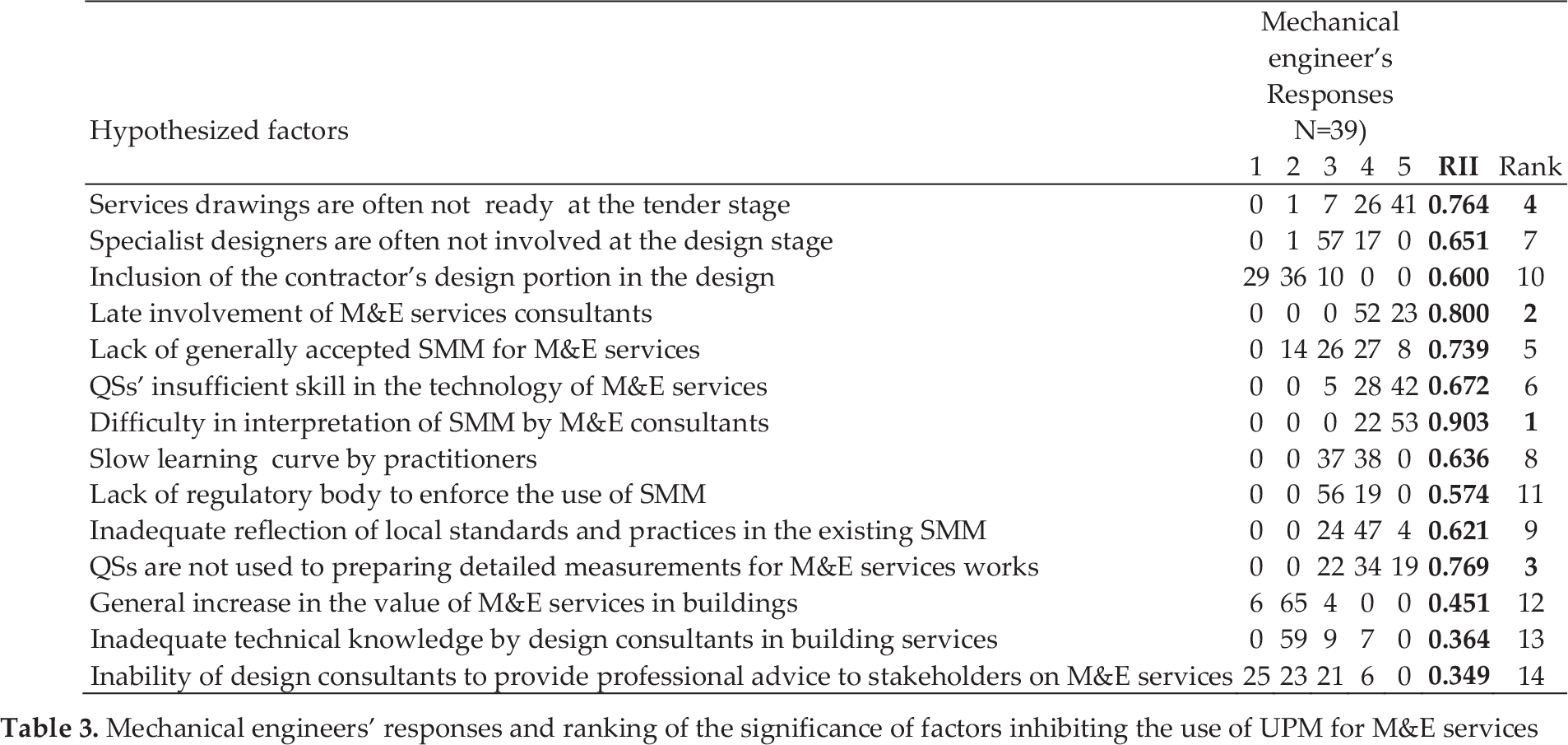
Mechanical engineers' responses and ranking of the significance of factors inhibiting the use of UPM for M&E services
Lack of regulatory body to enforce the use of SMM
Inadequate reflection of local standards and practices in the existing standard Method of Measurement
Quantity Surveyor's are not used to preparing detailed measurement for M&E services
The first issue here is the lack of a regulatory body to enforce the use of SMM for M&E services. Nevertheless, the standard forms of contract in use in Malaysia, for example Clause 12 of PAM (2006), Clause 26(a) of PWD 203A (Rev.10/83) and Clause 26.4 of 203A (2007), require the bills of quantities to be prepared in accordance with the Standard Method of Measurement for Building Works prepared by Institute of Surveyors, Malaysia. The rules of the existing SMM are not used in preparing M&E services BoQ and there is no regulatory body to enforce these rules. Similarly, an inadequate reflection of local practices and procedures in the existing SMM is another important obstacle.
The result also agreed with the observations of [29], that construction industries in less-developed countries often use codes and standards that are imported from developed countries. According to him, the problem with this type of standard is that they do not reflect people's priorities and are not created in a language appropriate to the educational background of the industry practitioners. This observation is particularly evident in Malaysia because “Malay” is the mother tongues of Malaysians but the SMM2 in use is a replica of the British SMM6 with little modification. It was also found that in traditional practices, quantity surveyors are not used to preparing detailed measurements of M&E services. Perhaps, this problem could be traced to the evolution of quantity surveying as a profession and SMM because the only aspect of building services incorporated in buildings in the past was plumbing and drainage systems. In the UK building services were only introduced into the rules of SMM4 in the 1960's [30]. Therefore, detailed rules for SMM were not adopted for M&E services by quantity surveyors in traditional practices because there were no detailed rules for measuring building services components in the earlier editions of SMMs. Finally, the t test results also revealed that, complex technological requirements and an increase in the value of M&E services do not contribute to the non-adoption of SMM in preparing M&E services BoQ from the perspectives of the three groups. Although the four (4) variables under complex technological development are statistically significant, (p < 0.05) their t- values are < -1.960, therefore they are ineffective in practical decision making and could not be said to have contributed to the obstacles preventing the use of the uniform pricing mechanism for M&E services from the perspectives of the practitioners. However, this finding contradicts a previous studies which affirmed that complex technological development is one of the factors preventing quantity surveyors and design consultants from providing an appropriate cost management framework for the procurement and cost management of M&E services in developing countries [31].
4.1.4 Relative Importance Indices (RII)
Although the mean differences from the t – test results for the factors contributing to obstacles inhibiting the adoption of UPM are large enough to be considered statistically significant, the corresponding correlations might be quite small, suggesting their limited practical importance. Therefore, in order to determine the significance of each of the factors identified, the relative importance indices (RII) of the barrier factors identified were computed from the perspective of the respondents, as shown in Table 5. This is considered essential in order to determine the most significant factors inhibiting the adoption of uniform pricing mechanisms for M&E services from the perspectives of each group and examine the strength of their association through statistical correlation. The RII adopted in identifying the mean item score for each obstacle is computed to obtain the relative importance of the factors to the obstacles inhibiting the use of SMM for M&E services BoQ by using the formula and methodology described by [32]. The formula used is given as, RII = Σn/H x N.
Electrical engineers' responses and ranking of the significance of factors inhibiting the use of UPM for M&E services

Relative importance indices of ten most significant factors inhibiting the use of UPM for M&E services (in descending order of significance)

Where ‘n’ is the scale adopted for the study for rating a factor by the respondents and it ranges between 1 to 5; H is the highest weight on the scale; while ‘N’ is the total number of respondents in each group. The relative importance indices of the factors were then ranked in descending order from the perspectives of the quantity surveyors, mechanical engineers and electrical engineers as shown in Table 2 – 4. The frequency of responses for each factor are indicated and used for the computation.
The first three most important factors according to the quantity surveyors from the RII results in Table 3 includes difficulty in interpreting the SMM by M&E services consultants with RII of (0.941), followed by the slow learning curve of practitioners (0.901) and quantity surveyors' insufficient skills in the technology of M&E services (0.899). The least important factor according to quantity surveyors is the inclusion of the contractor's design portion in the design (0.296). The mechanical engineers (Table 4) shared common views with the quantity surveyors, ranking difficulty in interpreting the SMM as the most important factor with RII of (0.903), followed by the late involvement of M&E services consultants (0.800) and that quantity surveyors are not used to preparing detailed measurement of M&E services works (0.769).
There is a slight difference in the opinion of quantity surveyors and mechanical engineers as to the late involvement of M&E consultants and that quantity surveyors are not used to preparing detailed measurements of M&E services as these were ranked fifth with RII of (0.861) and sixth with RII (0.792) respectively by quantity surveyors.
The least ranked item by mechanical engineers is inability of design consultants to provide professional advice to stakeholders on M&E services (0.349).
However, the first three factors from the perspectives of electrical engineers, as shown in Table 5 include, the late involvement of the M&E services consultants with RII of (0.916), this factor ranked second from the perspective of the Mechanical engineers and fifth from that of the quantity surveyors; difficulty in interpretation of SMM by M&E services consultants ranked second with RII of (0.851), this factor was ranked first by the mechanical engineers and quantity surveyors; and lack of generally accepted SMM for M&E services (0.791), the mechanical engineers ranked this factor as fifth with RII of (0.739). The inability of design consultants to provide professional advice on M&E services was ranked as the least important factor (0.367).
Table 5 shows the overall weighted average of the ranking given by the three disciplines of the ten (10) most significant factors contributing to obstacles inhibiting the use of SMM for M&E services. The first five most important factors in order of significance are difficulty in interpretation of SMM by M&E services consultants with an average RII of (0.898), late involvement of M&E services consultants (0.859), quantity surveyors' insufficient skill in the technology of M&E services (0.761), services drawings are often not ready for billing at the tender stage (0.759) and lack of generally accepted SMM for M&E services (0.769). This does not imply that the other factors identified do not contribute to the obstacles preventing the use of SMM for M&E services, it is an indication of the most critical obstacles from the perspectives of the quantity surveyors, mechanical engineers and electrical engineers.
To measure the strength of the relationship between the variables as ranked by the various disciplines and determine the strength of the association in the ranking of the factors, the correlation between the ranks of the obstacles by the quantity surveyors, and the mechanical and electrical engineers was determined by using Spearman's rank correlation coefficient given as Rs = 1-6Σd2/n(n2-1), [32].
Where d is the ranked difference between quantity surveyors, mechanical engineers and electrical engineers; n is the total number of factors contributing to the barriers in the correlation (n = 14). Spearman's rank correlation was therefore employed to measure the degree of systematic change in response between the disciplines in the correlation, as indicated by group means, from one discipline to the other as shown in Table 6. The degree of change is represented by the absolute magnitude of the correlation “Σd2”. The larger the difference, the closer the correlation would be to ±1, depending on the direction of the difference, however, a correlation of below 0.4 may be statistically significant but is usually interpreted as indicating no “meaningful” relationship.
Test of agreement on Ranking of critical barriers as perceived the respondents

Table 6 shows that the correlation coefficient (i.e., rs) for quantity surveyors and mechanical engineers (rs = 0.749, p<0.01), mechanical engineers and electrical engineers (rs=0.908, p< 0.010) and quantity surveyors and electrical engineers (r = 0.697, p< 0.01) had a strong positive correlation with 12 degrees of freedom (i.e., n = 14 – 2) and are all statistically significant. It can be concluded that there is a general agreement among the various disciplines (quantity surveyors, mechanical engineers and electrical engineers) concerning the obstacles to the adoption of UPM for the procurement and cost management of M&E services in the Malaysian construction industry.
The importance of this study is that it identified the critical factors impeding the adoption of UPM for M&E services in the context of the Malaysian construction industry. In addition, the study also provided information on the relative importance indices of the obstacle factors. This will provide a guide for industry stakeholders in developing appropriate strategies to overcome the obstacles, in order to enhance M&E contract practices and ensure the reliability of early budget estimates and generates better value for clients' money.
5. Conclusions
The adoption of a uniform pricing mechanism for the procurement of mechanical and electrical (M&E) services in the Malaysian construction industry is essential. This will lead to the production of tender documents that could provide greater cost certainty at the post-contract stage and also assist in the examination of tender documents. This study has found that, there are ten significant obstacles to the adoption of UPM for M&E services in the Malaysian Construction Industry.
These obstacles include difficulty in interpretation of the SMM by M&E consultants, late involvement of M&E service consultants, quantity surveyors' insufficient skill in the technology of M&E services, services drawings often being not ready for billing at the tender stage, lack of generally accepted SMM for M&E services, quantity surveyors' not being used to preparing detailed measurements for M&E services, the slow learning curve of practitioners, inadequate reflection of local standards and practices in the existing SMM, specialist designers often not being involved at the design stage and the lack of a regulatory body to enforce the use of SMM.
However, there is a reasonable degree of agreement among practitioners on the factors inhibiting the adoption of a uniform pricing mechanism for M&E services. As the Spearman's correlation coefficient indicates that there is a strong association between the variables as ranked by various disciplines, which are therefore the ten most significant
Footnotes
6. Acknowledgments
The authors wish to thank the Research Management Unit of the Universiti Teknologi Malaysia for funding this research under RSG vote No. 02H06. Also the UTM office of Asset and Development units for their support during the research.