




Abstract
In the context of construction management, Social Infrastructure Projects (SIPs) have long been overlooked. However, SIPs are one of the main criteria for enhancing economic productivity. This paper analyses the results of a survey aiming to develop a framework for SIP success factors to enhance the likelihood of success in the provision of SIPs in Malaysia. The principal component analysis reduces a set of 41 project success factors to six dimensions based on the idea of the project life cycle, i.e., the preconstruction factor, the construction factor and post-construction factor, and three internal factors: the organizational factor, the information management factor, and the change management factor. Understanding these success factors could be crucial in managing SIPs, since it will allow project stakeholders to take precautionary steps to identify foreseeable problems and areas for improvement. This will increase the success rate of the project and could even help avoid problems completely.
Keywords
1. Introduction
The construction industry is one of the most dynamic industries because it provides human beings with better living conditions and contributes significantly to the economy of any nation. However, most developing countries face a lack of sufficient physical and social infrastructures to sustain the economic growth of the nation [1]. More specifically, it is imperative that social infrastructure is made available to serve new communities so as to enhance the quality, image and desirability of the new place, as well as its commercial value [2]. Teriman [3] echoed the idea that social infrastructure should meet the basic needs of communities and improve the quality of life, equity, stability and social well-being. The challenges of the new era thus call for greater focus on Social Infrastructure Projects (SIPs) for sustainable development. Understanding SIPs' success factors helps reduce the complex nature of management issues, which in turn makes it easier and more efficient to manage those factors with limited resources [4]. To improve SIP efficiency, it is necessary to answer the question: What factors are needed for the success of an SIP?
The main objective of this paper is to propose a framework of SIPs success factors. A critical review of the current literature on project success factors generates an initial list of perceived success factors. A total of 10 interviews with experienced practitioners are conducted to identify the underlying dimensions that were not found in the existing literature. SIPs represent a context-driven topic, whereas project success is a complex and multi-faceted concept [5]. Therefore, an exploratory approach is employed to investigate the new research area linking SIPs with project success factors. To the knowledge of the authors, this paper represents the first attempt to explore SIP success factors. Limitations are also presented in order to enhance the originality of this paper. Suggestions for the direction of future research are presented at the end of the paper.
2. Literature Review
2.1 Social Infrastructure Projects (SIPs)
The notion of SIPs emerged over the last decade mainly due to the fact society at large has a great interest in public infrastructure [6]. Argy et al. [7] differentiate social infrastructures into hard social infrastructure (e.g., hospitals, schools and community halls) and soft infrastructure (e.g., social security and education). Therefore, social infrastructure may refer to building and community facilities or to services like training, education and security. This paper, however, only focuses on hard social infrastructure (buildings or facilities meeting social needs).
SIPs involve a wide range of partners, including in most cases various government agencies, private companies and non-profit organizations, together with a selection of user groups, freelance scientists, independent consultants as well as academic research institutes [8]. Although SIPs are generally smaller scale compared to economic infrastructure, they are as complex and dynamic as generic construction projects because the post-construction and maintenance stage involves an on-going involvement with the community [9].
Previous studies have focused mainly on examining SIPs within the Public Private Partnership (PPP) contracting method, as in [9], [10], [11], [12], [13]. Studies have also focused on specific types of SIP, such as stadium [14], house renewal [13], hospitals [12], [15] and schools [15]. It is worth noting that Jefferies et al. [14] identified six success factors for the stadium project namely a solid consortium with a wealth of expertise, considerable experience, high profile, good reputation, an efficient approval process that assisted stakeholders in a very tight timeframe, and innovation in the financing methods of the consortium. These studies are limited because they focus on the context of the PPP contracting method and methodologically focus on case study, leaving a gaping hole in the domain of SIPs.
Therefore, the critical review of the current literature on SIPs reveals that it is necessary to explore project success factors; more specifically, it is necessary to provide a universal framework of SIPs success factors. This is where the genesis of this paper lies. The review of project success factors from the current literature is presented in the following subsection.
2.2 Project success factors
The concept of project success factors, more popularly known as Critical Success Factors (CSFs), was defined as a course of action which is pursued to reach objectives [16]. Because an understanding of project success factors in general is, on its own, insufficient for the success of a project [17], it is necessary to clarify the success factors of a project, especially when the project is highly complex and uncertain [18]. Therefore, the CSFs approach is considered an appropriate method for exploring complex and dynamic SIPs [9]. The subsequent discussion is justified in the sense that project success factors do not change frequently but may require revision and updating from time to time [19].
The literature review on project success factors was broadly structured according to two metaphors suggested in [20]. The first metaphor perceives the project success framework as a universal tool, while the second perceives it as a context-specific tool.
The review begins with the first metaphor. Sanvido et al. [21] suggested four CSFs in the planning and design stage. Meanwhile, Chua et al. [22] identified specific CSFs for different construction project objectives: budget, schedule, and quality for appropriate allocation of limited resources. These studies are less applicable to SIPs because their focus is on generic construction projects.
With regard to the second metaphor, four CSFs groupings were identified as critical in large-scale construction projects in Thailand: comprehensiveness, competence, commitment, and communication [23]. In the Vietnam construction industry, the project success factors of large construction projects could be grouped into four “coms”, namely comfort, competence, commitment, and communication [24]. Meanwhile, Trop et al. [25] identified eleven critical success factors for large public projects in Norway. These studies are limited because they focus on respective countries and do not particularly focus on SIPs.
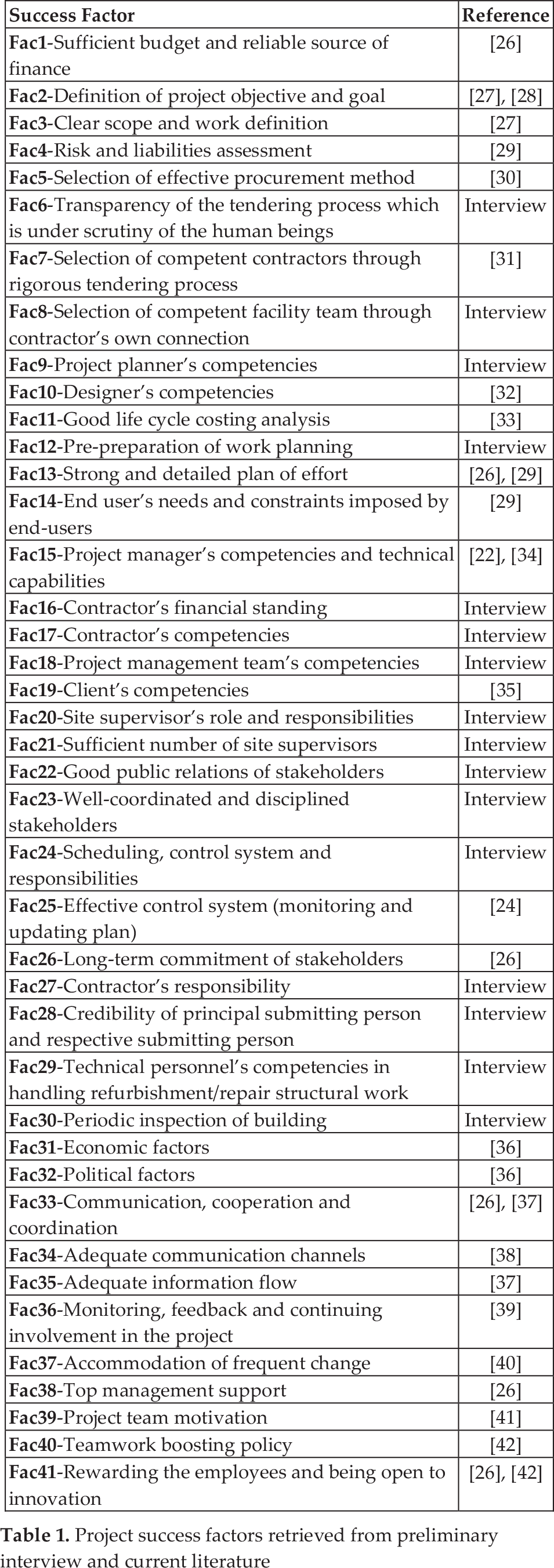
A great many studies have been conducted on project success factors, and this section therefore presents only a summary of the review. A comprehensive literature review identified 25 success factors, together with the 16 project success factors identified through a preliminary interview, which are discussed in detail in the subsequent section. These form the backbone of the survey instrument shown in Table 1.
Project success factors retrieved from preliminary interview and current literature
3. Research Methodology
This paper adapted the same research flows found in [30]. There were two stages of data collection: qualitative data collection and quantitative data collection.
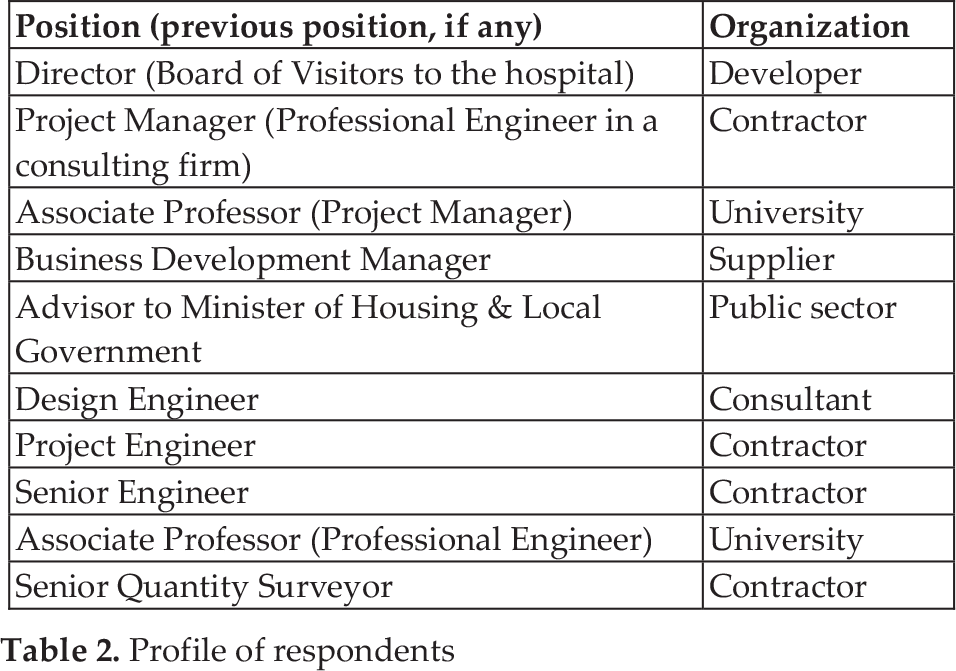
The first stage of data collection adopted standardized open-ended interviews. This type of interview is structured in terms of the wording and arrangement of the questions. All respondents are asked the same questions in the same sequence [43]. This facilitates a faster interview process that can be easily analysed and compared as well as reducing the biases within the study [43]. In preliminary qualitative data collection, the standardized open-ended interviews were conducted with ten experienced practitioners who had wide knowledge of SIPs. The respondents were required to answer four predetermined questions in half an hour. The selection of respondents was made through purposive sampling [44]. Table 2 shows the profiles of the respondents. The first stage of data collection generated 16 project success factors, shown in Table 1. The board of visitor is a critical volunteer force between hospital and public to settle problems faced by patients by providing views and suggestions on ways to improve services.
Profile of respondents
The second stage of data collection adapted a questionnaire survey, conducted in 2012 (January–May), which consisted of closed-ended questions with sufficient space provided for the respondents to give additional information, eliciting the respondents' perceived agreement on the 41 project success factors as listed in Table 1. The sequence of factors is randomly orientated. The questionnaire was pre-tested for comprehensibility by consulting two experienced project managers, two experienced engineers and three academics at two universities. A number of changes were suggested and implemented prior to distribution. The target respondents for this paper were drawn randomly from the registered list of the CIDB (Construction Industry Development Board of Malaysia). A total of 500 questionnaires were sent to SIP stakeholders in Malaysia such as project managers, architects, engineers, contractors, sub-contractors, quantity surveyors and suppliers. The respondents were invited to rate each project success factor on a five-point Likert scale of 1 (strongly disagree) to 5 (strongly agree). Principal Component Analysis (PCA) was conducted to reduce the dimension of the project success factors, which will be discussed in the next subsection.
4. Results
A total of 145 completed questionnaires were received, representing a 29% response rate, which is acceptable: it is suggested in [45] that most questionnaire surveys' response rates fall within 20-30% in the construction industry.
There are issues relating to the adequacy of the sample size for establishing the reliability of factor analysis [46]. Cronbach's alpha is commonly used as a measure of the internal consistency of how well the items in the set are correlated to each other. It is not uncommon for researchers to suggest a threshold value of 0.7 [47]. The Cronbach's alpha of this paper is 0.946, suggesting a high internal consistency as well as a high level of reliability of the survey instrument. Meanwhile, Kaiser-Meyer-Olkin (KMO) and Bartlett's Test are commonly used to measure the sampling adequacy in factor analysis. The threshold value of KMO should be greater than 0.5 if the sample size is adequate [48]. The test result of KMO is 0.865, suggesting that the sample size is more than adequate for factor analysis, as shown in Table 3. Bartlett's test of sphericity is also significant, suggesting that the population was not an identity matrix [49].
KMO and Barlett's Test

Consequently, the rule of an eigenvalue greater than one extracts 10 components, as shown in Table 4. The value of total variance explained by Component 1 to Component 10 were 34.096%, 6.468%, 4.967%, 4.445%, 3.552%, 3.341%, 3.249%, 2.902%, 2.667% and 2.530%, respectively. The cumulative of total variance explained accounted for 68.217%, which is greater than the threshold of 50% total variance explained [50].
Total variance explained

The factors were then rotated and the result is shown in Table 5. Dogbegah et al. [51] recommended checking for two strange situations, namely complex structures among variables and components that have one variable loading on them. Complex variables may have higher loading on more than one factor and they make interpretation of the output difficult [52]. As for complex structure, Fac30 (periodic inspection of buildings) is found to be complex, as is presented in Components 1 and 7. Both loadings of Fac30 express the influence of each original variable within the two components. For the sake of interpretability, Fac30 is retained in Component 7 as it possesses the higher loading. Second visual checks identified that Components 9 and 10 each have only one variable loading on them, and thus both components were eliminated from further data interpretation. In short, there are eight principal components that explain 63.019% of the total variance.
Rotated component matrix

As this paper represents an exploratory approach involving a large number of factors, the interpretation of the eight principal components has posed a considerable challenge. This is due to the combination of variables that load highly on a component being difficult to interpret [51]. As such, interpretation of factors requires a certain amount of inventiveness and imagination [53]. Therefore, assessing and naming each component was carefully conducted by looking for some meaningful interpretation.
5. Discussion
Because PCA only groups variables together, possible names for each component can be proposed on the basis of the understanding of the content or relationship among the variables. Studies have been conducted to group project success factors according to the project life cycle, such as in [54] and [55]. This research direction has greatly inspired the process of naming each component. As such, Components 5 and 6 were labelled preconstruction factor, Component 1 was labelled construction factor, and Component 7 was labelled post-construction factor. Meanwhile, there are three internal factors; in this sense, Component 2 was labelled organizational factor, Component 3 was labelled information management factor and Components 4 and 8 were labelled change management factor. Each of the components is briefly discussed in the corresponding section.
5.1 Components 5 and 6: Preconstruction factor
These components consist of Fac2 (definition of the project objective and goal), Fac3 (clear scope and work definition), Fac7 (selection of competent contractor through rigorous tendering process), Fac20 (clear site supervisor's role and responsibilities) and Fac21 (sufficient number of site supervisors). These components accounted for 6.893% of the total variance explained. In general, the definition of the project objective and goal as well as a clear scope and work definition represent important elements for any project. There is no exception for SIPs. Ika [20] further echoed that project success is seen in terms of the project's predefined objectives. Defining the objective leads to scope and work definition among the construction personnel. As for clear roles and responsibilities and sufficient site supervisors, there was a case of structural failure at Majidee School in Johor Bahru (Peninsular Malaysia) in 1988 where a technician had to supervise four schools and concreting was allowed at night. This points to a lack of supervision. In addition, because the engineer cannot be onsite full time for most projects, it is important that site supervisors possess the right competencies to undertake the task of ensuring that structures are constructed according to plans and engineering principles.
5.2 Component 1: Construction factor
This component consists of the variables Fac1 (sufficient budget and reliable source of finance), Fac15 (project manager's competencies and technical capability), Fac16 (contractor's financial standing), Fac17 (contractor's competencies, Fac18 (project management team competencies), Fac31 (economic factor), and Fac38 (top management support) and accounted for 34.096% of the variance explained. The variables can be further categorised into two subgroups, namely competencies (Fac15, Fac17 and Fac18) and financial (Fac1, Fac16, Fac31 and Fac38). For the competencies, many authors, for example in [22], [34] and [38], have postulated that, regardless of time and place, the construction personnel's competencies influence the success of a construction project. Nguyen et al. [24] and Phua and Rowlinson [30] reinforced the proposition that financial budget is of particular importance because the construction industry involves a large cash flow. In the sense that the contractor's financial standing represents the company's reputation, its status can be a measure of the project's success [56]. Lastly, the economic factor and top management support directly relate to the financial performance of a construction project. The former is particularly prominent because of the unprecedented price spikes in vital construction materials such as steel, copper, cement, and one very important indirect construction material, fuel [57]. Consequently, the unstable price of materials has an enormous impact on the overall cost, thus affecting the overall success of any construction project.
5.3 Component 7: Post-construction factor
This component accounted for 3.249% of the total variance explained. It consists of four success factors: Fac28 (credibility of principal submitting person and respective submitting person), Fac27 (contractor's responsibilities), Fac29 (technical personnel's competencies in handling refurbishment and repair structural work), and Fac30 (periodic inspection of building). As for the post-construction stage, there are a number of issues that arise where the submitting person applies for the Certificate of Completion and Compliance (CCC) without visiting the sites, and sometimes, in the case of small SIPs in rural areas, is not even aware of the location of the site. According to the revised Uniform Building By-Law 1984 (Amendment 2007), the main condition of issuing the CCC is that the building work needs to be completed in accordance with the approved building plans, and the principal submitting person must have supervised the work accordingly. Apart from this, it is the responsibility of the contractor to reconstruct any defect within the building defect period. Within the context of construction failure, it would appear that contractor accountability is only limited to de-registration of the Construction Industry Development Board (CIDB) licence, which enables the particular contractor to take up a certain amount of the construction project's costs and not incur penalties as the person responsible. In this sense, there is a need to make the principal submitting person responsible and criminally accountable for any construction failure, particularly with respect to SIPs, which concern the public at large. After the construction is completed, it is not uncommon for repair and refurbishment work to be overlooked in the structural safety aspect. Works are often carried out by incompetent supervisors or left to the contractors themselves. The work should be managed by qualified technical personnel, and professional engineers must also be engaged. Lastly, buildings usually deteriorate over time because the owners normally fail to perform periodic inspections, because the buildings are perceived as an additional financial burden. Therefore, building inspection plays an important role in building operations.
5.4 Component 2: Organisational factor
Four variables Fac23 (well-coordinated and disciplined stakeholders), Fac39 (project team motivation), Fac40 (teamwork boosting policy) and Fac40 (rewarding the employees and being open to innovation) form this component. This component accounted for 6.468% of the variance explained. The most variable asset of a company is its employees. As such, motivating, boosting and rewarding employees in a company undoubtedly enhances the chances of achieving success in undertaking projects. The Project Management Body of Knowledge has officially defined human resource management as one of the six fundamental functions of project management. The finding of this paper is in line with the dominant trend. However, in stark contrast to this, [58] has shown that the personnel factor is only a marginal variable in project success.
5.5 Component 3: Information management factor
This component consists of Fac33 (communication, coordination and cooperation), Fac34 (adequate communication channels), Fac35 (adequate information flow) and Fac36 (monitoring, feedback and continuing involvement in the project). This component accounted for 4.967% of the total variance explained. The construction industry is surrounded by highly complex legal issues and the constant threat to contractors of claims and expenses incurred means that the risk of not managing and controlling documentation becomes an area of great concern for those involved in the creation and storing of project documentation [59]. In other words, the rate of exchanging project information between different professions is crucial in the provision of any construction project [60] because every profession is heavily dependent on the information that has to be supplied by other parties to proceed with its own scope of work [61].
5.6 Components 4 and 8: Change management factor
These components comprise Fac19 (client's competencies), Fac37 (accommodation of change), Fac9 (project planner's competencies), and Fac10 (designer's competencies). These components accounted for 7.347% of the total variance explained. These components were labelled as the change management factor because the variables are perceived as important in addressing change in the construction industry. The primary causes of change orders are owner-initiated changes and designer's errors and omissions [62]. Clients should have certain knowledge of construction in order to reduce change. Of course, change inevitably happens in any construction project, and this highlights the role of project planners and designers in addressing the problem, because these professions are directly involved as the receivers of first-hand information. Lu and Issa [63] posited that the most costly changes are those related to design issues.
6. Conclusion
The construction industry has long been perceived as one of the most dynamic industries, and underpins the economic growth of all nations. Dainty [64] proposed that methodological pluralism should be embraced in the context of construction management. Drawing extensively from interviews and studies in the literature, 41 success factors have been reduced to six dimensions, as shown in Figure 1, forming the basis for improving the provision of SIPs in the Malaysian construction industry. The contribution of this paper is twofold. First, it represents the idea of context-driven research that identifies the success factors in the provision of SIPs to address the dynamic nature of the industry. Second, in the methodological aspect, it presents a grounded empirical approach. This assembles a simple framework that should help decision-makers to focus on key areas to avoid failure. This can be achieved through the appropriate allocation of various project resources. It is important to note that identification of project success factors is an important step in capturing lessons learned. Lessons learned are usually documented to increase the likelihood of success in future projects. Because the scope of this paper focuses on SIPs in Malaysia, the findings may not be applicable to other geographical locations. In addition, the notion of project success should not be limited to success factors. There are other variables, such as the criteria for success and the relationship between success factors and success criteria. Furthermore, this paper is to be seen largely as exploratory research and requires confirmatory research on the scope in terms of the methodological aspect. These limitations present recommended avenues for future research.

Project success factors of social infrastructure projects