




Abstract
External knowledge has been the object of increasing attention in the past few years, corresponding to the rise in company innovation models that are based on a higher degree of openness towards external actors. This study investigates the practices that firms adopt in searching for external knowledge to innovate their products, exploring the relationships between performance of innovation processes and the breadth and depth of search practices. In so doing, we explore the role of openness through the lens of search practices, rather than examining the variety of external actors from which firms draw relevant knowledge for product innovation.
1. Introduction
Recent literature has pointed out the importance of openness [1] and refers to external knowledge identification as a search strategy[2,2]. Openness to external knowledge has been conceptualized according to the breadth and depth of the search for innovation. The breadth is measured by the diversity of external inputs and represents how widely a firm explores external knowledge; the depth is defined differently by differentauthors: in[4] it is the degree to which existing knowledge is reused (or exploited); in [2] it represents how deeply a firm draws on external sources. Along the same lines, in [3] it was argued that firms need to re-order their search strategies “as a balancing act between fruitful diversity in potential knowledge impulses and the efficiency of how to access it” (p. 4). They found that firms need to expand the search scope, since on average they only draw deeply from one source.
The domain of knowledge, it has been argued, also plays a role in defining a search strategy. In [3] the authors refer to the external knowledge impulses – market-driven or technology-driven – while in [5] the authors refer to the generated knowledge.
In addition, the effects of search strategies on innovation performance are under debate. While in [2] the relation is represented by an inverted U-shape (i.e., searching widely and deeply is curvilinearly related to innovation performance), in [6] the author's findings are different. The lack of conclusive evidence on this topic comes down to two research gaps: (1) the operationalization of search strategies, which are more complicated than academics previously expected; and (2) the search strategies-performance link, which is not completely understood.
Over the last decades the gap between what people do in theory and what people actually do has led management scholars to adopt a practice-based approach [7] that emphasizes how actors interact with the socio-physical features of context in everyday activities (see also [8] for a case study). In this context, our work addresses the research gaps, examining the degree of openness in innovation searches through the lens of search practices – an area not yet explored– and providing empirical evidence for its impact on innovation performance.
2. Theory and hypotheses
The context of this paper is the search for innovation, and the analysis focuses on the practices firms are developing to search for ideas and knowledge in their innovation activities. Practice is taken to mean “how things get done in organizations” [9], including behaviours and accompanying structures or processes. Understanding searching in practice may also bring us closer to an understanding of organizational life.
In particular, our focus is on those search practices which highlight the relations a firm develops with external actors – i.e., the practices which define the degree of openness.
Previous contributions on search strategies have successfully tackled the operationalization question (research gap no.1), adopting a where-to-search perspective.). By contrast, we adopt a how-to-search perspective and investigate the organizational practices used for searching, thus focusing on the degree of openness.
2.1 Search practices in the literature
We reviewed literature on search topics according to two main perspectives: where to search and how to search. Contributions on the first perspective (where) refer to the choice of:(a) knowledge boundary (internal and external), (b) knowledge domain (market and technology), (c) knowledge proximity (local and distant) and (d) search intensity and scope (depth and breadth). Empirical articles focus on some of the above dimensions and sometimes the definitions adopted are different for the same concept. Table A in the Appendix synthesises the search dimensions, their definitions and the operationalization adopted in the literature.
Literature on the second perspective (how) investigates the search practices. According to the early front-end innovation literature, activities can be broken up into two broad categories [10]: the first group's activities deals with the process of idea generation while the second includes those related to idea management. Idea generation refers to opportunity identification and analysis carried out by environmental scanning [11,11], seeding ideas [13,13], and application exploration [15]. It can occur inside or outside a business.
Idea management is the process of capturing, storing, and organizing ideas adopted in the late front-end process. It can be used also for preliminary idea evaluation and screening, as well as idea diffusion across the company [16,16]. It integrates activities such as idea generation, screening, collaboration and idea development fromearly through to late innovation FE.
It is possible to identify a number of recurrent themes in the literature within these interlinked categories [18].
An interesting source of demand-side innovation triggers comes from taking a much deeper look at how people actually behave as opposed to how they say they behave. “Deep dive” is just one of the terms used to describe the approach [22].
2.1.1 Openness to external sources
This component is related to practices that ensure insights from outside, and includes sources such as universities [23], licensing [24], other companies, alliances [25] and also web 2.0 [26]. Increasingly, professional organizations are offering focused search capabilities– for example, in trying to pick up on emerging trends in particular market segments. Some firms have sophisticated IT systems giving them early warning of emergent fashion trends which can be used to drive a high-speed flexible response on a global basis. The web can also be used as a multi-directional information marketplace. Many websites act as a brokering service, linking needs and resources, creating a global market-place for ideasand providing a rich source of early warning signals. For example, the innocentive.com website is used as a match-making tool, connecting those with scientific problems with those able to offer solutions. Websites can also be employed as online laboratories for conducting experiments or prototype testing. Second Life (www.secondlife.com), for example, is an online role-playing game with over five million users. People assume alternate identities represented by avatars and interact in an alternative online world – in the process creating a powerful laboratory for testing out ideas. The potential of adver-gaming is being explored, for example, by US clothing retailer American Apparel, which has opened a virtual store; IBM has also set up offices at several locations.
2.2 Hypotheses
The research objective is to shed light on the relations between the degree of openness – expressed in terms of search practices' depth and breadth – and the innovation performance (see Figure 1). More specifically, this study draws on the concept of external search breadth and depth [2,2] and analyses these two constructs by looking at the usage patterns of different practices of external search that involve science/technology partners and value chain partners [27]. Specifically, search breadth is defined as the number of search practices that firms activate in their innovative activities, while search depth refers to the extent to which firms dig deep for new knowledge in their search practices.
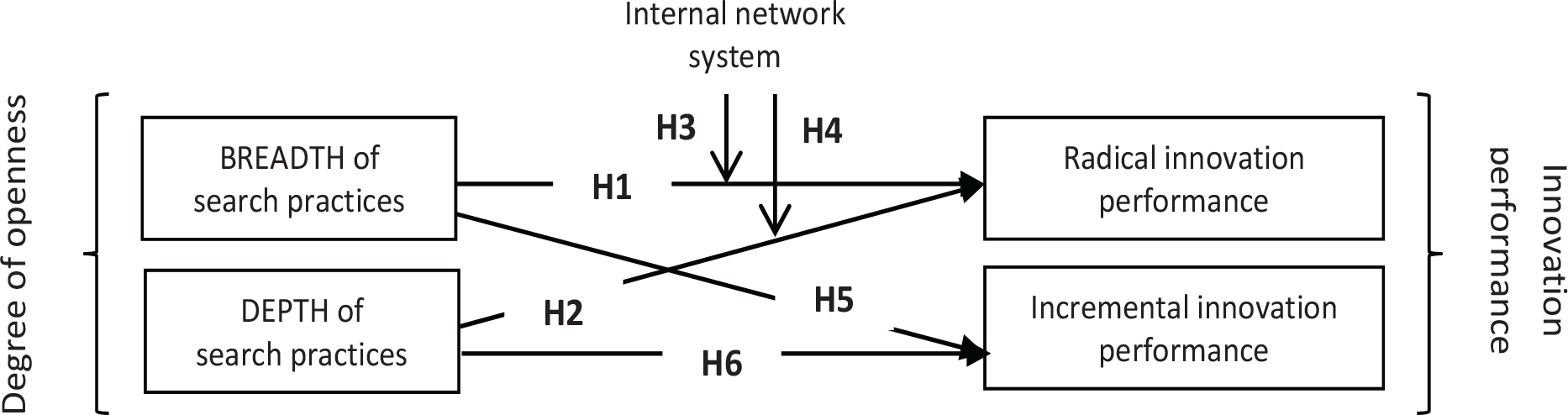
Research framework and hypotheses
Based on the theoretical arguments discussed above, we propose that both breadth and depth of search practices can be beneficial for radical innovation performance. There is indeed broad agreement that success in radical product innovation requires managers to combine aspects of technological and customer knowledge and competence in new ways [28]. Wide exposure to external knowledge and ideas can increase managers' chances of finding technological solutions that meet the needs of new customers [29,29]. Thus:
H1. Breadth of search practices positively affects radical innovation performance
H2. Depth of search practices positively affects radical innovation performance
The way firms enact search practices to draw on external knowledge can, however, be insufficient to determine the outcome of radical innovation endeavours. Their contribution to innovation performance is conditional to how firms can combine knowledge absorbed from outside with pre-existing knowledge available in the firm's resource base. This is an established idea that essentially draws on the concept of combinative capabilities introduced in [31] and on the traditional distinction between knowledge creation and knowledge application. Thus:
H3. The degree of use of internal network systems for knowledge integration positively moderates the effect of depth of search practices on radical innovation performance
H4. The degree of use of internal network systems for knowledge integration positively moderates the effect of breadth of search practices on radical innovation performance
Following the idea that firms enact different knowledge creation processes when they deal with incremental innovation compared to when they undertake more radical technical or market changes, we propose that incremental innovation requires different external knowledge search strategies. Following the theory on dominant design [32], we expect that when firms are engaged in fine-tuning a product by means of incremental innovations, exposure to a broad variety of knowledge sources may be beneficial. The variety of search practices a firm uses can, indeed, allow a broad scanning of the relevant environment. As the product matures and the market expands, the number of actors that can bring relevant market or technological ideas to the firm increases. However, as for incremental innovations the architecture has already been defined;improvements in the product require modular changes that do not require a deep coordination with external actors or within the firm's internal product development teams. In other words, incremental innovations are likely to require firms to draw more broadly on external knowledge by means of a greater variety of search practices, but less intensively than non-innovators. In much the same way, incremental innovations do not require a particularlygreat use of combinative capabilities. Thus:
H5. Breadth of search practices positively affects incremental innovation performance
H6. Depth of search practices negatively affects incremental innovation performance
H7. The degree of use of internal network systems for knowledge integration does not have any effect in the relationship between search practices and incremental innovation
3. Empirical study
3.1 Data
An online cross-sectional survey was utilized for data collection. A structured questionnaire was developed to measure the theoretical constructs, and 5-point Likert scales were used to measure the items. A test of the resulting questionnaire was conducted on two groups of subjects: colleagues and target respondents. The target sample frame consisted of Italian medium and high-tech companies selected according to the OECD science classification. Accordingly, 500 medium and high-tech firms were randomly selected from the AIDA dataset by considering only companies with more than 50 employees. The data collection process was supported by the use of Survey Monkey® web utilities. Respondents were typically the vice presidents or directors of R&D departments, or the CEOs of participating firms. Target firms were firstly contacted by phone in order to introduce the initiative. Those who agreed to participate were sent an email, including a cover letter of the survey and the Survey Monkey® account for survey access. This was followed by a reminder by phone and email two weeks after the initial contact. Of the 500 surveys emailed in Italy, 112 responses were received, a response rate of 22.4%. In order to test the non-response bias we compared the early and late respondents by a t-test (no statistically significant differences at 99% confidence interval).
3.2 Variables
This comprises sub-factors related to bringing together people with different knowledge sets and network ambassadors to help teams connect with other people company-wide (Table B2 in the Appendix).
3.3 Method
Tobit regression models were considered to estimate the determinants of sales of innovative products. As the other performance indicators were measured on a Likert scale, we estimated the effects of their antecedents using ordinal Probit regression models. All the models were estimated using Stata 9.0. Table 3 (a and b) shows the estimates of regression models. In accordance with previous literature, we tested curvilinear effects of breadth and depth of search practices on sales revenue from product innovation by adding quadratic effects to the regression models, if they were significant. As multicollinearity can be a concern due to the high correlation between the breadth and depth of search practices, we estimated their effect on innovation performance by also considering distinct regression model specifications including these variables separately. The results of these models do not differ from the ones reported in this article, where regression models simultaneously consider the effect of breath and depth.
4. Findings
4.1 Descriptive statistics
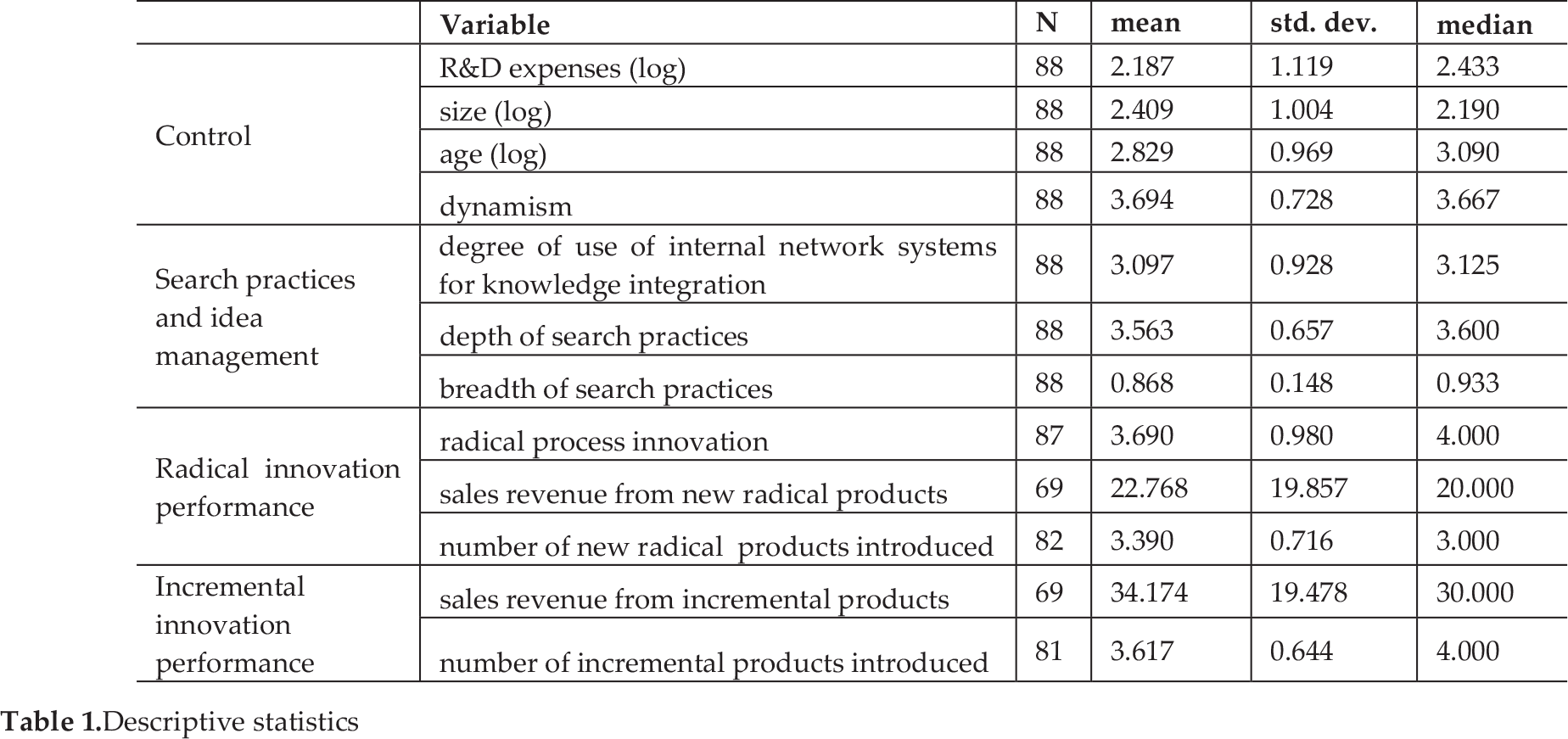
Table 1 shows descriptive statistics, and Table C in the Appendix reports the Spearman Correlation coefficients. The overall evidence of descriptive statistics shows some key facts. First, on average firms in the sample exhibit a strong orientation towards both radical and incremental innovation. Consistent with this, the level of environmental dynamism experienced by firms in the sample is high (median value: 3.667) and the firms' attitudes towards external searchesare also high. The difference between breadth and depth of search practices is particularly high (0.727, p-value <0.01%). Multicollinearity may thus come into play when estimating the impact of search practices on innovation performance.
Descriptive statistics
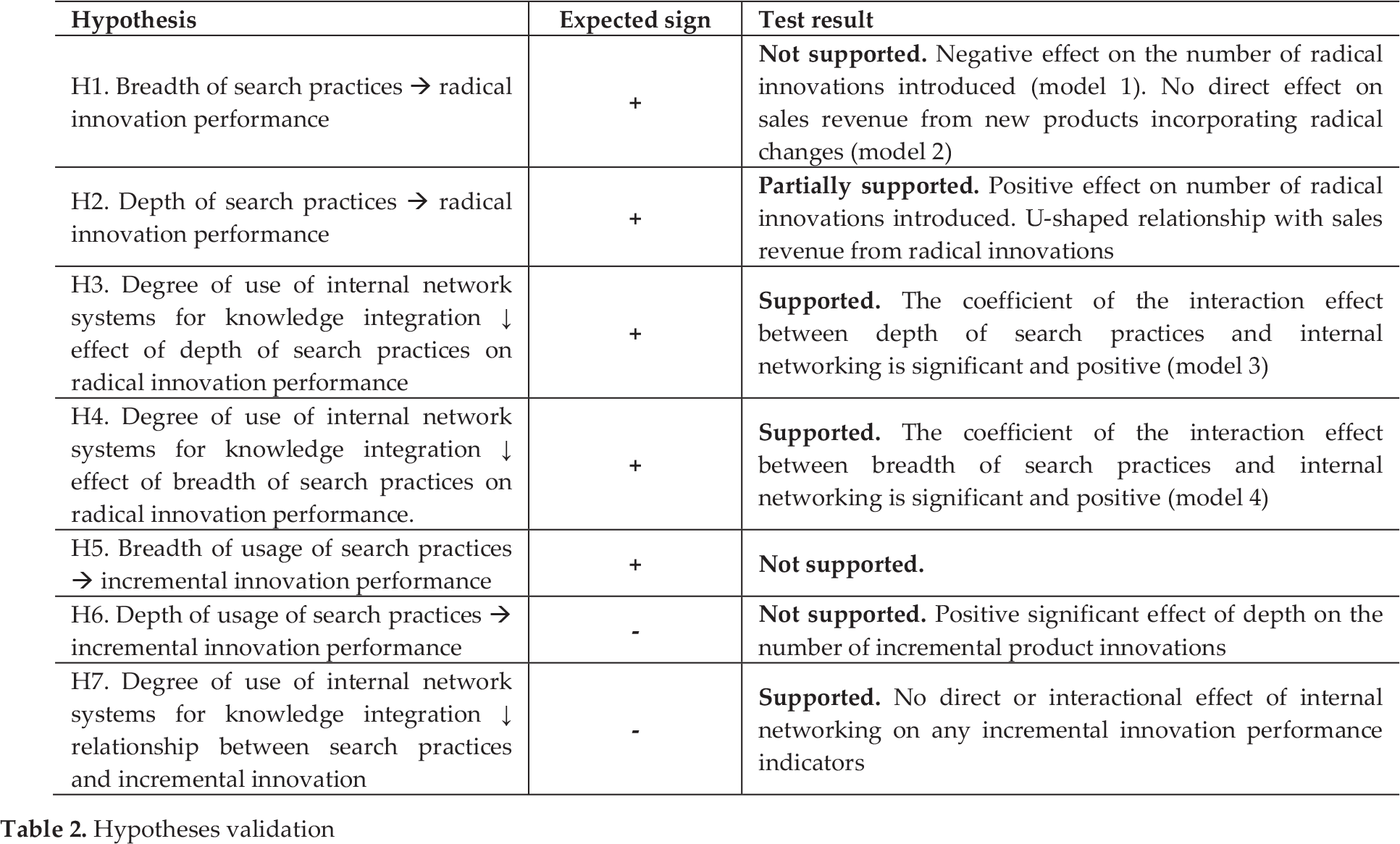
In hypotheses H1 and H2 we posited that breadth and depth of search practices have a positive effect on radical innovation performance. The results show mixed evidence (Table 3a). Model 1 indicates that breadth of search practices has a negative effect on the number of radical product innovations introduced, whereas depth of search practices has a positive effect. Model 2 indicates that breadth of search practices does not have any effect on the sales revenue from radical products, whereas depth of search practices shows a U-shaped curvilinear relationship to this type of performance indicator. This overall evidence thus provides very partial support to hypotheses H1 and H2.
In hypotheses H3 and H4 we posited that the degree of use of internal networks for knowledge integration positively moderates the relationship between search practices and radical innovation performance. We tested these hypotheses applying a hierarchical approach to Tobit regression models on sales revenue from radical products (model 5, 6 and 7). As high correlation among interaction terms make it difficult to precisely estimate multiple interaction coefficients simultaneously, we tested the interaction effect of internal boundary spanning and breadth and depth of search practices separately. Models 3 and 4 show that the coefficients of the interaction effects are positive and significant, thereby supporting the argument that breadth and depth of search practices have a positive effect on the success of radical products in the presence of internal boundary spanning.
In hypotheses H5 and H6 we posited that breadth of search practices has a positive effect on incremental product innovation performance, whereas depth of search practices exerts a negative effect. The results do not support these hypotheses (Table 3b). Specifically, model 5 shows that depth of knowledge search is positively related to the number of incremental product innovations, whereas it does not exert any significant effect upon sales from incremental product innovations. In a similar way, models 5 and 6 indicate no effect caused by breadth of search practices on the outcome of incremental innovation endeavours.
Lastly, in hypothesis H7 we argued that the use of internal network systems for knowledge integration is not related to incremental innovation performance. Models 6, 7 and 8 confirmed this result, showing that internal boundary spanning had no effect on incremental innovation, either direct or as moderator.
Table 2 provides a summary of the validation of the hypotheses in relation to the regression models estimated.
Hypotheses validation
5. Discussions and Conclusions
External knowledge has been the object of increasing attention in the past few years, corresponding to the rise in company innovation models that are based on a higher degree of openness towards external actors. In accordance with this focus, this study has investigated the knowledge search practices that firms enact to innovate their products, exploring the relationships between the performance of innovation processes and the breadth and depth of innovation processes. In so doing, we have explored the role of openness in explaining innovation performance through the lens of search practices rather than by looking at the variety of external actors from which firms draw relevant knowledge for their innovation activities [2]. Essentially, this analysis has highlighted three key findings. First, it shows that the depth of search practices is more beneficial to radical innovation performance than the breadth (i.e., the degree of external knowledge that firms gain through these mechanisms is more beneficial than the variety of mechanisms used). This result is consistent with theoretical models [32] and empirical evidence [2] positing that, when firms are dealing with radical product innovation, deep coordination with a few partners is more beneficial than a broad external search. The
The
Antecedents of radical innovation performance

p-value < 0.1%
p-value <1%
p-value < 5%
p-value < 10%; (…) standard error
Antecedents of radical innovation performance

p-value < 0.1%
p-value <1%
p-value < 5%
p-value < 10%; (…) standard error
Since some of these results contradict recent previous works on external search strategies, this study raises some important issues that should be the object of further discussion. In this regard, whereas some previous studies found an inverted U-shaped relationship between search strategies and innovation performance [4,4,27], we furnished evidence that apparently contradicts the perils of over-searching; we show that the depth of knowledge drawn from external search practices has an influence on radical innovation performance, in a U-shaped relationship. This discordance could be due to our method of focusing on search strategies, unlike previous studies we take into consideration how firms organize their search strategies. Another plausible explanation could be related to the possibility that we are considering an aspect of the relationship between search practices and radical innovation performance that is different to those investigated in other analyses. The strong propensity of our sample to open search and radical innovation could be seen as preliminary confirmation of this explanation. In this regard our data are from a survey carried out on a sample that may exhibit some self-selection bias in respect to survey initiatives such as the Community Innovation Surveys launched at each country level, which are typically addressed to a more broad and heterogeneous sample.
In collecting these results, this study does have some limitations beyond those discussed above. We believe that three limitations in particularcould identify important directions for future research. First, the sample size is small and this may limit the validation of the moderation effect exerted by network systems. Furthermore, we have investigated a sample with aptitude for exploratory innovation, and thus selection bias could hamper the generalizability of our results. Accordingly, a replication of the study on a broader and multi-country level in the high-tech industry could allow generalizability of our results to be tested.
The second limitation regards the type of innovation performance under analysis. Innovation performance is a multidimensional construct [33] and this study has only taken into consideration the number of product innovation and sales revenue from innovations. These dimensions do not, for example, consider possible continuity in firms releasing innovative products on the market over. Future studies on the effectiveness of knowledge search practices should therefore include a more comprehensive measure of a firm's innovation performance. Another open issue (our third limitation) is whether the relationship between search practices and innovation performance is mediated and moderated by variables not present in our theoretical framework. In accordance with the conceptual distinction between potential and realized absorptive capacities [34], we can plausibly expect that search practices may have a positive effect on knowledge absorption and accumulation, but that some firms may fail to apply the knowledge absorbed from external sources in new products that prove successful on the market. The positive moderation role exerted by the degree of use of internal networking in the relationship between the usage of search practices and innovation performance points in this direction. However, a more comprehensive test of the effectiveness of the main attributes of search practices should take into consideration some “intermediate” level of innovation performance. Following this line of reasoning, we may for example expect that search practices may have more salient effects on exploratory learning about new market or technological opportunities, rather than on exploitative learning. Future studies on the topic should try to tackle these limitations.
Footnotes
7. Appendix
Spearman correlation coefficients

| Variable | 1 | 2 | 3 | 4 | 5 | 6 | 7 | 8 | 9 | 10 | 11 | 12 | |
|---|---|---|---|---|---|---|---|---|---|---|---|---|---|
| 1 | R&D expenses (log) | 1.000 | |||||||||||
| 2 | Size (log) | −.044 | 1.000 | ||||||||||
| 3 | Age (log) | −.111 | .125 | 1.000 | |||||||||
| 4 | Dynamism | .143 | .049 | −.129 | 1.000 | ||||||||
| 5 | Internal boundary spanning | .106 | −.003 | −.074 | .225 * | 1.000 | |||||||
| 6 | Depth | .097 | .037 | .030 | .052 | .727 ** | 1.000 | ||||||
| 7 | Breadth | .062 | .090 | .077 | .033 | .380 ** | .585 ** | 1.000 | |||||
| 8 | Radical innovation process (frequencies) | .140 | −.081 | .037 | .253 * | .281 ** | .155 | −.094 | 1.000 | ||||
| 9 | Frequencies of new radical products | −.036 | −.046 | .097 | .058 | .272 * | .101 | −.025 | .119 | 1.000 | |||
| 10 | Sales revenue from new radical products | .094 | −.184 | −.110 | .458 ** | .267 * | .263 * | .039 | .449 ** | .237 * | 1.000 | ||
| 11 | Number of new radical products introduced | .093 | −.128 | .021 | .403 ** | .038 | .000 | .130 | .258 * | −.005 | .396 ** | 1.000 | |
| 12 | Sales revenue from incremental products | −.104 | .046 | −.163 | .005 | −.036 | −.029 | .043 | −.138 | −.031 | −.052 | −.043 | 1.000 |
| 13 | Number of incremental products introduced | .145 | −.047 | −.217 | .199 | .234 * | .219 * | .121 | .114 | .122 | .464 ** | .074 | .060 |
p-value < 0.1%
p-value <1%
p-value < 5%
p-value < 10%