




Abstract
This exploratory study addresses the education management and research management as the major constituents of the educational management for the tertiary academic institutions. The study revealed four main activities; includes education development, education assessment, research development, and research assessment; in the educational management for the Universities. Four aspects of each main activity, namely Programs Establishment, University Culture, Faculty Capabilities, and Facilities were investigated at three decision levels. The proposed model was developed based on the secondary data, i.e. analysis of literature, and primary data, i.e. interviews with stakeholders of tertiary academic institutions. Model structures were defined and confirmed by 493 respondents, representing University administrators of leading tertiary educational institutions around the world, faculty and staffs, employers, and graduates. The resulting model was subsequently evaluated for accuracy and validity by multiple linear regression (MLR) analysis and the structural equation modeling (SEM) technique. The conceptual model and research equations provides a novel approach for prospective investors or current administrators of the tertiary academic institutions to review and appraise their performance toward fulfillment of ultimate goals, i.e. producing high-competent graduates and significant research outcomes for the well-being of the society.
Keywords
1. Introduction
There is a universal acceptance of the extremely vital role of higher education in the functioning of a modern society. Higher education acquires even a key role in any sustainable development programs for efficient and effective functioning of a modern society with socioeconomic, political and technological development becoming more and more knowledge intensive and relying greatly on development and managerial skills and knowledge. Thus, other roles and responsibilities are expected of higher education institutions in the present and future, aside from the basic missions of teaching, research and community service. There is a strong need for higher education to act more responsively to the global trends and should provide prospective graduates with diversified academic and cultural surroundings in order to enhance their global awareness and capability.
An important part of higher education philosophy is generally based on the communication between faculty members and students. In research projects, the transfer of knowledge atmosphere, the share of experience, and the involvement are the core of the soft skills the students need to achieve to be prepared for development. Focusing on students and the education quality they obtain, especially at research Universities, is a mindset that should be encouraged [16].
This paper develops a conceptual model of educational management which consists of education and research management for academic institutions like Universities. The findings of this model are graduates and research outcomes, which have been produced for the betterment of the society.
2. Literature Review
Striving for synergy is already marked in education, with further education colleges and Universities collaborating mainly in the field of direct entry from college into the second or third year of a degree program. This partnership has tended to be on an ad hoc basis, with the further education college often being the instigator [30].
Many Universities have merged with smaller further education colleges, incorporating them into the institution. There have been fewer cases of a true partnership, where there is a definite transfer and combination of skills. Han et al. [28] stated that the essence of any partnership should be (a) mutual faith in the relationship and (b) a reasonable exchange.
In addition to the alliance being satisfactory, it must also exist within a free-market environment. Business units may contact outside the organization, in order to ensure overall cost-effectiveness. Top-down planning and hierarchical decision making is gradually disappearing in this type of industrial situation, with alliances requiring flexibility in order to be responsive and cost effective [9].
The current University management structure does not lend itself easily to the ideas of flexibility and responsiveness. The University Culture is quite different from that experienced in the industry. Educational institutions are becoming increasingly proactive. The question arises as to whether the external environment is forcing this change, or whether strategic planners in educational institutions are taking the lead.
If a University is looking to collaborate with another educational institution, industrial experience can be fruitful as a guide to the possible pitfalls involved. Research shows that strategic alliances are most fruitful when both parties want to learn from the other's skills. Grown-up well-known Universities collaborating with new Universities must therefore guard against this arrogance, born of decades of being lead institutions. The whole area of partnerships, associations and mergers is of increasing importance to an educational institution operating in a competitive atmosphere, and one in which Universities should, perhaps, be taking a more strategic approach than at present.
In research-based University, teaching staff is actively involved in the research. In addition, the University usually has dedicated research staff and a considerable support staff. Typically, to work as a faculty member in higher education, one must first obtain a doctorate in an academic field, although some lower teaching positions require only master's degree. Staff or administration members usually have education, training that is necessary for the fulfillment of their responsibilities. Depending on the University, the main administration is more or less centralized. In fact, most of the administrative staff works in different administrative sections, such as student affairs, admission center, financial management, human resource management. In addition, there may be central support units, such as a University library with dedicated staff.
According to the concept of three decision levels in Supply Chain Management (SCM), this concept would be adopted in higher education [29].
Strategic Level: Strategic level decisions are the highest level. Strategic level decision concerns general direction, long-term goals, philosophies and values. These decisions are the least structured and most imaginative; they are the most risky and of the most uncertain result, partly because they attain so far into the future and partly because they are of such significance.
Planning Level: Planning level decisions support strategic decisions. They tend to be medium range, medium importance, with moderate outcomes.
Operating Level: Operating level decisions are every day decisions, used to support planning level decisions. They are often made with little thought and are structured. Their impact is immediate, short term, short range, and usually low cost. The outcomes of a bad operating level decision will be minimal, although a series of bad or sloppy operating level decisions can cause harm. These decisions can be pre-programmed, pre-defined, or set out clearly in policy manuals.
2.1 Different Factors in the Universities
To accomplish proper teaching and research works in the Universities; different factors have to need analyzed. Four factors, namely Faculty Capabilities, Facilities, Programs Establishment, University Culture [12, 14, 16, 17, 32] will be illustrated in this section.
2.1.1 Programs Establishment (PE)
This is where teaching (associated with a University) is a major program activity of the establishment. As per demand, social structure and globalization, Universities will adopt different programs to satisfy the requirement of the respective arena in the course of time. Programs Establishment would be occurred for the education and research in terms of development and assessment in the Universities. Universities design different programs, to enhance the diversification in education development and establish various programs to assess the development. Universities also intend different programs to increase the diversification in research development and research assessment.
Universities have to attempt product differentiation, i.e. Programs Establishment. With the growing number of establishments attaining University status, this issue should be appearing on each program director's agenda. Hands-on experience, industrial placements, social demand, provision of IT Facilities, and innovative academic methods all demonstrate attempts to differentiate Programs Establishment [31].
2.1.2 University Culture (UC)
Culture is comprised of assumptions, values, norms and tangible signs of organization members and their behaviors. Members of any organization soon come to sense the particular culture of an organization. Culture is one of those terms that are difficult to express clearly, but everyone knows it when they sense it. For example, the culture of a large, for-profit corporation is quite different from that of a hospital or a University. In fact, University Culture is the personality of the University [16].
In academic culture, employees are highly skilled and tend to stay in the organization, while working their way up the ranks. The organization provides a stable environment in which employees can develop and exercise their skills. Universities, hospitals, large corporations, etc. are using this culture [17].
2.1.3 Faculty Capabilities (FC)
Faculty members establish good communication, provide rich environment for classroom observation, model best practices, create opportunities for reflection, and support students' participation in curriculum planning teaching and research. The University environment is basically a collection of individual experts, namely faculty members, who represent an accepted body of knowledge for many degree-granting areas. Universities have traditionally been utilized as transfer mechanisms for providing students with a knowledge base that will enable the students to function and thrive on graduation [16].
Traditionally, University faculty members are evaluated according to the three major criteria: teaching, research, and services [7]. Several studies are accomplished to improve the use of students' evaluations to better access teaching effectiveness. Centra [4] proposed the list of parameters for measuring instructors' characteristics, such as ability to communicate, attitude toward students, knowledge of the subject matter, organizational skills, enthusiasm, fairness, flexibility and encouragement of students to think for themselves.
2.1.4 Facilities (FA)
Universities offer a wide range of modern facilities to their students. These include state of the art lecture halls, libraries, laboratories and IT services to ensure that students are provided with an environment in which they can learn, both successfully and comfortably. Universities also have sporting, social, religious, crèche and health amenities to ensure that time spent at third level is a fully rounded experience.
Modern Teaching Facilities: Lecture rooms are principally conducted using state-of-the-art distance learning technology, online education, e-learning via Internet. State-of-the-art recording and delivery systems create a true collaborative environment, while all presentation materials are simultaneously shared through a separate data stream. The interactive distance learning Facilities are becoming more common nowadays.
Modern Research Facilities: Research undertaken by the Universities is focused on contributing to respective country's development as a scientific and technological hub. It is conducted at the academic departments, digital libraries, research centers and national research institutes to which the University fellows are affiliated. Online databases, e-journal, digital library, etc. represents modern research Facilities in the Universities.
2.2 Education and Research Assessment
The overall goal of assessment is to improve student learning in terms of education and research. Assessment provides students, parents or guardians, and teachers with valid information concerning student progress and their attainment of the expected curriculum. Assessment should always be viewed as information to improve student accomplishment.
Assessment measure whether or not learning and/or learning objectives are being met. Assessment requires the gathering of evidence of student performance over a period to measure learning and understanding. Evidence of learning could take the form of dialogue, journals, written work, portfolios, and tests along with many other learning tasks. Assessment for research would be a review of conference and journal entries, written work, presentation, research papers, essays, story writing tests, exams etc. and will display a sense of more permanent learning and clearer picture of a student's ability. Effective faculty members will use assessment techniques regularly and on a daily basis to improve student learning and to guide instruction [16].
Education quality is a rather vague and controversial philosophy in research and policy discussion. To different people, the definition may be different and so the indicators used to describe education quality may be different. Some may highlight the quality of inputs to the education systems whereas others stress the quality of processes and outcomes. No matter whether referring to input, process, outcome, or all of these, the definition of education quality may often be associated with fitness for use, the satisfaction of the needs of strategic constituencies (e.g. parents, University Council, faculty members, students, employers, etc.) or conformance to strategic constituencies' requirements and expectations.
Comm, C.L. and Mathaisel [6] defined education quality as follows: “Education quality is the character of the set of elements in the input, process, and output of the education system that provides services that completely satisfy both internal and external strategic constituencies by meeting their explicit and implicit expectations.”
The concerns regarding the concept of quality in higher education are clearly expressed by Barnett [2]: “What counts as quality is contested. The different views of quality generate different methods of assessing quality and in particular alternative sets of performance indicators (PIs). However, PIs are highly limited in their informational content, and have nothing to tell us about the quality of the educational process.” For assessing University education and research quality, different indicators may be developed to give information about the performance of an educational institution in different aspects of input, process, and outcome.
3. Research Methodology
Model development and analysis was based on both primary and secondary data. Once the existing body of literature has been thoroughly investigated, a conceptual framework is proposed. The conceptual model was developed based on the analysis of literature, past theoretical frameworks, interviews of University administrators, etc. Based on the survey research techniques, the resulting model was evaluated for accuracy and validity by the Structural Equation Modeling (SEM) technique through AMOS (Analysis of Moment Structures). The applicability of the model can be confirmed empirically.
The questionnaire was developed and analyzed to determine reliability and validity of the tools. In the scale reliability test, the Cronbach's alpha value is 0.961, which means the scale is excellent reliable [10] and could be used to test the content validity. Validity of the variables was confirmed by experts, as well as academicians. Non-probability sampling techniques based on the judgment (purposive) sampling was applied. This judgment sampling depends on the personal judgments from all stakeholders of the Universities. The respondents were asked to indicate the level of significance using five-point Likert scale (1 = strongly disagree, 5 = strongly agree) [8]. For the survey research questionnaire interval scale, statistical parametric scale, were used.
The questionnaires were pre-tested to check the content validity and revised where necessary to ensure the content validity. In pretest, all the respondents were academicians of different world-ranking Universities. As our target groups were University administrators, faculty and staffs from different top ranked universities, employers and graduates, data were gathered through emails, and self-administered. In large-scale research, the questionnaire was sent to 2356 respondents through emails those are top management in 1–2000 ranking universities around the world. 242 questionnaires were distributed by self-administered to University administrators, faculty members, staff, graduates and employers. Lastly, 823 research questionnaires by self-administered to graduates of different Universities were randomly distributed. Finally, 493 questionnaires were collected from all stakeholders, including experts, faculty, staff, graduates and employers, out of 3421 respondents. Among them, 174 respondents were experts in University administration, faculty, staff, 166 respondents were graduates, and 153 respondents were employers.
4. Model Development
To produce quality graduates and research outcomes, the Universities must plan, manage, assess and control their educational and research administration.
4.1 Holistic View of the University as a Service Provider
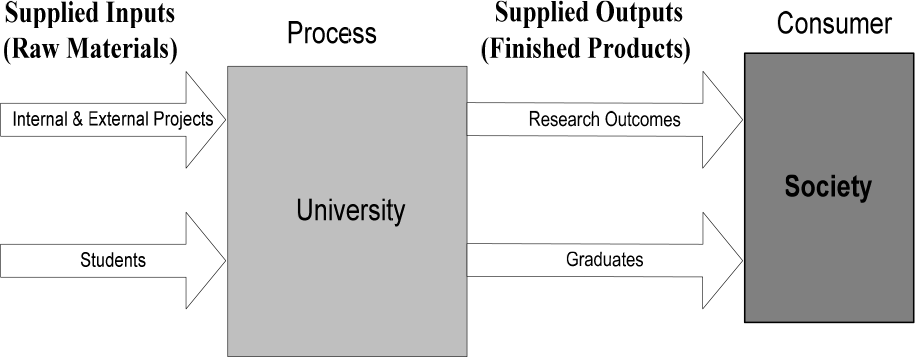
The supplied inputs, the supplied outputs, and the process of the University are illustrated in Fig.1, which work all together to produce the final outcomes, i.e. graduates and research outcomes to the society, i.e. the consumer [36].
Holistic View of Educational Management
Supplied Inputs: The inputs to the process of the University are students and internal and external research projects in education and research wing respectively. The authors recognized supplied inputs as raw materials in Fig.1.
Supplied Outputs: The outputs of the process of the University are graduates and research outcomes in education and research wing respectively. The authors defined supplied outputs as finished products.
Supplied outputs will be delivered to the consumer. Some graduates would serve as supplied inputs to the process of the University.
Process of the University: In educational management, three decision levels, as illustrated in Fig. 2 are involved in the process of the University:
Phase 1 : Strategic Level Phase 2: Planning Level Phase 3: Operating Level

Educational Management Model for the Tertiary Academic Institutions
4.2 Educational Management
Integrated form of educational management for the Universities has been mentioned in Fig. 2. Through proper educational management, the University can produce quality outcomes for the society. The researchers present three decision levels, including strategic, planning and operating, for both education and research wing in the University. Each level consists of two parts, namely development and assessment for both wings. Development and assessment would be occurred concurrently. Assessment at different levels assures stakeholders' satisfaction in this model [14, 15].
There are two inputs, namely students and research projects, and two outputs, namely graduates and research outcomes in this model. Four aspects, namely Programs Establishment, University Culture, Faculty Capabilities, and Facilities are considered for development and assessment in the education and research wing. The final outcomes of the University are delivered to the end customer, i.e. the society.
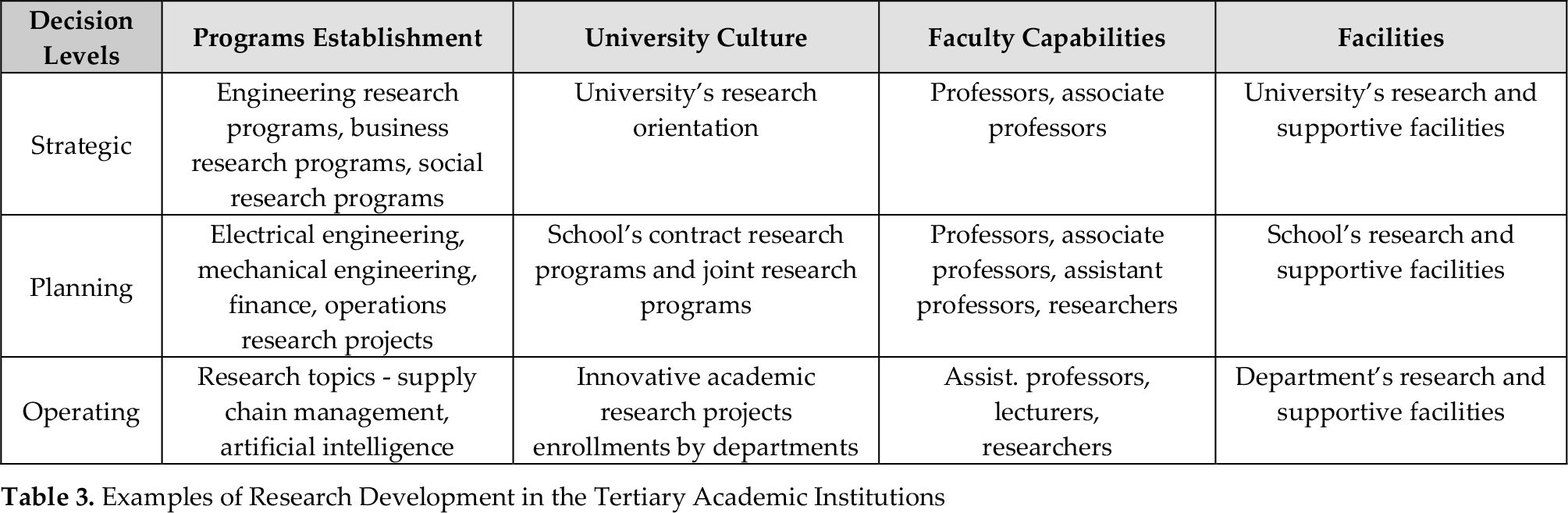
Based on three decision levels, some examples are provided to focus the four aspects for both education and research in the Universities. Table 1 and 2 illustrate the examples of the development and assessment for the education wing in the Universities [16]. On the other hand, Table 3 and 4 illustrate the examples of development and assessment for the research activities in the Universities.
Examples of Education Development in the Tertiary Academic Institutions

Examples of Education Assessment in the Tertiary Academic Institutions

Examples of Research Development in the Tertiary Academic Institutions
Examples of Research Assessment in the Tertiary Academic Institutions

4.3 Final Outcomes
The authors defined graduates with desirable quality and quality research outcomes as final outcomes of the educational management model for the tertiary educational institutions.
4.3.1 Graduates with Desirable Quality
Graduates with desirable quality is one of the final outcomes in the educational management for tertiary academic institutions. Benchmarking and value enhancement determinants are identified and incorporated in the process of the University to produce graduates with desirable quality [21, 22].
Graduates benchmarking includes knowledge (tacit or explicit), skills, competencies, capabilities, ethics, career development programs, etc.
Graduates value enhancement includes source of fund (self-funding, scholarship, etc.), wisdom, faculty capabilities, facilities, Information & Communication Technology (ICT), research involvements, etc.
4.3.2 Quality Research Outcomes
The authors defined another final outcome of the educational management is quality research outcomes. The University develops strategic plans for multidisciplinary research to maintain an emphasis on research as an important component of the academic mission of the University. Research outcomes may include problem solution, pure theory, internal and external projects applications, thesis findings, research publications, or research findings, etc.
5. Model Evaluation
The researchers pointed out eight hypotheses to verify the educational management model for tertiary academic institutions. Hypothesis 1 stands for education development, hypothesis 2 for education assessment. Hypotheses 5 and 6 represent research development and research assessment respectively. Hypotheses 3 and 4 stand for graduates and hypotheses 7 and 8 for research outcomes [18, 17].
In the educational management, the authors represent six models in this section. From the research model, the following hypotheses are established.
Four factors namely, Programs Establishment, University Culture, Faculty Capabilities and Facilities at three decision levels, affect education development in the Universities to produce graduates.
Four factors namely, Programs Establishment, University Culture, Faculty Capabilities and Facilities at three decision levels, affect education assessment in the Universities to produce graduates.
There is a relationship between education development and graduates.
There is a relationship between education assessment and graduates.
Four factors namely, Programs Establishment, University Culture, Faculty Capabilities and Facilities at three decision levels, affect research development in the Universities to produce research outcomes.
Four factors namely, Programs Establishment, University Culture, Faculty Capabilities and Facilities at three decision levels, affect research assessment in the Universities to produce research outcomes.
There is a relationship between research development and research outcomes.
There is a relationship between research assessment and research outcomes.
5.1 Model A- Education Development
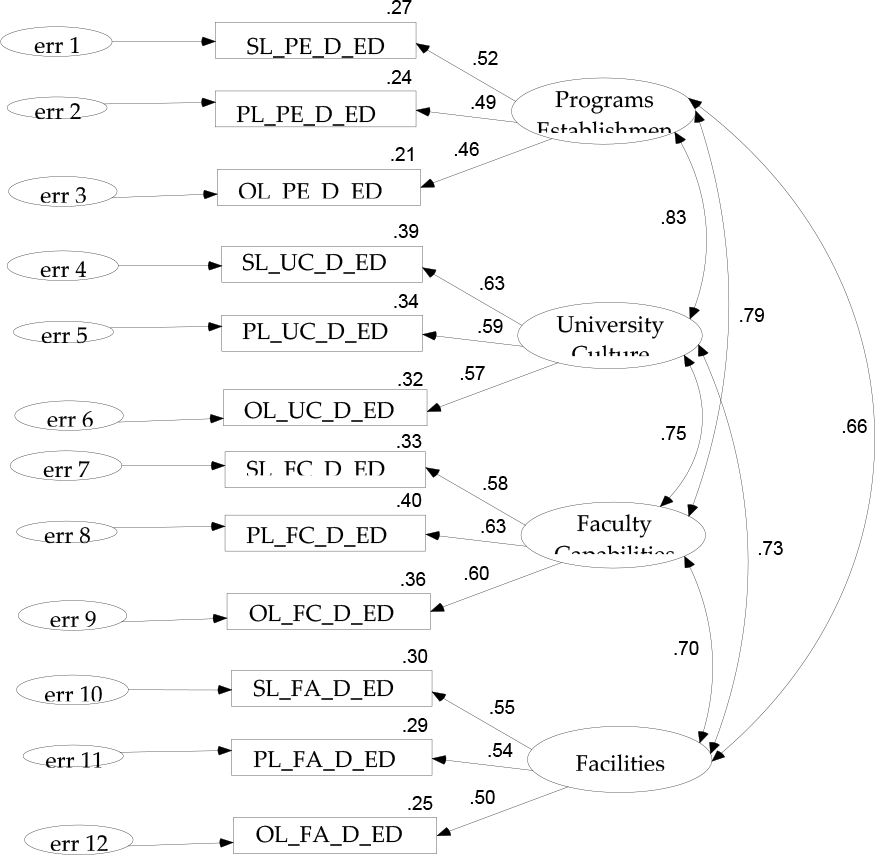
To verify hypothesis 1, the researchers used Model A that comprises of Programs Establishment, University Culture, Faculty Capabilities and Facilities at three decision levels.

AMOS Graphics Output of Model A



Model Fit Index: CMIN/DF = 3.567(Ratio of relative chi-square close to 5 indicates reasonable fit) [1, 35], Degrees of freedom =19, NFI = 0.845, CFI = 0.882 (NFI and CFI values close to 1 indicate a very good fit) [1, 3].
Equation (1), (2), (3), (4), graphics output and model fit index through AMOS states that Programs Establishment, University Culture, Faculty Capabilities, Facilities at three decision levels affect significantly the education development to produce graduates, i.e. hypothesis 1 fails to reject.
5.2 Model B - Education Assessment
To verify hypothesis 2, the researchers utilized model B that comprises of Programs Establishment, University Culture, Faculty Capabilities and Facilities at three decision levels, i.e. strategic, planning and operating level.
MLR Equations:

AMOS Graphics Output of Model B MLR Equations:



Model Fit Index: CMIN/DF = 2.630, Degrees of freedom =48, NFI = 0.897, CFI = 0.932
Equation (5), (6), (7), (8), graphics output and model fit index through AMOS states that Programs Establishment, University Culture, Faculty Capabilities, Facilities significantly affect the education assessment to produce graduates, i.e. hypothesis 2 fails to reject.
5.3 Model C – Graduates
The researchers identified graduates as final outcomes of the education part in the University. It is divided into two segments including education development and education assessment. Model C represents Graduates that contains Education Development and Education Assessment. There are four subgroups, namely Programs Establishment, University Culture, Faculty Capabilities and Facilities.
MLR Equations:


From the research findings, equation (9) states that University Culture is the most significant factor in education development. On the other hand, equation (10) represents that University Culture is highly contributed to education assessment. Finally, equation (11) depicts that education development is highly contributed to produce quality graduates in the Universities.

AMOS Graphics Output of Model C

The above equation shows the significant relationship among all factors namely Programs Establishment, University Culture, Faculty Capabilities, and Facilities in education development as well as education assessment to produce the graduates [33]. University Culture at education development and education assessment are highly contributed to produce the graduates in the Universities.

The equation (11), (12), graphics output and model fit index through AMOS magnifies that hypotheses 3 and 4 fail to reject and states that there are significant relationship between education development and graduates as well as education assessment and graduates.
5.4 Model D - Research Development
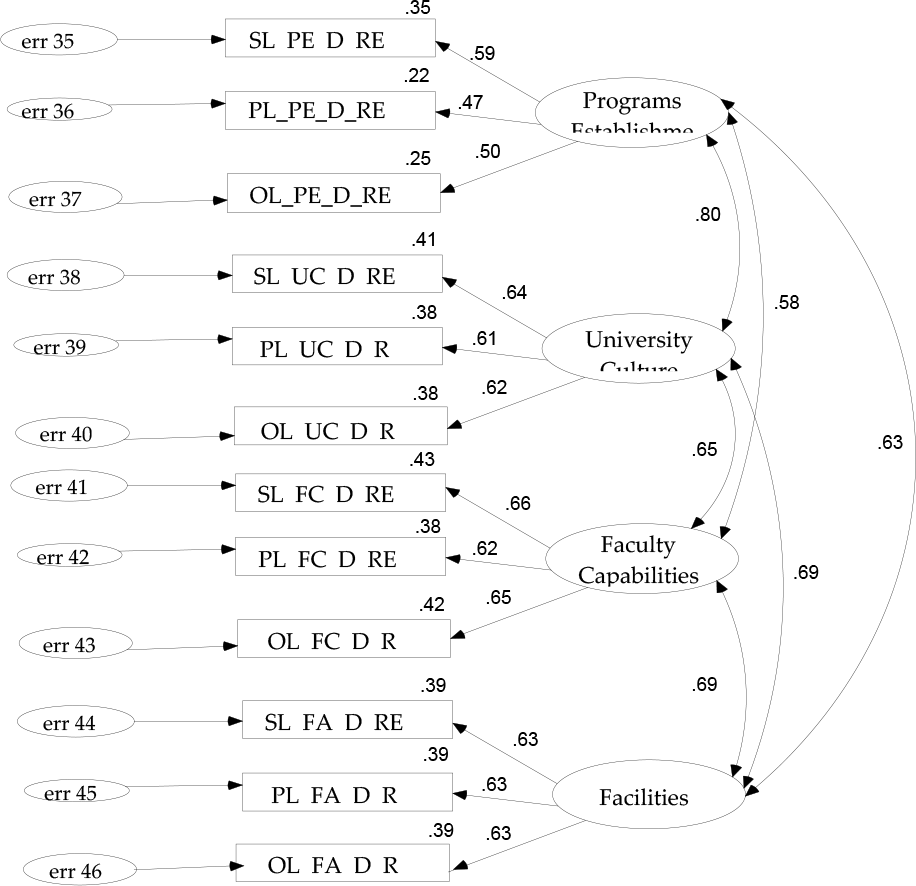
The researchers used Model D for research development that comprises of Programs Establishment, University Culture, Faculty Capabilities and Facilities at strategic, planning and operating level to verify hypothesis 5.
MLR Equations:


AMOS Graphics Output of Model D



Equation (13), (14), (15), (16), graphics output and model fit index through AMOS states that Programs Establishment, University Culture, Faculty Capabilities, Facilities at three decision levels significantly affect the research development to produce research outcomes, i.e. hypothesis 5 fails to reject.
5.5 Model E - Research Assessment
The researchers used Model E for research assessment that comprises of Programs Establishment, University Culture, Faculty Capabilities and Facilities at three decision levels to justify hypothesis 6.
MLR Equations:





AMOS Graphics Output of Model E

AMOS Graphics Output of Model F
Equation (17) states that operating level decisions are more predominant than strategic and planning level decisions in Programs Establishment of research assessment. Equation (18) represents that strategic level decisions are highly contributed to University Culture in research assessment. Equation (19) depicts that planning level decisions are more significant than strategic and operating level decisions of faculty capabilities in research assessment. Equation (20) highlights that planning level decisions are highly contributed to Facilities in research assessment.

Equation (17), (18), (19), (20), graphics output and model fix index through AMOS states that Programs Establishment, University Culture, Faculty Capabilities, Facilities at three decision levels significantly affect the research assessment to produce research outcomes, i.e. hypothesis 6 fails to reject.
5.6 Model F - Research Outcomes
The authors identified research outcomes as final outcomes in the research activities of the University. To verify the hypotheses 7 and 8, the model F contains two groups, including Research Development and Research Assessment. There are four subgroups, namely Programs Establishment, University Culture, Faculty Capabilities and Facilities.
MLR Equations:


From the research findings, equation (21) states that University Culture is the most significant factor in research development. On the other hand, equation (22) denotes that Faculty Capabilities are highly contributed to research assessment. Finally, equation (23) depicts that research development is highly contributed to produce research outcomes in the Universities.
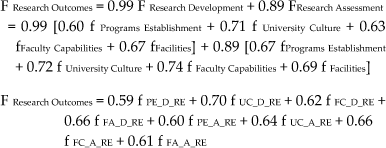
From the research results of equation (24), which demonstrate the significant relation among four aspects, namely Programs Establishment, University Culture, Faculty Capabilities, and Facilities in research development as well as research assessment to produce the research outcomes in the Universities [34]. University Culture and Facilities in research development as well as Faculty Capabilities in research assessment are highly contributed to produce the research outcomes in the Universities.

The equation (23), (24), graphics output and model fit index through AMOS rectifies that hypotheses 7 and 8 fail to reject and states that there are significant relationship between research development and research outcomes as well as research assessment and research outcomes.
6. Acknowledgments
The authors would like to express gratitude to their Honorable GURU, Dr. Chamnong Jungthirapanich, Ex-Associate Dean of Graduate School of Information Technology, Assumption University of Thailand, for his excellent suggestions and guidelines towards this research.
7. Discussion
From the literature review and conceptual model, quality graduates and researches would be produced through proper development and appropriate assessment. From the equations (5), (6), (7), (8) and (12)
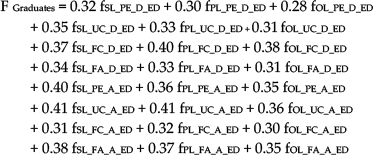
From the in-depth analysis of equation (25), strategic and planning level decisions of University Culture and strategic level decisions of Programs Establishment are highly contributed in education assessment to produce the graduates. However, planning level decision of Faculty Capabilities is highly contributed in education development to produce the graduates in the tertiary academic institutions.
On the other hand, from the in-depth analysis of equation (26), strategic, planning and operating level decisions in University Culture are highly contributed to research development to produce the research outcomes. Nevertheless, planning level decision in Faculty Capabilities is highly contributed to research assessment to produce the research outcomes in the tertiary academic institutions.
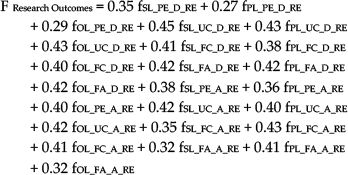
The authors defined the society as the function of graduates and research outcomes; therefore, well-being society consists of value-added graduates and research outcomes.

One of the main goals of an educational management is to improve the well-being of the end customer or the society. Improved well-being society would be possible through producing quality graduates and quality research outcomes by implementing proper educational management for the tertiary academic institutions from the raw materials, i.e. students and research projects to finished products, i.e. graduates and research outcomes.
8. Conclusion
This research represents the first large scale empirical study that systematically investigate input, output and process of the tertiary academic institutions through the education and research management. This empirical study based on 493 respondents from all stakeholders, including experts and administrators, faculty members and staffs of the university, employers, graduates, etc. The hypotheses testing and SEM technique through AMOS were also applied.
There is ample evidence that higher education is one of the most important institutions in any society. Higher education provides benefits to both the society as a whole and individuals within the society. Individual benefits include wealth and a better life for those who are educated; social benefits are usually in terms of economic growth and prosperity of the society. Therefore, this educational management model provides fruitful outcomes in terms of value-added graduates and significant research outcomes for the well being of the society.