




Abstract
This exploratory research addresses educational management model for the universities. Its applicability was successfully verified and validated through survey data from leading tertiary educational institutions around the world. The proposed model was developed based on the analysis of literature, past theoretical frameworks, interviews with stakeholders. Model constructs were identified and confirmed by 493 respondents, representing university administrators, faculty and staffs, employers, and graduates. The resulting model was subsequently evaluated for accuracy and validity by multiple linear regression (MLR) analysis and the structural equation modeling (SEM) technique. The study revealed education development, education assessment, research development, and research assessment as four main activities in educational management. Four aspects of each activity, namely programs establishment, university culture, faculty capabilities, and facilities were investigated at strategic, planning, and operating levels. The conceptual model for the universities provides a novel approach for prospective investors or current university administrators to review and appraise their performance toward fulfillment of ultimate goals, i.e. producing high-caliber graduates and high-impact research outcomes for the betterment of the society. The research model represents two contributions to the society including human resource contribution and research contribution.
1. Introduction
Education, being part of the service industry, is characterized differently from the manufacturing industry, as its product, i.e. knowledge, is intangible. Effective education relies much on its personnel's knowledge, experience, and ethics. Supply chains are relatively easy to define for manufacturing industries, where each participant in the chain receives inputs from a set of suppliers, processes those inputs, and delivers them to a different set of customers. With educational institutions, one of the primary suppliers of process inputs is customers themselves, who provide their bodies, minds, belongings, or knowledge as inputs to the service processes (Sampson, 2000).
In educational management, a university works in close collaboration with schools, further education colleges, its current students, university staff, and employers of its graduates in designing curricula (O'Brien and Kenneth, 1996) to ensure that the needs of all stakeholders are satisfied. Universities are expected to have substantial external funding commitments for associated faculty lines, evidence of long-term sustainability, a program of research training, and substantial infrastructure. Faculty and research, teaching staffs in institutes usually participate in interdisciplinary graduate and undergraduate education programs.
An important part of higher education philosophy is generally based on the communication between faculty members and students. In research projects, the transfer of knowledge atmosphere, the share of experience, and the involvement are the core of the soft skills the students need to achieve to be prepared for development. Focusing on students and the education quality they obtain, especially at research universities, is a mindset that should be encouraged.
This paper attempts to develop a conceptual model for the universities. The desirable goals may be quality graduates and research outcomes. The ultimate goal is, however, the improved well-being of the society.
The strategies to operate supply chain management (SCM) in the service industry, like educational institutions are the same as in the manufacturing industry. Three business forces, including e-commerce, globalization and customer expectations support the three levels of decisions, namely strategic, planning and operating, used in the SCM (Nixon, 2001).
2. Literature Review
Based on findings from literature review, the researcher found a large number of papers and articles in educational management. A university works in close collaboration with schools, further education colleges, its current students, university staff, and employers of its graduates in designing curricula (Heskett, 1964) to ensure that the needs of all stakeholders are satisfied.
Striving for synergy is already marked in education, with further education colleges and universities collaborating, mainly in the field of direct entry from college into the second or third year of a degree programme. This partnership has tended to be on an ad hoc basis, with the further education college often being the instigator (Jones, 1989).
In addition to industry supporting universities in terms of finance, there has also been relationship at course level, with sponsors of a course having a large input into the structure, contents and planning of the course. This incorporation with industry has led to some concern over externally funded staff having divided loyalties and industry profits directing research interests (Turner, 1988). Wagner (1989) supported the view that academe and industry were very different, both in the different management challenges, which they faced, and in the different cultures in which management was to be enacted.
Technology, globalization and competition have caused to shift the ground under higher education, challenging national borders and calling into question honored traditions and long-held assumptions creating a brave new world for higher education during the last decade (Green, Eckel and Barblan, 2002). Universities must have quality beyond the competition, technology before the competition, and costs below the competition to compete in this global environment (Watson, 1993).
There is ample evidence that higher education is one of the most important institutions in any society. Higher education provides benefits to both the society as a whole and individuals within the society. Individual benefits include wealth and a better life for those who are educated; social benefits are usually in terms of economic growth and prosperity of the society (Comm, 2003).
An important part of higher education philosophy is generally based on the communication between faculty members and students. In research projects, the transfer of knowledge atmosphere, the share of experience, and the involvement are the core of the soft skills the students need to achieve to be prepared for development. Focusing on students and the education quality they obtain, especially at research universities, is a mindset that should be encouraged (Comm, 1998).
In the educational supply chain, there are direct and indirect student services to process the raw material, i.e. the student. Direct student services include student design and development, student sourcing and selection, student academic and non-academic trainings, student practical trainings, student result testing and finally student further development. The indirect student services are campus advancement and maintenance, IT infrastructure, hostel, clearances, bookstore, security, restaurants and sport facilities, etc. (Lau, 2007).
Research is expensive and long-term requiring customized and responsive supply chain to satisfy the customer. For example, if there is an applied research to develop a specific IT system for an industry, the supply chain should be used to search for all the relevant operators, who are professional in developing the IT system, and the facilitates, which can execute the research faster. On the other hand, if there is a basic research to develop a few social observations through survey as a mean to gather relevant data, the supply chain should be managed to communicate the professionals and facilities in the university so as to prevent duplicated research scope and to streamline the survey time and cost (Habib, 2010a).
According to the concept of three decision levels in SCM, this concept would be adopted for the higher educational institutions (Harris, 1998).
To accomplish proper teaching and research works in the universities; different factors have to need analyzed. Four factors, namely faculty capabilities, facilities, programs establishment, university culture (Lau, 2007; Habib and Jungthirapanich, 2008b, 2009a, 2009c, 2010a) will be illustrated in this section.
2.1 Programs Establishment (PE)
Programs establishment would be occurred for the education and research in terms of development and assessment in the universities. Universities design different programs, to enhance the diversification in education development and establish various programs to assess the development. Universities also intend different programs to increase the diversification in research development and research assessment. Universities have to attempt product differentiation, i.e. programs establishment. Hands-on experience, industrial placements, social demand, provision of IT facilities, and innovative academic methods all demonstrate attempts to differentiate programs establishment (Kotler and Bloom, 1984).
2.2 Faculty Capabilities (FC)
Faculty members establish good communication, provide rich environment for classroom observation, model best practices, create opportunities for reflection, and support students' participation in curriculum planning, teaching and research. Traditionally, university faculty members are evaluated according to the three major criteria: teaching, research, and services (Comm and Mathaisel, 1998), (Centra, 1981).
2.3 University Culture (UC)
The concept of organizational culture would be applicable for the universities by the name of University Culture. However, the type of the university culture will fully depends on the university management or administrator. In fact, university culture is the personality of the university (Habib, 2009b).
2.4 Facilities (FA)
Universities offer a wide range of modern facilities to their students. These include state of the art lecture halls, libraries, laboratories and IT services to ensure that students are provided with an environment in which they can learn, both successfully and comfortably. Lecture rooms are principally conducted using state-of-the-art distance learning technology, online education, e-learning via Internet. Online databases, e-journal, digital library, etc. represents modern research facilities in the universities (Habib and Jungthirapanich, 2010d, 2010e; Habib, 2010f).
3. Research Methodology
Model development and analysis was based on both primary and secondary data. Once the existing body of literature has been thoroughly investigated, a conceptual framework is proposed. The conceptual model was developed based on the analysis of literature, past theoretical frameworks, interviews of university administrators, etc. Based on the survey research techniques, the resulting model was evaluated for accuracy and validity by the Structural Equation Modeling (SEM) technique through AMOS (Analysis of Moment Structures). The applicability of the model can be confirmed empirically.
The questionnaire was developed and analyzed to determine reliability and validity of the tools. In the scale reliability test, the Cronbach's alpha value is 0.961, which means the scale is excellent reliable (Ebel, 1951) and could be used to test the content validity. Validity of the variables was confirmed by experts, as well as academicians. The researcher applied non-probability sampling techniques based on the judgment (purposive) sampling. This judgment sampling depends on the personal judgments from all stakeholders of the universities. The respondents were asked to indicate the level of significance using five-point Likert scale (1 = strongly disagree, 5 = strongly agree) (Cutler, 1998). The researcher used interval scale, statistical parametric scale, for the survey research questionnaire.
The questionnaires were pre-tested to check the content validity and revised where necessary to ensure the content validity. In pretest, all the respondents were academicians of different world-ranking universities. As our target groups were university administrators, faculty and staffs from different world ranking universities, employers and graduates, data were gathered through emails, and self-administered. In large-scale research, the researcher sent the questionnaire to 2356 respondents through emails those are top management in 1–2000 world-ranking universities. The author distributed 242 questionnaires by self-administered to university administrators, faculty members, staff, graduates and employers. Finally, we also randomly distributed 823 research questionnaires by self-administered to graduates of different universities. As a whole, 106 questionnaires were received by emails and 387 questionnaires were received by self-administered. Finally, 493 questionnaires were collected from all stakeholders, including experts, faculty, staff, graduates and employers, out of 3421 respondents. Among them, 174 respondents were experts in university administration, faculty, staff, 166 respondents were graduates, and 153 respondents were employers.
The growing interest of Structural Equation Modeling (SEM) techniques and recognition of their importance in empirical research are used to test the extent to which the research meets recognized standards for high quality statistical analysis (Strub and et al., 2002; Udomleartprasert and Jungthirapanich, 2003). The interrelationships among all educational management components are investigated and confirmed by SEM technique.
4. Model Development
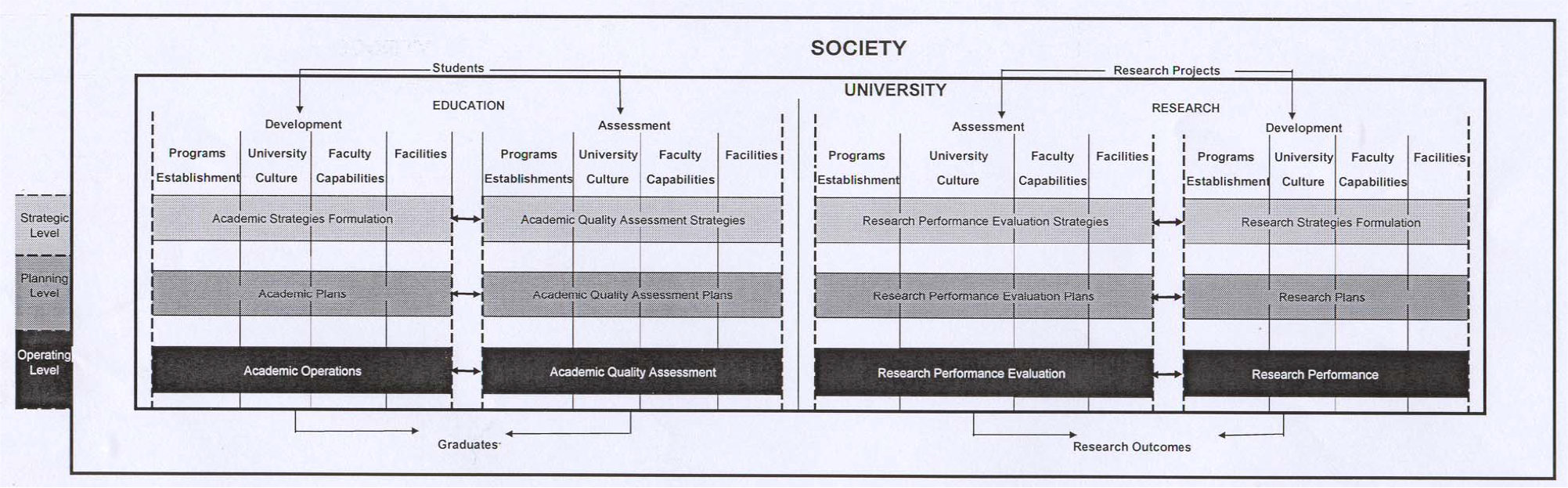
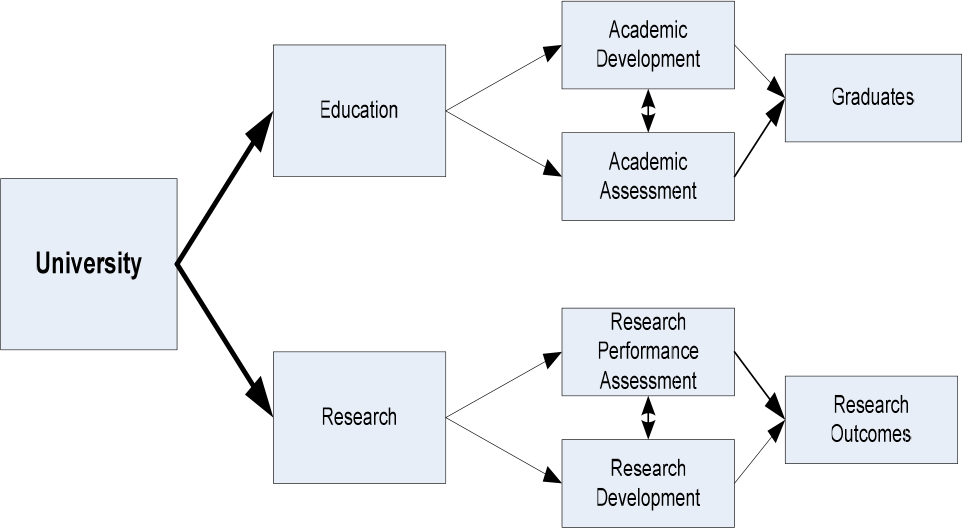
The researcher identified two major wings including development and assessment for both education and research in the university. Fig. 2 represents educational management for the universities in four aspects, including programs establishment, university culture, faculty capabilities, and facilities, are considered for development and assessment in both education and research part. The final outcomes of the university, i.e. graduates and research outcomes are delivered to the society (Habib and Jungthirapanich, 2010c). In educational management, three decision levels, as illustrated in Figure 1 are involved in the process of the university (Habib and Jungthirapanich, 2008a):

Three-decision Levels in the Universities
Educational Management Model for the Universities
Phase 1: Strategic Level
Phase 2: Planning Level
Phase 3: Operating Level
Strategic Level in the Universities
Figure 2 illustrates integrated form of educational management for the universities. Through proper educational management, the university can produce quality outcomes for the society. The researcher presents three decision levels, including strategic, planning and operating, for both education and research wing in the university. Each level consists of two parts, namely development and assessment for both wings. Development and assessment would be occurred concurrently. Assessment at different levels assures stakeholders' satisfaction in this model (Habib and Jungthirapanich, 2009b, 2009c).
There are two inputs, namely students and research projects, and two outputs, namely graduates and research outcomes in this model. Four aspects, namely programs establishment, university culture, faculty capabilities, and facilities are considered for development and assessment in the education and research wing. The final outcomes of the university are delivered to the end customer, i.e. the society (Habib, 2010f).
4.1 Final Outcomes
4.1.1 Graduates with Desirable Quality
Graduates with desirable quality is one of the final outcomes in the educational management. Benchmarking and value enhancement determinants are identified and incorporated in the process of the university to produce graduates with desirable quality (Habib and Jungthirapanich, 2009d, 2010a, 2010b).
Graduates benchmarking includes knowledge (tacit or explicit), skills, competencies, capabilities, ethics, career development programs, etc.
Graduates value enhancement includes source of fund (self-funding, scholarship, etc.), wisdom, faculty capabilities, facilities, Information & Communication Technology (ICT), research involvements, etc.
4.1.2 Quality Research Outcomes
The author defined another final outcome of the educational management is quality research outcomes. Research outcomes may include problem solution, pure theory, internal and external projects applications, thesis findings, research publications, or research findings, etc. (Habib and Jungthirapanich, 2009e, 2010b, 2010c; Habib, 2009b, 2010g).
5. Model Evaluation
In the educational management, the author represents model A and B in this section. Model A stands for graduates and model B represents research outcomes. From the research model, the following hypotheses are established. Hypotheses 1 and 2 stand for graduates and hypotheses 3 and 4 for research outcomes (Habib, 2010b; Habib and Jungthirapanich, 2010a).
H1: There is a relationship between education development and graduates.
H2: There is a relationship between education assessment and graduates.
H3: There is a relationship between research development and research outcomes.
H4: There is a relationship between research assessment and research outcomes.
5.1 Model A: Graduates
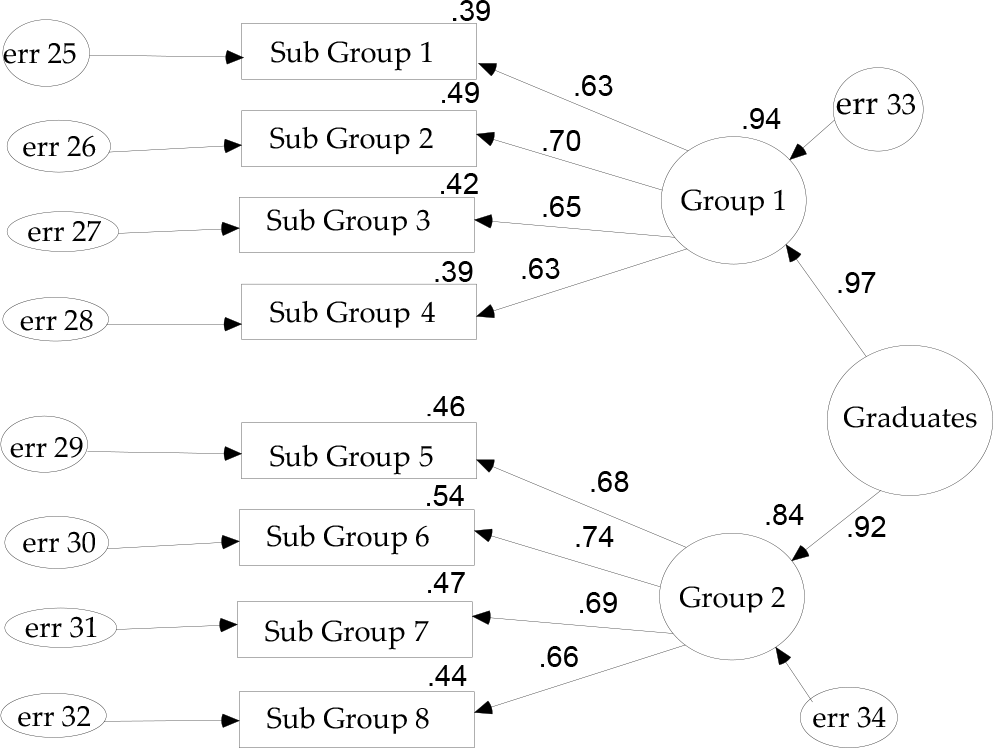
The researcher identified graduates as final outcomes of the education part in the university. Education part is divided into two segments including education development and education assessment. Model A contains group 1 and group 2. Group 1 is defined as the education development, which consists of four subgroups, including subgroup 1, subgroup 2, subgroup 3 and subgroup 4 those are representing programs establishment, university culture, faculty capabilities and facilities respectively.
On the other hand, group 2 stands for the education assessment, which consists of 4 subgroups, namely subgroup 5, subgroup 6, subgroup 7 and subgroup 8, those are representing programs establishment, university culture, faculty capabilities and facilities respectively. Fig. 4 illustrates the inter relationships among different variables to justify the hypothesis 1 and 2 by SEM through AMOS.
AMOS Graphics Output of Model A (Standardized Estimates)
Multiple Linear Regression (MLR) Equations



From the research findings, equation (1) states that university culture (sub group 2) is the most significant factor in education development. On the other hand, equation (2) represents that university culture (sub group 6) is highly contributed to education assessment. Finally, equation (3) depicts that education development is highly contributed to produce quality graduates in the universities.

The above equation shows the significant relationship among all factors. University culture at education development and education assessment is highly contributed to produce the graduates in the universities.
The equation (3), (4), graphics output and above all statistical discussion on AMOS magnifies that hypotheses 1 and 2 fail to reject and states that there are significant relationship between education development and graduates as well as education assessment and graduates.
5.2 Model B: Research Outcomes
The author identified research outcomes as final outcomes in the research wing of the university. This part is divided into two segments including research development and research assessment. The model B contains 2 groups, namely group 3 and group 4. Group 3 is defined as the research development, which consists of four subgroups, namely subgroup 9, subgroup 10, subgroup 11 and subgroup 12, those are representing programs establishment, university culture, faculty capabilities and facilities respectively.
On the other hand, group 4 stands for the research assessment, which consists of four subgroups, namely subgroup 13, subgroup 14, subgroup 15 and subgroup 16, those are representing programs establishment, university culture, faculty capabilities and facilities respectively. Fig. 5 illustrates the inter relationships among different variables to justify the hypothesis 3 and 4 by SEM through AMOS.

AMOS Graphics Output of Model B (Standardized Estimates)
Multiple Linear Regression (MLR) Equations


From the research findings, equation (5) states that university culture (sub group 10) is the most significant factor in research development. On the other hand, equation (6) represents that faculty capabilities (sub group 15) are highly contributed to research assessment. Finally, equation (7) depicts that research development is highly contributed to produce research outcomes in the universities.

From the research results of equation (8), they show the significant relation among four aspects. University culture and facilities in research development as well as faculty capabilities in research assessment are highly contributed to produce the research outcomes in the universities.
Model Fit Index
Chi-square = 189.828, Degrees of freedom = 19, Probability level = 0.000, CMIN/DF = 9.991, (Ratio of relative chi-square close to 5 indicates reasonable fit) (Wheaton and et al., 1997), RMSEA = 0.135, NFI = 0.872, CFI = 0.883 (NFI and CFI values close to 1 indicate a very good fit) (Bentler, 1990).
The equation (7), (8), graphics output and above all statistical discussion on AMOS rectifies that hypotheses 3 and 4 fail to reject and states that there are significant relationship between research development and research outcomes as well as research assessment and research outcomes.
6. Discussion
From the literature review and conceptual model, quality graduates will be produced through proper education development and proper education assessment.

From the research results, education development is highly contributed to the graduates in the universities.
Graduates = 0.61 (Prog. Estab_ED_DEV) + 0.68 (Univ. Cult_ED_DEV)+ 0.63 (Fac. Capab_ED_DEV)+ 0.61 (Facilities_ED_DEV) + 0.63 (Prog. Estab_ED_ASS) + 0.68 (Univ. Cult_ED_ASS) + 0.63 (Fac. Capab_ED_ASS) + 0.61 (Facilities_ED_ASS)
From the research findings, university culture in education development and university culture in education assessment are highly contributed to the graduates in the universities.
From the literature review and conceptual model, quality research outcomes will be produced through proper research development and research assessment concurrently.

From the research results, research development is highly contributed to the research outcomes in the universities.
Research Outcomes = 0.59 (Prog. Estab_RE_DEV) + 0.70 (Univ.Cult_RE_DEV)+ 0.62 (Fac. Capab_RE_DEV) + 0.66 (Facilities_RE_DEV) + 0.60 (Prog. Estab_RE_ASS) + 0.64 (Univ. Cult_RE_ASS) + 0.66 (Fac. Capab_RE_ASS) + 0.61 (Facilities_RE_ASS)
From the research findings, university culture in research development, facilities in research development and faculty capabilities in research assessment are highly contributed to the research outcomes in the universities.
The author defined the society as the function of graduates and research outcomes; therefore, well-being society consists of quality graduates and quality research outcomes.

One of the main goals of an educational management is to improve the well-being of the end customer or the society. Improved Well-being society would be possible if we could able to produce quality graduates and quality research outcomes by implementing proper educational management for the universities from the raw materials, i.e. students and research projects to finished products, i.e. graduates and research outcomes.
7. Acknowledgement
The author would like to express his gratitude to Dr. Chamnong Jungthirapanich, Associate Dean of Graduate School of Information Technology, Assumption University of Thailand, for his excellent suggestions and comments to improve this reserach paper.
8. Conclusion
Educational management represents the process component, which may be accomplished in three levels, including strategic, planning and operating levels. This empirical study of 493 respondents from all stakeholders including experts and administrators of the university, employers, graduated students, etc. are applied. The hypotheses testing and structural equation modeling (SEM) through AMOS are also applied.
The applicability of the model can be confirmed empirically. However, model evaluation by actual implementation is suggested for prospective investors or current university administrators. The current decision makers who need to improve their management can apply the research equations of educational management model to their universities. This model for the universities provides two main contributions to the end customer, i.e. the society, including human resource contribution and research contribution. This paper provides a novel approach to developing and assessing educational management in the academia.