




Abstract
The hyper-chaotic least square method for finding all of the real solutions of nonlinear equations was proposed and the following displacement analysis on the 33rd non-plane 2-coupled–degree nine-link Barranov truss was completed. Four constrained equations were established by a vector method with complex numbers according to four loops of the mechanism, and four supplement equations were also established by increasing four variables and the relation of the sine and cosine functions. The established eight equations are those of the forward displacement analysis of the mechanism. In combining the least square method with hyper-chaotic sequences, a hyper-chaotic least square method based on utilizing a hyper-chaotic discrete system to obtain and locate initial points so as to find all the real solutions of the nonlinear questions was proposed. A numerical example was given. A comparison was also done with another means of finding a solution method. The results show that all of real solutions were quickly obtained, and it proves the correctness and validity of the proposed method.
1. Introduction
In the kinematic analysis and the innovative design of the plane mechanism, the planar basic kinematic chain is analyzed as an independent structure unit; in particular, the displacement analysis forms the most basic work. Yang [1] pointed out that the basic kinematic chain is a Barranov truss by definition. According to the numbers of a basic loop and topology, there are 33 species of basic kinematic chains which are from one to four loops, where these is a 9-link Barranov truss from the 6th to the 33rd species. The coupling coefficients of the Barranov truss are, from the 6th to 29th species, 1, while the others are 2. It is difficult to research the displacement analysis of a 9-link Barranov truss; the more difficult work is involved in the displacement analysis of the 9-link Barranov truss, for which the coupling coefficient is 2. As a solution to this problem, the displacement analysis of the mechanism is usually summarized as the problem of solving simultaneous nonlinear equations. Broadly, there are two groups of algorithms: the numerical method and analytical method. The numerical method usually takes the homotopy continuation algorithm for obtaining the most solutions or all solutions, but the construction of the initial equations is very difficult, and the efficiency is low [1]. Hang [2] calculated the assembly configuration numbers of all 33 species of basic kinematic chains, whereas the results of the 25th and 31st types are imprecise. Typical analytical methods mainly include the Wu algorithm, the resultant elimination method, and the Groebner algorithm. The analytical method can obtain all of the solutions; however, the middle expansion items are too large, the computational time is long, and the multidimensional problems cannot be solved adequately. With the resultant elimination method it is easy to produce the extraneous roots, so a mass of techniques and experience are used for solving this problem, and the result should be verified by the numerical method [3-8].
The researched 9-link Barranov truss is the 33rd non-planar basic kinematic chain in [1], which has a symmetrical structure, and the variables of position-closed equations are 3 or 4, so the elimination is very difficult. If the Sylvester algorithm is directly applied in the elimination, the displacement analysis is not finished due to the variables of every equation being 2. If we adopt the Wu algorithm or the Groebner algorithm separately, the speed and memory of the computer is not sufficient. Wang Pin [9] solved this problem by using the Dixon method, and analyzed the reason of producing an extraneous root. Unfortunately, the computational process is very complicated. In conclusion, the problem of how to quickly acquire all of the real solutions is important in this field, and it is also one of the most basic problems of another 9-link Barranov truss.
Chaos marks one of the most important achievements of the 20th Century. The solution to the engineering problem by using chaos is a challenge for the modern theory of mechanisms. Luo Yonxin [10] proposed a method of solving 6-SPS within the range of real numbers. In this method, the concentrated points of Julia using the Newton Method appear in the neighbourhood unions of the Jacobian gram determinant (the value is 0) of the set of equations to be solved, but it is not proven and the process of solving the multivariable Jacobian gram determinant is very complicated. The chaotic sequence is a new method for obtaining all of the solutions for the real numbers of the mechanism by using the Newton iterative starting points of chaotic and hyper-chaotic systems [11-13]. When the Newton and the quasi-Newton method are not convergent, the mathematical programming method [14] is adopted. However, the computational efficiency of solving the 33rd Barranov truss using the hyper-chaotic system mathematical programming method is low. The Newton method makes higher demands for the initial value, while the least square method can expand the range of choosing the initial value. Furthermore, for a given initial value, the Newton method is not convergent; while the least square method may be convergent. Combining the Newton downhill method with hyper-chaotic sequences, a hyper-chaotic Newton-downhill method based on utilizing a hyper-chaotic discrete system to obtain and locate initial points in order to find all of the real solutions of the nonlinear questions was proposed [15]. In this paper, the hyper-chaotic sequence and the least square method is combined. The initial value is gained by adopting the hyper-chaotic Hénon map, which is applied in the least square method for solving the 33rd Barranov truss. The calculation example shows that the proposed method is correct and effective.
2. The Hénon hyper-chaotic system
The Lyapunov exponent is one of the most effective methods which describes the chaotic character of nonlinear systems. The numbers of the Lyapunov exponent are equal to the dimensions n of a system state space, and if there is a Lyapunov exponent larger than zero, the system is chaotic; if there are two Lyapunov exponents lager than zero, the system is hyper-chaotic. The more Lyapunov exponents there are, the more unstable the system will be [16]. Generally, the state variable number is more (e.g. a discrete high-dimensional system whose n is larger than 2), the probability of unstable state is higher.
There is a generalized Hénon map in [17]:

Where i=2,3,…n, n1 is the dimension of system; k is the discrete time; and a and b are the adjustable parameters. When i=2, the above map is a Hénon map. When a=1.76 and b=0.1, calculating the Lyapunov exponents of the systems whose dimensions form 2 to 10, we find the relationship between the numbers n of the Lyapunov exponents and the dimensions n1 of system is as follows:
As illustrated in Fig. 1, when

Lyapunov exponent of Henon maps with n=13
3. The least square method of nonlinear equations
There is a nonlinear equation:

Its solution is
(1) Choosing primarily
(2) Executing the iteration based on the formula (3);
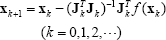
Where,
In order to solve the above problem, many scholars proposed some improved algorithms; the most famous one is the damping least square method (L-M algorithm). Based on this algorithm, Zhan Chongxi presented a new method which is more effective than the L-M algorithm, and the convergent rate is faster. Adopting this method, the basic idea is as follows:
Let

Where,
4. The hyper-chaotic least square method of nonlinear equations
The procedure for solving the nonlinear equations set based on the hyper-chaotic least square method is as follows:
(1) Constructing the chaotic set
(2) Setting
5. Mathematical model
Fig. 2 is the configuration of a 9-link Barranov truss. The length of every link is

Structure of a nine-link Barranov truss
Four vector equations are obtained according to the vector relationship of the figure:

The above four equations are rewritten in the complex exponential form:

The polynomial expression (7) which has four unknown variables

Let

According to the mathematical property

The formulas (8) and (9) constitute an equation set which has the solution
Putting the following half-angle formulas

If
6. Calculation experiment
As illustrated in Fig. 2, let the positions of the fixed hinge be
The computing results of the variables

7. Conclusions
The four constraint equations of the 9-link Barranov truss of the 33rd non-planer dual coupling are established by the combination of the vector method and the complex method, with four additional equations gained by increasing four variables based on the trigonometric function, and then the equations set of the mechanism which has 8 variables is obtained. The hyper-chaotic sequence which is produced by the hyper-chaotic system is regarded as the initial value of the least square method, a method of solving all of the real solutions of the nonlinear equations set which is called the least square method based on the hyper-chaotic sequence. The correct position of the 33rd 9-link Barranov truss is calculated, and the procedure is given. The method researched overcomes the defect of non-convergence and low computational efficiency using the Newton iteration method, the quasi-Newton method, and the hyper-chaotic mathematical programming method.
The example calculation shows that the proposed method is correct and effective, and the efficiency of solving real solutions is high and the result is the same as the similar method. The new idea presented can solve the position of the Barranov truss, the Assur group and a partial parallel mechanism. The position analysis of the Barranov truss affords a good foundation for Kinematics and dynamics.
The computing results of angle variables

Footnotes
8. Acknowledgments
This research is supported by the National Natural Science Foundation of P.R. China (No:51075144), the grant of the 12th Five-Year Plan for the construction program of the key discipline (Mechanical Design and Theory) in Hunan province.