




Abstract
Wheelchair propulsion has been reported to be responsible for musculoskeletal pain in the upper extremities. Epidemiological studies have shown a high prevalence of shoulder complaints in paraplegic and quadriplegic spinal cord injured (SCI) people. It has been argued that the high incidence of shoulder complaints in SCI was the result of the weight-bearing or propulsion function of the upper extremity in those subjects.
This work aimed at proposing an alternative wheelchair propulsion technique based on the levers' system. The interface prototype-users, the wheelchair skills evaluation, the oxygen uptake and the cardiac frequency are investigated by an objective and subjective studies.
Our prototype is designed to be an attempt in the field of disabled athletes having some advantages of a non-conventional manual wheelchair propulsion technique, avoiding complications induced by the conventional one.
1. Introduction
Gait is very difficult and mostly impossible following spinal cord injury or any other disease affecting the lower limbs. Therefore, lower-limb disabled subjects rely solely on the use of their upper extremities to obtain a certain degree of independence in daily living activities. Patients try often to find other modalities of physical transport compensating the functional normal gait.
Wheelchairs are the most efficient devices dedicated to these patients, offering them the ability to lead a normal life by allowing them to perform most of their daily activities. This can range from being able to move from place to place to competing in sporting events.
Despite these advantages, musculoskeletal problems are commonly associated to this manual conventional hand-rim wheelchair propulsion. Inefficiency and stressful conditions related to this technique, especially for upper limbs, have been already reported in previous studies (see for example: van der Woude et al. 2001). Epidemiological studies have also shown a high prevalence of shoulder complaints in paraplegic and quadriplegic spinal cord injured (SCI) people. High incidence of shoulder complaints in SCI was the result of the weight-bearing or propulsion function of the upper extremity in those subjects.
Disadvantages can also affect the cardiopulmonary system and seems to be associated with an increased tendency for cardiovascular diseases (Dearwater, 1986; Hoffmann, 1986).
Results of studies concerning the wheelchair propulsion have shown that changes in movement patterns and in muscle activity may lead to alterations in gross mechanical efficiency during a learning process of conventional manual wheelchair propulsion 5. Improved motor strategies, as a result of specific training, may increase the moments of propulsive force applied on the handrim, which may improve users' ability to produce more effective moments. The mechanical efficiency (which is the ratio between productive force and energy expenditure) was found to be more important in experienced subjects compared to a group of inexperienced subjects in the wheelchair propulsion.
Conventional wheelchair propulsion is commonly divided into two phases in each complete propulsive cycle: the drive phase and the recovery phase. This type of propulsion is probably limited by a low mechanical efficiency, which has been attributed to the position of the arms, to the synchronicity of the arm movements (a large component of static work) and the inherent histochemical characteristics of the upper body musculature (Glaser 1985).
2. Alternative mode of manual wheelchair propulsion
Several modes of manual wheelchair propulsion may be found in the literature. These include the conventional hand-rim technique, lever-propelled, hub-crank and others.
Systematic research has played an important role in the development and design of wheelchairs, in studies concerning vehicle mechanics and its interactions with the human movement system to better understand the wheelchair's user interface.
Variations in propulsion techniques become a most important issue in patients who use wheelchairs to reduce the incidence of the dysfunctions that may usually occur in upper extremities due to the conventional wheelchair propulsion. A change in propulsion mechanisms has been used and non-conventional techniques have been proposed to reduce the impact of the conventional wheelchair propulsion technique on the quality of life of handicapped persons.
3. Lever-propelled wheelchair propulsion: Limits and advantages
Lever-based wheelchair propulsion has been proposed worldwide since several years. Typical design consisted of two levers connected to the rear wheels of the wheelchair, similar to that used in steam locomotive (McLaurin et al. 1986).
Since the 1960s, Hildebrandt et Engel have conducted an interesting research concerning the physiological advantages of a lever-propelled wheelchair propulsion system (Engel et al. 1974, 1976; Bennedik et al. 1978). In this system, upper limbs have to realize series of cyclic, synchronous or asynchronous movements in the sagittal plan. Generally, forces applied by the hands of users on the two levers are transmitted to the rear wheels of the wheelchair through a simple mechanical system. This latter offers to users the possibility to manipulate the wheelchair by moving it backward and forward in addition to the rotation.
However, several disadvantages had been associated with this technique. The most important is the limited top speed of the propulsion related to the frequency of the push and recovery phases. Absence of pausing between the pushing and the pulling phases is also one of the disadvantages especially because the dissociation between the movement of the wheels and the levers is also difficult (McLaurin et al. 1986).
Brunning et al. have designed another model of lever-based propulsion system between 1976 and 1981. This system has used a roller clutch to drive a sprocket on the drive wheel like a bicycle. Disadvantages of the absence of pausing between stokes in spite of the length of the stroke reported in the first model, has been resolved in this model. Possible reverse of the chair was achieved by designing a reversing roller clutch which was controlled by pressure of the palm of the hand for forward motion and by finger pressure for reverse. The system was described as effective in spite of several disadvantages reported in the publication of McLaurin et al. 1986.
A bicycle-type chain and sprocket transmission have been also used to propose a lever-based prototype. These systems have been intended to provide a simpler means for obtaining an optimum mechanical advantage than with the handrim conventional propulsion (McLaurin, 1990).
Crank-to-rod system is a commercially model of lever-based propulsion. It's a simple mechanical system fixed to the rear wheels to convey the forces applied by users on a couple of handgrips to move the wheelchair forward or backward. The length of the levers can be adjusted to match the anthropometric dimensions of the user.
All disadvantages of the lever-based propulsion, reported in the literature, have not dominated the potential advantages of such mechanism and of the type of arm movements they require. The advantages (mechanical and physiological) have been attributed to the lever propulsion technique. Lever-propelled propulsion is very efficient especially for persons whose energetic resources are very low. Outdoors wheelchair activities can be possible with an important distance (Van der Woude et al 2001).
One of the common advantages is the number of muscle groups recruited especially at the shoulder and the elbow joints. The direction of the forces exerted is probably very close to the center of the shoulder movement reducing the toque and the compressive articular load (Van der Woude et al. 2001b).
During a submaximal test on different wheelchair propulsion technique, the lever-propelled system seemed to have a greater mechanical efficiency with less energetic consumption when compared to the hand-rim propulsion technique (Dallmeijer et al. 2004).
4. Wheelchair Lever-propelled Models
Although many commercial models with lever-based propulsion technique are proposed in the literature, researchers have reported their ineffectiveness and their incompatibility in term of wheelchair-user interface. These include seating comfort, support and mobility dependent on seating and rolling characteristics of the wheelchair. Main disadvantage of levers was the difficulty in achieving the control and maneuverability associated with handrims. These disadvantages appear to be overcomed by more recent designs (McLaurin et al. 1986).
The most crucial commercial model has been named Wijit® (Figure 1). It consists of two levers connected to the rear wheels of the wheelchair. Kinematic components are not described on the website of the manufacturers and no study, to our knowledge, demonstrates its efficiency and superiority to the conventional system. This system does not allow backward propulsion and the levers movement is asynchronous (Thomas et al. 2002). Another disadvantage of the model is the length of the levers which is relatively reduced. Thus, loads on the upper arms induced by the conventional handrim system are also reproduced by this system and users are obliged to extend theirs arms in the recovery phase inducing extreme loads on the rotator cuff and especially the supraspinatus.

the wheelchair Wijit system (www.wijit.com)
5. New lever-propelled wheelchair design
A proof-of-concept prototype wheelchair for motor disabled persons has been proposed with the objective to demonstrate the feasibility of a new propulsion approach (Figure 2). The design has been developed1, to validate a non-conventional manual wheelchair propulsion technique in order to reduce loads and stresses of the upper limb joints. Therefore, changing the propulsion technique could reduce risks of musculoskeletal disorders of the upper limbs that may result a secondary handicap.

New lever-based non conventional propulsion technique
Based on the previous kinematic analysis, the conventional propulsion technique consists in repetitive movements of the upper limbs during the pushing and the recovery phases. These movements are inappropriate for the physiological and biomechanical work of the concerned joints because their stabilization muscles are continually included. This leads to a possible musculoskeletal injury and a degenerative disorder of the shoulder joint.
Suggested prototype system consists of an adapted wheelchair designed to carry out a different manual propulsion technique to change the positions taken by the upper limbs during the two phases of manual propulsion (Figures 3 and 4). By propelling levers, users will not obliged to work in a stressed position of the shoulder joints. Therefore, extension movements leading to propel levers use different muscular groups than those used in the conventional technique. Triceps are used to supply push-like movement without needs to place shoulder in extension position that may induce prolonged contractions of the rotator cuff, main source of maximal loads (Mulroy, 1996).

Diagram of the lever propelled prototype. Two levers (1) end with two sets of rolling bearing (4) connected to the rotation axis (5) of the two rear wheels of the wheelchair. Push-like mechanism on the two levers propels the wheelchair forward or backward. Sets of rolling bearing allow to each wheel of the wheelchair to move separately offering the possibility to rotate the wheelchair.

The new prototype without the brake system
The new wheelchair is a classical sport wheelchair equipped with bicycle freewheels or a rolling bearing system attached to the rear wheel hub so that the wheel can go forward with a push of the external part of the freewheel without going backwards when the external part moves in the other direction (Figure 5). In mechanical or automotive engineering, a freewheel or overrunning clutch is a device in a transmission that disengages the driveshaft from the driven shaft when it rotates faster. The condition of a driven shaft spinning faster than its driveshaft exists in a bicycle or a vehicle going downhill when the rider holds his or her feet still, no longer pushing the pedals. Without a freewheel the rear wheel would drive the pedals round.

Rolling bearing system connecting the levers to the rear wheels of the wheelchair
The external part of the rolling bearing system is attached to an extended bar manipulated by the hand of the user (Figure 6). Thus, the two wheels of the classical wheelchair are adapted according to this system and two bars, manipulated by the hands of the user, propel the wheelchair forward. The new manual wheelchair propulsion technique requires a forward rotating motion by the two bars using the hands of the user imitating the system of the manual press. Simple kinematic analysis can describe the propulsion as push-like movements starting at the shoulders levels and continue through an arc shape until the level of knees.

End of the lever with the rolling bearing system connected to the rear wheel of the conventional wheelchair
In attempt to make the system going backward the system of the rolling bearing has been doubled offering the possibility of going forward and backward by a manual-alternating shift. A nail was placed between the two rolling system to stop one and let the other work in a specific direction (Figure 7). This system can offer to the prototype the capacity of turning to the side (Figure 8).
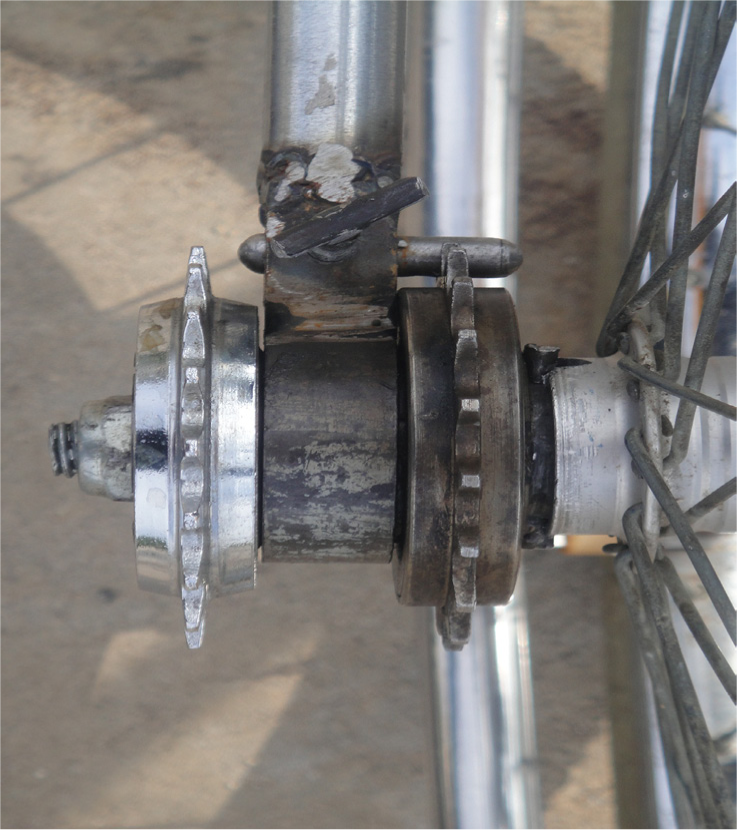
Double rolling bearing allowing backward and forward propulsion
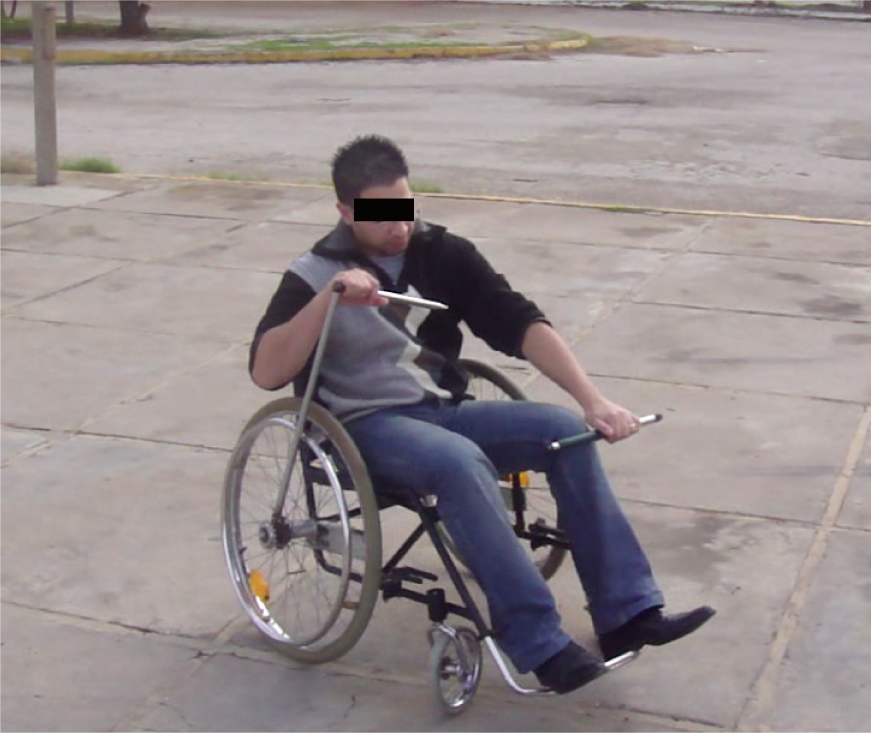
Turning to the right side with the new lever-based prototype
A brake system is also put on the heads of the levers to ensure security and maneuverability of the system (Figure 9) A linkage spring-based system has been designed to offer the possibility of synchronous propulsion of the two levers (Figure 10). Opening the linkage-system by pressing a small button can separate the two levers (Figure 11).

Brake system attached to the heads of levers

Linkage system of the two levers

Separation of the two levers for asynchronous propulsion
6. Subjective Evaluation of the prototype
A user self-questionnaire was designed to evaluate user satisfaction of our lever-based manual propulsion prototype (Rifai Sarraj et al. 2010). Data were collected after 2 days of practice on the new prototype and were aimed at: 1) identify the prototype's advantages and disadvantages in different conditions; 2) help to improve the prototype's design; 3) help to evaluate the user's overall satisfaction with the prototype's push-bar propulsion system.
Questions in the evaluation was addressed to seventeen disabled participants to investigate comfort, adjustability, steering ride, maneuverability, crossing obstacles, safety, weight, size, portability for transport, aesthetic appearance and overall satisfaction with propulsion system.
Analysis of the questionnaire results showed that the prototype has minor and major problems. The problems raised by the users concerned its portability, weight, size, ability to cross obstacles and the adjustability of certain accessories (the add-on push bar). On the other hand, the results of the questionnaire suggest that the prototype wheelchair is superior on a number of factors including user comfort, ride and safety (Figure 12). Furthermore, the nonconventional prototype was awarded a higher overall satisfaction score.
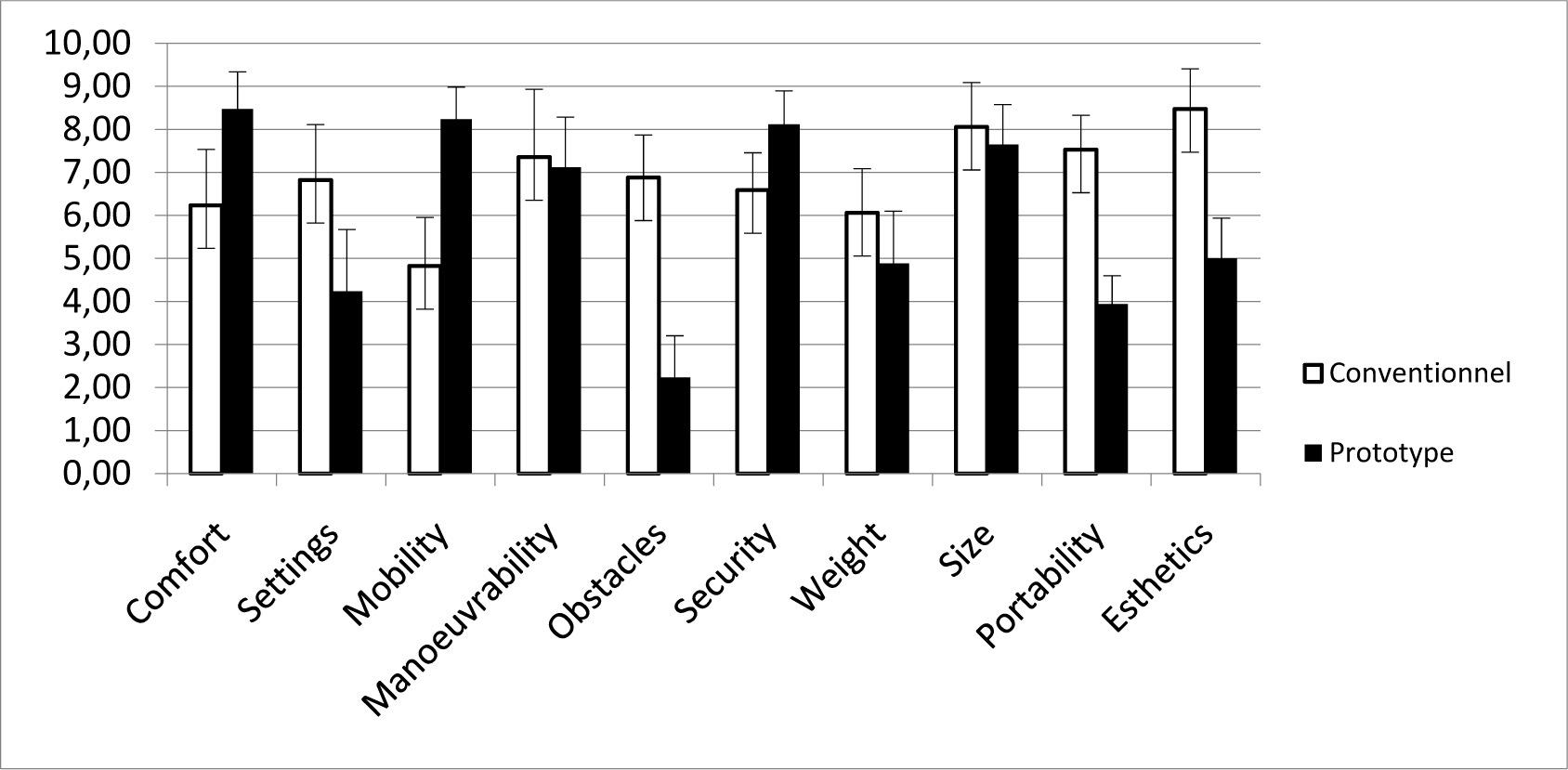
Evaluation of the wheelchairs via a user questionnaire. Mean scores and standard deviations are given for conventional wheelchairs and for the prototype.
Results must be considered in view of the limitations inherent in the study, such as: time for familiarization with the prototype chair for all participants prior to testing (couple of days), small sample size (seventeen), various abilities and unfamiliar new propulsion technique with different kinematics.
The critical interface between a user and his/her wheelchair is a very important issue for manufacturers and the designers. The subject must be able to control the wheelchair (mainly during outdoor or sporting activities) with minimal physical and cognitive efforts.
The study questionnaire aimed at subjectively evaluating the prototype and the associated constraints and problems. However, the prototype should be considered as an experimental model and it should be to emphasize the fact that ergonomic adjustments specifically related to the propulsion bar had not been taken into consideration prior to performance of the survey.
Although the prototype is not identical to the conventional wheelchair from a mechanical point of view but it seems to function as well as their own personalized, familiar chairs. Users' evaluation of the prototype did not report any discomfort in the arms and thus contrasted with the strain induced by hand-rim propulsion of a conventional wheelchair. Similarly, the users' general comments, as reported by the investigating therapists, confirmed the superiority of this type of lever-based propulsion compared to the conventional one. In fact, the comments showed that in addition to the wheelchair users' physical characteristics, several other elements (related to the users' attitudes, interests and cognitive profile over time) must be taken into consideration when ensuring the compatibility of the subject-prototype interface. Maneuverability, safety, the potential purchase price, aesthetics, adaptability and the precision and ease of displacement were the most cited factors.
In terms of maneuverability, the user must feel as if he/she is in full command of the wheelchair at all times. If this is not the case, the subject may experience frustration and/or passivity. The wheelchair or prototype must also offer the user a good level of safety – notably during extreme use and even if a part fails. In terms of cost, the prototype appears to be potentially marketable. However, integration of the non-conventional manual propulsion technique will be complex. In addition to ergonomic adjustments, it will be necessary to use lightweight material for the push-bars so as not to increase the weight of the wheelchair while keeping the final product at a reasonable price. In terms of optimal user-device interaction and responsiveness, the new wheelchair must offer the user a high level of handling precision (particularly when used for sport). It must avoid the repetitive strain problems associated with conventional wheelchairs but must not become less mechanically efficient. When participating in sporting events or during activities of daily living, the user and the wheelchair must interact harmoniously. Significant cognitive and physical overload is produced when the user's attempts to achieve high performance levels during sport-specific movements are confounded by a poor response from his/her wheelchair. With respect to adaptability, the wheelchair's interface must be suited to the user's characteristics (such as height and weight). It is also necessary to take into account the context of the wheelchair's use and offer the user the time required to perform the appropriate movement in each situation.
The feedback from prototype users revealed that the new design was acceptable and presented advantages over conventional wheelchair models with standard hand-rim propulsion.
User-rated comfort and overall satisfaction with the prototype demonstrated the correlation between improvements in propulsion and the change in technique. Safety and steering ride were also satisfactory. However, adjustability, maneuverability, the ability to cross obstacles, weight, size and portability were judged by the users to be unsatisfactory. The difficulties encountered during use of the prototype are probably due to ergonomic aspects that have yet to be addressed.
The study's limitations must be borne in mind (notably those related to the small sample size and the heterogeneity of the surveyed users). It should also be noted that the users spent a very short time using the prototype (between 2 and 7 days), relative to their experience of a conventional wheelchair; this gave the users relatively little time to become accustomed to the prototype's novel propulsion technique.
7. Evaluation of the prototype using the Wheelchair Skills Test©
Further objective evaluation of the prototype has been realized using the Wheelchair Skills Test (Rifai Sarraj et al. 2010b). This reliable test consists of a series of skills spanning the spectrum from those as basic as applying the brakes (wheel locks) to those as difficult as climbing curbs and performing wheelies (Kirby et al. 2004).
Eleven sport paraplegic persons have participated to the study (6 males and 5 females) having all a minimum of two years' experience in wheelchair propulsion. Tests were performed on the basketball court of the University of Balamand in Lebanon. Test instructions and procedures were reproduced from the original guide of the Wheelchair Skills Test Manual (Version 2.4).
Results of the evaluation suggest that the prototype had several advantages on a number of factors compared to classical propulsion, including those related to security, maneuverability and handling abilities. Skills tested with failure were those related to the esthetic and advanced factors not available in such experimental model. Some other factors related to the maneuverability of backward rolling has been resolved after the study by integrating a double mechanical system and the skill was retested to ensure its good functioning. Main skills tested with success and failure are summarized in Table 1.
List of skills tested in our prototype

The overall Score of the Wheelchair Skill test was 70% of success and can be considered as high regarding of the experimental nature of the prototype and of the difference between the new proposed technique and the usual conventional one.
Results of the test showed the absence of major problems in the prototype related to the design and the propulsion technique. Nevertheless, the number of failing skills was not considerable and most of them can be resolved by a technical study aimed to resubmit the prototype as a commercial well-designed model.
8. Energy Expenditure of Two Types of Manual Wheelchair Propulsion
The aim of this study is to compare the energy expenditure of the two types of manual wheelchair propulsion technique. A total of 15 participants were recruited for the study: eight males with paraplegia and seven able-bodied males. Criteria for inclusion were paraplegic with a minimum three years of experience in wheelchair propulsion, and the absence of any medical contra-indications.
All tests were made in the Laboratory of Physiology and Biomechanics of Motor Performance at the University of Balamand. The University Research ethics committee approved the protocol and the procedures complied with the recommendations of the American College of Sports Medicine (ACSM) in 1999.
Subjects that participated in this study were prepared and informed of the protocol methodology prior to the test. This testing protocol consisted of two sessions of manual wheelchair propulsion movements achieved using the two wheelchairs each scheduled on a separate day. Type of the wheelchair in each session was selected by a drawing lot. Each subject was transferred to the selected wheelchair, and the footrests were adjusted to each subject.
A metronome was used to fix the rhythm of the testing propulsion. The duration of each session was seventeen minutes distributed as follows: two minutes of rest, two minutes of warm up, two minutes of preparation to the rhythm, six minutes of rhythmical propulsion, two minutes of maximal number of propulsion movements, one minutes of active recovery and two minutes of passive rest.
During warm up, the subject propelled the selected wheelchair freely using minimal effort. The preparation consisted of two phases of propulsion, each three seconds, and the rhythmical propulsion consisted of a propulsion of two seconds each during the first three minutes and one second each during the second period.
Oxygen consumption and carbon dioxide production (VCO2) were measured breath-by-breath, at rest, during exercise, and throughout recovery using CPX® Medical Graphics. The system was calibrated before each test session using standard gas mixtures.
The subjects breathe through a mask connected to a pneumotachograph located on the expiratory circuit and connected to a pressure transducer. The quantity of expired oxygen and carbon dioxide were measured, respectively, with a zirconium O2 analyzer and an infrared CO2 analyzer. Before each test the volume was calibrated with a 3-1 pump and the analyzers were standardized with a bottle containing 12% O2 and 5% CO2. Peak VO2 data were averaged over 15 seconds intervals. The respiratory exchange ratio (RER) was calculated as VCO2/VO2.
Heart rate was recorded every minute during exercise and while at rest using a heart rate monitor (POLAR S610i). The wristwatch was positioned on the handle of the wheelchair and the electrode was placed over the manubrium and the left seventh inter-costal space of the subject. Peak levels for all variables were defined as the highest value measured during the exercise test.
Mean values of VO2 peak were respectively 19.59 ± 5.76 and 17.28 ± 5.14 for the conventional wheelchair and the non-conventional wheelchair for the paraplegic group (p>0.21). Mean values of VO2 peak were respectively 22.19 ± 2.57 and 18.5 ± 2.49 for the conventional wheelchair and the non-conventional one for the able-bodied subjects with a p > 0.0092
Mean values of Max Heart Rate for the paraplegic group were respectively 152.75 ± 29.33 for the conventional wheelchair 126.25 ± 26.27 for the non-conventional wheelchair (p>0.038). For the able-bodied subjects the mean values of Max Heart Rate were respectively 158.29 ± 18.75 and 134.43 ± 16.51 (p>0.013296).
There was no difference between the mean values of VO2 peak for the two types of wheelchair in the paraplegic group. However, there was a significant difference between values of VO2 peak for the conventional wheelchair and the non-conventional one in able-bodied subjects.
Similarly, the values of Max Heart Rate measured during exercise on the two types of wheelchair were significantly different in both groups. Values measured during exercise on the conventional wheelchair were higher.
Able-bodied subjects showed greater VO2 peak values using the conventional wheelchair. These results were not found for the paraplegic subjects. The Max Heart Rate values, recorded during exercises on the classical wheelchair, were higher than values recorded on the non-conventional wheelchair for both groups.
The purpose of the experiment was to compare each of the two important parameters related to the energy expenditure for the two types of propulsion techniques. It is proposed that the new prototype was more economical and we hypothesize that the VO2 and the Max Heart Rate must be greater in exercising using the classical technique.
The results further showed that the new propulsion technique is more economical than the classical technique only in able-bodied subjects despite the important differences in Maximal Heart Rate in both groups. Apossible explanation may imply the fact that the paraplegic subjects are more accustomed to propelling the classic wheelchair; hence exercising the new prototype has introduced a new motor strategy necessitating more practical learning. It has been reported that practice may refine the movement pattern to approximate more closely the optimal mechanical and physiological adaptations within the constraints of the propulsion task. Exercising a new propulsion technique could influence the energy expenditure during a new motor learning phenomena.
9. Wheelchair racing efficiency of non-conventional prototype
Wheelchair racing can be an important modality for community reintegration, as well as health promotion. This type of racing can also be an important test to compare the prototype to the conventional handrim wheelchair.
Performance in wheelchair racing depends on three main factors: characteristics of the athlete, type of the wheelchair and wheelchair-athlete interface. A simple wheelchair racing on our prototype, aimed to ensure its maneuverability and efficiency in sport activities, can evaluate these last two characteristics. Participants in this test will pass in a similar racing test on the conventional wheelchair to compare results in the two types.
A total of 15 participants were recruited for the study: eight males with paraplegia and seven able-bodied males. Criteria for inclusion were paraplegic and trained experienced racer.
Racing distance was fixed at 400 meters. Two visible lines with large cones marked the “Start” and “Finish” points. Cones were also placed on both sides of the trail in order to show clearly the path of the race. Starting position was fixed by placing the front wheel of the prototype or the conventional wheelchair on the first starting line. The participant propels the conventional wheelchair or prototype as quickly as possible until the finish line without any slowing down. To eliminate the effect of reaction time the participant starts when he was ready.
Heart rate was recorded before, during and after the test using a heart rate monitor POLAR © type pulse monitors S610i. The wristwatch was attached to the handle of the chair while the electrode was placed above the manubrium sterni and the inter costal space of the subject's left seventh rib. The time of test was also evaluated using a stopwatch.
Each participant passed, in a random order, two racing tests: one on the prototype and another on the conventional wheelchair. The two tests were separated by a minimum of twenty-four hours to avoid the fatigue factor. Heart rate and time of the test were compared between the prototype and conventional wheelchair.
The non-conventional prototype was found to have significant smaller values of heart rate with shorter push time, smaller relative push time an average of 120.75 ± 13.33 bpm compared to 179 ± 9.94 bpm in tests performed in the handrim conventional wheelchair. Total time of the racing tests was also found to have significant lower values of 90 s ± 9.02 for the prototype compared to 113.63 ± 7.8 in tests performed in the conventional wheelchair (Table 2).
Results of racing tests comparing the conventional handrim propulsion (Conv. Prop) and the prototype propulsion (Non-Conv. Prop). Heart rate was expressed as beat per minute (bpm) and time as seconds.

8. Conclusion
Patients with paraplegia rely solely on the use of their upper extremities for independence and the completion of daily living activities. Classic wheelchair propulsion is inefficient and not suitable for all physiological biomechanics of the upper extremity joints.
Proposing a new prototype could change the strategy of the classic propulsion technique and may have some advantages particularly in the muscular patterns.
Several evaluations aimed to investigate the advantages and the disadvantages of the new propulsion prototype have been made. Results of evaluations suggest that such prototype wheelchair should still be improved but yet it show several clear advantages compared to the conventional system.
Efficiency in the new propulsion technique can be correlated to the learning strategy and its duration. The effect of learning on the reduction of energy consumption has been investigated.
The prototype is designed as an attempt to facilitate sport activities for disabled athletes as it shows some advantages of a non-conventional manual wheelchair propulsion technique, avoiding complications induced by the conventional one.
Footnotes
1
The development of the prototypehas been realized at the Centre of Research and Innovation in Sport of the University of Claude Bernard Lyon I in France