




Abstract
Background
Numerous studies have been conducted to evaluate the association between excision repair cross-complementing group 6 (ERCC6) gene polymorphisms and bladder cancer risk, but their findings have been inconsistent. Here we performed a meta-analysis to attempt to clarify this association.
Methods
Studies were retrieved from the PubMed and China National Knowledge Infrastructure databases up to October 1, 2015, with strict selection and exclusion criteria. A total of 5,032 samples, comprising samples from 2,475 bladder cancer patients and 2,557 controls from 5 studies, were included in the meta-analysis. The odds ratio (OR) with 95% confidence interval (CI) was used to evaluate the strength of the associations.
Results
Regarding the Met1097Val polymorphism, no significant association with bladder cancer risk was found in any of the genetic models evaluated (Val vs. Met: OR = 1.10, 95% CI, 0.97-1.25; Val/Val vs. Met/Met: OR = 1.23, 95% CI, 0.86-1.75; Val/Val + Val/Met vs. Met/Met: OR = 1.12, 95% CI, 0.96-1.30; Val/Val vs. Met/Met + Val/Met: OR = 0.81, 95% CI, 0.57-1.14). Similarly, as regards the Arg1230Pro polymorphism, we also found no positive results.
Conclusions
According to the results of our meta-analysis, there is no evidence of a link between the ERCC6 gene polymorphisms and bladder cancer risk. Well-designed further studies, with larger sample sizes and adjustment for confounders such as smoking status, are needed to confirm these conclusions.
Introduction
Bladder cancer remains one of the most common and deadly urinary tract cancers among Western Europeans and Americans (1, 2). Previous epidemiological studies have indicated that occupational exposures, environmental pollution, dietary habits and cigarette smoking are associated with bladder cancer (2). Despite being exposed to an environmental carcinogen, most people remain unaffected, and only certain individuals develop bladder cancer, suggesting that interindividual differences, including genetic susceptibility, likely play a significant role in bladder carcinogenesis (3, 4).
The protein products of more than 130 genes regulate the various DNA repair pathways that maintain genome integrity and activate the cellular responses to DNA damage (5). Single nucleotide polymorphisms (SNPs) in DNA repair genes are thought to regulate the DNA repair capacity and accordingly may play a significant role in carcinogenesis (6). The protein encoded by the excision repair cross-complementing group 6 (ERCC6) gene, alternatively named Cockayne syndrome group B (CSB), is known to be involved in DNA damage repair (7, 8). ERCC6 plays a role in transcription and nucleotide excision repair (NER), which removes bulky adducts and repairs DNA damage induced by environmental agents, including UV light, crosslinking and oxidative agents (9). It is plausible that mutations in the ERCC6 gene can diminish its activity, thus resulting in defects in overall DNA repair by NER. Several SNPs have been identified in the ERCC6 gene, 2 of them, Met1097Val (rs2228526) and Arg1230Pro (rs4253211) are commonly investigated.
Numerous studies have been performed in an attempt to identify an association between the ERCC6 Met1097Val and Arg1230Pro polymorphisms and bladder cancer predisposition, but the results remain inconsistent. Several factors may account for such conflicting results, including ethnic differences, the limitation of the statistical power of individual studies, small sample sizes and possible selection bias. In search of a conclusive association, we conducted a comprehensive quantitative meta-analysis of related studies to evaluate the association between ERCC6 gene polymorphisms and the risk of bladder cancer.
Materials and methods
Identification and eligibility for relevant studies
We searched the PubMed and China National Knowledge Infrastructure databases covering all research articles published with a combination of the following key words: “bladder cancer or bladder carcinoma or urinary system cancer,” “ERCC6 or excision repair cross complementation group 6 or DNA repair” and “polymorphism or mutation or variant” (last search updated October 1, 2015). We evaluated potential genetic association studies by examining their titles and abstracts. The inclusion criteria for the studies were as follows: (i) case-control studies, regardless of sample size; (ii) cases were histologically confirmed, regardless of bladder cancer type (invasive or in situ); (iii) evaluation of the ERCC6 Met1097Val and Arg1230Pro polymorphisms and bladder cancer risk; (iv) English or Chinese language articles. The primary reasons for exclusion of studies were as follows: (i) reviews or meta-analysis; (ii) not human studies; (iii) cases or controls only; or (iv) insufficient or overlapping data.
Data extraction
Two investigators independently extracted the information from all eligible articles and reached a consensus on all items. Finally, we collected the following characteristics from each study: the first author, year of publication, region, ethnicity, source of controls, genotyping methods, the number of cases and controls, and the distributions of the ERCC6 Met1097Val and Arg1230Pro polymorphisms.
Statistical analysis
Crude odds ratios (ORs) with 95% confidence intervals (CIs) were used to assess the strength of the association between the ERCC6 Met1097Val and Arg1230Pro polymorphisms and bladder cancer susceptibility in the allelic model (Val vs. Met or Pro vs. Arg), the homozygous model (Val/Val vs. Met/Met or Pro/Pro vs. Arg/Arg), the dominant model (Val/Val + Val/Met vs. Met/Met or Pro/Pro + Pro/Arg vs. Arg/Arg), and the recessive model (Val/Val vs. Met/Met + Val/Met or Pro/Pro vs. Arg/Arg + Pro/Arg). The assumption of heterogeneity was evaluated by the chi-square-based Q-test. The fixed-effect model was used to estimate the summary ORs if the p value for heterogeneity was more than 0.10, whereas the random-effect model was used to evaluate the summary ORs. The departure of the frequencies of the ERCC6 Met1097Val and Arg1230Pro polymorphisms from Hardy-Weinberg equilibrium (HWE) expectations was assessed by the chi-square test in controls. One-way sensitivity analyzes were performed to examine the influence of individual studies on the meta-analysis's results. Publication bias was evaluated by Egger's and Begg's test with funnel plots. Asymmetry of the funnel plot suggested publication bias.
All statistical tests in this meta-analysis were performed using the Stata software package, version 9.2 (Stata Corp., College Station, TX, USA). A p value less than 0.05 was considered statistically significant.
Results
Study characteristics
Articles were retrieved on the basis of the search criteria from the selected databases. A total of 286 results were identified, as shown in the study selection process depicted in Figure 1. Following the inspection of the titles, abstracts and full-text articles, 9 studies were selected for further data extraction. During the extraction of the data, 4 studies were excluded because of insufficient data (10, 11), overlapping data (12) or irrelevance to ERCC6 Met1097Val and Arg1230Pro polymorphisms (13). Ultimately, 5 independent studies, including 4 European studies and 1 Asian study, were selected for the meta-analysis (14–18). All studies were consistent with HWE. Four of the 5 studies were of the Met1097Val polymorphism and 3 of the studies included the Arg1230Pro polymorphism. The total number of samples was 5,032, which comprised samples from 2,475 bladder cancer patients and 2,557 controls. The details of the studies included are summarized in Table I.
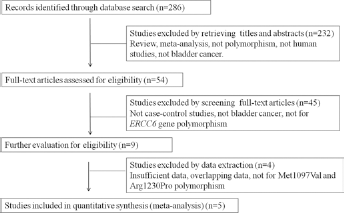
Flow chart of study selection based on the inclusion and exclusion criteria.
Characteristics of the included studies
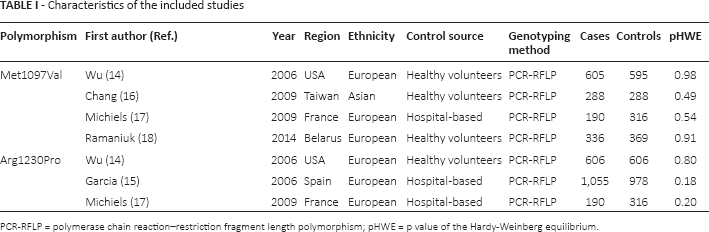
PCR-RFLP = polymerase chain reaction–restriction fragment length polymorphism; pHWE = p value of the Hardy-Weinberg equilibrium.
Quantitative synthesis
The main results of this meta-analysis and the heterogeneity test are shown in Table II and Figure 2. Concerning the Met1097Val polymorphism, we did not find any significant association with bladder cancer risk in any of the genetic models evaluated (Val vs. Met: OR = 1.10, 95% CI, 0.97-1.25; Val/Val vs. Met/Met: OR = 1.23, 95% CI, 0.86-1.75; Val/Val + Val/Met vs. Met/Met: OR = 1.12, 95% CI, 0.96-1.30; Val/Val vs. Met/Met + Val/Met: OR = 0.81, 95% CI, 0.57-1.14). Similarly, regarding the Arg1230Pro polymorphism, we found no association with bladder cancer risk (Tab. II). In addition, no significant heterogeneity was detected between studies in any of the genetic models evaluated (Tab. II).
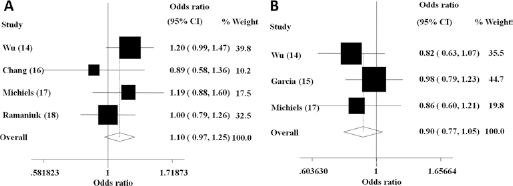
Forest plots of the association between ERCC6 polymorphisms and bladder cancer under the allelic model. The areas of the black squares reflect the weight of each study. The diamonds represent the combined odds ratio and 95% confidence interval using the fixed-effects model for the Met1097Val polymorphism (A) and Arg1230Pro polymorphism (B).
The main results for correlations between ERCC6 gene polymorphisms and bladder cancer risk
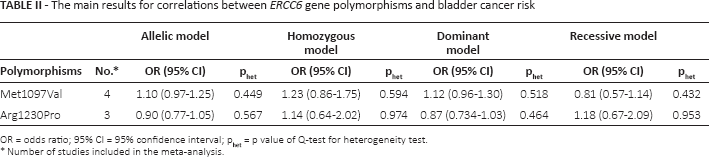
OR = odds ratio; 95% CI = 95% confidence interval; phet = p value of Q-test for heterogeneity test.
Number of studies included in the meta-analysis.
Sensitivity analysis was performed by sequentially excluding individual studies to assess the stability of the results. All of the corresponding pooled ORs were not materially altered (data not shown). Begg's rank correlation method and Egger's weighted regression method were used to assess statistical publication bias. No publication bias was observed in this meta-analysis, as shown in Figure 3 (data not shown).
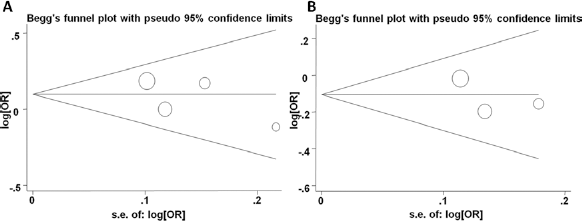
Funnel plots to detect publication bias in this meta-analysis, under the allelic model for both Met1097Val (A) and Arg1230Pro (B) polymorphisms. The horizontal line indicates the pooled log odds ratio (OR) and guidelines to assist in visualizing the funnel are pooled at 95% pseudo confidence limits for this estimate.
Discussion
As an essential protein involved in NER, ERCC6 has been extensively studied regarding its relationship with gastric cancer (19, 20), prostate cancer (21, 22) and lung cancer (23). Though considered to a lesser extent in bladder cancer, the conclusions from previous studies of the association between the ERCC6 polymorphisms and bladder cancer risk remain controversial. As a powerful statistical method, meta-analysis can yield a comprehensive conclusion for combining the results of different studies of the same topic, estimating and explaining their diversity (24, 25). Accordingly, we conducted the present meta-analysis to evaluate the association between the ERCC6 Met1097Val and Arg1230Pro polymorphisms and bladder cancer risk.
The 5 studies selected to conduct the meta-analysis comprised a total number of 5,032 samples, including samples from 2,475 bladder cancer patients and 2,557 controls. Here, we found no significant association between the ERCC6 Met1097Val and Arg1230Pro polymorphisms and bladder cancer risk in any of the genetic models evaluated. But we need to be somewhat cautious regarding this result due to some limitations.
ERCC6 is known to play a crucial role in the repair of DNA damage induced by environmental factors, oxidative agents, etc. (9). Among the ERCC6 gene polymorphisms studies, only 1, of recurrence after treatment for superficial bladder cancer, revealed that Met1097Val was related to DNA repair capacity (26). Meanwhile, significant associations were reported between the Met1097Val variants and susceptibility to cytokinesis-blocked micronucleus frequency in coke-oven workers (27) and superficial bladder cancer treatment outcome (26). As the results of this present meta-analysis suggest, we can speculate that neither of the SNPs of ERCC6, namely Met1097Val and Arg1230Pro, is associated with bladder cancer development. Interestingly, it has been reported that ever-smokers with allelic combinations in 3 NER genes, including the ERCC6 1097Val variant allele, have a nearly 30-fold increased risk of bladder cancer (12), whereas Pro-carriers of the ERCC6 Arg1230Pro polymorphism exhibit a decreased risk of laryngeal cancer, which is most pronounced in heavy smokers (28). However, the genotypic distributions of ERCC6 Met1097Val did not depend on the smoking status of the groups of both patients and controls (18). The effects of chance are another possible explanation for the negative results in this analysis, as a few studies with small sample sizes may produce a fluctuating risk estimate.
Carcinogenesis is a multistage process promoted by complex interactions between genetic and environmental factors. The accumulation of DNA lesions induced by environmental mutagens can trigger genome instability that may result, as a possible outcome, in malignant cell transformation. The primary causes of bladder cancer are environmental exposures. Indeed, tobacco smoking is associated with approximately 50% of bladder cancer cases in men and 33% of cases in women (29). Additionally, occupational exposures, especially polycyclic aromatic hydrocarbons and aromatic amines, contribute significantly to the development of bladder cancer. Accumulating evidence from epidemiological studies suggest that other environmental risk factors, such as polluted water, dietary factors, permanent hair dye use and phenacetin-containing drugs, are carcinogens for bladder cancers (30). To date, the underlying molecular mechanisms whereby these bladder cancer etiological factors cause this disease are not fully understood. It is widely accepted that environmental carcinogens, such as tobacco carcinogens, mainly induce bulky DNA adducts that lead to genomic instability. The NER pathway is the major cellular DNA repair mechanism to repair bulky DNA lesions caused by tobacco, ionizing radiation and other DNA-damaging agents (31, 32). In bladder cancer, the NER pathway is one of the most critical and commonly used pathways for the maintenance of genomic stability. The NER pathway can be divided into 2 subpathways in human cells – namely, the global genomic repair and the transcription-coupled repair. Defects in genes for critical proteins of these pathways have frequently been found in various diseases, including bladder cancer (4). In fact, polymorphisms in NER pathway genes have been implicated in bladder cancer etiology. For instance, it has previously been reported that SNPs in major NER genes, such as XPC, XPD and cyclin H, are significantly associated with bladder cancer risk (13, 33, 34).
This meta-analysis had several limitations which must be addressed. First, only a few studies related to ERCC6 gene polymorphisms and bladder cancer risk were retrieved for this analysis, probably affecting the quality of each analysis. The most likely explanation may be the negative relationship between polymorphism and bladder cancer susceptibility. Due to the few eligible studies and small number of subjects, we could not run the routine ancillary analyses (metaregression and subgroup analysis). Second, although we failed to detect any publication bias, selection bias may have existed because only studies published in English and Chinese were retrieved in this study. Third, lack of information based on well-documented smoking status may have had an impact on the results, because smoking is an established risk factor for bladder cancer, which may interact with the ERCC6 polymorphisms in bladder cancer risk. We could only extract the smoking status of subjects from the study of Ramaniuk et al (18). Fourth, bladder cancer susceptibility might result from the interaction of genetic variants and environmental factors. We could not perform the stratified analysis by ethnicity, age and sex, and other confounding factors, because of the few studies included. Thus, gene-gene and gene-environment should be explored in further studies.
In summary, our results suggest that the ERCC6 gene polymorphisms might be not associated with bladder cancer risk. Well-designed studies with larger sample sizes and adjustment for confounders such as smoking status are needed to confirm this conclusion.
Footnotes
Financial support: This work was supported by the Natural Science Foundation of Health Commission in Jiangxi Province (No. 20141074) and the Educational Commission of Jiangxi Province (No. 14077).
Conflict of interest: None of the authors has any financial interest related to this study to disclose.