




Abstract
Objectives
Dickkopf-1 (DKK-1) is involved in osteoporosis, arthritis, and cancer development and can become a potential therapeutic target of these diseases. The different expression of DKK-1 in different cancers shows that the function of DKK-1 depends on the histological type of the cancer cells and the tissue microenvironment. Because DKK-1 is a secreted protein, we investigated whether it could be found in the serum of patients with cervical cancer.
Study design
The expression of DKK-1 was measured by enzyme-linked immunosorbent assay (ELISA) in the serum of 60 healthy women, 60 patients with cervical intraepithelial neoplasia (CIN) and 156 patients with cervical cancer. Detailed treatment information of all 156 patients with cervical cancer and exhaustive follow-up data of 138 patients were collected.
Results
The levels of serum DKK-1 were significantly increased in patients with cervical cancer (11.90 [SD, 17.28] μg/mL) compared with healthy women (1.48 [SD, 1.86] μg/mL) and patients with CIN (4.77 [SD, 10.24] μg/mL) (p=0.00, p=0.00). The expression of DKK-1 in serum was correlated with lymphatic metastasis and tumor diameter in cervical carcinoma and associated with the prognosis of patients with cervical cancer.
Conclusions
DKK-1 detection with ELISA as a biological marker can be used for the detection and diagnosis of cervical carcinoma. DKK-1 in serum is a good predictor of poor prognosis in patients with cervical cancer.
Introduction
Cervical cancer is the third most common cause of cancer-related death in women worldwide. An estimated 500,000 cases are newly diagnosed and nearly 280,000 women die of cervical cancer every year (1). Research has proved that infection with human papillomavirus (HPV) plays an important role in the development of the precursors of cervical cancer. However, only a small fraction of women with HPV infection develop cervical cancer, which indicates that other factors also take part in the progression to cervical cancer (2). In spite of extensive research, the mechanism of tumorigenesis and development of cervical cancer is still mysterious. Prognostic factors such as International Federation of Gynecology and Obstetrics (FIGO) stage, tumor volume and lymphatic metastasis influence the prognosis of patients with cervical cancer. But patients with similar clinical stage and pathological characteristics have different outcomes in terms of progression-free and overall survival. It is difficult to predict the prognosis of patients with cervical cancer and it is urgent to find a novel clinical and prognostic factor for the disease.
The Wnt pathway plays an important role in cancer (3), and thus it is not surprising that Wnt modulators, including DKKs, are also involved. As a member of the DKK family, DKK-1 is a secreted protein that antagonizes Wnt signaling and plays important roles in head induction, skeletal development, and limb patterning of vertebrate embryogenesis. DKK-1 also is involved in the development of arthritis, osteoporosis, and cancer and can become a potential therapeutic target of these diseases (4).
As a negative regulator of the Wnt signaling pathway, DKK-1 is downregulated in colon, gastric and breast cancers (5-7). In contrast, other studies have shown that the expression of DKK-1 was upregulated in lung, pancreatic, esophageal and hepatocellular cancers (8-11), indicating a potential oncogenic function of DKK-1. Therefore, the different function of DKK-1 in different cancer types depends on the histological type of the cancer cells and the tissue microenvironment. However, to our knowledge the expression of DKK-1 in cervical cancer is little known. In this study we investigated the expression of DKK-1 in patients’ serum to establish if DKK-1 can be used as a novel diagnostic and prognostic biomarker in human cervical cancer.
Materials and Methods
Patients
Serum samples were collected from 60 healthy women, 60 patients with cervical intraepithelial neoplasia (CIN I-III) (16 patients with CIN I, 19 patients with CIN II and 25 patients with CIN III) and 156 patients with cervical cancer admitted to the Shengjing Hospital of China Medical University from January 2004 to December 2006. The collection of serum from the patients was approved by the Ethics Committee of the Shengjing Hospital of China Medical University. Informed consent was obtained from all patients and controls before the collection of serum. The serum samples from patients with cervical cancer were selected for the study based on the following criteria: 1) patients were newly diagnosed and previously untreated; 2) they were pathologically diagnosed as having cervical cancer (stages I-IV); and 3) they had no osteoporosis, arthritis, or other cancers. The obtained sera were stored at −150°C.
The stage of patients with cervical cancer was assessed by 2 experienced gynecologists according to the FIGO guidelines. Lymph node metastases were diagnosed either by pathological examination after lymphadenectomy or by contrast-enhanced computed tomography detection of nodes with a diameter >1 cm. Detailed treatment information of all 156 patients with cervical cancer and exhaustive follow-up data of 138 patients were collected. Follow-up duration was from the date of primary therapy to the date of death or last contact (July 2011). Patients with FIGO stages I-IIa received hysterectomy or radical hysterectomy and resection of the pelvic and paraaortic lymph nodes via laparotomy. If necessary, adjuvant radio/chemotherapy of the pelvic and paraaortic regions was performed depending on the tumor volume and pathological result after the operation. Primary radio/chemotherapy was generally recommended to patients with advanced FIGO stages (IIb-IV).
Enzyme-linked immunosorbent assay
As our previous studies described (12, 13), the expression of DKK-1 in serum was measured by enzyme-linked immunosorbent assay (ELISA) according to the manufacturer's protocol. First, 50 μL of standard diluent and 50 μL of serum sample were added to a 96-well microplate. Then, 50 μL of diluted biotinylated anti-DKK-1 antibody was added to all wells and incubated for 60 minutes at 37°C. After a wash to remove any unbound antienzyme reagent, 80 μL of streptavidin-horseradish peroxidase was added to the wells and incubated for 30 minutes at 37°C. After a wash, 50 μL of substrate solution was added to the wells and allowed to react for 15 minutes at 37°C. The reaction was stopped by adding 50 μL of sulfuric acid. Color intensity was determined by a photometer at a wavelength of 450 nm, with a reference wavelength of 620 nm.
Statistical analysis
Statistical analyses were done with SPSS for Windows (version 13.0; SPSS, Chicago, IL). The expression of DKK-1 in serum of the patients with CIN, the cervical cancer group, and the healthy control group were analyzed using the t test and analysis of variance. Receiver operating characteristic (ROC) curve analysis was used to find a cutoff level of DKK-1 in serum with optimal diagnostic sensitivity and specificity. Prognostic variables were analyzed by the log-rank test, and disease-free survival (DFS) was assessed by the Kaplan and Meier method. The independent prognostic factors were analyzed using Cox's proportional hazards regression model with stepwise comparisons. P<0.05 was defined as statistical significance.
Results
Patients
The analysis was based on data obtained from 138 patients. The mean age of the patients with cervical cancer was 50.9 years (35-81 years). The median follow-up period was 51 months (4-88 months). Seventy-six patients underwent hysterectomy or radical hysterectomy and resection of the pelvic and paraaortic lymph nodes. After the operation, no further treatment was initiated in 36 patients (47.4%), whereas 40 patients (52.6%) received adjuvant radio- and/or chemotherapy. Sixty-two patients received primary radiotherapy (in 32 patients concurrently with cisplatin) and were evaluated for response. Fifty-two patients achieved responses (42 [67.7%] had complete responses and 10 [16.1%] had partial responses). At the last follow-up date, 97 patients were tumor free, 20 patients had persistent disease, and 21 patients had disease recurrence. Of the total, 32 died of their disease.
Level of DKK-1 in serum of patients with cervical cancer
DKK-1 was detected in all serum samples by ELISA. There were no significant differences in age between patients with cervical cancer, patients with CIN and healthy women (p=0.56). The mean level of serum DKK-1 (SD) was 11.90 (17.28) μg/mL in patients with cervical cancer. In contrast, the mean (SD) levels of serum DKK-1 were 1.48 (1.86) μg/mL and 4.77 (10.24) μg/mL in healthy women and patients with CIN, respectively. The expression of DKK-1 in serum was significantly upregulated in patients with cervical cancer compared with healthy women and patients with CIN (p=0.00, p=0.00). Although the serum DKK-1 levels were lower in healthy women than in patients with CIN, the difference was not statistically significant (p=0.20). DKK-1 levels did not differ in patients of different CIN groups (p=0.45). ROC curves were drawn with the data of our results. Using a serum level of 1.1 μg/mL of DKK-1 as the cutoff to diagnose cervical cancer, we obtained a sensitivity of 63.5% and a specificity of 66.7%, whereas we obtained a sensitivity of 64.1% and a specificity of 65.3% using a serum DKK-1 level of 0.95 μg/mL as the cutoff (Fig. 1).
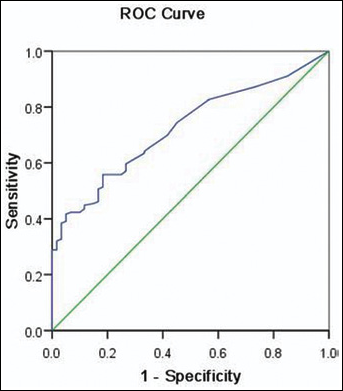
ROC curves of DKK-1 in serum of patients with cervical cancer. With a cutoff of 1.1 μg/mL, DKK-1 has a sensitivity of 63.5% and a specificity of 66.7% in diagnosing cervical cancer. With a cutoff of 0.95 μg/mL, the sensitivity is 64.1% and the specificity 65.3%.
Association between serum DKK-1 expression and clinicopathological parameters
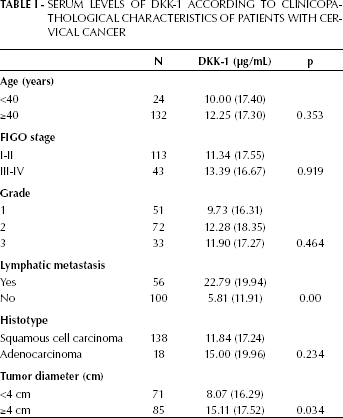
With regard to FIGO stage, although the expression of DKK-1 in stages (III-IV) (13.39 [16.67] μg/mL) was higher than in stages (I-II) (11.34 [17.55] μg/mL), the difference had no statistical significance (p=0.919). DKK-1 levels were lower in patients without lymphatic metastasis (5.81 [11.91] μg/mL) than in patients with lymphatic metastasis (22.79 [19.94] μg/mL) (p=0.00). The percentage of lymphatic metastasis was higher in patients with DKK-1 ≥1.1 μg/mL (50.51%) than in patients with DKK-1 <1.1 μg/mL (10.53%) (p=0.00).
With regard to cervical cancer diameter, the expression of DKK-1 in serum was significantly upregulated in patients with a tumor diameter ≥4 cm (15.11 [17.52] μg/mL) compared with its expression in patients with a tumor diameter <4 cm (8.07 [16.29] μg/mL) (p=0.034). A tumor diameter ≥4 cm was more common in patients with DKK-1 ≥1.1 μg/mL (70.71%) than in patients with DKK-1 <1.1 μg/mL (28.07%) (p=0.00). The serum DKK-1 level in cervical cancer was not correlated with age, pathological grade and histology type (Tab. I).
Serum Levels of DKK-1 According to Clinicopathological Characteristics of Patients with Cervical Cancer
Serum DKK-1 was a good prognostic factor
In 40 patients who received radical hysterectomy and resection of the pelvic and paraaortic lymph nodes via laparotomy, the DKK-1 level after operation (2.06 [2.44] μg/mL) was lower than before operation (13.89 [20.40] μg/mL) (p=0.00). Cox regression analysis was used to evaluate the association between DKK-1 levels and survival outcome (DFS). Among the 7 parameters examined (year, histology type, FIGO stage, tumor diameter, lymphatic metastasis, grade, DKK-1), the analysis revealed that FIGO stage (p=0.021, hazard ratio=1.645), tumor diameter (p=0.013, hazard ratio=4.203), lymphatic metastasis (p=0.002, hazard ratio=5.760), histology type (p=0.016, hazard ratio=3.284) and DKK-1 (p=0.008, hazard ratio=1.026) were associated with prognosis in patients with cervical cancer. A cutoff DKK-1 level of 1.1 μg/mL was determined to predict DFS on the basis of the result of a ROC analysis of disease-free status versus DKK-1 level. The result by Kaplan-Meier analysis indicated that cervical cancer patients with a DKK-1 level ≥1.1 μg/mL were more likely to have disease recurrence and persistence than patients with a DKK-1 level <1.1 μg/mL (p=0.00) (Fig. 2).
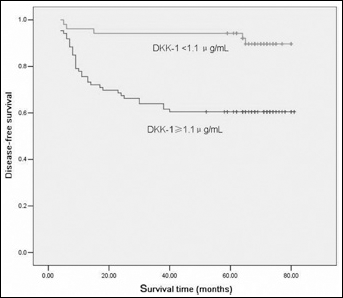
Disease-free survival (DFS) curves related to DKK-1 in serum of patients with cervical cancer obtained with the Kaplan-Meier method.
Discussion
The Wnt signal transduction pathway plays an important role in cell patterning, proliferation, and fate determination during embryogenesis. This highly regulated signaling cascade is essential for normal developmental processes, but defects in the pathway have also been closely linked to oncogenesis (14, 15). Wnts include negative and positive regulators, which act either intracellularly to modulate components of the signal transduction machinery or extracellularly to modulate ligand receptor interactions. Extracellular Wnt antagonists are composed of 5 families: the secreted frizzled-related protein, Wnt inhibitory factor 1, Xenopus Cerberus, Wise, and the Dickkopf (DKK) family (16). The DKK family encodes secreted proteins and consists of DKK-1, -2, -3, -4, and a unique DKK-3-related gene, called Soggy.
DKK-1 binds to low-density lipoprotein receptor-related protein-5/6 and blocks interaction with Wnt-1, resulting in β-catenin degradation and effects on proliferation (17, 18). Another study showed that DKK-1 functions not only as an antagonist of the Wnt/β-catenin pathway but also as an agent that can upregulate other Wnt signaling pathways if the requisite Wnt/receptor combinations are available (19). DKK-1 also can suppress cell growth and induces apoptotic cell death by activating the c-Jun N-terminal kinase pathway (3). DKK-1 might promote cancer invasion through inducing filopodia extension and actin filament rearrangement by activating P-JNK1 in ovarian cancer (20).
Since DKK-1 is a secreted protein, we investigated whether it is secreted into the serum of patients with cervical cancer. Our results showed that the levels of serum DKK-1 were significantly increased in patients with cervical cancer compared with healthy women and patients with CIN. Using ROC curves drawn from our results, we obtained a sensitivity of 63.5% and a specificity of 66.7% with a DKK-1 level of 1.1 μg/mL for cervical cancer diagnosis, and a sensitivity of 64.1% and a specificity of 65.3% with a DKK-1 level of 0.95 μg/mL. All these results indicated that DKK-1 in serum might be a good biological marker in the diagnosis of patients with cervical cancer.
With regards to cervical cancer diameter, the serum levels of DKK-1 were higher in patients with a tumor diameter ≥4 cm than in patients with a tumor diameter <4 cm. A tumor diameter ≥4 cm was more common in patients with DKK-1 ≥1.1 μg/mL than in patients with DKK-1 <1.1 μg/mL. These results showed that DKK-1 in serum may be associated with tumor growth in cervical cancer. The serum concentration of DKK-1 was higher in patients with lymphatic metastasis than in patients without lymphatic metastasis. The percentage of lymphatic metastasis in patients with DKK-1 ≥1.1 μg/mL was higher than in patients with DKK-1 <1.1 μg/mL. These results showed that DKK-1 in serum may be a good predictor of poor prognosis and may play an important role in lymphatic metastasis in cervical cancer.
Our Cox regression analysis results showed that FIGO stage, tumor diameter, lymphatic metastasis, histology type and DKK-1 were closely related to the risk of relapse or persistence of cervical cancer. Kaplan-Meier analysis indicated that patients with a higher level of serum DKK-1 had a higher risk of recurrence and persistence of cervical cancer. In 40 patients who received radical hysterectomy and resection of the pelvic and paraaortic lymph nodes via laparotomy, the levels of serum DKK-1 decreased significantly after the operation. All these results confirmed that DKK-1 could be a good predictor of poor prognosis in cervical cancer. It could be used to predict the prognosis of patients with cervical cancer after surgery or radio/chemotherapy and monitor the recurrence of cervical cancer.
Because the number of serum samples we tested was limited, our results are just preliminary and might have some limits. A larger number of cervical cancer samples need to be collected and more studies are also needed to corroborate our results.
In conclusion, our study has shown that DKK-1 detection by ELISA can be used for the detection and diagnosis of cervical cancer. Our study has also found that DKK-1 in serum is a good predictor of poor prognosis in cervical cancer patients. Therefore, more research needs to be done in the future into the function and mechanism of DKK-1 in the development and metastasis of cervical cancer.