




Abstract
Background
Daily disposable contact lenses are gaining in popularity among practitioners and wearers for the improved ocular health and subjective outcomes they offer. Recently a novel daily disposable contact lens material with water gradient technology was introduced. Delefilcon A lenses consist of a 33% water content silicone hydrogel core and an outer hydrogel layer which is totally free of silicone and contains 80% water.
Methods
The aim of the present study was to confirm the layered structure of delefilcon A contact lenses. Thickness of hydrogel coating on the silicone hydrogel core was assessed using Raman spectroscopy. To investigate the layered structure of the material, depth spectra of the lenses were recorded.
Results
The results obtained suggest that at about 6 μm a boundary between the hydrogel layer and silicone hydrogel core exists, which is in good agreement with the manufacturer's data.
Conclusions
Data collected in this experiment confirm a water gradient at the delefilcon A lens surface.
Introduction
Soft lens manufacturers have tried a range of product improvements to enhance clinical performance, wearing comfort and ocular health. Until recently, soft contact lens materials were divided into 4 groups based on water content and presence of ionic charge (1, 2). This classification was not sufficient to describe silicone hydrogel materials and their precise interaction with proteins and components of soft contact lens care solutions (3). In 2014, silicone hydrogels were officially classified in a fifth Food and Drug Administration (FDA) group for the first time (4). The new grouping system encompasses such criteria and additional information about surface treatment (4, 5).
Approximately 65% of wearers are fitted with silicone hydrogel contact lenses worldwide (6). High oxygen permeability (Dk) is achieved by incorporating silicone in lens material without a significant decrease in water content (1, 7). Moreover, silicone hydrogels provide good handling characteristics and mechanical strength. On the other hand, the hydrogel material (high water content) could provide excellent wettability, lubricity and resistance to lipid fouling, which are still a problem in silicone hydrogel contact lenses (8-9-10). Incorporation of a greater amount of water into the silicone hydrogel material can provide biocompatibility and comfort (i.e., proper initial comfort, short adaptation time, and proper contact lens fitting), but there are still some limitations. High water content in soft contact lens materials can lead to on-eye dehydration which can result in high lid–lens friction, lower wettability or even changes in lens fitting (11, 12). In addition, in silicone hydrogels there is usually a need for special modification to maintain a hydrophilic surface (4, 13). Manufactures have used plasma treatments or internal wetting agents (1). The lack of eye-lens wettability can affect the lipid or protein adsorption from the ocular environment (13). As a result of this, patients may report wearing discomfort due to subjective and objective dry eye outcomes that lead to reduced time of wearing or even contact lens dropouts (14-15-16-17).
Manufacturers have tried to target characteristics such as the maintaining of proper surface wettability and lubricity and high oxygen transmissibility during the day, to create new alternatives for contact lens wearers. What is more, there has been a great deal of interest in the daily disposable contact lenses. Approximately 26% of wearers are fitted with daily disposable contact lenses (6). Studies have shown that daily disposable contact lenses offer improved ocular health and subjective outcomes (18-19-20-21-22). For those reasons, Alcon Laboratories has introduced water gradient daily disposable soft contact lenses available under the Dailies Total 1 trademark (delefilcon A). Delefilcon A is composed of a silicone hydrogel core with 33% water content and an outer hydrogel layer which is totally free of silicone and contains 80% water (23). Water gradient technology provides different properties at the lens surface and in the bulk. The Dk/t value with a surface water content of more than 80% is 156. Changes in modulus of the surface layer is much lower than in the core (0.0025 MPa and 0.7 MPa, respectively) (24). The average thickness total thickness of a delefilcon A lens is about 100 µm, and the hydrated hydrogel surface thickness, as stated by the manufacturer, is about 6 μm (23). Various studies on the characterization of the surface layer have established a surface layer thickness of 5.9 ± 0.8 µm (25) and 10 µm (26).
So far, the published literature about delefilcon A lenses is limited. Thus, there is still a need for further material characterization and prospective studies of their clinical performance. The aim of the present study was to confirm the layered structure of delefilcon A contact lenses. The thickness of the hydrogel coating on the silicone hydrogel core was assessed using Raman spectroscopy.
Methods
Contact Lenses
Delefilcon A contact lenses were examined to establish the thickness of the surface hydrogel layer present on a silicone hydrogel core. According to the manufacturer's information, delefilcon A lenses consist of a 33% water content silicone hydrogel core completely covered with a 0.5- to 20- μm thick hydrogel layer containing 80% water (23). In the central area of a -3.00 D lens, which is 90-μm thick, the hydrogel cover should be about 6% on each side (27). It is, however, important to note that lenses of different power have different thickness profiles. Thus, due to the method of preparation, hydrogel surface coatings may have different sizes.
The lens powers of the samples used in this study were chosen randomly, ranging from -0.75 to +0.75 D. Each lens was taken out of the blister and shaken to remove excess water from the surface. Then, after being placed on a glass, its Raman spectra were collected.
Raman Depth Imaging
Raman spectra were obtained on an inVia Renishaw Raman microscopy system (Renishaw, Old Town, Wotton-under-Edge, UK) with a 488-nm Ar-Ion laser and 3,000 mm−1 grating. The laser light was focused on the sample with a 50 × 0.75 microscope objective (LEICA). All Raman spectra were obtained from 800 to 1,900 cm−1 with the following measurement parameters: 10 s acquisition time, 9.37 mW laser power at the stage. To investigate the layered structure of the material, each Raman spectrum was recorded after a 1-µm step in z range. Spectra were corrected using WiRETM 3.3 software attached to the instrument. All figures were obtained using OriginPro 9.1 software (OriginLab Corp.).
To ensure the accuracy of the experimental results, 5 lenses were measured, and after spectral acquisition, each lens sample was replaced with a new one. To avoid the effect of dehydration, all samples were measured immediately after placing on a glass, and if necessary, the laser power was adjusted to avoid the sample overheating and being damaged.
Results
An exact analysis of spectra was difficult due to the fact that the detailed chemical composition and technological process of manufacturing of the lenses are protected under patent law. However, there are some typical bands that may be ascribed to hydrogel and to silicone hydrogel materials. This allowed us to establish the thickness of the hydrogel coating on the silicone hydrogel core.
Figure 1 presents Raman spectra collected for different depths within the material – directly at the surface and 10 μm into the lens. At first glance, they may seem to be similar. However, there are some characteristic bands that change when moving from surface to the bulk. Going deeper into the lens material, one can see that the presence of silicone hydrogel moieties perturbs the hydrogel structure. This is reflected by the higher intensities of the 1,089, 1,260, 1,416 and 1,454 cm−1 bands, and a small shift in the 1,620 cm−1 band. The following data seem to be typical for silicone hydrogels, especially with growing intensities of CH2 and CH3 vibrations at 1,416 and 1,454 cm−1. These 2 bands are characteristic for silicone hydrogel hybrids, and their intensities depend on the silica content in the polymer matrix (28). The 1,620 cm−1 band might be ascribed to υ(C = O) vibration which occurs in the presence of water and representsC = O weak hydrogen bonds with H2O molecules (29). A small shift of the 1,620 band to about 1,615 cm−2 might be a result of decreasing water content when going into the less hydrated silicone hydrogel core of the lens.
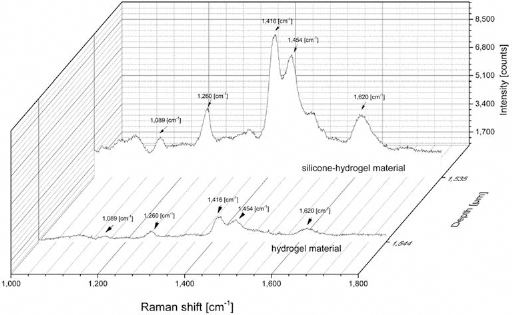
Raman spectra obtained directly at the surface and 10 μm into the bulk.
In the 3D surface plot (Fig. 2) Exemplary results of depth imaging of the delefilcon A sample are shown. As shown by the measurements presented, the mean thickness of the hydrogel layer might be estimated to be about 6 ± 2 μm, which is consistent with manufacturer's data (23, 27).
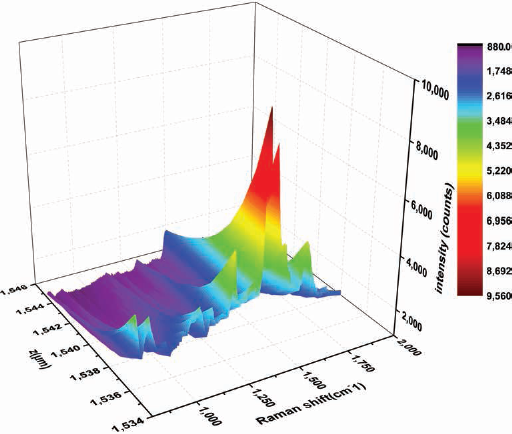
Raman depth imaging of the layered structure of delefilcon A contact lenses.
Dursch et al measured fluorescent solute partitioning in delefilcon A lenses, which also allowed them to establish the thickness of the layer (26). As shown in their study, the silicone hydrogel core was surrounded by polyelectrolyte surface-gel layers of significantly greater water content and aqueous solute uptake compared with the core. This technique allowed them to establish the thickness of the hydrogel layer to be about 10 μm. As they concluded, this result was in good accordance with the manufacturer's data.
However, it is claimed that delefilcon A lenses should be covered with a hydrogel layer of about 6 μm (27). Since in this experiment, thickness measurements of the surface coating were repeatable irrespective of lens power and position relative to its center, it seems that Raman depth imaging is much more accurate. Another probable reason for this result is that solute-partitioning measurements were performed in an aqueous environment, while Raman examination was performed in air. When the anterior surface of the lens is exposed to air, as is the case when the lens is placed on the eye, it dehydrates to some extent (7, 12, 15, 30). Thus, results obtained in this study seem to be more accurate, considering the clinical situation after a lens has been placed on the eye.
Contact lens characteristics that are linked to water content play a key role in lens comfort and performance (7). For this reason, surface dehydration might be an undesirable result. Schafer et al compared surface water characteristics of delefilcon A, nesofilcon A and etafilcon A after wear (31). Initially, delefilcon A seemed to have the same high water content as hydrogel lenses. However, it quickly dehydrated to reach the refractive index of silicone hydrogel low water core, while nesofilcon A and etafilcon A samples maintained their water content. This change might be important for lens performance because it can alter the surface refractive index. It might produce visual aberrations or reduce surface wettability which can worsen lens on-eye performance. So far, there is not much data on this issue. Nevertheless, delefilcon A lenses do not seem to perform worse than other daily disposable contact lenses (32, 33).
Discussion
In this study, Raman spectroscopy was used to characterize the novel daily disposable water gradient of delefilcon A contact lenses. Data collected in the Raman depth imaging experiment confirmed the water gradient at the delefilcon A lens surface. Therefore, this technique can be successfully used to measure the thickness of layered materials.
Results obtained in this study suggest that at about 6 μm, a boundary between the hydrogel layer and silicone hydrogel core exists, which is in a good agreement with the manufacturer's data.
As reported, hydrated lenses consist of a hydrophobic core of 33% water content and hydrophilic surface of 80% water content. Because Raman spectroscopy allows us to measure hydrated and dehydrated samples, further studies of delefilcon A surface water loss will be valuable. Changes in the maintenance of high surface water content over time may have an influence on visual performance of the contact lens material. Thus, additional studies of the effects of surface water loss on visual aberrations and patient initial and end-of-day wearing comfort are needed.
Footnotes
Financial support: No grants or funding have been received for this study.
Conflict of interest: None of the authors has any financial interest related to this study to disclose.