




Abstract
Background
Resin-based dental materials allow bacterial growth on their surface and lack antibacterial activity, leading to functional and esthetic failure. Quaternary ammonium polyethyleneimine (QPEI) nanoparticles (NPs) incorporated in resin-based composite at 2% wt/wt have demonstrated prolonged and complete inhibition of bacterial growth. This study focused on optimization of QPEI NP synthesis to reduce the concentration required for bacterial growth inhibition. The objective here was to enhance antimicrobial efficacy by excess base neutralization, using phosphoric or hydrochloric acid, and by using surfactants.
Methods
QPEI NP variants were prepared (i) under controlled neutralization of acid, using NaHCO3, (ii) under controlled carbonate ion neutralization with HCl or H3PO4 and (iii) by treatment with N-lauroylsarcosine or glycerol monostearate. NPs incorporated in the dental materials were examined for their antibacterial effect against Enterococcus faecalis.
Results
Controlled addition of NaHCO3 resulted in modified QPEI NPs with an increased ability to inhibit bacterial growth. Surface treatment with N-lauroylsarcosine resulted in enhanced antibacterial activity at 0.5% wt/wt concentration in acrylate and epoxy resin-based dental materials.
Conclusions
The antimicrobial efficacy of QPEI NP may be improved significantly by controlling the addition of NaHCO3, neutralization of excess base and the surface-agent effect.
Keywords
Introduction
Since the first use of bisphenol A glycerol dimethacrylate (Bis-GMA) resin filled with silica particles, introduced by R.L. Bowen in 1962, resin-based composite materials have gained tremendous popularity and can be found in fillings, esthetic restorations, sealers, luting cements and adhesives (1, 2). Contemporary resin-based dental materials have an esthetic advantage over other restorative materials. Monomers such as triethylene glycol dimethacrylate and urethane dimethacrylate, alone or in combination with Bis-GMA, are used to reduce composite viscosity and to increase the polymerization rate (3, 4). Epoxy-amine systems, based on resins such as the diglycidyl ether of bisphenol A (DGEBA), which contribute to low polymerization shrinkage, good adhesion and slow setting, are used as cements or sealers for root canal treatment.
Despite their superior esthetics and excellent handling properties, resin-based materials allow bacterial growth on their surface. Several approaches have been proposed to resolve this issue, including the use of (i) soluble molecules such as chlorhexidine (5) and ammonium-functionalized dendrimers (6), (ii) heavy metal ions, mainly silver compounds (7), the use of which is controversial due to their potential cytotoxicity (8) in addition to poor esthetic properties (9) and (iii) antibacterial resin monomers such as methacryloyloxdodecylpyridinium bromide (MDPB) (10) and long chain methacrylate-based quaternary ammonium monomers (11).
Quaternary ammonium poylethyleneimine (QPEI) nanoparticles (NPs) were reported to be highly potent bactericides when incorporated as fillers in various dental materials (12-13-14-15-16-17-18-19-20-21). Such NPs consist of a cross-linked poylethyleneimine core and octyl functional groups, with most of the amines converted into ammonium ions. The effect of incorporating QPEI NPs into dental materials on their mechanical characteristics has been previously investigated (12). Although no serious reduction in mechanical strength was observed in the short run, large amounts of QPEI may act as a plasticizer within the hard dental resin material, which is reinforced by inorganic filler particles in the long run. This is likely to occur due to the inherent softness of the poylethyleneimine (PEI), which is the backbone of the QPEI NPs. The substitution reactions in the preparation stages involve the Menshutkin reaction between amines and alkyl halides, followed by the formation of hydrogen halide. The acid is subsequently neutralized with excess NaHCO3. As this procedure may lead to formation of ammonium carbonate salt instead of ammonium halide, the electrostatic attraction forces between the ammonium cations and the negatively charged bacterial membrane may be reduced because of a possible “masking” effect of the carbonate anions. The antibacterial performance of the QPEI NPs might be affected by their dispersion within the base polymer. This can be resolved by incorporating surfactants such as glycerol monostearate (GMS) or N-lauroylsarcosine (NLS).
In this study, 2 different approaches were examined with the aim of improving the bactericidal potency of the base polymer incorporating the QPEI NPs. The hypothesis was that controlled neutralization of hydrogen halide acid with NaHCO3 and neutralization of excess base with phosphoric or hydrochloric acid, along with the incorporation of surfactants, would enhance the antimicrobial efficacy and allow a reduction in the final concentration of the QPEI NPs.
Materials and Methods
Preparation of QPEI
QPEI NPs (labeled QPEI) were synthesized as previously described (12). This synthesis was used as a general platform for the synthesis of all of the QPEI NP variants.
Low-carbonate QPEI NPs variants were prepared by 3 different methods. First, the original synthesis protocol was modified by using a minimal amount of the NaHCO3 required during the hydrogen iodide neutralization (the NPs labeled QPEI-LC). The amount of NaHCO3 added was determined visually when gas formation stopped. The second and third variants were prepared by treatment of the original QPEI with strong acids. A 10-g quantity of QPEI NPs was placed in a 500-mL glass beaker, and 300 mL of a hydrochloric acid (Sigma, St. Louis, MO, USA) solution prepared at pH = 2 was added slowly while stirring, using a magnet. After 1 hour, the NPs were allowed to sediment followed by elution of the liquid phase. The remaining NPs (labeled QPEI-Cl) were freeze-dried. This procedure was repeated with phosphoric acid (Sigma, St. Louis, MO, USA) (the NPs labeled QPEI-Ph).
QPEI NP treatment with surface-active agents was conducted by rinsing 2 g of the nanoparticles with 100 mL 2% wt/wt of a surfactant in water solution, followed by filtration through a Buchner funnel and lyophilization. The surfactants used were NLS (Sigma), (NPs labeled “QPEI-NLS”) and GMS (Sigma) (labeled “QPEI-GMS”). Figure 1 summarizes the synthesized variants.
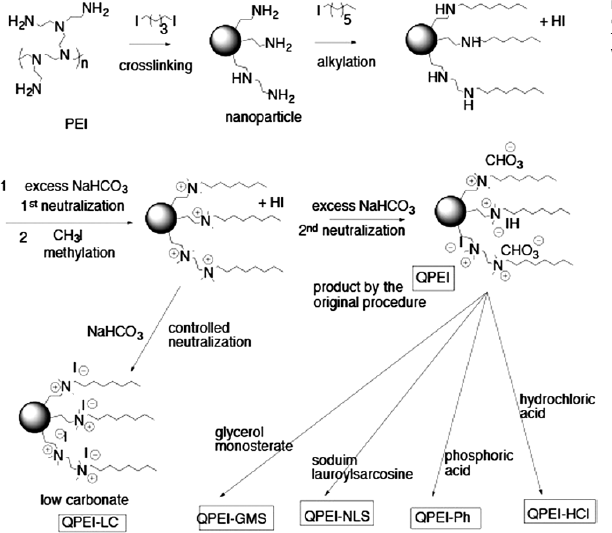
Scheme showing fabrication of quaternary ammonium poylethyleneimine (QPEI) nanoparticle variants.
Characterization
The infrared spectra of the prepared NPs were taken with a Nicolet iS-10 Fourier transform infrared (FT-IR) spectrometer, with a diamond ATR interface and operated using OMNIC software (Thermo Scientific, Waltham, MA, USA). The output spectra are the average of 16 scans in the 525-4,000 cm−1 range.
Thermal analysis of the QPEI variants was performed, using a differential scanning calorimeter (DSC 1; MettlerTolledo, Schwerzenbach, Switzerland), by heating the QPEI NPs in a sealed 40-μL aluminum pan from 0 to 250°C at a rate of 10°C/min under nitrogen. The glass transition temperature (Tg) was determined and calculated using STAR software. Each experiment was repeated 5 times, and all data were statistically analyzed, applying analysis of variance followed by the Mann-Whitney test (p<0.05).
Particle diameter in suspension was measured using a Zetasizer 2000 device (Malvern Instruments, Malvern, UK). A 0.01-g quantity of NPs was placed in a 20-mL glass vial, and 10 mL of absolute ethanol was added. Samples were stirred using a high-speed homogenizer (IKA T 25 digital ULTRA-TURRAX; KA®-Werke GmbH & Co. KG, Staufen, Germany), operated at 4,000 rpm for 5 minutes. A 1-mL volume of each sample was transferred to a disposable polystyrene cuvette. The diameter of the nanoparticles samples was recorded as the average of 10 readings.
Antibacterial activity
Four resin-based dental materials were used to examine the potency of the synthesized NPs to inhibit bacterial growth. These included 3 epoxy-amine root canal sealer pastes: AH Plus and AH26 (Dentsply DeTrey, Konstanz, Germany) and BJM RCS (BJM Laboratories, Or Yehuda, Israel). A methacrylate resin-base restorative material, Filtek Supreme XT Flowable (3M ESPE, St. Paul, MN, USA), was also evaluated. Each of the QPEI NPs variants was added to the test materials at 2%, 1%, 0.5% and 0.25% wt/wt concentrations, and mixed using a ceramic crucible and pestle for 5 minutes when a smooth and homogenous paste was obtained. Test materials without QPEI NPs served as controls.
Antibacterial activity was examined using the direct contact test (DCT) against Enterococcus faecalis. In brief, the sidewalls of wells in a polystyrene microtiter plate (96-well flat-bottom plate; Nunclon, Nunc, Denmark) were coated with similar amounts of the mixed material (surface area ∼ 4 × 8 mm), 8 wells for each concentration. The materials were processed according to the manufacturer's instructions and allowed to self-cure in a 37°C incubator. Plates were aged for 14 days at 37°C in phosphate-buffered-saline (Sigma, St. Louis, MO, USA), which was replaced every 48 hours. Then the plates were dried, positioned vertically and 10 μL of bacterial suspension (2 × 10⁶ colony-forming units [CFU]/mL) was placed on the surface of each material tested. The plates were incubated at 37°C for 1 hour until all of the suspension liquid had evaporated, ensuring that the bacteria came in direct contact with the tested material.
At this stage, the plates were positioned horizontally and 220 μL of brain-heart infusion (BHI) broth was added to each well. Absorbance at 650 nm was measured every 20 minutes during a 20-hour incubation in a 37°C temperature-controlled plate-reader (VERSAmax; Molecular Devices Corporation, Sunnyvale, CA, USA). The obtained data were plotted as optical density changes vs. time. The linear part of the bacterial logarithmic growth phase was statistically analyzed, the slope correlating with grow rate. Each experiment was repeated 3 times. The results were statistically analyzed using ANOVA followed by Tukey's test (p<0.05).
To observe the antibacterial effect, AH Plus samples incorporating 2% wt/wt QPEI-NLS were prepared and visualized using an electron microscope. An E. faecalis suspension of 10 µL (optical density [OD] = 0.3 at average absorbance at 650 nm [A650nm]) was placed on the surface for 1 hour at 37°C. Unmodified AH Plus surfaces served as controls. The specimens were fixed with formaldehyde, glutaraldehyde and osmium tetroxide in cacodylate buffer, followed by dehydration with a graded ethanol and Freon series, and then coated with gold. Specimens were observed using an extra high-resolution scanning electron microscope (SEM) (Magellan™ 400L; FEI, Hillsboro, OR, USA) at magnifications of 2.5 K and 40 K.
Results
Characterization
The FT-IR spectra of the QPEI NP synthesis variants are shown in Figure 2. Differences in peaks representing functional carbonate groups (850-910 cm−1, 1,350-1,400 cm−1), primary and secondary amines (3,200-3,700 cm−1) and quaternary ammonium (910-970 cm−1) were observed. Characteristic peaks and their correlation to specific functional groups are summarized in Table I. A high intensity of the carbonyl peak (1,720 cm−1) was evident in the GMS NPs samples but not in the control QPEI NPs, reflecting a high surfactant concentration in the sample (see Supplementary Figure, available online as supplementary material at www.jab-fm.com).
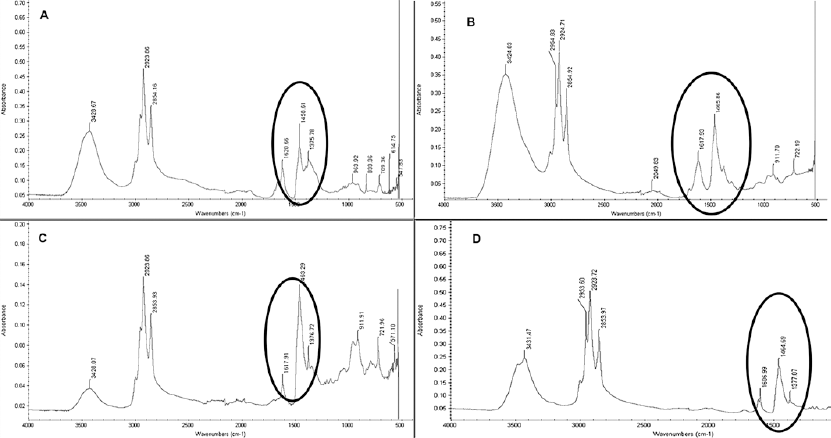
Fourier-transform infrared (FT-IR) spectra of quaternary ammonium poylethyleneimine nanoparticles (QPEI NPs) with various carbonate contents: untreated QPEI (
Fourier transform infrared (FT-IR) spectra peaks of QPEI NP variants
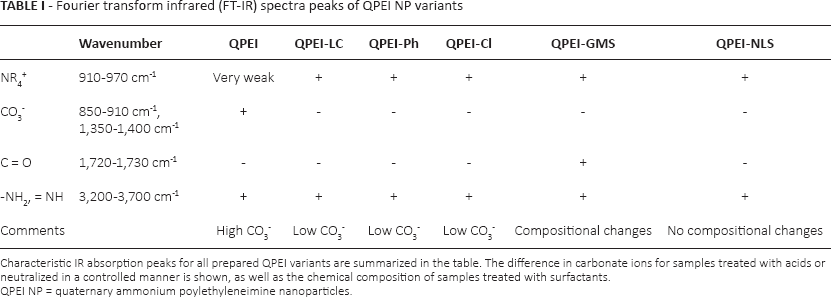
Characteristic IR absorption peaks for all prepared QPEI variants are summarized in the table. The difference in carbonate ions for samples treated with acids or neutralized in a controlled manner is shown, as well as the chemical composition of samples treated with surfactants.
QPEI NP = quaternary ammonium poylethyleneimine nanoparticles.
The average Tg values for the QPEI NPs are shown in Table II. Tg values measured for nanoparticle samples of QPEI-LC, QPEI-Cl, QPEI-Ph, QPEI-NLS and the original QPEI NP were found to be between 40°C and 45°C. In the sample treated with surfactant GMS, the Tg value was significantly higher than that of the other samples (p<0.05).
Tg values of tested QPEI variants

Note: statistically significant difference indicated by columns, sharing the same letter within each group of significance, identified as “a” and “b”.
Glass transition temperatures (Tg) of all QPEI variants are summarized in the table above. All samples had the same lack of statistical significance (a) (p>0.05) except the QPEI-GMS (b) with has a significantly higher value. GMS = glycerol monostearate; QPEI = quaternary ammonium polyethyleneimine.
Table III summarizes the size of the NP samples. The data are the average of 10 readings and are presented as particle diameter in nanometers. Samples prepared with controlled acid neutralization, samples treated with strong acid and the original QPEI NP were all within the same range of 100-120 nm. Samples labeled NLS were within a much lower range of 12 nm. There are no available data for samples labeled QPEI-GMS, as they were fiber-like bulk material.
QPEI NP average diameter (in nanometers)

Average diameters of QPEI NP variants calculated from the data collected using a Zetasizer 2000.
QPEI NP = quaternary ammonium poylethyleneimine nanoparticles; STDV = standard deviation.
Antibacterial activity
The minimal inhibitory concentration (MIC) of QPEI NP variants incorporated in different dental materials after material aging is shown in Table IV. Total bacterial growth inhibition was determined as the absence of the logarithmical phase in the bacterial growth curve.
Minimal inhibitory concentration of QPEI NP variants (% wt/wt) required to induce total bacterial growth inhibition
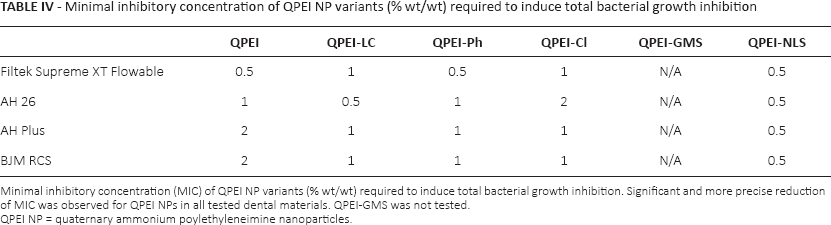
Minimal inhibitory concentration (MIC) of QPEI NP variants (% wt/wt) required to induce total bacterial growth inhibition. Significant and more precise reduction of MIC was observed for QPEI NPs in all tested dental materials. QPEI-GMS was not tested.
QPEI NP = quaternary ammonium poylethyleneimine nanoparticles.
A representative DCT curve for AH Plus sealer material is shown in Figure 3. Total inhibition of E. faecalis was observed at 2%. Samples incorporating 1% QPEI showed only a partial effect, and no activity was found in samples with 0.5% and 0%.
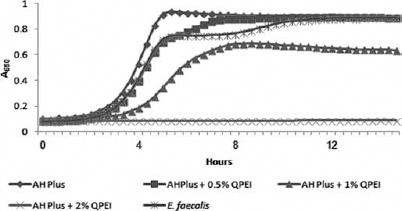
Antibacterial activity of modified endodontic sealer (AH Plus) incorporating quaternary ammonium poylethyleneimine (QPEI) nanoparticles. Enterococcus faecalis microorganism growth was evaluated following direct contact with endodontic sealer surface incorporating 0%, 0.5%, 1% or 2% wt/wt QPEI nanoparticles after aging (representative sample of direct contact test results). Each point on the curve is the average absorbance (A650 nm) measured simultaneously in 8 wells in the same microtiter plate for the dental material test groups, and 8 wells for the E. faecalis group. No bacterial growth was observed in the modified sealer following 2% QPEI incorporation.
The QPEI-GMS NPs were of a fiber-like consistency and thus could not be incorporated in the dental polymers. Therefore, the antibacterial test could not be performed for this variant.
Following direct contact with an AH Plus surface without NP, SEM images of E. faecalis demonstrated the presence of normally dividing cells with an intact cell wall (Fig. 4A, B). Within minutes of contact with a surface containing 2% wt/wt QPEI-NLS, morphologic changes in the bacterial cell wall were observed, and only a few groups of bacteria were observed on the surface (Fig. 4C, D).
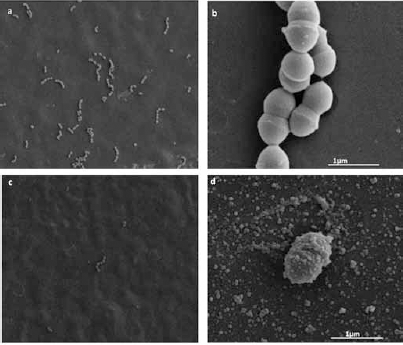
SEM micrographs of Enterococcus faecalis on AH Plus samples. With AH Plus 0% wt/wt, dividing bacterial cells with intact cell wall and early biofilm formation were observed (
Discussion
In the present study, various modifications in the synthesis of QPEI NPs were characterized, and relative antibacterial potencies were determined when these particles were incorporated in several resin-based dental materials. Structural analysis of the QPEI NPs variants in this study focused on infrared spectroscopy, size determination and differential scanning calorimetry. Collectively, these methods may provide an informative characterization of chemical and morphological alterations that occur under various synthesis conditions.
Characteristic functional groups such as alkyl groups, amines and quaternary ammonium cations were detected in all of the variants, as in the control QPEI NP. Interestingly, carbonate ions detected in the original QPEI NPs were not detected in samples treated with strong acids or surfactants, or when controlled neutralization was performed. A weak peak at 910-970 cm−1 representing quaternary ammonium, was indeed evident in all of the samples, but appeared with greater intensity in samples with a lower content of carbonate ions – i.e., QPEI NP samples treated with phosphoric or hydrochloric acid and samples neutralized under controlled conditions. It is likely that a higher content of the large carbonate anion may mask the quaternary ammonium cations, resulting in reduced antibacterial efficacy.
Upon evaluating NPs size, we found that samples which were prepared with controlled acid neutralization, and samples that were treated with strong acid, similarly to the original QPEI NPs, were all in the same range of 100-120 nm. However, in samples treated with a surface-active substance, such as NLS, the size of the particles was significantly reduced. This is probably due to the tendency of NPs to form larger agglomerates as a result of strong interactions among themselves.
Most of the synthesized QPEI NP variants were of a fine powder consistency – their appearance similar to that of the original QPEI NP. The QPEI-GMS samples differed markedly from the other QPEI NP samples: their consistency was fibrous and their color was white and not yellow as seen in the other variants. Consequently, it was impossible to mix this variant with the tested dental materials. This morphological alteration might be the result of a strong attraction between the non-ionic surfactant and the QPEI, causing absorption of a large amount of GMS onto the NP's surface. This premise was supported by thermal analysis. It was found that the Tg values of QPEI-GMS NPs were significantly higher compared with the other NPs. As the Tg is sensitive to strong intermolecular interactions, the molecular weight and morphology of the tested sample, it can be assumed that some of these changes occurred as a result of treating QPEI NPs with GMS.
In the present study, E. faecalis was chosen as the test bacterium. Indeed, most dental infections are multispecies ones. Nonetheless, E. faecalis is known to be a highly resistant oral pathogen, displaying resistance to numerous antimicrobial measures (22, 23). Moreover, E. faecalis is considered the gold standard bacterium in endodontic research (22). Thus, it is likely that an efficient antibacterial effect against this bacterium may imply an efficient and broad-spectrum activity against other bacteria.
Most dental materials, including endodontic sealers are specifically designed to have extremely low solubility in an aqueous environment to fulfill their original task. Regrettably, most studies have investigated their antibacterial effect utilizing the traditional agar diffusion test and variations of this method. As these methods depend on the dissolution/diffusion of the antibacterial component, they are not suitable for testing the antibacterial effect of dental materials. For this reason, the DCT was developed. In the DCT, bacteria are allowed to come in direct contact, under controlled conditions, with the tested material, and the rate of bacterial outgrowth can be quantified and analyzed (13).
Previously, QPEI NPs were examined for their antibacterial effect against numerous gram-positive and gram-negative bacteria. In root canal sealers, the strongest antibacterial effect against E. faecalis was observed at 2% wt/wt of the added QPEI NPs (21). Total inhibition was reported for 1%-2% wt/wt of QPEI NPs in resin composite against a wide range of pathogens (14, 24, 25). Also, complete inhibition of E. faecalis and Staphylococcus aureus was achieved at 2% when incorporated into orthopedic bone cement (20). Another variation of QPEI that is not a cross-linked polyethyleneimine with quaternary ammonium functional groups was active against Escherichia coli (26). Other findings show that coating of glass slides and immobilization of QPEI polymers onto magnetite nanoparticles are effective against Staphylococcus epidermidis, S. aureus, Pseudomonas aeruginosa and E. coli (27). It was found that the QPEI NPs disperse uniformly within the tested materials, with some tendency to form larger agglomerates (16). X-ray photoelectron spectroscopic examination confirmed that the QPEI NPs are present on the material's surface as well as inside the bulk material (25). QPEI NPs are also advantageous when used in dental materials as they demonstrate good biocompatibility when incorporated at 1%-2% wt/wt in dental materials (14, 15, 28). In the present study, the synthesized variants showed enhanced antibacterial potency with a lower MIC needed to cause total bacterial inhibition. Consequently, <1% concentrations incorporated in the dental materials resulted in total bacterial inhibition. This may be advantageous in terms of not compromising the biocompatibility and physical properties of the base materials.
The DCT findings led to different results for each combination of dental polymer with the QPEI variants. For Filtek Supreme, a radically polymerized acrylic resin-based material, the best results were obtained with the QPEI, QPEI-Ph and QPEI-NLS samples. This may be due to the low concentration of halide (iodide in QPEI-LC and chloride in QPEI-Cl). High levels of halides may lead to inhibition of acrylate polymerization, weaken the polymer matrix and thus cause diffusion of NPs from the material's surface.
For epoxy-based root canal sealers, the strongest antibacterial effect was exhibited by the QPEI-NLS variant. Lack of initiators in the epoxy-amine resins renders them very stable during the polymerization process. The effectiveness of particle distribution within the polymer matrix may be one of the most important parameters affecting the antibacterial potency. We postulate that treatment of QPEI NPs with NLS surfactant leads to a significant decrease in the MIC (up to 4 times less when compared with untreated QPEI).
In conclusion, for materials requiring antibacterial or antibiofilm surface properties, incorporation of QPEI NPs might be of great advantage. Nevertheless, each polymer matrix will require tailoring of the synthesis of the QPEI NPs to obtain optimal efficacy without compromising other physical properties.
Footnotes
Financial support: None.
Conflict of interest: E.I.W. and N.B. hold patents regarding preparation and use of quaternary ammonium nanoparticles (QPEIs) that are mentioned in this work. N.Z. and D.K.-S. declare no conflicts of interest.