




Abstract
Purpose
The purpose of this in vitro study was to evaluate the dentin shear bond strength of 4 self-etching adhesives having a different pH on primary and permanent teeth dentin.
Methods
The occlusal enamel was removed from 60 freshly extracted third molar and 60 primary second molar human teeth, which were randomly separated into 4 groups (n = 15). Four adhesive systems were applied: G-Bond (GC Corporation, Tokyo, Japan, pH: 1.5), Futura Bond M (Voco, Cuxhaver, Germany, pH: 1.4), Adper Prompt L-Pop (3M/ESPE, St Paul, MN, USA, pH: 0.8), and Clearfil S3 Bond (Kuraray Medical, Tokyo, Japan, pH: 2.7) according to the manufacturer's instructions. After the application of dentin bonding agents, a composite resin material (Z250 Restorative A2, 3M ESPE, St. Paul, MN, USA) for permanent teeth and a compomer resin material (Dyract Extra A2, Dentsply, Konstanz, Germany) for primary teeth was applied onto the prepared dentin surfaces. The data were obtained by using a universal test machine at a crosshead speed of 1 mm/min.
Results
The mean values were compared using Tukey's multiple comparison test. Although there was no difference between adhesives on the permanent teeth, Clearfil S3 adhesive showed higher bond (18.07 ± 0.58 MPa) (P>0.05). Lower bond strength values were obtained from primary teeth and especially G-Bond adhesive (9.36 ± 0.48 MPa) (P<0.05).
Conclusions
Self-etching adhesives with different pH and solvent types can be used successfully for permanent teeth dentin but adhesives with low pH did not provide greater shear bond strength values.
Introduction
Developments in adhesive dentistry have led to fundamental changes in the practice of dentistry (1, 2). The main objective of these developments is to improve the adhesion that interlocks the adherent to the adhesive (3). In 1955, to increase adhesion, the enamel acid-etch technique was introduced by Buonocore for the first time (4). Afterwards, new developments occurred in the modern adhesive dentistry inspired by this first enamel acid-etch technique announced by Buonocore.
Adhesive systems are classified according to the enamel and dentin bonding mechanisms: etch-rinse, self-etching, and glass ionomer adhesive systems (5). In the classification of self-etching adhesives, acidic monomers and hard tissue interactions play an important role (6, 7). In order to obtain ideal adhesion, the acidic monomers should penetrate into the superficial layer of the dentin or partially solve hydroxyapatite crystals and demineralize the smear layer (8-9-10-11). In current dental practice, self-etching adhesives are divided into 3 groups, namely, “mild” (pH>2), “moderate” (1H<pH<2), and “strong” (pH<1) according to their aggressiveness (12-13-14). While “mild” self-adhesive systems preserve smear plugs and provide thin hybrid layer formation (15), strong ones completely dissolve smear plugs and provide thick hybrid layer formation. These adhesives display same effects similar to etch and to rinse adhesives in the dental hard tissue (7, 16-17-18-19).
The solvent type (acetone, alcohol, ethanol, and water) may play an important role in the bond strength of self-etching adhesives. It was reported that acetone-based self-etching adhesives showed higher bond strength. Furthermore, water-based self-etching adhesives showed higher bond strength values (20).
Several studies have been performed to discover whether the aggressiveness of self-etching adhesive systems affects bond strength or not (3, 21), but there are few studies related to both primary and permanent teeth. Also, there are limited studies on solvent-type adhesives (20).
The degree of acidity and the solvent type of the adhesive system may be important in the bond strength of adhesive systems. Thus, the aim of this study is to evaluate the dentin shear bond strength values of 4 self-etching adhesives with different pHs.
Material and methods
A total of 60 extracted (caries-free) permanent third molars and 60 extracted primary second molars were used in this study. Any remaining soft tissues were thoroughly hand-scaled and removed from the tooth surfaces. All samples were disinfected in 0.5% chloramine solution and were placed in distilled water. Afterwards, the crowns were embedded into plastic molds vertically by using a self-curing acrylic resin (Imıcrly, Konya, Turkey). To remove enamel, 320-grit silicon carbide abrasive papers were used under water washing. All flat dentin surfaces were polished with 600, 800 and 1000 grit silicon carbide papers on an abrasive machine (Phoenix Beta, Buehler, Germany) under washing, respectively. Later on, the dentin surfaces were controlled for the presence of enamel with a stereomicroscope (SZ-PT, Olympus, Japan), and finally, primary and permanent molar teeth were randomly divided into 4 groups.
Bonding procedures
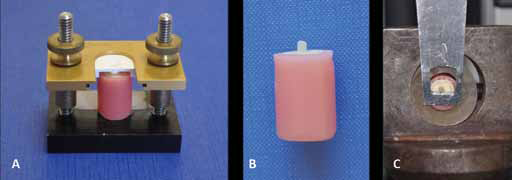
The self-etching dentin bonding agents were applied to each group. Group 1-G-Bond, group 2-Futura Bond, group 3-Adper Prompt-L-Pop Bond, and group 4-Clearfil S3 Bond were used for both permanent and primary dentin. Dentin adhesives were applied according to the manufacturers’ instructions. Information about the adhesives are presented in Table I. A halogen light curing unit (Hilux 200, Benlioglu Dental, Ankara, Turkey), which has a light intensity of 400 mW/cm2 was used. After the application of dentin bonding agents, a composite resin material (Z250 Restorative A2, 3M ESPE, St. Paul, MN, USA) was applied for permanent dentin and a compomer resin material (Dyract Extra A2, Dentsply, Germany) was applied for primary teeth dentin. All samples were made with the help of a teflon tube with an inner diameter of 2.34 mm and a height of 3 mm. All resin materials were carefully attached to the previously specified and prepared dentin surfaces by an impression putty mold (Fig. 1a). Composite and compomer resin materials were cured with a halogen curing light (Lunar Curing Light; Benlioglu Dental, Ankara, Turkey) according to the stipulated curing time, where light intensity was at least 400 mW/cm². After curing procedures, the Teflon tube was carefully removed from both the surrounding prepared composite and compomer samples (Fig. 1b). All specimens were stored in distilled water at 37°C for 24 h.
Adhesive systems used in this study
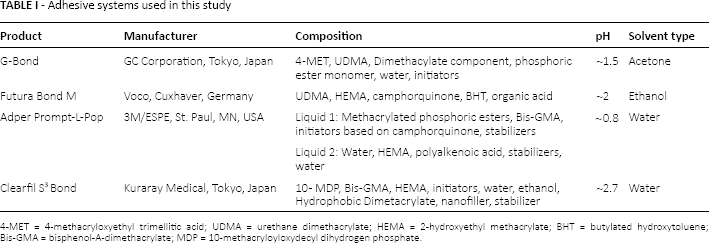
4-MET = 4-methacryloxyethyl trimellitic acid; UDMA = urethane dimethacrylate; HEMA = 2-hydroxyethyl methacrylate; BHT = butylated hydroxytoluene; Bis-GMA = bisphenol-A-dimethacrylate; MDP = 10-methacryloyloxydecyl dihydrogen phosphate.
(
Shear bond strength test
The specimens were debonded using a universal testing machine (Lloyd Instruments, Segensworth East Fareham, Hants, UK) at a crosshead speed of 1 mm/min at room temperature (23 ± 2°C) (Fig. 1c). The shear bond strength values were calculated by dividing the highest fracture force (Newton) with the bonded area (diameter 2.34 mm) and converted to megapascals (MPa).
Fracture analysis
After shear bond strengths were applied to resin-dentin bonded surfaces and the specimens were debonded, failure modes were recorded. For this purpose debonded areas were examined visually for their failure region and were also observed under a stereomicroscope (SZ 4045 TRPR; Olympus, Tokyo, Japan) at 25x magnification to evaluate the site of failure. There were 3 types of fracture: 1) Adhesive failure: the failure at the interface was between resin and dentin; 2) Mixed failure: the failure was partially adhesive and partially cohesive resin fractures and/or dentin fracture; 3) Cohesive failure: The failure was in the resin or dentin.
Statistical Analysis
First, 1-way ANOVA was performed to test whether there were any differences between the 4 different self-etching adhesive systems in a completely randomized design: Ŷij = μ + αi + eij where Ŷij are the values of shear bond, μ is the overall mean, αi is the effect of the ith self-etching adhesive systems and eij = residual error. Means were separated by using Tukey's multiple comparison. Significance was evaluated at P<0.05 for all tests. Second, independent sample t test analysis was performed to determinate the difference between the MPa values of permanent and primary dentine. The computational work was performed by means of MINITAB (MINITAB Statistical Software 13.20 (2000); Minitab, State College, PA, USA). Differences between the groups in terms of failure type was performed using a Kruskal Wallis H test. (SPSS 15 for Windows, SPSS, Chicago, IL, USA).
Results
The mean shear bond strength values measured in Newton and converted to MPa along with their standard error for all groups are presented in Table II. In addition, recorded failure modes as percentages are given in Table III. Note that the percentages were calculated by dividing the count in a cell by the number of observations in each subgroup. The average bond strength values for permanent and primary dentin were 16.84 MPa and 12.25 MPa, respectively.
Shear bond strength values obtained from the permanent and primary teeth
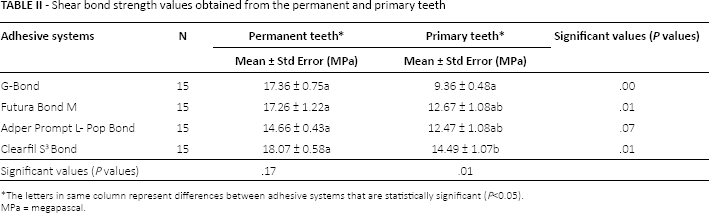
The letters in same column represent differences between adhesive systems that are statistically significant (P<0.05).
MPa = megapascal.
Fracture types
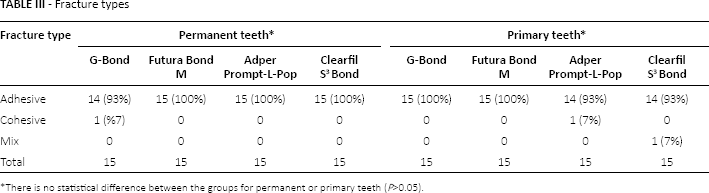
There is no statistical difference between the groups for permanent or primary teeth (P>0.05).
Although there was no statistically significant differences between adhesive systems in permanent teeth, tested conditions evaluated by Tukey test revealed that Clearfil S3 bond showed higher values (P>0.05). In primary teeth, Clearfil S3 bond values were statistically significantly higher than G-bond (P<0.05), but there was no statistically significant difference between Clearfil S3, Adper Prompt-L-Pop and Futura bond M (p>0.05).
In all adhesives (except Adper Prompt-L-Pop adhesive), there were statistically significant differences between bond strength values of permanent and primary teeth dentin groups (P<0.05).
With regard to the fracture type, the most common fracture type was the adhesive type, but there were no statistical differences between the groups in both permanent and primary teeth (P>0.05).
Discussion
In adhesive dentistry, the clinical success of composite and compomer resin restoration depends on the adhesive systems and the structure of enamel and dentin (22). Various tests can be used to evaluate this clinical success (11). In the present study, the shear bond strength test method is preferred. The shear bond strength of 4 self-etching adhesives which have different aggressiveness was evaluated in primary and permanent dentin surfaces.
Watanabe and Nakabayashi (23), for the first time, developed a self-etching system which is easily connected to enamel and dentin. Self-etching systems have hydrophilic and hydrophobic components; these components decrease the clinical application time and the technical sensitivity. Additionally, in self-etching systems, the washing stage of acidic gel and the risk of collapse of collagen are eliminated 23-24-25). Although self-etching adhesive systems have advantages such as quick and easy application and a reduction in the processing steps, the quality of the adhesion of the best of them is not adequate (26).
It was stated that the pH of the adhesive system and the type of solvent are important to get better bond strength (20). Zhang and Wang (21) claimed that the chemical reaction and interaction strongly depend on the aggressiveness of the adhesives. But Osorio et al (27) showed that strong self-etching adhesives (pH<1) containing water or acetone failed after 1 year of water storage. According to our results, Clearfil S3 bond, a mild self-etching adhesive, showed the highest bond strength values in permanent dentin surfaces. However, Adper Prompt-L-Pop bond, a strong self-etching adhesive, showed lower bond strength values than other adhesives in permanent dentin surfaces. In primary teeth, Clearfil S3 bond showed higher bond strength values than the G-bond, a moderate self-etching adhesive. This condition showed that strong (pH<1) or moderate (1H<pH<2) self-etching adhesives cannot always provide a high success rate in bond strength. In the present study, different bonding agents including water, ethanol, and acetone were used as the solvent. It was found that the type of solvent did not influence the bond strength.
Bolanos-Carmona et al (28) reported that the performance of different self-etching adhesives depends on the content of the products. Self-etching adhesives have different contents depending on the manufacturer. Thus, self-etching adhesives may exhibit high or low bond strength (28). Self-etching adhesives that have a high bond strength contain the most promising functional monomers. For instance, Clearfil S3 bond contains 10-MDP (Methacryloyloxydecyl dihydrogen phosphate-10) as a functional monomer. This monomer provides perfect chemical interaction between the bonding system and the calcium or hydroxyapatite. This interaction might have contributed to the superior and stable bonding effectiveness (20, 29, 30). The other probable reasons for Clearfil S3 exhibiting a higher bond strength are: the acidity of adhesives, the fact that resin monomers can penetrate into dentin, the content of the adhesive and the fact that it does not create aggressive demineralization.
Some researchers reported that dentin thickness is less for primary teeth than for permanent teeth and the adhesive is closer to the pulp. Additionally, there are physical, micromorphological, and chemical differences between primary and permanent teeth. These situations may cause the bond strength of the primary teeth to differ from that of permanent teeth (31-32-33-34-35-36). Koutsi et al (37) reported that there more dentinal tubules with a larger diameter in permanent teeth than in primary teeth. Thus, dentinal permeability and bond strength in primary teeth were affected. Conversely, Burrow et al (38) reported that lower bond strength values in primary teeth originated from the water content that originates from dentin near the pulp, and not from the intertubular dentin structure.
The results of our study are similar to previous studies by Can-Karabulut et al (39) and Courson et al (40). They reported that permanent teeth showed higher bond strength than primary teeth. Different restorative materials in the restoration of primary and permanent teeth were used in the previous studies. Our differences can be explained by the fact that these materials can lead to different bond strength values.
In this study, the most common fracture type was the adhesive type. Researchers observed that the adhesive failures between dentin and the bonding system occurred in lower bond strength values (40-41-42). But our results differ from theirs due to the different methods used in their studies. Also, other researchers reported that failure types were not correlated with bond strength values (43-44-45).
We evaluated the shear bond strength of 4 self-etch adhesives with different aggressiveness. Within the limitations of the experimental study, the following conclusions were drawn:
It was determined that adhesives with low pH do not provide greater shear bond strength values.
Self-etching adhesives with different pH and solvent types can be used successfully on the permanent teeth dentin, but Clearfil S3 should be preferred in the primary teeth dentin.
Functional monomers used in adhesive systems (such as 10-MDP) may lead to a better bond strength.
Footnotes
Acknowledgement
The authors are grateful to Mr. Soner Cankaya for his contribution in statistical analysis.
Financial support: The authors declare that there is no financial support.
Conflict of interest: The authors declare that they have no conflicts of interest.