




Abstract
Background
The purpose of the present study was to evaluate the effect of nanofillers on the mechanical properties of 2 sizes (diameters 0.6 and 0.9 mm) of conventional and nanofilled fiber-reinforced composites (FRCs) polymerized with conventional light-curing and additional postcuring.
Methods
The FRCs samples were divided into 8 groups (10 specimens each). Conventional FRCs with glass fibers preimpregnated with polymethyl methacrylate (groups 1, 2, 3 and 4) and FRCs with impregnating solution containing 32% nanofilled resin (groups 5, 6, 7 and 8) were tested in 2 different sections (0.6 and 0.9 mm in diameter). Two different polymerizations were analyzed: hand light-curing for 40 seconds with an halogen light, and additional postcuring for 25 minutes in a light-curing oven. Each sample was evaluated with a 3-point bending test on a universal testing machine, after 48 hours of dry storage. All of the data were statistically analyzed.
Results
After oven postcuring, nanofilled FRCs exhibited significantly higher load values than conventional FRCs. No significant differences were found when comparing conventional and nanofilled FRCs after hand light-curing. Moreover, 0.6-mm FRCs showed significantly lower load values than 0.9-mm FRCs, both for conventional and nanofilled FRCs.
Conclusions
Nanofilled FRCs showed higher load values after additional oven postcuring.
Introduction
Fiber-reinforced composites (FRCs), containing various fibers such as carbon, polyaramid, polyethylene and glass, have received increasing acceptance as restorative materials (1). Polyethylene fibers have been used in fixed partial denture (2), trauma stabilization (3), endodontic posts and cores (4), periodontal splinting (5), orthodontic fixed lingual retainers (6, 7) and space maintainers (8).
Recently, glass-reinforced fibers have been developed. The matrix is a light-cured thermoset bisGMA, which allows superior bonding, since it is identical to adhesives that are commonly used in dentistry (9). Embedding glass fibers into resin composite to reinforce the material properties has been reported to be indicated for several clinical applications such as periodontal tooth splinting, replacement of missing teeth, Maryland bridge, complete denture repair, overdenture components, direct construction of posts and cores (10-11-12-13-14-15). Mechanical (10-11-12-13) and clinical efficacy (14, 15) of FRCs has been extensively tested. However, FRCs still present some drawbacks, such as low wear resistance, possibility of bulk fracture, microleakage and adhesive failure. Measures to solve these problems included increasing the inorganic filler content, reduction of filler size and modification of the polymerization system (16). In fact the mechanical properties of composite-based materials depend highly on the concentration and particle size of the filler. The compressive strength, hardness, flexural strength and elastic modulus increase with the amount of inorganic fraction, while the polymerization shrinkage has been reported to decrease (17).
Nowadays, nanotechnology has been introduced in the dental field. The main point involved with this new trend is the addition of nanofillers particles to resin-based dental materials (18). Restorative materials with nanomer-sized particles have been tested, and an increased filler loading has been demonstrated to involve better physical properties and improved polish retention (18).
Mechanical properties such as polymerization efficiency would need to be evaluated before new nanofilled FRCs could be recommended for specific dental applications. The use of postcuring ovens to postcure light-cured resin composites can lead to a decrease in the negative effects of polymerization shrinkage and an increase in the hardness and wear resistance of the material (19). In fact in literature, there are no studies that have evaluated the effect of additional postcuring on mechanical characteristics of nanofilled FRCs.
Accordingly the purpose of the present investigation was to evaluate and compare deflection strengths of conventional and nanofilled FRCs of 2 different sizes (diameter: 0.6 mm and 0.9 mm) tested both after hand light-curing and after secondary heating oven curing.
The null hypothesis of the study was that there were no significant differences between conventional and nanofilled FRCs of the 2 different diameters, either under conventional or after postcuring polymerization.
Material and methods
Conventional and nanofilled FRC specimens were tested in the present investigation.
Conventional FRCs (groups 1-4) were constituted of 600/900 E-glass fibers (Ahlstrom, Helsinki, Finland) silanated and preimpregnated with polymethyl methacrylate (PMMA) and bisphenol A glycidyl methacrylate (bis-GMA). Nanofilled FRCs (groups 5-8) were constituted of an impregnating solution containing about the 32% of nanofilled resin (Nanocryl; Hanse Chemie, Geesthacht, Germany) that possess 50% colloidal silica particles. Two FRCs sections were evaluated: 0.6 and 0.9 mm in diameter.
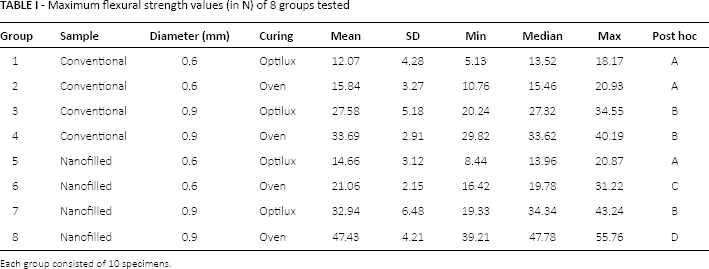
The FRCs samples were divided into 8 groups, each consisting of 10 specimens (Tab. I); before polymerization, all 80 specimens were cut to a size of 20 mm with scissors and handled according to the manufacturer's guidelines. Both conventional (groups 1-4) and nanofilled (groups 5-8) FRCs were tested in 2 different sections
Maximum flexural strength values (in N) of 8 groups tested
Each group consisted of 10 specimens.
All FRCs were light-cured by hand with a halogen curing unit (Optilux 501; SDS Kerr, Danbury, CT, USA; light intensity 930 mW/cm2; wavelength range 400-505 nm) for 40 seconds. The internal radiometer device of the curing unit measured the light intensity. Subsequently, FRCs of groups 2, 4, 6 and 8 were polymerized for a further 25 minutes in a light-curing oven (Targis Power; Ivoclar Vivadent AG, Schaan, Liechtenstein; with 8 lamps Osram Dulux 18 w/71).
The samples were stored under dry conditions for 48 hours and then evaluated with a 3-point bending test. The span length between supports was 14 mm, and the crosshead speed was 1 mm/min (20). The load was applied with a universal testing machine (Lloyd LRX; Lloyd Instruments, Fareham, United Kingdom) to the middle of the test specimens. The flexural strength values were recorded with Nexygen MT software (Lloyd Instruments). The interpoint load distance was 7 mm. The middle point of the machine was moved by a computer-controlled stepper motor, and at the same time, the force and the position of the middle point of the machine associated with the passive position were recorded by electronic sensors. All 10 samples for each group were tested at 1-mm deflection. The mechanical parameter considered was the maximum load value for each specimen.
Statistical analysis was performed with Stata 10 (StataCorp, College Station, TX, USA), and descriptive statistics were calculated (mean, standard deviation, median, minimum and maximum values).
Normality of the distributions was assessed with the Kolmogorov-Smirnov test. A multifactor analysis of variance (ANOVA) was applied to determine whether there were significant differences among the various groups. Tukey post hoc test was applied. Significance for all statistical tests was predetermined as a p value <0.05.
Results
Descriptive statistics for the values of maximum load (N) of the 8 groups tested included mean, standard deviation, median, minimum and maximum (Tab. I; Fig. 1). The results of ANOVA indicated significant differences among the various groups. Tukey test showed that, after oven postcuring, nanofilled FRCs exhibited significantly higher load values than conventional FRCs (p<0.05). No significant differences were found when comparing conventional and nanofilled FRCs after hand light-curing (p>0.05). Moreover, 0.6-mm FRCs showed significantly lower load values than 0.9-mm FRCs, both for conventional and nanofilled FRCs (p<0.001).
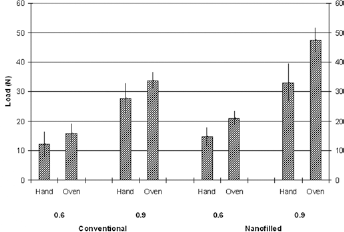
Mean flexural strength values (N) of the conventional and nanofilled fiber reinforced composites (FRCs) with diameters 0.6 mm and 0.9 mm, polymerized with conventional hand halogen curing unit and after additional oven postcuring.
Additional postcuring determined a significant increase in load values for nanofilled FRCs (p<0.01), whereas no significant increase was found for conventional FRCs (p>0.05).
Discussion
The null hypothesis of the study was rejected. In the present investigation, the presence of nanofillers improved flexural strength values, but the increase was significant only after oven postcuring. Reinforcement of polymers with long, continuous fibers has been established as an effective means of developing engineering materials for a wide range of applications. FRCs are successful primarily because of high stiffness/weight (specific modulus) and strength/weight (specific strength) when compared with other structural materials (21). To be considered a viable alternative to existing dental materials, FRCs must be evaluated for their mechanical properties such as polymerization efficiency, before they can be recommended for specific applications. It was suggested that postcuring oven polymerization of light-cured composites decreases the negative effects of polymerization shrinkage and increases the hardness and wear resistance of the material (19). A previous investigation (22) evaluated the effect of oven postcuring on mechanical properties on conventional FRCs. No significant difference was found between the hand light-cured and the postcuring oven-polymerized conventional FRCs groups. This is in agreement with our results reported when testing conventional FRCs.
Moreover, in the present study, nanofilled FRCs were evaluated. Nanotechnology is the production of functional structures in the range of 0.1-100 nm by various physical or chemical methods (23). Dental nanocomposites provided a cosmetically acceptable result with excellent mechanical properties (24, 25). In fact in the present report, the introduction of nanofillers had no influence on FRCs polymerized with conventional hand light-curing for 40 seconds. On the contrary, when testing FRCs after postcuring polymerization, nanofilled fibers showed significantly higher load values than conventional fibers. A possible explanation could be that the intensity of light at a given depth and for a given irradiance period is a critical factor in determining the extent of reaction of monomer into polymer, typically referred to as the degree of conversion, and significantly associated with values of mechanical properties (26). The extent of resin cure is affected mainly by monomer and activator type, light source intensity, duration of exposure and filler type and size (27). According to SEM observations, some authors have demonstrated that different curing units did not influence the superficial morphology of composite resins (28). Even if no morphology alteration has been reported, it has been shown that postcuring oven treatment increased the surface microhardness of composites (29). Previous reports showed the effect of postcuring on conventional FRCs (22). To our knowledge, no studies have evaluated the effect of oven postcuring on nanofilled FRCs.
Moreover, in the present investigation, 0.6-mm FRCs showed significantly lower load values than 0.9-mm FRCs, both for conventional and nanofilled FRCs. This is in agreement with previous studies that evaluated, with a 3-point bending test, conventional FRCs with different diameters (20, 22, 30).
In the literature, there are no reports of studies that have evaluated mechanical properties of nanofilled FRCs, therefore further investigations will be necessary to deepen and enable a discussion of the preliminary results of the present report.
Conclusions
Within the limitations of the present study, this investigation demonstrated that after oven postcuring, nanofilled FRCs exhibited significantly higher load values than conventional FRCs. No significant differences were found when comparing conventional and nanofilled FRCs after hand light-curing. Moreover, 0.6-mm FRCs showed significantly lower load values than 0.9-mm FRCs, both for conventional and nanofilled FRCs.
Footnotes
Financial support: None.
Conflict of interest: None.