






Abstract
Background
The endothelial form of nitric oxide synthases (eNOS) seems to have an important role in vascular development, maintenance of the vascular tone and tumor growth in human prostate cancer (PC). The purpose of this study was to investigate the association between grade and stage of disease, age of diagnosis, vascular or perineural invasion, pre-diagnostic plasma prostate-specific antigen (PSA) levels, prostate cancer risk and Glu298Asp polymorphism of the eNOS gene.
Methods
Ninety-five prostate cancer patients and 111 benign prostate hyperplasia subjects were included. The Glu298Asp polymorphism of the eNOS gene was determined by polymerase chain reaction and restriction fragment length polymorphism
Results
The odds ratio (OR) between the GT and GG polymorphism was 0.76, indicating that the presence of the GT polymorphism decreased the risk of prostate cancer of more than 20% compared to the GG polymorphism. This difference, however, was not statistically significant. The GT polymorphism had an inverse association with cancer grade compared to the reference group (OR=0.47, p value=0.2).
Conclusions
These results suggest that prostate cancer development is not associated with the Glu298Asp polymorphism of the endothelial nitric oxide synthase gene in our population. Further studies in larger samples are needed to confirm our results and characterize the molecular mechanisms by which eNOS is involved in the susceptibility to prostate cancer.
Keywords
Introduction
Age, race, and family history of prostate cancer are well-established risk factors for prostate cancer (1); recently, several additional genetic risk factors have been identified for this disease (2-5). Genetic factors have been extensively studied in different countries. There are conflicting results from studies on the association of some genetic polymorphisms with prostate cancer. These different results may partly be explained by ethnic differences.
Various studies suggest that NO levels increase with cancer and inflammation, and this may have a bimodal behavior during cancer development. Detection of genetic alterations may be a useful tool as a molecular indicator of prognosis. The eNOS3 gene is located at 7q35-q36 and seems to have an important role in mechanisms such as vascular development, maintenance of vascular tone and tumor growth in human prostate cancer (6, 7).
NO is synthesized by at least 3 isoenzymes of NO synthase (NOS), of which one is called endothelial NOS (eNOS) and is located at 7q35-36. eNOS has an important role in vascular development and carcinogenesis (8). Various genetic polymorphisms of eNOS have been previously described (9).
Genetic polymorphisms in the eNOS gene may be responsible for variations in the genetic control of plasma NO (10, 11). Recently, a point mutation of guanine to thymine at nucleotide position 1917 in the eNOS gene (Glu298Asp polymorphism in exon 7) has been reported (12, 13).
Genetic studies are beginning to delineate the association between genetic polymorphisms and possible outcomes. Prostate tumors have a generally poor prognosis, and the connections between tumor development and clinical outcomes are still not well understood. These connections may be determined by genetic variation. Genetic factors have been extensively studied in different countries, but until now the studies on some gene polymorphisms in association with prostate cancer have led to conflicting results. These different results may partly be explained by ethnic differences. Most of the studies have been performed in populations of European origin, whereas the effect of these risk variants in other populations is still unknown.
In this study, we characterized for the first time the relation between the Glu298Asp genotypes and the risk of prostate cancer, tumor stage and grade and serum prostate-specific antigen (PSA) levels in a group of Iranian patients with prostate cancer. The present study is the first of this kind conducted in an Iranian population.
Materials and Methodspatients and Samples
This case-control study comprised a total number of 206 subjects, including 95 patients with prostate cancer (PC) and 111 controls with benign prostatic hyperplasia (BPH), recruited between February 2010 and April 2011 at the department of Urology at the Shahid Labbafinejad Hospital, in Tehran (Iran).
For all the cases written informed consent was obtained and a structured questionnaire was completed to obtain information on potential risk factors including age, BMI, history of prostate cancer on first degree relatives, blood group, total and free PSA levels.
Blood samples were taken using sample tubes containing EDTA and DNA extraction was performed according to the salting out method (14). All purified DNA samples were stored at 4°C. Factors such as diagnosis, tumor volume, pathological stage and grade, perineural and vascular invasion were determined according to the pathological reports of open laparoscopic/radical prostatectomy. PC patients had radical prostatectomy while BPH subjects had open suprapubic prostatectomy.
The control group with BPH had to fulfill the following criteria in order to decrease the likelihood of misdiagnosed prostate cancer: (i) either serum PSA <4.0 ng/mL or, if >4.0 ng/mL, pathological reports showing no malignancy at transrectal ultrasound guided prostate biopsy; (ii) normal digital rectal examination (DRE); (iii) confirmed absence of malignancy on pathological prostatic tissue samples from open prostatectomy.
Genotyping of the Glu298Asp polymorphism
eNOS genotyping for the Glu298Asp mutation was performed as described by Hingorani et al (15). The primers used were 5′-CATGAGGCTCAGCCCCAGAAC-3′ (forward) and 5′-AGTCAATCCCTTTGGTGCTCAC-3′ (reverse). DNA was amplified for 30 cycles, each cycle comprising denaturation at 95°C for 1 minute, annealing at 60°C for 1 minute, extension at 70°C for 1 minute with a final extension time of 5 minutes at 70°C. The initial denaturation stage was carried out at 95°C for 5 minutes. PCR products were digested with the restriction enzyme MboI at 37°C for 16 hours. In the presence of a T at nucleotide 894, which corresponds to Asp 298, the 206 bp PCR product was cleaved into 2 fragments of 119 and 87 bp. The PCR products were separated on a 2.5% agarose gel and identified by ethidium-bromide staining (Fig. 1).
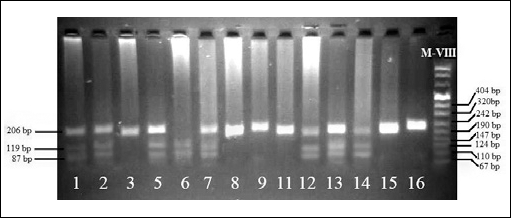
Representative screening for the eNOS GT polymorphism; genotype TT: 119 bp and 87 bp band; genotype GG: 206 bp band, or genotype GT: all 206 bp, 119 bp and 87 bp bands.
Statistical analysis
Data analysis was performed with STATA (V.11) software. The chi-square test and student T test were respectively used to evaluate the association between categorical variables and to compare the mean values of variables. Serum PSA levels were log transformed and linear regression models were fitted to estimate the effect of the polymorphisms on total serum PSA; logistic regression models were used to determine the odds ratio (OR) for categorical dependent variables. Results were considered significant if p values were less than 0.05.
Results
Subject characteristics
The age of the subjects considered in our study ranged between 47 and 89 years, with an average ± standard deviation of 67±8.7 years. Patients with PC were, on average, 7 years younger than BPH subjects (p<0.001). As expected, the mean levels of total PSA were significantly higher in the patients' group (467 ng/dL) than in the BPH controls (p<0.001). Similarly, in the patients' group, the percentage of positive family history of cancer was significantly greater than that in BPH controls (17.4% versus 1%, p<0.001). The overall education level of PC patients was significantly greater than that of BPH controls (p<0.001). Among PC patients 31% had poorly differentiated tumors (Gleason score ≥7) and 21% were at an advanced tumor stage at the time of diagnosis (TNM stage III, IV).
Genotypes and risk of prostate cancer
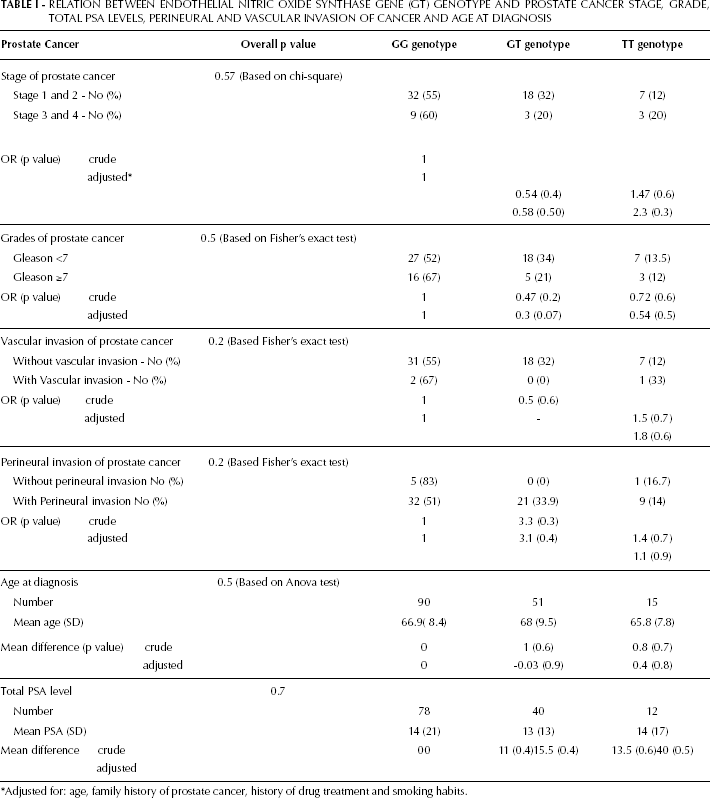
Considering the GG genotype as reference group, the GT polymorphism showed a reverse association with cancer grade compared to the reference group (adjusted OR: 0.3; 95%CI: 0.08-1.06; p=0.06). The crude OR between the TT genotype and cancer grade was 0.92 (95%CI: 0.19-4.5; p=0.9) indicating that the presence of this genotype decreased the risk of having a high Gleason grade compared to the GG genotype.
The OR between the various genotypes of the eNOS polymorphism and advanced stages of prostate cancer was lower than 1 for GT (0.6; 95%CI: 0.13-2.89; p=0.5) and higher than 1 for the TT genotype (2.31; 95%CI: 0.44-12.2; p=0.3) compared to the GG genotype as reference group.
Considering the GG genotype as reference group, the OR between the GT genotype and vascular invasion was 0.74 (95%CI: 0-9.8; p=0.8) indicating that the presence of this genotype decreased the risk of vascular invasion compared to the GG genotype. In other words, the GT genotype had a protective effect on progression to vascular invasion of the tumor, although this result was not statistically significant. On the other hand, the OR between the TT genotype and vascular invasion was higher than 1 (2.16; 95%CI: 0.03-47.3; p=0.9); this indicates that the presence of the TT genotype was associated with vascular invasion, although the result was not statistically significant even after adjustment for potential confounders (OR=1.9; 95%CI: 0.03-23; p=1). Compared to the GG genotype as reference group, the OR between the GT genotype and perineural invasion in pathological specimens of PC patients was 4.2 (95%CI: 0.54-11; p=0.2) indicating that this genotype had an harmful effect on the development of perineural invasion and increased the risk of invasion more than 4 times compared to the reference group. This result of OR was reduced after adjustment for potential confounders (age, family history of cancer and personal history of drug use) to 3.1 (95%CI: 0.4-13.1; p=0.4), however in both conditions the association was not statistically significant.
Among PC patients the mean difference in terms of age between patients with the GT genotype and the GG genotype was of 1 year, whereas it was of 0.8 years between patients with the TT genotype and the GG genotype. This suggests that patients with the GG polymorphism had, on average, lower ages than the rest of the patients.
With regard to the mean values of total PSA in serum, patients with the GT genotype had, on average, higher PSA levels (the difference in the means was of 11 ng/mL) than those with the GG genotype. This suggested that there was a positive association between this genotype and the total serum PSA, however the result was not statistically significant. Moreover there was no significant difference in the mean values of total PSA between patients with TT and GG genotypes (the mean difference was of 13.5 ng/mL, p=0.6). However, after adjusting for other factors the patients who had the TT genotype had, on average, 40 ng/mL total PSA more than those who had the GG genotype. Therefore the TT genotype had a detrimental effect on serum PSA levels although the result was still not statistically significant (p=0.5) (Tab. I).
RELATION BETWEEN ENDOTHELIAL NITRIC OXIDE SYNTHASE GENE (GT) GENOTYPE AND PROSTATE CANCER STAGE, GRADE, TOTAL PSA LEVELS, PERINEURAL AND VASCULAR INVASION OF CANCER AND AGE AT DIAGNOSIS
Adjusted for: age, family history of prostate cancer, history of drug treatment and smoking habits.
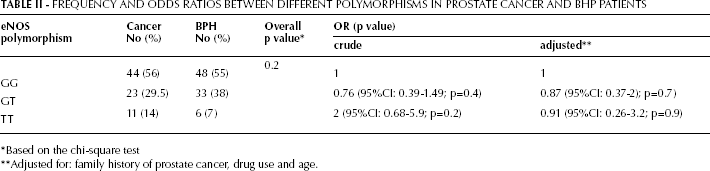
The OR of the GT the genotype was 0.87 (95%CI 0.37-2; p=0.7). Similarly, subjects with the TT genotype had a decreased risk of cancer compared to those with the GG genotype, but this was again not statistically significant (adjusted OR=0.91; 95%CI: 0.26-3.2; p=0.9) (Tab. II).
FREQUENCY AND ODDS RATIOS BETWEEN DIFFERENT POLYMORPHISMS IN PROSTATE CANCER AND BHP PATIENTS
Based on the chi-square test
Adjusted for: family history of prostate cancer, drug use and age.
The allele frequency of eNOS
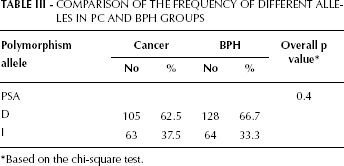
In the eNOS polymorphism the OR between the presence of the G allele and cancer was 0.86, indicating that the presence of the G allele decreased the risk of cancer of about 14%. This suggests that there is a reverse association between this allele and the development of PC (Tab. III).
COMPARISON OF THE FREQUENCY OF DIFFERENT ALLELES IN PC AND BPH GROUPS
Based on the chi-square test.
Discussion
PC is one of the most common malignancies in men. There is a variety of genetic polymorphisms that may have an etiologic role in PC. There are few studies concerning the relationship between the eNOS genotypes and PC risk. The analyses of these genetic polymorphisms may represent a helpful tool as a molecular indicator of prognosis.
In this study, we assessed the relation between the eNOS polymorphism and the risk of PC, tumor stage and grade and serum PSA level. After adjusting for potential confounders, such as family history of prostate cancer, history of drug treatment for prostate disorders and smoking habits, the TT genotype had a protective effect for developing poorly differentiated malignancy (Gleason score >7), although this effect was not statistically significant. In our study the GT genotype decreased the risk of developing advanced stages of cancer by more than 40%, but the possession of the TT genotype increases this risk more than twice compared to the GG genotype. This suggested that the GT genotype had a protective effect on more advanced stages of cancer while the TT genotype was positively associated with the advanced stages compared to the genotype in the reference group. These results, however, were not statistically significant even after adjustment for potential confounders.
The GG genotype had a reducing effect on the onset and the time of diagnosis of PC although even the adjusted effect was not statistically significant. Possession of the GT genotype decreased the risk of PC by more than 10% compared to the GG genotype (used as reference genotype).
The majority of PC cases are unlikely to be due to major susceptibility genes (16-18) and genetic polymorphisms are likely to be more important from a public health perspective. In a study by Medeiros et al in the Portuguese population, the authors showed that the GG genotype was associated with advanced stages of the disease and they identified the GG genotype as a parameter predictive of metastasis (19). Marangoni et al have shown in 2006 that the GG and GT Glu298Asp genotypes were associated with positive prostate cancer antigen expression in peripheral blood, presenting a 3.32-fold higher risk of PC occurrence (20). The authors also concluded that the G allele may have a secondary influence on PC predisposition, but an essential role on tumor cells hematogenous dissemination, probably due to the angiogenic stimulus (20).
Our results showed that the presence of the GT genotype decreases the risk of PC by more than 10% compared to the GG genotype, used as reference group. In another study by Lee et al it was shown that polymorphisms of the NOS genes are genetic susceptibility factors for PC, especially for the more aggressive forms of the disease (21). The frequency of the Glu298Asp genotype is reported in the general population in a Japanese study (82.6% GG; 17.4% GT; and 0% TT) (13) and in a study in the French population (42.5% GG; 42.5% GT; and 15.0% TT) (22).
In our study the frequency of the G allele in the BPH group was higher than in the group of patients with PC and the presence of the G allele decreased the risk of cancer of about 14%.
In conclusion, in a population of Iranian men with PC the Glu298Asp polymorphism seems not to be associated neither with the risk of PC and serum PSA levels nor with the advanced PC stage and grade. Additional studies in larger cohorts are needed to confirm these results and to establish a genetic profile that may be helpful in the prediction of the outcome of PC in Iranian patients.
Footnotes
ACKNOWLEDGMENTS
We thank all those who collaborated with us in this survey.