






Abstract
The emotional deficit perspective predicts that youth with psychopathic traits are relatively unresponsive to negative affective cues and display smaller attentional biases for affective stimuli following negative experiences than youth without psychopathic traits. In contrast, because the negative preception hypothesis predicts that youth with psychopathic traits learn to tune out negative affective experiences, it predicts that such youth exhibit greater attentional biases away from sadness-related stimuli following negative experiences than youth without psychopathic traits, and that these biases increase with age. This study was designed to test the conflicting predictions of the emotional deficit perspective and the negative preception hypothesis by administering an affective dot probe task to 135 male and female detained adolescents (13.06 to 17.62 years of age) following a frustration experience. Analyses showed that age moderated the impact of psychopathic traits: as age increased, higher levels of the affective-interpersonal component of psychopathy were associated with increasing attentional bias away from both sadness-related and happiness-related stimuli. These findings provide initial evidence corroborating the negative preception hypothesis in youth with psychopathic traits.
Introduction
The increasing evidence for the reliability and construct validity of ratings and self-reports of psychopathic traits in youth has encouraged the application of theoretical perspectives validated in adults to the study of mechanisms underlying psychopathic traits in youth (Frick & White, 2008; Kosson, Cyterski, Steuerwald, Neumann, & Walker-Matthews, 2002; Salekin, 2006).
1
One influential set of theoretical approaches on psychopathy can be collectively termed
Validity of a psychopathy syndrome among youth
There is substantial evidence that psychopathy ratings in adolescent males provide valid indicators of a syndrome comprised of psychopathic features. Although less extensive and consistent than in males, there is also evidence for the validity of psychopathy in adolescent females (Bauer, Whitman, & Kosson, 2011; Vincent, Odgers, McCormick, & Corrado, 2008). 2 A similar factor structure seems to underlie psychopathy scores in both youth and adults; in both adolescents and adults, variance in clinical measures of psychopathy appears to reflect a constellation of core affective and interpersonal traits (commonly referred to as Factor 1) and a group of antisocial and lifestyle traits (commonly referred to as Factor 2; Jones, Cauffman, Miller, & Mulvey, 2006; Kosson et al., 2013; Neumann, Kosson, Forth, & Hare, 2006; see Frick, Bodin, & Barry, 2000, for evidence of a somewhat similar set of dimensions in parent- and teacher-ratings of psychopathic traits in youth). The interpersonal-affective component reflects self-centered, manipulative, and deceptive behaviors and evidence of a lack of empathy and callousness toward others; in contrast the antisocial lifestyle component reflects impulsive, irresponsible behavior and early, persistent, and versatile antisociality (e.g., Hare, 2003; Harpur, Hare, & Hakstian, 1989). Parent and teacher ratings of psychopathic traits in youth exhibit moderate stability over time (Frick, Kimonis, Dandreaux, & Farell, 2003; Lynam, Caspi, Moffitt, Loeber, & Stouthamer-Loeber, 2007), and clinical ratings demonstrate relatively high stability over time (Hemphälä, Kosson, Westerman, & Hodgins, 2015). Psychopathy ratings in male youth are associated with many of the same criteria as Psychopathy Checklist-Revised (PCL-R) ratings in adults, including violent criminal behavior, violations of institutional rules, passive avoidance and emotional processing deficits (Corrado, Vincent, Hart, & Cohen, 2004; Murrie, Cornell, Kaplan, McConville, & Levy-Elkon, 2004; Vitale, Newman, Serin, & Bolt, 2005), and anomalies in autonomic and regional brain activation akin to those identified in adult psychopathic offenders (Finger et al., 2008; Fung et al., 2005). However, some of the emotional processing and physiological anomalies observed in youth with psychopathic traits can be explained in two different ways.
Emotional deficits in youth with psychopathic traits
The emotional deficit perspective is widely considered one of the most promising explanations for psychopathy in adults. Although there are several distinct theories within this overarching perspective, they share the premise that a genetic/biological diathesis leads to reduced emotional responsiveness in early childhood which underlies the development of psychopathic traits during childhood or adolescence (Blair, Peschardt, Budhani, Mitchell, & Pine, 2006; Fowles, 1980; Frick & White, 2008; Lykken, 1995). Cleckley (1988) argued that psychopathic individuals are fundamentally and generally lacking in emotional capacity and are less responsive than others to most kinds of emotion cues. Several other theoretical perspectives posit more specific forms of unresponsiveness. In contrast, the integrated emotions system (IES) model (Blair, 2013) suggests a more specific incapacity to appreciate sadness, fear, and happiness, emotions that are reportedly critical to learning the impact of a person’s actions on other people. More concretely, to the extent that young children predisposed to develop psychopathic traits fail to experience these emotions, they are less likely than other children to form stable attachments to caregivers, less likely to develop empathy for others, and less likely to learn to inhibit antisocial behaviors. Accordingly, youth with psychopathic traits will be less responsive than most others to happiness, sadness, and fear stimuli. Other perspectives posit a still more narrow emotion deficit. Notably, Lykken’s low fear hypothesis (1995; Patrick, 2007) suggests the emotion deficit may be specific to fear.
Both the general emotion deficit perspective and the IES model provide parsimonious explanations for many behavioral deficits and physiological anomalies seen in psychopathic adults and are congruent with findings from several studies of youth with psychopathic traits. Such youth display poor affect recognition (Blair, Budhani, Colledge, & Scott, 2005), reduced impact of emotional information on language processing and memory (Dolan & Fullam, 2010; Loney, Frick, Clements, Ellis, & Kerlin, 2003), reduced electrodermal reactivity to distress cues (Blair, Jones, Clark, & Smith, 1997), and reduced amygdala activity while viewing affective faces (Marsh et al., 2008).
In recent years, the dual process theory of psychopathy has suggested that the two major components of psychopathy are associated with different kinds of emotional processing dysfunctions. Based on links between Factor 2 traits and conduct problems and impulsivity and proneness to experience negative affectivity, Dindo and Fowles (2011) have proposed that the antisocial lifestyle (or Factor 2) components of psychopathy are associated with difficulty regulating emotion (leading to enhanced responsiveness to emotional triggers). However, the dual process theory view of Factor 1, like the IES model, argues that the core interpersonal and affective (or Factor 1) components of psychopathy reflect a temperamental emotional deficit associated with reduced emotional responsiveness to emotion cues. In short, both the general emotion deficit perspective and several specific emotion deficit theories emphasize links between the interpersonal affective core of psychopathy and reduced responsiveness to several specific emotions. 3
An alternative perspective on emotional processing and psychopathy
However, in recent years, there have been reports of empirical findings in adult and in adolescent samples that appear inconsistent with emotion deficit perspectives. These findings include both: 1) evidence of physiological responsiveness under conditions designed to induce affective experiences and 2) evidence of dynamic changes in the apparent emotional responsiveness of psychopathic offenders as a function of changes in attentional cues, instructions, and simple task parameters. Because the evidence for physiological responsiveness under affective conditions is also the evidence that spawned the negative preception hypothesis, we present this evidence below (see
Here, we summarize recent findings suggesting greater variability in emotional responsiveness – rather than consistent unresponsiveness -- among individuals with psychopathic traits than among individuals without such traits. This variability is evident in physiological reactivity, in affective circuity, and in performance/behavioral measures. Newman and colleagues reported that psychopathic offenders exhibit both inhibited startle amplitude and reduced amygdala activation during emotional processing when they are distracted by other tasks or demands but that both anomalies disappear when participants are instructed to attend directly to affective stimuli; under these conditions, psychopathic offenders show normal startle reflex potentiation and normal increases in amygdala activation (Larson et al., 2013; Newman, Curtin, Bertsch, & Baskin-Sommers, 2010). In addition, Arbuckle and Shane (2016) reported that, under baseline conditions, offenders with psychopathic traits exhibited reduced hemodynamic responses to affective conditions, but these same individuals demonstrate a greater ability to enhance activity in limbic and paralimbic areas in response to simple instructions. Additional evidence for greater responsiveness of affective circuitry to changes in instructions in offenders with psychopathic traits has been reported in recent studies of empathic responsiveness (e.g., Decety, Chen, Harenski, & Kiehl, 2013; Meffert, Gazzola, den Boer, Bartels, & Keysers, 2013).
Other recent studies suggest that the facial affect recognition deficits associated with psychopathy may be moderated by changes in stimulus duration. In two different samples, individuals with psychopathic traits demonstrate a greater impairment in classifying affective stimuli when affective cues are presented only briefly than when they are presented for longer intervals (e.g., Salvador-Silva, Vasconcellos, Kosson, Hauck-Filho. & Arteche, 2015; Vasconcellos, Salvador-Silva, Gauer, & Gauer, 2014). Such findings suggest that some of psychopathic offenders’ performance impairments can be eliminated by increasing the duration of affective stimuli. Additional relevant evidence was presented by Levenston, Patrick, Bradley, and Lang (2000). 4
In addition to this variability, the relationship between negative affectivity and psychopathic traits is different in children, where it is often positive (e.g., Bauer et al., 2011; Kubak & Salekin, 2009; Schmidt, McKinnon, Chattha, & Brownlee, 2006), than in adults, where there is usually no significant zero-order relationship between negative affectivity and psychopathy (Hale, Goldstein, Abramowitz, Calamari, & Kosson, 2004; Hare, 2003; Schmitt & Newman, 1999). In fact, two recent longitudinal studies report that greater negative affectivity and fear reactivity in the second year of life is associated with higher levels of psychopathic traits in the sixth year of life (Gorin et al., 2018; Mills-Koonce et al., 2015). We argue that these findings suggest the value of an alternative perspective on emotional function in psychopathy that we call
The negative preception hypothesis
The term negative preception was coined by Lykken to explain findings on individuals with psychopathic traits in the countdown paradigm (e.g., see Lykken, Macindoe, & Tellegen, 1972). The paradigm instructs individuals to watch as a number display counts down to zero, at which point they are administered a noxious stimulus, e.g., an electric shock (in older studies) or a loud noise (in more recent studies). During anticipation of predictable noxious stimulation, psychopathic offenders manifest
Negative preception refers to a specific mechanism proposed to underlie this pattern of psychophysiological functioning. Hare (1978) theorized that the HR increase reflected an active coping response, while the reduced electrodermal activity reflected the effectiveness of this coping response, and that the pattern of findings indicated that psychopathic offenders were very effective at coping with the noxious stimulus. Lykken referred to this coping response as
Penney and Kosson (2015) proposed an extension of the negative preception hypothesis. They argued that youth with psychopathic features learn to attenuate not only the impact of noxious external stimulation (such as loud noises or punishments), but also many internal negative emotional experiences such as sadness and anxiety. In a manner akin to Lykken’s account of negative preception, this more generalized attenuation mechanism is said to achieve a reduction in the intensity of affective responses. Moreover, because the short-term elimination of negative emotional experience results in relief, the process of negative preception is negatively reinforced. However, over time, as some boys and girls are becoming increasingly reliant on this maladaptive attenuation of emotional responses, this short-range “benefit” contributes to a series of destructive developmental outcomes: youth who tune out their own negative emotions gradually become less in touch with the affective responses of others (which might otherwise trigger affective responses in themselves) and lose the opportunity to learn from their own emotional responses. Further, the consistency with which the negative preception mechanism is employed was said to contribute to the automatization of the process. In short, as the attenuation of emotional responding becomes increasingly automatic, it promotes the development of an impoverished affective life and a limited understanding of the experience of others, including difficulty learning from negative emotions, reduced awareness of others’ emotional states, impairments in empathy, reduced attachment to others, and difficulty processing affective information. In addition, along with automaticity comes a resistance to altering the automatic attenuation process. It is noteworthy that the negative preception hypothesis posits substantial resistance to processing emotion but not an incapacity for entering into emotional experiences of others (see Penney & Kosson, 2015, for additional discussion of these issues and for a fuller discussion of the role of negative preception within a larger theory of impaired affect regulation in psychopathy).
In summary, both the negative preception and the emotion deficit perspectives argue that some youth and adults with psychopathic traits exhibit an apparent reduction in emotional responsiveness. The two hypotheses differ with respect to the nature and cause of this reduced emotional responsiveness: The negative preception hypothesis suggests that this emotional unresponsiveness reflects a maladaptive developmental process rather than a biologically based affective deficit.
The negative preception hypothesis also provides relatively parsimonious explanations for all of the findings noted above that appear to contradict the emotion deficit perspectives. First, we address the shift from positive correlations between negative affectivity and psychopathic traits in youth to non-significant correlations in adults. Because negative preception is said to develop over time, the negative preception hypothesis predicts that, as youth rely increasingly on negative preception to attenuate negative affective experiences, the abatement of negative emotional experiences becomes increasingly effective and increasingly automatic, and contributes to a reduction in the subjective awareness of negative affective states. 5
The negative preception hypothesis can also account for recent evidence of dynamic changes in the emotional responsiveness of psychopathic offenders as a function of attention manipulations. Because chronic distancing from one’s own negative affective experiences should make emotional processing more difficult and more effortful, the negative preception hypothesis predicts that the emotional impairments of individuals with psychopathic traits will depend on situational factors that impact their ability to allocate effort to overcome their automatic distancing from several negative emotions. The need for a greater investment of time and effort can explain the ability of psychopathic individuals to increase processing of threat stimuli and display startle potentiation and normal amygdala reactivity to threats, and why offenders with psychopathic traits often appear to have reduced hemodynamic responses to affective conditions but demonstrate an unusual ability to enhance activity in limbic and paralimbic areas in response to simple instructions (Arbuckle & Shane, 2016). Further, it explains recent findings suggesting greater impairment in affect recognition for individuals with psychopathic traits when affective cues are presented only briefly than when they are presented for longer intervals.
In its emphasis on the automatic recruitment of (maladaptive) coping resources in the face of emotional provocation, the negative preception hypothesis also calls attention to one important limitation of many prior studies. In reviewing the literature on psychopathy and emotional function, Kosson, Vitacco, Swogger, and Steuerwald (2016) pointed out that most studies have focused on the ability to classify affective information or physiological responses to affective information rather than the actual response to an emotional provocation or induction. Although the mere presentation of affective information may sometimes be sufficient to induce brief emotional states, most prior studies of psychopathy have not attempted to induce substantial emotional responses, and few studies have examined relationships between psychopathic traits and behavioral or physiological responses following affectively charged experiences (see Kosson et al., 2016 for some exceptions). More studies are needed that examine the emotional responsiveness of individuals with psychopathic traits following substantial affective challenges. In fact, the studies presenting participants with actual noxious stimuli (e.g., electrical shock, loud noises) are among the few studies that provide direct evidence of maladaptive responses to affective stimuli (i.e., negative preception) rather than a lack of emotional responsiveness (e.g., Ogloff & Wong, 1990; Wang et al., 2012). Whereas the emotion deficit perspectives predict that psychopathic traits should reduce responsiveness to validated procedures for inducing negative affect, the negative preception hypothesis posits that psychopathic traits should be associated with a different kind of response to emotion inductions rather than the absence of an emotional response. Because few psychopathy studies have examined responsiveness following an affectively charged experience, the present study was designed to examine behavior following an affectively charged experience.
The affective dot probe paradigm
The affective dot probe (ADP) is a very useful paradigm for pitting the predictions of the emotion deficit perspective against those of the negative preception hypothesis. Measures of attentional bias have some important advantages over traditional performance based measures of emotional processing. On some measures of emotional processing, it is difficult to distinguish unresponsiveness to affective stimuli from difficulty processing affective stimuli: either could lead to performance deficits. In contrast, dot probe paradigms provide a straightforward method of examining individual differences in attentional bias regardless of the ability to process affective stimuli – because participants do not respond directly to affective stimuli.
The current study was designed to test the predictions of emotion deficit and negative preception hypotheses by administering the affective dot probe paradigm to youth varying in psychopathic traits immediately following an affectively charged experience designed to induce frustration. Because affective dot probe paradigms can provide evidence of both attentional investments in affective stimuli (greater attention to affective stimuli than to neutral stimuli) and attentional investments away from affective stimuli (greater attention to neutral stimuli than to affective stimuli), they provide a context in which these two theoretical perspectives make very clear, specific, and conflicting predictions regarding the performance of offenders with psychopathic traits.
More concretely, several of the emotion deficit theories predict that youth with psychopathic traits will exhibit reduced attentional responsiveness to negative affective stimuli, as operationalized by smaller indices of attentional bias -- i.e., smaller differences in responses to probes near affective words versus neutral words. In contrast, the negative preception hypothesis predicts that the presence of psychopathic traits will increase responsiveness to affective stimuli; in particular, psychopathic traits will be associated with a greater investment of attention away from affective stimuli -- as indicated by larger attention bias scores (larger difference scores) indicating faster responses to targets near neutral words than to targets near affective words.
It is possible to examine attentional biases in the absence of affective experiences simply by assessing fleeting reactions to affective slides. However, given the possibility that affective responses may be especially brief in youth with psychopathic traits and the centrality of current /immediate affective experiences in the negative preception hypothesis, we elected to test responsiveness to words (associated with sadness and associated with happiness) following a negative affective experience involving failure on a laboratory task. Once again, whereas the emotion deficit perspective predicts that psychopathic traits are associated with reduced responsiveness to negative affective stimuli following a frustration experience, the negative preception hypothesis predicts that it is particularly in the presence of an immediate negative emotional experience that an attentional bias away from negative affective stimuli should be evident.
Although Cleckley’s original emotion deficit perspective suggested that the deficit was general, most discussions of the emotion deficit perspective focus on negative emotions. Even so, both the emotion deficit perspective and the negative preception hypothesis can also be linked to predictions for positive emotional stimuli. Notably, the IES model argues that not just fear and sadness, but also happiness is reduced in people with psychopathic traits. Because the amygdala plays a critical role in recognition of happiness and the processing social reward, youth and adults with psychopathic traits are said to be underreactive to happiness cues, which contributes to their interpersonal unresponsiveness.
Although the negative preception hypothesis was designed to explain responsiveness to negative affective cues (i.e., attention biased away from processing such cues), it may also have implications for responsiveness to positive affective stimuli. Notably, there are conflicting findings regarding links between emotion and attentional bias. It has been argued that the negative biases associated with sadness and depression lead not only to increased attention to negative cues but to increased sensitivity to positive cues which, in turn, triggers unfavorable comparisons and dwelling on failure (e.g., Joiner, Alfano, & Metalsky, 1993; Lyubomirsky, Tucker, & Kasri, 2001). Based on evidence that greater responsiveness to sadness inductions is associated with greater attentional bias towards happy faces following a mood induction (Sanchez, Vazquez, Gomez, & Joorman, 2014), youth with psychopathic traits might be expected to disattend from sadness stimuli and attend differentially to happiness stimuli (e.g., Sanchez et al., 2014). Alternatively, an affective style of tuning out negative emotions might lead youth with psychopathic traits to tune out happiness as well as sadness stimuli which appears to fit with the characterization of youth with psychopathic traits as generally “unemotional.” Moreover, given that the dot probe task consists of quasi-random mixtures of sadness and happiness trials, participants might disattend from all emotion words because they do not know whether a word denotes sadness or happiness prior to semantic processing. In fact, one recent study suggests that, among adult offenders, psychopathic traits are associated with greater attention to positive stimuli under baseline conditions (Edalati, Walsh, & Kosson, 2015). However, because there are no prior studies of attentional bias in individuals with psychopathic traits following an affectively charged experience, it seemed plausible that, among youth offenders, psychopathic traits might be associated with greater attention towards happiness stimuli or with greater attention away from happiness stimuli or with reduced responsiveness to happiness stimuli. Thus, another aim of the current study was to evaluate whether attentional biases generalize to happiness stimuli.
The current study
We designed the current study to evaluate the predictions of the emotional deficit perspective versus those of the negative preception hypothesis by assessing attentional bias in youth with and without psychopathic traits following a failure experience (completion of a difficult task) expected to induce frustration. Because the emotion deficit perspective predicts reduced attentional responsiveness to affective stimuli in youth with psychopathic traits, it predicts reduced attentional bias towards or away from affective stimuli following a frustration experience. In contrast, the negative preception hypothesis predicts that youth with psychopathic traits will exhibit a greater attentional bias away from sadness stimuli – relative to youth without such traits -- following a frustration experience.
Because the negative preception hypothesis proposes that youth with psychopathic traits learn over time to rely increasingly on negative preception, it suggests that any relationship between negative preception and psychopathy is likely to increase in strength as youth grow older. Consequently, the negative preception hypothesis predicts a more robust association between psychopathic traits and indices of maladaptive emotion regulation in older adolescents than in younger adolescents. Although emotion deficit perspectives are silent about developmental changes in relationships between negative affect and psychopathic traits, because they suggest that negative affective experiences are relatively few and far between beginning early in life, these accounts have no basis for predicting changes in emotion-related attentional bias during the course of adolescence. To address these competing views, we included age as a predictor in analyses and examined the Age X Psychopathic Traits interaction.
In addition, because the emotion deficit and the negative preception hypotheses about psychopathy and affective deficits are specific to the core interpersonal and affective features of psychopathy (Factor 1; e.g., Drislane, Vaidyanathan, & Patrick, 2013; Frick & White, 2008) and because many studies have revealed emotion-processing anomalies that are specific to Factor 1 or Factor 2 scores (e.g., Newman et al., 2010; Patrick et al., 1993; Patrick, Cuthbert, & Lang, 1994; Verona, Patrick, Curtin, Bradley, & Lang, 2004), we examined whether relationships between attentional bias and psychopathic traits were specific to the interpersonal-affective or the antisocial lifestyle components of psychopathy (i.e., Factor 1 and Factor 2 ratings). Whereas the emotion deficit perspective suggests that indices of the core affective and interpersonal features of psychopathy should be associated with reduced attentional bias under emotionally evocative conditions, the negative preception hypothesis predicts that the affective and interpersonal features of psychopathy are associated with stronger attentional bias away from negative affective material under affectively charged conditions. Again, we also examined whether Psychopathic traits X Age interactions would indicate stronger relationships in older than younger adolescents.
Finally, to examine whether any significant relationships with psychopathic traits reflected shared variance among the components of psychopathy or individual differences in performance on the task designed to frustrate participants, we also conducted regression analyses in which performance on the task and ratings on one component of psychopathic traits were entered as a covariate before considering relationships between the other component of psychopathy, age, and attentional biases.
Method
Participants
Participants were 135 detained adolescents in a suburban county near a large urban Midwestern center. Length of stay at the facility ranged from days to weeks (for youth in short term detention) to six months or longer (for those completing an intensive treatment program). We included participants if they completed the measures of attentional bias, negative affectivity, and the PCL: YV assessment, and had estimated IQ scores of 70 or greater. Based on evidence for the construct validity of indices of psychopathic traits in European Americans, African Americans, and Latino Americans, we included youth of all three ethnic groups in this study. Out of an initial pool of 138 eligible adolescents who had completed the measures and had IQ scores of 70 or higher, initial analyses identified three very young participants who were outliers on age (outside the whiskers of a boxplot), leaving 135 participants for principal analyses. With the exception of these three outliers, all participants with complete data who met the aforementioned criteria were included in analyses. Participants ranged in age from 13.06 to 17.62 years of age (mean = 15.74 years; SD = 0.98). The ethnicity distribution was: 35 African American, 52 European American, and 48 Latino/Latina youth. One hundred sixteen participants were male; the remaining 19 were female. For this sample, the mean numbers of nonviolent and violent charges at the time of the study were 2.61 (SD = 2.73) and 1.94 (SD = 2.03).
Measures
Psychopathy Checklist: Youth Version (PCL: YV)
The PCL: YV is a 20-item behavioral checklist based on the PCL-R, but modified extensively to provide a developmentally appropriate measure of psychopathic traits in adolescents. Like the PCL-R, the PCL: YV requires an extensive interview and collateral (usually file) information and substantial training. All 20 items are based upon the 20 PCL-R items; however, item descriptions and rating criteria were modified to permit scoring based upon the contexts in which adolescents function and to take into account developmental norms. For example, because youth exhibit more impulsive and irresponsible behavior than adults, the PCL: YV manual requires that adolescents be rated according to deviance from their peers. Substantial evidence demonstrates that PCL: YV scores are internally consistent, that trained raters commonly obtain high inter-rater agreement, and that PCL: YV total scores correlate with various criteria similarly to PCL-R scores (Forth, Kosson, & Hare, 2003). Harpur, Hakstian, and Hare (1988) provided evidence for a two-factor model of psychopathy consisting of interpersonal-affective and antisocial lifestyle dimensions that was evident in multiple samples (see also Harpur et al., 1989). More recent studies suggest that each of these components can also be split into two narrower components or dimensions (reflecting interpersonal, affective, lifestyle, and antisocial features) which provide good fit in both adults (Hare & Neumann, 2008) and in adolescent boys (Neumann et al., 2006) and girls (Kosson et al., 2013). In this sample, interrater agreement was available for 24 of the 138 participants and was good for overall ratings of psychopathy (single-rater one-way intraclass correlation coefficient [ICC] = .83), and lower but acceptable for single ratings of Factor 1 and Factor 2 (ICCs = .72 and .66, respectively). The internal consistency was acceptable for total scores (αs = .84) and for factor scores although lower for Factor 2 than expected (αs = .80 and .72).
Wechsler Intelligence Scales for Children–IV (WISC-IV; Wechsler, 2003)
Intelligence was estimated from performance on the Block Design and Vocabulary subtests of the WISC-IV. The use of these subtests to obtain a full scale intelligence quotient yields satisfactory reliability and validity as evidenced by correlations with full scale IQ scores across variance in child age (Sattler, 2001). The mean estimated IQ for the sample was 91.69 (SD = 12.29).
Attentional Bias for Affective Stimuli
We assessed attentional bias using the dot probe paradigm following a frustrating experience. As noted above, researchers have widely used the dot probe paradigm to provide an indirect measure of individual differences in attentional bias towards or away from negative or threatening stimuli (Frewen et al., 2008). In this study, examiners presented the dot probe paradigm on a laptop computer using DirectRT. On each of 40 trials, two words appeared in the top and bottom half of a computer screen for 500 ms, after which one of the words was replaced by either one or two asterisks. Participants were required to press a keyboard key as rapidly as possible to indicate the number of asterisks presented. One of the words was always neutral in valence; the other, affective in valence (50% positive/related to happiness, 50% negative/related to sadness; see Appendix for a list of the words). The positive and negative words were not significantly different in arousal,
Attentional bias away from negative affective stimuli was indicated by slower responses to asterisks in the vicinity of sadness stimuli than to asterisks in the vicinity of neutral stimuli. For participants with such a bias, the difference (response latency to asterisks near neutral stimuli – response latency to asterisks near sadness stimuli) is negative. Conversely, an attentional bias towards negative/sadness stimuli would be manifest in faster responses to asterisks near sadness stimuli and a positive difference score. Similarly, attentional bias toward (or away from) happiness stimuli was indicated by faster responses (or slower responses) to asterisks near happiness stimuli than to asterisks near neutral stimuli.
Immediately prior to completing the dot probe, each participant completed ten trials of the difficult version of the Remote Associates Test (RAT; Mednick, 1962). The RAT requires participants to identify a common word associated with three words presented on a monitor. The difficult version was used to ensure that participants solved very few problems during the allotted time (Dutton & Brown, 1997; Vohs & Heatherton, 2001). Failure experiences have been validated as powerful techniques for inducing brief states of dysphoria and negative mood in both adults and in youth samples (Epple & Herz, 1999; Nummenmaa & Niemi, 2004; Ward, Friedlander, & Silverman, 1987). In this sample, the number of RAT problems completed correctly was available for 116 participants. The mean of 1.36 (SD = 0.95) indicates that most participants found this task quite difficult.
Procedures
Research assistants informed participants about study procedures during visits with parents or guardians and explained that the study required approximately one day of testing. We required parent/guardian informed consent and participant assent for adolescents to be tested. In all cases, testing occurred on a separate day in a private room, where participants completed self-report and behavioral tests. Interviewers usually administered the PCL: YV interview and file review as the final assessment procedure to ensure that knowledge about psychopathic traits could not affect interviewer behavior when administering other measures. All participants received $39-$45 for their participation. (Some tasks unrelated to the current study provided performance-based incentives.)
Results
None of the variables demonstrated significant skewness (all skewness statistics < 3.00). Regressions were conducted in SPSS; follow-up simple slopes analyses and Johnson-Neyman testing were conducted using Hayes’ PROCESS macro to examine the interaction of psychopathic traits and age on attentional bias for affective stimuli. The regression for the affective-interpersonal features of psychopathy predicting attentional bias regarding sadness stimuli revealed no significant main effects, both
Regression Analyses Examining Relationships between Psychopathic Traits, Age, and Attentional Bias regarding Happy and Sad Words (N = 135).

Note. F1 = Psychopathy Checklist: Youth Version (PCL: YV) Factor 1 rating; F2 = PCL: YV Factor 2 rating; Age = age in years.
*
Analyses of simple slopes were conducted to understand the nature of this change. PROCESS provides analyses of simple slope at the 10th, 25th, 50th, 75th, and 90th percentile on the moderator. As shown in Figure 1, these analyses showed that the relationship between F1 ratings and attentional bias became increasingly negative as participant age increased. For sadness stimuli, core affective-interpersonal traits were associated with a nonsignificant bias toward sadness stimuli at the youngest ages,
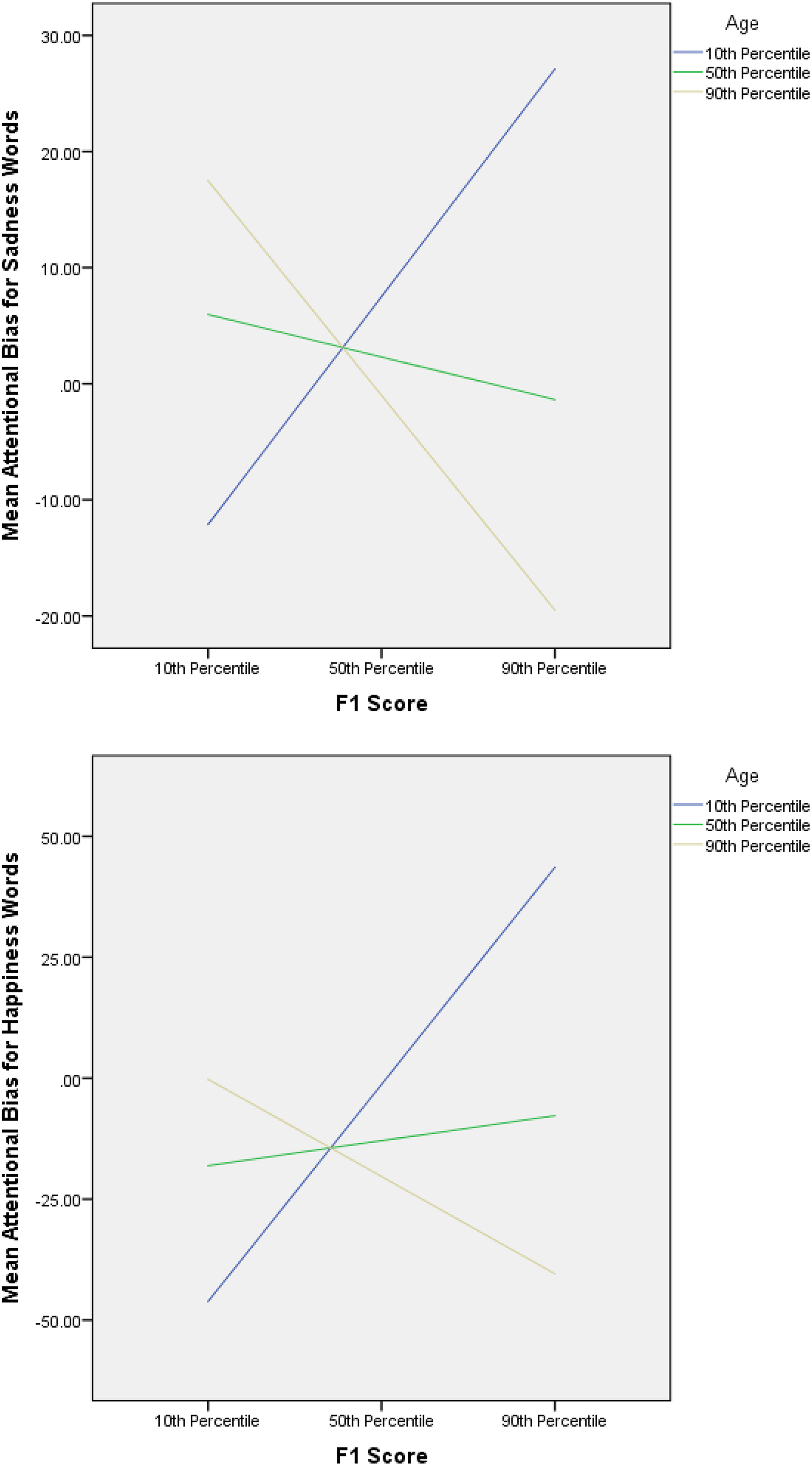
Factor 1 X Age Interactions in Attentional Bias for Sadness and Happiness Stimuli.
A parallel set of analyses examining relationships between antisocial lifestyle features and attentional bias (see Table 1) revealed no main effects for sadness stimuli,
To examine whether the Factor 1 X Age interactions reflected performance on the RAT or variance shared with Factor 2, we conducted a regression controlling for RAT performance and Factor 2 scores. Although the effects of RAT and Factor 2 scores were non-significant (
Discussion
This study makes several contributions to our understanding of psychopathy in youth. Notably, current analyses provide the first direct evidence of attentional biases for affective stimuli associated with psychopathic traits following frustration experiences. Interactions between psychopathy factor scores and age for both positive affective stimuli and negative/ sadness affective stimuli indicate increasing attentional bias away from both kinds of affective stimuli with increasing age. That is, across affective stimulus types, the Factor 1 X Age interactions indicate that the regression coefficients decreased significantly at different age levels (Aiken & West, 1991).
None of these findings are consistent with emotion deficit perspective predictions of unresponsiveness to emotional stimuli. Had youth with psychopathic traits been unresponsive to emotional material following frustration, psychopathic traits would have been associated with smaller attentional biases toward or away from affective stimuli. Instead, among younger youth, psychopathic traits were linked with greater biases towards affective stimuli (albeit nonsignificant for sadness stimuli), and, among older youth, these traits predicted non-significant biases away from affective stimuli. The latter association between psychopathy ratings and attentional bias is especially novel. Not only do psychopathy ratings and attentional bias scores reflect non-overlapping measurement domains, but there is no simple way to explain greater attention to neutral than to negative words as reflecting a simple emotional deficit.
These attentional biases are consistent with the negative preception hypothesis and with the possibility that these biases reflect an attempt to cope with negative emotional arousal in youth with psychopathic traits. As noted above, Penney and Kosson (2015) extended the negative preception hypothesis from an explanation for active coping with noxious external stimuli to an explanation for active coping with negative affective experiences. According to this perspective, many youth who later develop psychopathic traits experience substantial sadness, fear/anxiety, and anger early in childhood; those who gradually develop the ability to attenuate the impact of their sadness and fear reactions experience an immediate short-term benefit through the reduction in negative emotions. However, as the negative preception process becomes increasingly automatic, it contributes to the core affective and interpersonal features of psychopathy, including difficulty processing emotional information (except for anger), lack of empathy for others, and a lack of attention to one’s own feelings (see also Vitale, Kosson, Resch, & Newman, in press).
It is important to note that, although current findings corroborate the predictions of the negative preception hypothesis and the affect regulation theory, they do not provide specific evidence of anomalous emotion regulation. Nevertheless, this theoretical perspective appears consistent with increasing empirical interest in attentional biases as relevant to emotion regulation strategies (e.g., Gratz & Roemer, 2004; Todd, Cunningham, Anderson, & Thompson, 2012; Viviani, 2013).
Although, as discussed above, the evidence of increasing attentional bias away from sadness stimuli with increasing age is especially central to the corroboration of the negative preception hypothesis, the findings for happiness stimuli are just as inconsistent with the integrated emotions system model but are broadly consistent with the negative preception hypothesis. As noted above, it is plausible that a mechanism that leads to an automatic focus away from negative affective cues could also lead to reduced attention to positive affective cues. The development of such a mechanism appears consistent with the common description of youth with psychopathic traits as “unemotional” and could explain why, in several studies, psychopathic traits have been linked not only with difficulty in processing negative affective information but also with difficulty in processing positive affective information (e.g., Bagley, Abramowitz, & Kosson, 2009; Verona et al., 2004). We note that an attentional bias away from happiness stimuli is not directly inconsistent with the low fear hypothesis. The low fear hypothesis does not explicitly address responsiveness to happiness stimuli; neither does it predict heightened attentional bias away from happiness stimuli.
We note that the finding of a relationship between psychopathic traits in younger youth and attentional bias
Along with an increasing interest in understanding links between psychopathology and maladaptive affect regulation (Kring & Sloan, 2010), researchers have increasingly emphasized the importance of a rich and differentiated emotional life. In fact, several researchers have argued that the recognition and differentiation of one’s own emotional experiences is critical to the development of effective emotion regulation (Barrett, Gross, Christensen, & Benvenuto, 2001; Kashdan, Barrett, & McKnight, 2015). From this perspective, increasing inattention to emotion cues following frustration by youth with psychopathic traits may be related to increasing inattention to their own emotional states, which may further reduce their ability to understand themselves and to learn from others about the impact of their behavior.
The current study is not the first to address attentional biases in youth with psychopathic traits. Kimonis, Frick, Fazekas, and Loney (2006) investigated attentional bias in youth with psychopathic traits as measured by the Antisocial Processes Screening Device (APSD) and reported that individual differences in attention were complexly related to psychopathic traits. Classifying youth on the basis of both self- and parent ratings of psychopathic traits, they reported that APSD total scores were not directly related to attentional bias. However, youth with psychopathic traits who were also rated as aggressive exhibited less attention to distressing pictures than youth high in aggression but without psychopathic traits.
Subsequently, Kimonis, Frick, Munoz, and Aucoin (2008) reported a somewhat similar interaction between self-reported psychopathic traits and aggression. In this study, only self-reported callous-unemotional (CU) traits were examined, and CU traits again did not themselves predict attentional bias. However, among youth reporting high levels of aggressive behavior and among youth with greater histories of community violence exposure, self-reported CU traits were associated with a non-significant reduction in attention to distress stimuli at one of two exposure durations tested; in contrast, among those self-reporting less aggression or less violence exposure, CU traits were associated with greater attention to distressing stimuli.
Although these findings appear, at first glance, quite different from current findings, the differences between these studies and the current study help to explain the apparent discrepancies. The two prior studies differed from the current study in participant age, the measure of psychopathic traits employed, the use of picture instead of word stimuli, the kinds of affective stimuli presented, and in assessing attention only under baseline conditions rather than following an affectively charged experience. Nevertheless, in spite of these differences, both these earlier studies and the current study suggest associations between psychopathic traits and both reduced attention to some negative affective stimuli and increased attention to some negative affective stimuli. Of course, the association between psychopathic traits and reduced attention to negative affective stimuli was significant only in one of the earlier studies and only among particularly aggressive participants (Kimonis et al., 2006). However, because the APSD does not assess the persistence or versatility of antisocial behavior, it could be argued that youth with high APSD scores and high levels of aggressive behavior are likely to be the youth characterized by the highest levels of PCL: YV psychopathy. In fact, the modest correlations previously reported between APSD ratings and PCL: YV scores (Cauffman, Kimonis, Dmitrieva, & Monahan, 2009; Murrie & Cornell, 2002; Salekin et al., 2004) suggest these instruments measure largely distinct constructs. In this context, it is not entirely surprising that the combination of psychopathic and aggressive traits yielded evidence for an attentional bias away from affective stimuli more similar to that obtained in the current study with the PCL: YV.
Two additional issues merit brief discussion. First, the second study by Kimonis and colleagues (2008) also yielded evidence for greater attentional bias toward distressing stimuli by some youth with CU traits. Given the modest correlations between CU and PCL: YV scores, it cannot be assumed these two groups of youth exhibit similar dispositions. Nevertheless, the Kimonis et al. study, like the current study, provides evidence that, among some youth, affective features of psychopathy are associated with greater attention toward some negative affective stimuli. Although the authors interpreted their findings as consistent with emotional unresponsiveness, we believe these findings are somewhat more complex. Notably, the impact of CU traits depended on levels of aggressive behavior in two studies and levels of exposure to violence in one study. Moreover, whereas youth with psychopathic traits and aggressive behavior in Kimonis et al. (2006) were characterized by reduced attentional bias toward distress stimuli, the average age of these youth was 9.3. In contrast, the youth with psychopathic traits in Kimonis et al. (2008) displayed a more complex pattern of findings: those whose histories included greater community violence exposure actually exhibited attentional bias away from distress stimuli and toward neutral stimuli, and these youth were 15.6 years of age, on average. More recently, Kimonis, Frick, Cauffman, Goldweber, and Skeem (2012) also reported attentional biases away from distressing stimuli and towards neutral stimuli – but only in youth classified as displaying primary psychopathy traits as assessed by self-reports on the Youth Psychopathic Traits Inventory (mean age = 16.4 years). In short, these studies have yielded discrepant patterns of findings as a function of participant age, the measure used to assess psychopathic traits, and the moderator variables examined.
Second, because Kimonis et al. (2008) examined attentional biases in the absence of affective experiences, it is plausible that the pattern of biases for CU youth may differ for baseline conditions than for affective state conditions. As noted above, the negative preception hypothesis posits attentional biases away from affective stimuli for youth experiencing negative emotional states, as part of an effort to reduce negative affect. It is not clear that such biases should be evident in the absence of an affectively charged experience. However, it could be argued that youth who have been exposed to violence may be more prone to negative affective states than youth who have not (Fergusson, Boden, & Horwood, 2008).
Although the assessment of attentional bias following an affectively charged experience represents a unique feature of this study which differentiates it from most prior studies of youth with psychopathic traits, the absence of a baseline condition represents an important limitation. Because the negative preception hypothesis posits attentional bias away from negative affective stimuli following negative affective experiences, additional studies that examine attentional bias both before and after such experiences are critical for testing the specificity of the attentional biases observed here. Further, although frustration experiences including those employing the difficult version of the RAT are well-validated for inducing negative affective states (Johnson, Gooding, Wood, Taylor, & Tarrier, 2011; Nummenmaa & Niemi, 2004; Vohs, Park, & Schmeichel, 2013), an assessment of participants’ affective state following completion of the RAT would provide additional evidence regarding the effectiveness of the RAT for inducing a negative affective state. In addition, it remains important to examine whether attentional biases are related to psychopathic traits following other kinds of affective experiences. In light of the interaction observed for positive affective stimuli following a frustration experience, it is also important to examine attentional bias following positive affective experiences.
Several additional limitations of the current study must be emphasized. First, the Age X Psychopathic Traits interactions reported here represent relatively novel findings. Despite the similarities between current findings and those of Kimonis and colleagues, the many differences in the methods and the differences in the findings make it important to examine the robustness of these associations in independent samples. Moreover, little is known about the developmental trajectory of the ability to disattend from sadness or distress cues. It is important to examine these relationships using well-validated measures of attentional bias for participants of different ages. In addition, although the current sample appears representative of detainee samples in age and PCL: YV scores, detained samples differ from incarcerated and community samples. It remains critical to evaluate the replicability of these relationships in different kinds of samples. A related limitation is that the current sample, like most offender samples, included many more males than females. Additional studies of girls are needed to examine whether current findings would generalize to female youth offenders. Finally, as noted previously, the cross-sectional nature of the data precludes conclusions about causality. Longitudinal studies are needed to determine whether the differences between older and younger youth in this study reflect increases in negative attentional bias within individuals over time.
Nevertheless, these findings are provocative and suggest the value of additional studies of attentional bias in youth with psychopathic traits. In the context of a growing number of anomalous findings that are not easy to explain on the basis of emotional unresponsiveness, current findings point to the value of new theoretical perspectives that seem likely to contribute in important ways to a better understanding of the mechanisms underlying psychopathic traits.
Footnotes
Acknowledgments
David S. Kosson, Department of Psychology, Rosalind Franklin University of Medicine and Science; Cami K. McBride, Department of Psychology, Roosevelt University; Steven A. Miller, Department of Psychology, Rosalind Franklin University of Medicine and Science; Lindsay A. Whitman, Private Practice, New York, NY; Nastassia R. E. Riser, VA San Diego Healthcare System.
We thank Louise Loud, Susan Korpai, Robert Cesar, Michael Fletcher, Holly Hinton, Rosemarie Gray, Robert Verborg, and the staff and youth of the Robert Depke Juvenile Justice Center for their consistent support of the research reported here. We also thank Zach Walsh for help in modifying the dot probe test used in this study, Melanie Chinchilla, Joshua Greco, Sarah Hampton, Kathleen Montry, Kristin Ridder, Rachel Tercek, and Sarah VanMoffaert for assistance in assessing participants, and Kerri Kotwica, Stephanie Smith, Dianna Taylor, and Corey Weir for help in entering and scoring dot probe data.
Funding
The research and preparation of this article were supported in part by a pilot grant from the School of Graduate and Postdoctoral Studies, Rosalind Franklin University of Medicine and Science.
Notes
Appendix
List of Words Used in Dot Probe Task

|
|
||||
| Active | Bag | Civilian | Deduct | Dutch |
| Expert | Factory | Indirect | Italian | Library |
| Lock | Oyster | Pianist | Pink | Recruit |
| Refund | Rhythm | Stimulus | Wit | Yield |
|
|
||||
| Devoted | Excited | Friendly | Happy | Hopeful |
| Joy | Love | Proud | Relieved Tender | |
|
|
||||
| Cry | Despair | Grief | Guilty | Misery |
| Rejected | Sad | Suicide | Tragic | Upset |