




Abstract
Psychopathy is a syndrome of personality pathology associated with callousness, manipulation, and persistent antisocial behavior. Whereas several contemporary perspectives emphasize innate emotional unresponsiveness as the core deficit in psychopathy, the negative preception hypothesis proposes that individuals with psychopathic traits experience negative emotions and disattend from some affective cues to attenuate negative emotional experiences. To examine whether psychopathy is associated with static attentional unresponsiveness to affect inductions and cues or with dynamic attentional biases away from affective cues, 94 incarcerated men assessed with the Psychopathy Checklist-Revised completed a dot-probe task before and after a sadness induction. Multilevel modeling indicated psychopathy predicted greater increases in self-reported negative affect due to a sadness induction. Moreover, the relation between psychopathic traits and attentional bias changed as a function of the induction. Psychopathy was independent of attentional bias regarding affective faces under baseline conditions but was associated with increasing attention away from sad faces following the sadness induction. In addition, psychopathy was associated with greater attention towards angry faces only following the sadness induction. These findings suggest individuals with psychopathic traits are responsive to some sadness inductions and exhibit anomalous attentional biases regarding emotion in some conditions, suggesting the utility of explanations that can explain maladaptive emotion regulation in individuals with psychopathic traits.
Introduction
Psychopathy is a syndrome of personality pathology associated with repeated and serious criminal and violent behavior. Given the substantial costs to society, studies have examined links between psychopathic traits and emotional functioning. Most contemporary explanations emphasize that an innate emotional unresponsiveness underlies the characteristic antisociality. These theories are collectively referred to here as emotion deficit perspectives (EDPs). The general EDP posits a pervasive incapacity to experience emotion is central to psychopathy (Cleckley, 1941). A slightly different perspective, the integrated emotion systems (IES) model, posits deficient functioning in a brain system including the amygdala and ventral prefrontal cortex, leading to reduced responsiveness to fear, sadness, and happiness cues (Blair, 2006, 2013). 1
Studies commonly report evidence corroborating these EDPs, including links between psychopathy and reduced physiological responsiveness to emotion (e.g., Verona et al., 2004), reduced impact of emotion on cognition (e.g., Christianson et al., 1996), and deficits in recognizing emotional expressions (e.g., Blair et al., 2001, 2004). However, evidence for deficient emotional functioning in psychopathy is less consistent than these findings imply. For example, studies of psychopathy and facial affect recognition have reported general or specific deficits (Blair et al., 2004; Dolan & Fullam, 2006), no deficits (Book et al., 2007; Glass & Newman, 2006), and even superiority (Beussink et al., 2020). Psychopathy has also been associated with no deficits in detecting emotional words or faces (Day & Wong, 1996), and prior studies of vocal affect recognition have yielded discrepant findings (Blair et al., 2002; cf. Bagley et al., 2009). Moreover, the reduced emotional responsiveness associated with psychopathy is often no longer observed following instructions that encourage emotional responding or focusing attention on emotion-related stimuli (e.g., Arbuckle & Shane, 2017; Meffert et al., 2013). Reviews and meta-analyses also highlight inconsistencies in the psychopathy literature. For example, Brook et al. (2013) concluded that, although many psychopathy studies suggest dysfunction or anomalies, findings across studies are discrepant and not consistent with any EDP. Similarly, Hoppenbrouwers et al. (2016) suggested individuals with psychopathic traits exhibit impairments in detecting and responding to threat and report lower levels of subjective happiness; however, such individuals do not report lower levels of sadness, fear, or surprise and, in fact, report higher levels of anger. These inconsistencies suggest the utility of considering alternative perspectives.
Emotion Regulation and Psychopathy
Anomalous emotion regulation has been linked to many types of psychopathology, including personality disorders (e.g., Kring & Werner, 2004; Linehan, 1993; Ronningstam, 2016) and psychopathy (Donahue et al., 2014; Garofalo et al., 2018). Some researchers have proposed anomalous emotion regulation underlies links between psychopathy and aggression (Long et al., 2014; Newhill & Mulvey, 2002). In addition to maladaptive anger regulation (Kosson et al., 2020; Patrick & Zempolich, 1998), several studies point to anomalous fear regulation in psychopathy. Notably, early studies suggested offenders with psychopathic traits employ a coping method that attenuates the impact of predictable, external aversive stimuli (e.g., Hare, 1978). Regarding evidence of reduced electrodermal activity preceding forewarned aversive stimuli (Hare et al., 1978) and normal or greater heart rate increases (Hare & Craigen, 1974), Hare (1978) proposed the heart rate increase reflects a coping response, and the lack of increased skin conductance indicates the response’s effectiveness. Lykken et al. (1972) termed this mechanism negative preception. Based in part on research indicating that psychopathy among youth is positively linked with negative affectivity (e.g., Price et al., 2013) and early adversity (e.g., Dargis et al., 2016), the Affect Regulation Theory’s negative preception hypothesis (NPH; see Kosson et al., 2018, 2020) posits that youth who develop psychopathic traits learn to attenuate the intensity and impact of sadness and fear experiences. The NPH was proposed as an extension of Lykken’s original negative preception hypothesis which introduced the mechanism as a method for coping with noxious external stimuli (see also Hare, 1978). Kosson et al. (2018) argued that youth who develop psychopathic traits learn to employ a similar strategy to reduce the impact of some of their negative affective experiences (e.g., sadness and fear) but not anger or positive experiences. Because such attenuation results in immediate relief, it is negatively reinforced. As some children rely increasingly on this strategy, it becomes relatively automatic and contributes to destructive developmental outcomes: an impoverished affective life, difficulty learning from negative emotions, and reduced awareness of others’ emotional states. 2
Emotion Regulation and Attentional Biases
Selective attention is both a basic component of attention and an emotion regulation strategy that can impact the processing and interpreting of emotional events (Todd et al., 2012; Wadlinger & Isaacowitz, 2011). Shifting attention toward positive stimuli can help maintain positive emotions, and shifting attention away from negative stimuli can attenuate negative emotions (Cisler & Koster, 2010; Sanchez et al., 2013). Attentional biases away from negative stimuli, observed in healthy adults at baseline and after negative mood inductions, reportedly reflect a “protective” bias to maintain neutral/positive moods (McCabe et al., 2000; McCabe & Gotlib, 1995). Conversely, negative affect is associated with bias towards negative stimuli (Bar-Haim et al., 2007; Bradley et al., 1997). Attentional biases have been linked with psychopathology and personality disorders (e.g., Krusemark et al., 2015; Todd et al., 2012). 3
Affective Attentional Biases in Psychopathy
The EDPs and the NPH make contrasting predictions regarding psychopathy-related attentional biases. Based on an unresponsiveness to (some or all) emotions, the EDPs predict psychopathy is related to small or absent attentional biases regarding these emotions both before and after a negative mood induction. In contrast, the NPH predicts psychopathy is associated with biases away from sadness stimuli especially following sadness, fear, and shame experiences, and baseline biases should be less robust or absent.
The affective dot-probe task (MacLeod et al., 1986) is a well-validated paradigm that can be used to test these conflicting predictions (Mogg & Bradley, 2005; see Koster et al., 2004; Staugaard, 2009 for criticisms). Most prior dot-probe studies have examined psychopathy and attentional biases under baseline conditions. Several studies reported neither psychopathic/callous-unemotional (CU) traits nor conduct problems were directly associated with baseline biases regarding negative stimuli in youth (Kimonis et al., 2006, 2008) or adults (Kimonis et al., 2020). However, two studies of detained adolescents have reported that CU traits or conduct problems are associated with reduced orienting towards distress images (Kimonis et al., 2018; Szabó et al., 2020), and one reported a relation between interpersonal features of psychopathy and greater orienting to distress cues (Muñoz Centifanti et al., 2013). One adult study reported the affective features of psychopathy were related to increased biases towards happy faces (Edalati et al., 2016).
Although findings are somewhat inconsistent across studies, several papers have reported that interactions between the interpersonal-affective traits of psychopathy and aggression or conduct problems (linked with the lifestyle-antisocial traits of psychopathy) are associated with reduced facilitation to distress in youth (e.g., Kimonis et al., 2006, 2008; Szabó et al., 2020) or with increased disengagement from threat in adults (Kimonis et al., 2020). Because the EDPs suggest psychopathy is related to small or absent biases regarding some or all emotions, findings of reduced affective facilitation are consistent with EDP predictions; however, greater disengagement from threat is not. Baseline biases are not explicitly predicted by the NPH.
Because these studies did not employ mood inductions, participants’ emotional states could have been influenced by chance features of their immediate history or dispositional affectivity (Askim & Knardahl, 2021). Studies employing affectively-charged experiences prior to assessing emotional responsiveness appear important to evaluating emotion regulation hypotheses. In the only known dot-probe study to employ this method, Kosson et al. (2018) reported interactions between the interpersonal-affective traits of psychopathy and age. Following a frustration experience, these traits were associated with positive biases toward both sad and happy words among younger detained adolescents, and both of these biases became increasingly negative as age increased. The increasing bias away from sadness corroborates the NPH but is inconsistent with the EDPs.
Current Study
Although some prior evidence of psychopathy-related attentional biases appears difficult to explain with EDPs, prior study limitations indicate the need for additional research. This study attempted to address some of these limitations, pit predictions of the EDPs against those of the NPH, and examine whether anomalous attentional biases in psychopathy in adults are similar to those identified in youth. First, given the focus of the NPH on biases following negative mood inductions, a preliminary aim examined whether psychopathic traits impacted responsiveness to a sadness induction. The EDPs suggest psychopathy should reduce the impact of the induction, whereas the NPH predicts psychopathy should not interfere with the initial impact of the mood induction.
Second, by examining attentional biases before and after a sadness induction, this study examined whether any psychopathy-related biases were dynamic (i.e., changed in magnitude or direction following an affect induction). The EDPs predict higher levels of psychopathy should be associated with a static absence of biases both before and after such an induction. In contrast, the NPH predicts psychopathy should be related to dynamic biases away from sadness stimuli following a sadness induction (i.e., a Psychopathy x Time x Stimulus Affect interaction).
Third, this study examined whether psychopathy-related attentional biases in adults are specific to certain emotions or are more general (as was reported in adolescents by Kosson et al., 2018). Evidence for more specific attentional biases in adults than in adolescents would suggest the nature of these biases changes with development. The NPH predicts psychopathy should be associated with a negative bias regarding sad faces but not regarding angry or happy faces following a sadness induction, whereas the EDPs predict a lack of bias (or reduced biases) regarding (either some or all) emotions. To assess whether any psychopathy effects reflected specific components of the syndrome, we also conducted supplementary analyses for the four validated components of PCL-based psychopathy.
Method
Participants
Summary of Demographic Variables (n = 94)

Measures
Psychopathy Checklist-Revised
The PCL-R (Hare, 2003) is a 20-item expert-rater scale used to assess psychopathy based on a semi-structured interview and collateral files. Ratings are underlain by four facets reflecting interpersonal, affective, lifestyle, and antisocial traits. Although only total psychopathy scores were examined in the primary analyses, facet scores were included in supplementary analyses. Interrater reliability calculated based on the larger protocol was acceptable (one-way random effects intraclass correlation coefficient for two single raters = .82 (N = 303)). Ratings have demonstrated high internal consistency and inter-rater reliability across samples (Hare, 2003).
Affective Dot-Probe Task
An affective dot-probe task was administered twice, both before and after a sadness induction, to assess individual differences and changes in attentional biases (MacLeod et al., 1986). Stimuli were faces of African American and European American men and women with emotional (sad, happy, angry) and neutral expressions (Minear & Park, 2004). The task included a practice block followed by an experimental block of 96 trials. On each trial, one neutral and one affective face appeared on a screen for 250 or 750 ms, before being replaced by one or two asterisks in one of the face locations. The task included congruent trials (with the probe and emotional stimulus appearing in the same location) and incongruent trials (with the probe and emotional stimulus appearing in opposite locations). Participants indicated the number of asterisks as quickly as possible. Median response times (RTs) were calculated for correct responses. An attentional bias index 4 was calculated separately for each emotion category and stimulus duration (MacLeod & Mathews, 1988) as median RT for incongruent trials - median RT for congruent trials. Negative index scores suggest bias away from emotion; positive index scores suggest bias towards emotion. Participants averaged above 97% correct on all trials. Based on evidence reported by Price et al. (2015), bias scores over three standard deviations from the mean were Winsorized to scores 1 millisecond greater than the next most extreme permissible value (Tabachnick & Fidell, 2007).
The Positive and Negative Affect Schedule
The PANAS (Watson et al., 1988) is a 20-item scale used to assess self-reported emotional state subdivided into two orthogonal dimensions: positive affect (PA) and negative affect (NA). Participants indicated the degree to which they were experiencing each emotion using a five-point scale. Scores demonstrate good internal consistency and construct validity among non-clinical samples (Gray & Watson, 2007). Current subscale scores were internally consistent (PA α = .89; NA α = .85).
Mood Induction
To induce a mild sad mood, experimenters administered an autobiographical stress interview (Burns et al., 2003; Lobbestael et al., 2008) that directed participants to recall and verbally describe a time they had felt very sad. The PANAS was completed before and after to examine induction effectiveness. Studies utilizing this manipulation have reported increases in NA and decreases in PA following sadness inductions (Burns et al., 2003; Watson et al., 1988).
Results
Sensitivity Analyses
Using Murayama et al.’s (2022) summary-statistics-based power analysis, information about the analyses was evaluated. Given the sample size over several repeated measures, this study had a power of at least .80 for Level 1 effects with Cohen’s d values greater than 0.29 (r values greater than .143; https://www.escal.site/). For Level 2 effects, this study had a power of .80 for effects greater than Pearson’s r = 0.28 and, for cross-level interactions, for effects greater than r = 0.29. This analysis suggests the study had ample power to detect medium effects but perhaps not enough power to detect small effects.
Preliminary Analyses
Using SPSS (version 27), paired samples t-tests indicated participants reported higher average levels of NA following the mood induction (M = 20.34, SD = 8.03) than at baseline (M = 12.74, SD = 4.89), t(93) = −10.14, p < .001, d = 1.05, 95% CI [0.70, 1.30]. Participants also reported lower levels of PA following the induction (M = 27.44, SD = 10.51) than at baseline (M = 32.53, SD = 8.95), t(93) = 6.26, p < .001, d = 0.65, 95% CI [-0.86, −0.42].
In order to evaluate higher-order interactions, SAS (version 9.4) was used to estimate two multilevel models to examine the effects of psychopathy on changes in self-reported emotional state (PA and NA) from pre- to post-induction.
5
For PA, there was no main effect of time in the model (F(1, 93) = 0.85, p = .36, R2β = .01), and there was no reliable Psychopathy × Time interaction (F(1, 1032) = 1.19, p = .27, R2β = .001; see Figure 1). In the model for NA, there was a main effect of time (F(1, 93) = 4.93, p = .03, R2β = .05) as well as a Psychopathy × Time interaction (F(1, 1032) = 4.76, p = .03, R2β = .01; see Figure 2). Follow-up analyses indicated self-reported ratings of NA increased from baseline to post-induction as a function of increases in psychopathy (b = −0.14, SE = 0.06, t(1032) = 2.18, p = .03). To further explore this interaction, analyses of simple slopes were conducted to examine NA change scores from pre- to post-induction at fixed levels of psychopathy (−1 SD, mean, and +1 SD). These analyses showed that the change in NA ratings over time increased in magnitude from low (NA change score = +6.74) to mean (+7.60) to high levels of psychopathy (+8.45). Follow-up analyses also indicated that psychopathy ratings were negatively related to levels of self-reported NA at baseline (b = −0.12, t(1032) = −2.70, p = .01) but were not related to self-reported NA reported following the mood induction (b = 0.02, t(1032) = 0.39, p = .70). Psychopathy Ratings and Self-Reported Positive Affect by Time. Note. Shaded areas represent 95% confidence intervals Psychopathy Ratings and Self-Reported Negative Affect by Time. Note. Shaded areas represent 95% confidence intervals

Primary Analyses
Multilevel Model Estimating the Effects of Stimulus Affect, Time, Stimulus Duration, and Psychopathy Ratings on Attentional Bias Scores
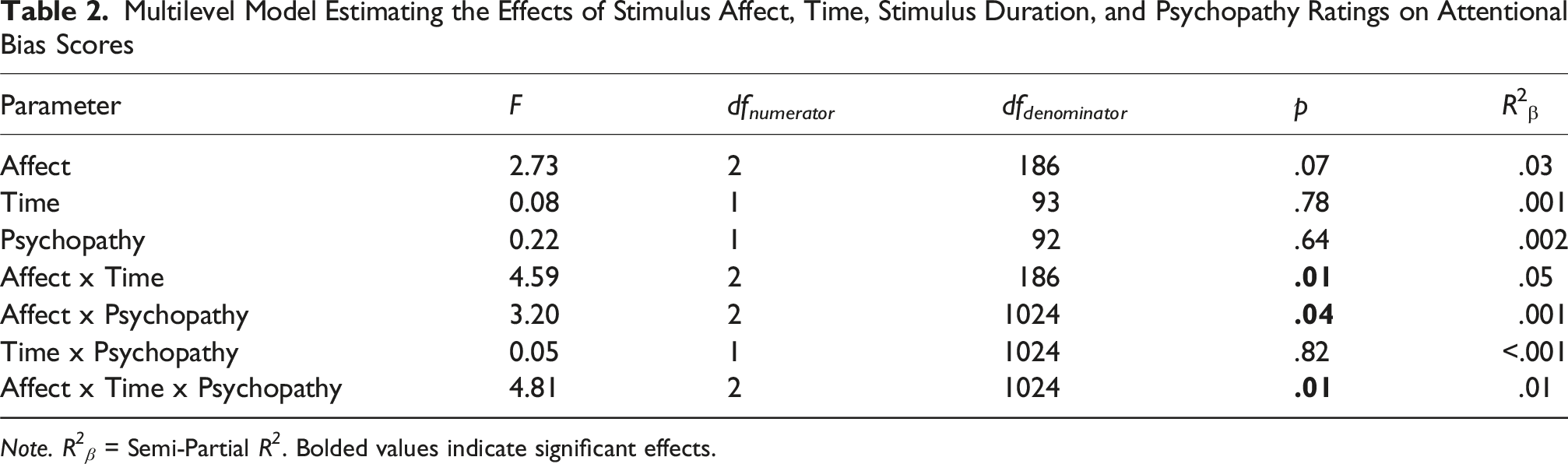
Note. R 2 β = Semi-Partial R 2 . Bolded values indicate significant effects.
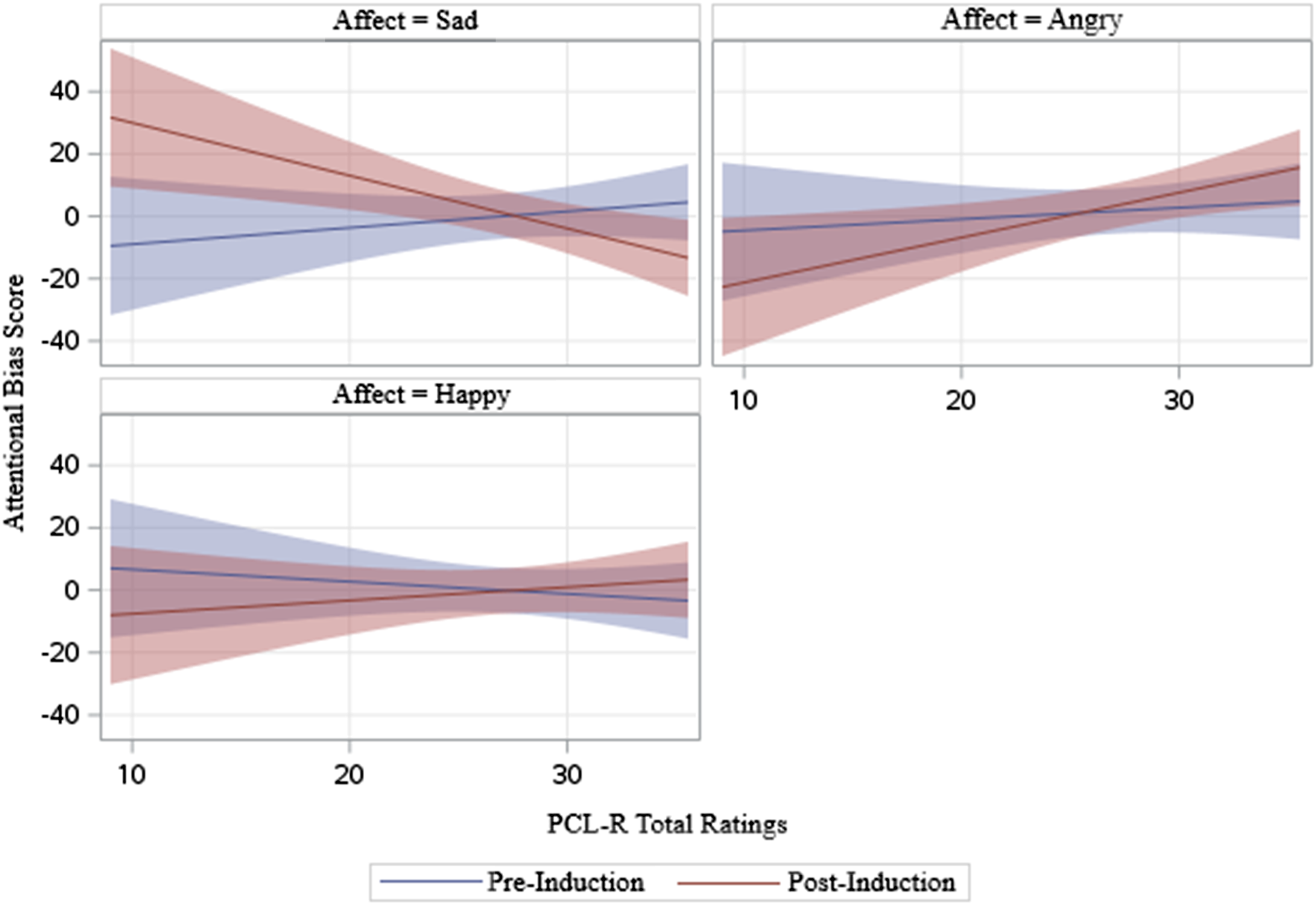
Psychopathy Ratings Predicting Attentional Bias Index Scores by Stimulus Affect and Time. Note. Attentional bias is reported as the difference (in ms) between mean response times when probes appear in the area of an emotional face versus in the area of a neutral face. Positive biases suggest greater attention to emotional than to neutral faces at the time the dot probe appears; Negative biases indicate greater attention to neutral than to emotional faces. Shaded areas represent 95% confidence intervals
Supplemental analyses were conducted for the four facets of PCL-based psychopathy. Although ratings on the interpersonal facet were unrelated to attentional biases, analyses of the other components demonstrated interaction effects similar to those reported for PCL-R total scores. Findings for multilevel models examining PCL-R facet ratings are summarized in Supplemental Materials (see also Table S1 and Figures S1 and S2).
Attentional Biases at Each Time Point
To provide consistency with the time-point specific analyses of prior studies, simple main effects of factor ratings on bias scores were also estimated. Results indicated psychopathy ratings were unrelated to baseline biases for all emotions (all estimates < |0.53|, ts(1024) < |0.90|, ps > .37, ds < 0.07). In contrast, psychopathy ratings were negatively related to post-induction sadness bias scores (b = −1.70, t(1024) = −2.87, p = .004, d = 0.18) and positively related to post-induction anger bias scores (b = 1.44, t(1024) = 2.44, p = .02, d = 0.15). Psychopathy ratings were not significantly related to post-induction happiness bias scores (b = 0.43, t(1024) = 0.72, p = .47, d = 0.05).
Discussion
This study investigated mechanisms underlying psychopathy by testing the competing predictions of the EDPs (positing stable emotion unresponsiveness) versus the NPH (positing dynamic, anomalous emotion regulation that includes specific negative attention biases). This study appears to be the first to examine the association between psychopathy and attentional biases both before and after an affective experience and to investigate whether any psychopathy-related attentional biases: (1) are dynamic and (2) specific to some emotions.
Do Psychopathic Traits Impact Responsiveness to an Emotion Induction?
Because tests of hypotheses for dynamic attentional biases depend on the presumption that psychopathy does not prevent an affective intervention from inducing sadness, participants’ responsiveness to the sadness induction is important. Evidence that psychopathic traits are associated with reduced response to a sadness induction would have corroborated the EDPs and also cast doubt on the value of using affect inductions to assess attentional biases in an affective context. Current results suggest psychopathy did not attenuate responsiveness to the sadness induction. Psychopathy ratings were unrelated to the decreases in self-reported positive affect from pre- to post-induction. However, higher levels of psychopathic traits were associated with larger increases in self-reported negative affect from pre- to post-induction.
Analyses also showed that higher levels of psychopathy were associated with reduced self-reports of negative affect at baseline but were unrelated to such reports following the sadness induction. The finding that baseline reports of negative affect decreased as psychopathy ratings increased appears consistent with the predictions of the EDPs; however, the near zero effect of psychopathy after the mood induction and the positive association between psychopathy and the magnitude of the increase in self-reported negative affect over time are both difficult to explain based on the proposal of emotional unresponsiveness.
Are Psychopathy-Related Attentional Biases Dynamic?
The sadness attentional biases associated with psychopathy ratings in the current study were dynamic: they differed significantly as a function of time. Low levels of psychopathy were associated with an increase from pre-induction to post-induction in bias towards sad faces, but high levels were associated with a nonsignificant increase over time in bias away from sad faces (p = .08). Separate analyses showed psychopathic traits were not related to baseline attentional biases for any affective stimuli but were negatively associated with biases regarding sad faces following the sadness induction. Both the repeated measures findings and the single-time-point findings are consistent with dynamic biases in attention, and both appear inconsistent with the EDPs. Rather, they appear consistent with the proposal that higher levels of psychopathic traits are associated with the use of an anomalous emotion regulation tactic to attenuate the impact of sadness-relevant material following sadness experiences. If corroborated by further research, such findings would suggest an important shift in our understanding of the nature of emotion regulation in offenders with psychopathic traits. Notably, researchers have frequently characterized individuals with psychopathic traits as emotionally unresponsive. However, as discussed by Hare (1978) nearly 50 years ago, the pattern of activity may be better explained by some form of unusual coping strategy than by a passive unresponsiveness. Evidence that negative preception biases are robust among individuals with psychopathic traits would challenge researchers to integrate the evidence of dynamic avoidance of some negative emotions with observations of callous and unemotional behavior.
Are Psychopathy-Related Attentional Biases Specific to Some Emotions?
This study examined whether psychopathic traits are linked to anomalous attention for two kinds of negatively-valenced faces (but not positively-valenced faces) or for only some (sad) negatively-valenced faces (but not angry faces). The specificity of current negative biases to sad faces appears contradictory to the EDPs and more consistent with the NPH. Whereas earlier findings linking psychopathy to electrodermal responses suggested an attenuated impact of aversive external stimuli (Ogloff & Wong, 1990), this study provides behavioral evidence that, following a sadness induction, PCL-R psychopathy is related to disattention that is specific to sad faces. Additional research appears warranted to examine whether disattention may underlie the reduced responsiveness to other negative affective stimuli observed in individuals with psychopathic traits (e.g., Fanti et al., 2016; Verona et al., 2004).
The largely near-zero effect sizes for happiness biases appear consistent with both the EDPs and the NPH but inconsistent with the positive bias associated with Factor 1 in Edalati et al. (2016). Happiness biases have been inconsistently observed in nonclinical samples under baseline conditions (e.g., Pool et al., 2016), and their reliability may depend on task characteristics and context effects (van Rooijen et al., 2017). The absence of happiness biases in the current and several prior studies of psychopathic traits as well as the small sample size in Edalati et al. (2016) raise questions about the robustness of the positive attentional bias they reported.
The positive relation between psychopathic traits and post-induction anger bias also appears consistent with the NPH. However, the NPH only predicted the absence of a negative relation. Consistent with NPH predictions, findings did not suggest psychopathy was associated with heightened disattention from anger following a sadness induction. However, analyses suggest psychopathy was associated with an increase in anger-related attention. This effect was not predicted and appears quite provocative. Given that psychopathy is associated with both proactive and reactive aggression, the possibility that psychopathic traits increase anger-related attention following a sadness induction suggests greater attention to anger or threat cues during some experiences of negative emotion may contribute to the heightened levels of reactive aggression and hostile expectations associated with psychopathic traits (e.g., Buades-Rotger et al., 2023). This finding also appears consistent with links between psychopathic traits and reported frequency of, comfort with, and preference for angry feelings (Hoppenbrouwers et al., 2016; Spantidaki Kyriazi et al., 2021). It is plausible that an attentional bias toward anger cues and greater comfort with or readiness to experience anger may contribute to the higher levels of anger experienced and expressed, on average, by people with psychopathy, and this kind of anger-related attentional bias could be targeted through intervention. At the same time, because only a sadness induction was employed, it is not certain that greater attention to anger cues would be observed following other kinds of affect inductions. Assessing the replicability of this psychopathy-anger bias link appears another important goal for future research.
How Do Current Results Compare to Those of Previous Studies?
Prior psychopathy studies have assessed attentional biases at only one point. Because current findings of greater changes in bias over time cannot be directly compared to prior findings at one point in time, this study also examined biases regarding affective facial stimuli at both baseline and post-induction. Findings that psychopathic traits were unrelated to baseline attentional biases are partially consistent with prior evidence documenting null relations between Factor 1-related traits and biases regarding negative stimuli in the absence of a mood induction in youth (Kimonis et al., 2006, 2008) and in adults (Kimonis et al., 2020). As noted above, some studies have reported that psychopathy or one dimension of psychopathic traits is associated with greater baseline attentional biases towards (Edalati et al., 2016; Muñoz Centifanti et al., 2013) or away from affective stimuli (e.g., Szabó et al., 2020). However, to our knowledge, none of these anomalies in baseline attentional bias have replicated across studies.
In contrast, following a sadness induction, psychopathic traits were negatively related to post-induction sadness biases and positively related to post-induction anger biases. The specificity of the negative association between psychopathy and post-induction sadness biases appears consistent with the NPH (but not the EDPs). The post-induction findings for sadness attentional biases appear similar to those reported for Factor 1 traits in older youth (Kosson et al., 2018); in that study, following a frustration experience, the associations between Factor 1 traits and both sadness and happiness biases became more negative as age increased. Considering current findings in conjunction with these findings, these studies provide evidence for the generality of negative relations between psychopathic traits and sadness biases following a negative emotional experience across two age groups (older adolescents vs. adults), across alterations in dot-probe stimuli (words vs. faces), and following different emotion inductions (frustration vs. recall of sadness experiences). Even so, a negative relation between psychopathic traits and attention away from happiness was evident only in the earlier study; current findings provide no evidence for happiness biases.
Conclusions and Limitations
Current results suggest that, under some conditions, psychopathy ratings are related to dynamic attentional biases that are substantially impacted by a sadness induction. Taken together, current findings provide evidence that individuals high in psychopathy are responsive to some emotion inductions and suggest they may be better characterized by anomalous emotion regulation than by a stable lack of emotional response.
Because this is the first known direct test of psychopathy’s impact on attentional bias to affective stimuli both before and after an affectively-charged experience, the robustness of current findings must be examined. Findings should also be viewed in light of several limitations. The use of an incarcerated sample of men, the limited range and nature of stimuli (i.e., posed facial emotions and no faces portraying fear), and the specificity of the mood induction are features of this study that may reduce the generalizability of findings. Future studies should address these relations across different kinds of samples, inductions, and attentional bias paradigms. Moreover, in light of criticisms of the dot-probe task and the traditional bias index, future studies should examine other measures of attentional responsiveness (e.g., physiological measures) to better understand mechanisms underlying observed biases. Lastly, extraneous factors can influence attentional biases in dot-probe studies (van Rooijen et al., 2017); although neither participant age nor IQ accounted for the observed effects, future studies should examine other potential confounds in analyses of attentional biases. In light of increasing evidence suggesting some of the emotion regulation anomalies observed in psychopathy are dynamic, additional studies addressing responsiveness to emotional provocations are warranted to elucidate the nature of anomalous emotional function in psychopathy.
Supplemental Material
Supplemental Material - Psychopathy and Emotion Regulation: Evidence for Dynamic Attentional Biases in Incarcerated Men
Supplemental Material for Psychopathy and Emotion Regulation: Evidence for Dynamic Attentional Biases in Incarcerated Men by Nastassia R. E. Risera, Courtney N. Beussinkb, Steven A. Millerc, & David S. Kosson in Journal of Experimental Psychopathology
Footnotes
Author Note
This study was approved by the Institutional Review Board at Rosalind Franklin University of Medicine and Science (DN17-300.31 PY) as the first author’s dissertation study; current results are a reanalysis of these data using multilevel modeling. Preliminary findings were presented at the 2022 meeting of the Society for the Scientific Study of Psychopathy.
Acknowledgments
We thank Rick Riddle, G. Mark McCorley, and the officers of the Lake County Jail, as well as Rosemarie Grey, Frank Kuzmickus, and Robert Verborg at the 19th Circuit Court for their support. We thank Daniela Vinesar, Chelsea Brieman, and Erica Christian for their help in testing participants.
Ethical Considerations
This study was reviewed and approved by the Institutional Review Board of Rosalind Franklin University of Medicine and Science.
Consent to Participate
All participants provided informed consent in writing. Participants were permitted to ask questions, skip questions, and terminate participation at any point.
Consent for Publication
Participants were informed before providing consent that study findings would be submitted to a journal for publication.
Funding
The authors received no financial support for the research, authorship, and/or publication of this article.
Declaration of Conflicting Interests
The authors declared no potential conflicts of interest with respect to the research, authorship, and/or publication of this article.
Data Availability Statement
This study was not preregistered. A copy of the dataset used in the analyses reported here can be retrieved from Kosson (2024, October 24). Evidence for Dynamic Attentional Biases in Incarcerated Men. Men. 
Supplemental Material
Supplemental material for this article is available online.
Notes
Author Biographies
References
Supplementary Material
Please find the following supplemental material available below.
For Open Access articles published under a Creative Commons License, all supplemental material carries the same license as the article it is associated with.
For non-Open Access articles published, all supplemental material carries a non-exclusive license, and permission requests for re-use of supplemental material or any part of supplemental material shall be sent directly to the copyright owner as specified in the copyright notice associated with the article.
