






Abstract
An intriguing difference between the E2 glycoprotein of CSFV and the other groups of pestiviruses (nonCSFV) is a lack of two cysteine residues on positions cysteine 751 and 798. Other groups of pestivirus are not restricted to one species as swine, whereas CSFV is restricted to swine and wild boar. We constructed chimeric CSFV/BVDV E2 genes based on a 2D model of E2 proposed by van Rijn et al. (van Rijn et al. 1994, J Virol 68, 3934–42) and confirmed their expression by immunostaining of plasmid-transfected SK6 cells. No equivalents for the antigenic units B/C and A were found on E2 of BVDVII. This indicates major structural differences in E2. However, the immunodominant BVDVII domain A, containing epitopes with essential amino acids between position 760–764, showed to be dependent on the presence of the region defined by amino acids 684 to 796. As for the A domain of CSFV, the BVDVII A-like domain seemed to function as a separate unit. These combined domains in E2 proved to be the only combination which was functional in viral background of CSFV C-strain. The fitness of this virus (vflc36BVDVII 684–796) seemed to be reduced compared to vflc9 (with the complete antigenic region of BVDVII).
Introduction
Classical swine fever virus (CSFV) is a small enveloped positive-strand RNA virus classified in the genus Pestivirus, which also comprises bovine viral diarrhea virus (BVDV) and border disease virus (BDV). Together with the genera Flavivirus and Hepacivirus, it forms the family Flaviviridae (Heinz et al. 2000). The genomic RNA of approximately 12.3 kb contains a single long open reading frame (ORF) encoding 3898 amino acids flanked by 5’ and 3’ non-translated regions (NTR). The translated polyprotein is processed by viral as well as cellular proteases to yield the mature viral proteins (Meyers and Thiel, 1996). The envelope of pestiviruses contains three glycoproteins, Erns, E1, and E2 (Thiel et al. 1991). In infected animals antibodies are raised against Erns and E2 (Wensvoort et al. 1990; Kwang et al. 1992). Up till now, no antibodies have been detected against E1 in infected animals.
The E2 glycoprotein has a molecular mass of 51 to 54 kDa and carries four potential N-glycosylation sites (Moormann et al. 1990). Though the E2 glycoprotein forms homodimers as well, the E1-E2 heterodimer is the major component of mature virions (Branza-Nichita et al. 2001). The E2 protein is also the major target for virus neutralising antibodies.
Hulst et al. (Hulst and Moormann, 1997) demonstrated that CSFV E2 and Erns proteins inhibit BVDV and CSFV infection. In cell culture this is achieved by binding of the CSFV E2 and Erns proteins to the BVDV-E2 and CSFV-E2 and Erns receptors, suggesting that there is homology in the binding sites between the E2 proteins and the Erns proteins of both viruses. In BVDV the putative receptor for E2 has been identified as a 50 kDa cell surface protein (Xue et al. 1997) and was identified as CD46bov (Maurer et al. 2004). The interaction between E2 and its receptor is reversible, but the interaction between Erns and its receptor, heparan-sulphate, is irreversible. These data suggest that during BVDV cell attachment and entry the virus must first bind to heparan-sulphate. Then it searches the host cell membrane for the E2 receptor. It was suggested that only if the E2 receptor binding domain binds to its receptor, receptor mediated endocytosis is initiated (Schelp et al. 2000; Hulst, Krey et al. 2005). Like the E1 glycoprotein the E2 glycoprotein has a C-terminal trans-membrane region (TMR). The TMR keeps both proteins in the ER where it accumulates in the absence of viral budding (Kohl et al. 2004). Erns lacks a trans-membrane spanning domain but results from co- and sequential immunoprecipitation studies between E2 and Erns suggested that Erns is attached to the pestivirus envelope through a direct interaction with E2 (Lazar et al. 2003). Recently, it was demonstrated that Erns does have an unusual type of membrane anchor (Fetzer et al. 2005), which is anchored in plane in the membrane by an amphipathic helix (Tews and Meyers, 2007).
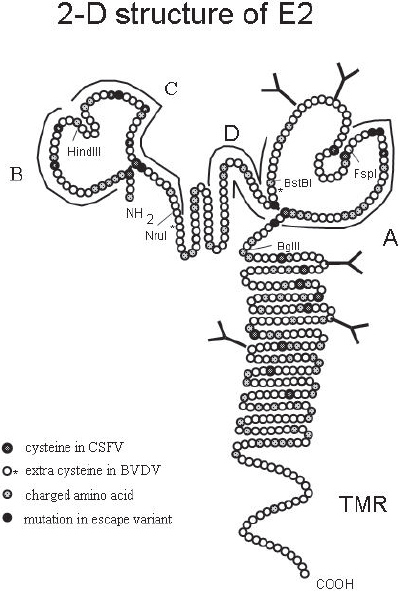
The E2 glycoprotein of CSFV and BVDV have been subject for mutagenesis studies (van Rijn et al. 1992; van Rijn et al. 1993; van Rijn et al. 1994; Paton et al. 2000; Deregt et al. 1998b). In some of these studies it was shown that mAbs specific for antigenic sites bind to the amino half of the E2 glycoprotein. Based on the studies for E2 of CSFV, an antigenic structure (see Fig. 1), in which two antigenic structural units, the non-conserved domains B/C and the conserved A domain, were proposed. For BVDV-E2, the location of the epitopes and their conformational requirements are somewhat similar to those reported for the non-conserved domains B and C for E2 of CSF (Paton et al. 1997, although the BVDV antigenic site extends further from the N-terminus. So far, no equivalent for BVDV has been found of the highly conserved domain A of CSFV. The absence of a fully conserved antigenic site in E2 or BVDV may simply reflect local variation in amino acids sequences between strains, but alternatively, the highly conserved antigenic domain A of CSFV may have no counterpart in BVDV due to more substantial differences in the three dimensional structure of the proteins. A major difference between the N-termini of the E2 proteins of BVDV and CSFV is an additional two cysteine residues (cysteine 751 and 798) in BVDV. Although neither of these were shown to be essential for mAb binding, their presence may still be an indication of significant topographical differences.
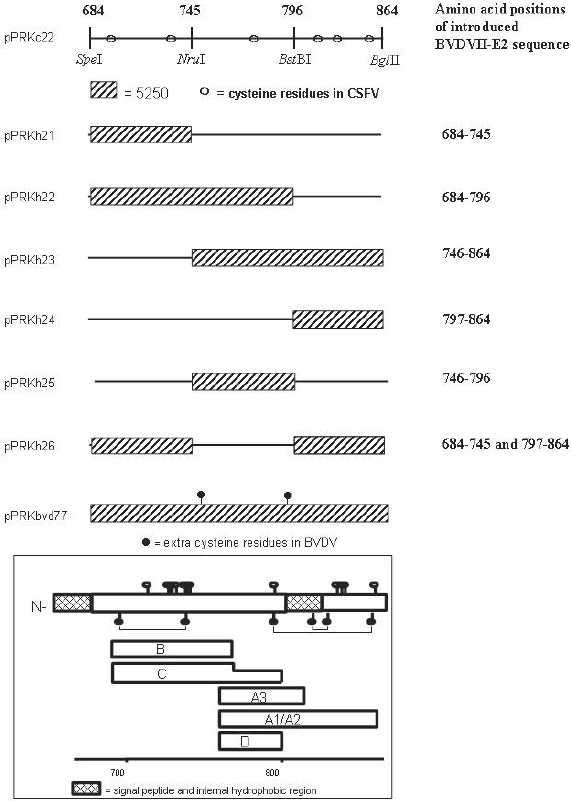
Schematic representation of hybrid CSFV/BVDV E2 constructs. Amino acid positions, restriction sites, cysteines, and exchanged regions are indicated. The drawing below represents the CSFV envelope glycoprotein E2. Proposed signal peptide transmembrane region and internal hydrophobic region are shown as closed bars. Position of MAR mutations and cysteines are indicated by open and closed circles, respectively. Proposed disulphide bonds in the N-terminal half of E2 are shown. The location of the antigenic domains are indicated by open bars in the lower part. Positions with respect to the amino acid sequence of CSFV strain C are shown at the bottom.
In this paper we describe chimeric CSFV/BVDV E2 expression constructs to study the role of the extra cysteine residues for antigenicity and functionality within E2. This could be important for the development of CSFV and BVDV vaccines.
Materials and Methods
Cells and Viruses
Swine kidney cell line SK-6 (Kasza et al. 1972) was maintained as described previously (van Gennip et al. 2000).
Swine kidney cells (SK6) were grown in Eagle's basal medium containing 5% fetal bovine serum, glutamine (0.3 mg/ml), and the antibiotics penicillin (200 U/ml), streptomycin (0.2 mg/ml), and mycostatin (100 U/ml). Fetal bovine serum was tested for the absence of BVDV and BVDV antibodies. SK-6 cells expressing bacteriophage T7 RNA polymerase (SK6.T7) (van Gennip et al. 1999) were grown in the same medium supplemented with 12.5 times diluted histidinol stock solution (125 mM histidinol in 100 mM HEPES). Foetal bovine epithelial (FBE) cells were grown in Earle's MEM supplemented as described for SK6 cells.
Recombinant C-strain viruses were grown as described (van Gennip et al. 2000) in Eagle's basal medium. Virus stocks were prepared by passaging the virus three times on SK6 cells. BVDV strain 5250 of porcine origin (Wensvoort et al. 1989) was biologically cloned three times by end point dilution on bovine turbinate (BT) cells and was also grown on SK6 cells as described above.
Cloning and Mutagenesis of C-strain E2
A BamHI/filled-in fragment containing E2 gene of plasmid pPRC34 (van Rijn et al. 1992) was cloned in a filled-in NdeI digested pUC19M (transformer site-directed mutagenesis kit; Clontech), resulting in plasmid pPRKc19.
Five different restriction sites were introduced in C-strain E2 of plasmid pPRKc19 using the Transformer site directed mutagenesis kit (Clontech) with primers (p866–p870) defined in Table 1 and LacZ repair primer p962 to achieve blue/white screening. Therefore, the primers were annealed with 130 ng plasmid pPRKc19 in annealing buffer (Clontech) by incubating at 100 °C for 3 min. and direct placing on ice. Then, T4 DNA polymerase (2–4 U; Clontech) and T4 DNA ligase (4–6 U; Clontech) were added and the mutagenesis reaction was carried out in synthesis buffer (Clontech) during 2 hr at 37 °C and the reaction was stopped during 5 min. at 70 °C. The reaction was phenol/chloroform purified and ethanol precipitated. Half of the reaction was transformed to SEM-competent (Inoue et al. 1990) E.coli BMH71-18 mutS cells (Clontech) and different dilutions were plated on agar plates containing Amp, Tet, IPTG and X-gal. After incubation o/n blue colonies were analyzed for introduction of restriction sites. All plasmids were sequenced to confirm the introduced sites and sequence of E2. The E2 gene was SpeI/AflII cloned in an expression vector pEVhisD11 (Peeters et al. 1992), in which the BglII site was destroyed. This plasmid was designated pPRKc22. Expression of C-strain E2 was confirmed by transfection of SK6 cells and an immuno peroxidase monolayer assay (IPMA) (Wensvoort et al. 1986) using a panel of monoclonal antibodies.
Primers used for mutagenesis and PCR.
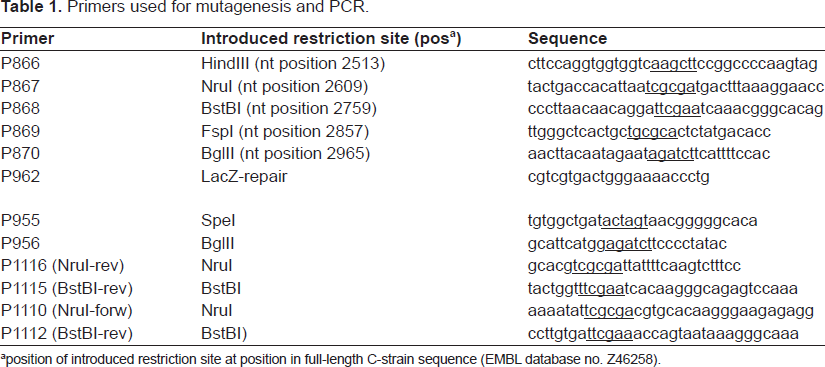
position of introduced restriction site at position in full-length C-strain sequence (EMBL database no. Z46258).
Construction of Chimeric CSFV/BVDV-E2 Expression Constructs
The SpeI-SalI fragment of pPRKc22 was cloned in expression vector pPRc83, which contains the structural genes of CSFV strain C (Npro-C-ERNS-E1-E2, amino acids 5 to 1063 of the sequence of CSFV strain C) (Moormann et al. 1996), resulting in plasmid pPRKc39. DNA fragments coding for targeted regions were derived by PCR from pPRK-bvd77 (van Rijn et al. 1997), containing BVDV E2 from strain 5250, with Vent polymerase by using pairs of oligonucleotide primers listed in Table 1. Different restriction sites are incorporated at 5’ ends of the primers (underlined). PCR fragments were inserted with the appropriate restriction sites in plasmid pPRKc22 or pPRKc39 to produce a series of chimeric constructs: pPRKh21 (p955/p1116), pPRKh22 (p955/p1115), pPRKh23 (p1110/p956), pPRKh24 (p1112/p956), and pPRKh25 (p1110/p1115), which are depicted in Figure 2. Plasmid pPRKh26 was constructed by subcloning the BstBI/SalI fragment from plasmid pPRKh24 into the BstBI and SalI sites of pPRKh21. All constructs were sequenced as above to ensure that the E2 gene segments were in the correct reading frame and to confirm the introduced sequence.
Proposed antigenic structure of CSFV envelope glycoprotein E2. Charged amino acids (D, E, K, R, H), cysteines, MAR mutations (•), proposed disulphide bonds in the N-terminal half of E2, antigenic domains, and glycosylation groups are indicated (van Rijn et al. 1994).
Transient Expression of Chimeric CSFV/BVDV Constructs
All plasmid DNA was purified by columns (Qiagen) as specified by the manufacturer. Expression of the chimeric constructs was studied by transfection of plasmids on SK6 cells, essentially as described (van Rijn et al. 1993; van Rijn et al. 1994). For transfection of plasmid DNA, 200 ng of Qiagen purified DNA was directly diluted in 25 ul of optimemI and mixed with 1 ug lipofectamine (GIBCO) diluted in 25 ul optimemI. After incubation at room temperature for 15 min, transfection was performed on subconfuent monolayers of SK-6 cells cells grown in 15 mm wells (Costar). Wells were washed once with optimemI, and 0.25 ml optimemI was added, followed by the transfection mixture. After transfection, the monolayers were incubated for 5 h at 37 °C. Then the transfection mix was replaced with 1 ml of Eagle's basal medium with 5% fetal bovine serum. Monolayers were fixed with cold (4 °C) methanol/acetone (1:1) and immunostained in an IPMA (Wensvoort et al. 1986) with mAbs 24 h after transfection.
Construction of CSFV/BVDV-E2 Chimeric Mutants Based on C-strain CSFV full-length cDNA
The ClaI/BglII fragment of plasmids pPRKh21, pPRKh22 and pPRKh26 containing the chimeric CSFV/BVDV-E2 genes were inserted in pPRKflc133 (Moormann et al. 1996), resulting in full-length plasmids pPRKflc35, pPRKflc36 and pPRKflc40. Plasmid pPRKflc35BVDVII 684–745 contains a chimeric E2 in a full-length cDNA of CSFV. The chimeric BVDV/CSFV-E2 of plasmid pPRKflc35BVDVII684–745 comprises the BVDVII-E2 sequence corresponding to amino acids 684 to 745 (Fig. 2). Plasmid pPRKflc36BVDVII684–796 harbours the BVDVII-E2 sequence between the SpeI and BstBI site corresponding to amino acid 684 to 796 and plasmid pPRKflc40BVDVII 684–745,797-864 harbours the BVDVII-E2 sequence between the SpeI and NruI (aa. 684–745) site and again from the BstBI to the BglII site (aa. 797–864).
The NgoMIV/BglII fragment of plasmids pPRKh23, pPRKh24 and pPRKh25 containing the chimeric CSFV/BVDV-E2 genes were inserted in pPRKflc133, resulting in full-length plasmids pPRKflc37BVDVII 746–864, pPRKflc38BVDVII 797–864 and pPRKflc39BVDVII 746–796. Plasmid pPRKflc37BVDVII 746–864 harbours the BVDVII-E2 sequence between the NruI and BglII site corresponding to amino acid 746 to 864. Plasmid pPRKflc38BVDVII 797–864 harbours the BVDVII-E2 sequence between the BstBI and BglII site corresponding to amino acids 797–864). Plasmid pPRKflc39BVDVII 746–796 harbours the BVDVII-E2 sequence between the NruI and BstBI site corresponding to amino acids 746 to 796).
Recovery of Chimeric CSF/BVD Viruses
Plasmids pPRKflc35-40 were purified on columns (Qiagen) and linearized with XbaI. The plasmid DNA's were extracted with phenol-chloroform, precipitated with ethanol, and dissolved in water. Linearized plasmids (200 ng) were transfected in duplicate to SK6.T7 cells grown in 2 cm2 wells as described (van Gennip et al. 1999). Culture media were collected at 4 days post transfection and the monolayers were immunostained with Mab C5 (Wensvoort, 1989a) for C-strain Erns expression. Media collected from monolayers in which expression was observed were applied on fresh monolayers of SK6 cells to determine the presence of infectious virus. Duplicate transfected monolayers were passaged repeatedly to support virus growth.
Analysis of Chimeric Viruses
Supernatants originating from subsequent passages from virus vflc36BVDVII 684–796 were subjected to virus titer determination in a plaque assay (Hulst et al. 2001). Selected supernatants from vflc36BVDVII 684–796 from passage P8 and P16 were subjected to monoclonal antibody typing using Mabs C5 specific for Erns of CSFV strain C (1:1000; (Wensvoort, 1989a), Mab WB166 specific for BVDV-E2 (1:500 (Paton et al. 1992) and Mab V3 specific for domain A of E2 (1:2000; (Wensvoort et al. 1986). Therefore, supernatants from these passages were infected on SK6 cells in 10-fold dilutions for 90 min. at 37 °C. Two days after infection, cells were fixed with methanol-acetone (1:1) and subjected to an IPMA (Wensvoort et al. 1986).
The region of vFlc36BVDVII 684–796 harbouring the chimeric E2 gene was RT-PCR amplified. Total RNA of SK6 cells infected with the respective viruses was isolated with the RNeasy RNA isolation kit (Qiagen). DNA fragments covering the E2 chimeric region of vFlc36 was amplified by RT-PCR as described (Widjojoatmodjo et al. 1999) and separated on a 1.0% agarose gel in 1xTAE, and purified on Costar Spin-X columns. Sequences of the purified PCR fragments were determined by thermocycle sequencing using the Bigdye terminator ready reaction cycle sequencing kit according to the manufacturer's conditions (Perkin Elmer/Applied Biosystems Division) with flanking and internal primers and analyzed on a 310 ABI PRISM genetic analyzer.
Results
Transient Expression of Hybrid CSFV/BVDV-E2 Proteins
The C-terminal half of the E2 protein of CSFV is considered to form a membrane-anchored stalk that is not involved in the major antigenic sites (van Rijn et al. 1994). The N-terminal half of E2 is predicted to be surface exposed. Several studies (van Rijn et al. 1996; Paton et al. 1997) showed that only the N-terminal half of E2 is involved in the antigenicity.
Starting point for this study is a chimeric E2, in which the antigenic region or CSFV was exchanged with that of a BVDV type II strain 5250 pPRK-bvd77; van Gennip et al. 2000. After transient expression, this protein could be discriminated from C-strain E2 by specific BVDV mAbs, indicating that this protein was correctly folded and expressed. Furthermore, this chimeric protein also showed to be functional in viral background (van Gennip et al. 2000).
To study the role of the region containing two extra cysteine residues within the N-terminal half in BVDV, a series of chimeric CSFV/BVDV-E2 expression constructs were constructed in the same expression vector as used for pPRKbvd77. The chimeric CSFV/BVDV constructs (Fig. 2) were defined by cysteine residues, based on the structural model of CSFV-E2 (Fig. 1). These chimeric DNA constructs were expressed by transient transfection of SK6 cells and tested for reactivity with a panel of mAbs (see Table 2). The mutagenised E2 of the C-strain in plasmid pPRKc22 reacted with all tested mAbs specific for CSFV and not with BVDV mAbs. It also reacted with mAb 4-9D4 raised against a linear epitope, located in the C-terminal half of E2 (Yu et al. 1996). This was considered as a control for expression of E2, since this region was not supposed to be affected by the mutations in the N-terminal half of E2. The chimeric BVDVII/CSFV E2 gene of plasmid pPRKbvd77 reacted with all tested BVDV mAbs and also with mAb 4-9D4.
Transient expression in SK6 cells with E2 hybrid genes of CSFV strain C and BVDVII strain 5250.
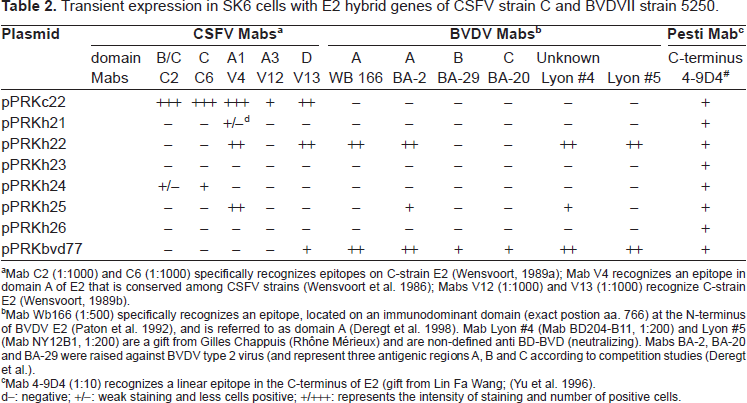
Mab C2 (1:1000) and C6 (1:1000) specifically recognizes epitopes on C-strain E2 (Wensvoort, 1989a); Mab V4 recognizes an epitope in domain A of E2 that is conserved among CSFV strains (Wensvoort et al. 1986); Mabs V12 (1:1000) and V13 (1:1000) recognize C-strain E2 (Wensvoort, 1989b).
Mab Wb166 (1:500) specifically recognizes an epitope, located on an immunodominant domain (exact postion aa. 766) at the N-terminus of BVDV E2 (Paton et al. 1992), and is referred to as domain A (Deregt et al. 1998). Mab Lyon #4 (Mab BD204-B11, 1:200) and Lyon #5 (Mab NY12B1, 1:200) are a gift from Gilles Chappuis (Rhône Mérieux) and are non-defined anti BD-BVD (neutralizing). Mabs BA-2, BA-20 and BA-29 were raised against BVDV type 2 virus (and represent three antigenic regions A, B and C according to competition studies (Deregt et al.).
Mab 4-9D4 (1:10) recognizes a linear epitope in the C-terminus of E2 (gift from Lin Fa Wang; (Yu et al. 1996).
-: negative; +/-: weak staining and less cells positive; +/+++: represents the intensity of staining and number of positive cells.
The hybrid E2 gene of plasmid pPRKh21, in which the N-terminal region (amino acid residues 684–745; numbering in C-strain polyprotein: see also Fig. 3) of CSFV was exchanged with that of BVDVII strain 5250 included the two N-terminal cysteine residues at amino acid position 693 and 737. This resulted in a hybrid E2 gene with 6 cysteine residues in the N-terminal half. This protein only stained weakly with a mAb V4 (anti domain A), and control mAb 4-9D4 (see Table 2). This indicated that the A-domain in this hybrid protein still was intact, although the binding seemed to be reduced compared to the control. Other epitopes, located in domains A3 and D were not recognised by their respective mAbs, although the sequences for these domains were present in this protein. BVDV mAb WB166 and BA-2 did not react with this protein because amino acids essential for their epitopes are located downstream of the exchanged region (760–764 region; numbering in C-strain polyprotein; see Figure 3, WB166: Leu 766; (Paton et al. 1992). The differences by exchanging this region also abrogated binding of the two Lyon mAbs #4, #5, BA20 and BA-29. Probably for the same reason as for mAb WB166, but the Lyon mAbs and BA-20 and BA-29 are undefined. We can conclude that they do not bind to the region (amino acid residues 684–745) of BVDV strain 5250 in pPRKh21 expressed protein.
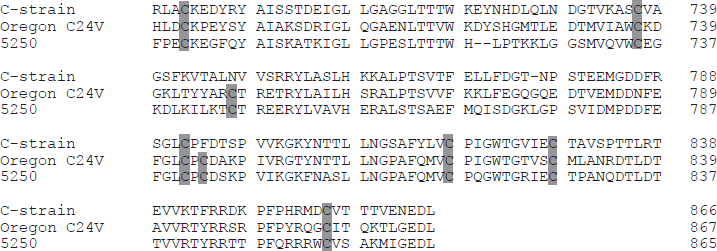
Comparison of the amino acid sequences of E2 proteins from position 690 to 865 of CSFV-strain C (accession number Z46258), BVDV strain Oregon C24V (accession number AF091605) and BVDV type II strain 5250 (acc. Number Y12168). The positions of amino acids (shaded grey) are based on those of CSFV strain C (Moormann et al. 1996). C693 CSFV = C696 Oregon, C737 CSFV = C740 Oregon, C751 Oregon (extra), C792 CSFV = C796 Oregon, C798 Oregon (extra), C818 CSFV = C822 Oregon, C828 CSFV = C832 Oregon, C856 CSFV = C860 Oregon.
When the N-terminal part of the introduced BVDV region was extended to aa. 796 (pPRKh22), this resulted in a hybrid protein including the two extra cysteine residues of BVDV strain 5250 (C751 and C794; numbering in C-strain polyprotein; see Fig. 3). Transfection of pPRKh22 on SK6 cells resulted in expression of a hybrid protein which was recognized by BVDV mAbs WB166, confirming the epitope mapping of Paton et al. (Paton et al. 1997), Lyon #4 and Lyon #5 (see Table 2). This hybrid E2 protein was not recognised by BA-20 and BA-29. Furthermore, the A and D domains of CSFV were recognized by their respective mAbs V4 (A) and V13 (D). These results indicate that this chimeric protein was correctly folded into a BVDV-like domain A (Deregt et al. 1998b) and the CSFV domain A.
Mabs selected for the antigenic region did not recognize the hybrid E2 protein expressed from plasmid pPRKh23, in which the region from aa. 746 to 864 from BVDVII strain 5250 was introduced. Expression of this chimeric protein was confirmed by mAb 4-9D4. Although the epitopes for the anti CSFV-E2 mAbs C2 and C6 are defined to the B/C domain and this domain can function as a separate unit (van Rijn et al. 1996) it was not recognized in this hybrid E2 protein. The same holds true for anti BVDV mAb WB166, which epitope is well defined (Leu, 766). Probably, the exchanged region does not result in the right folding of the E2 hybrid protein. The binding of the mAbs Lyon #4, #5, BA-20 and BA-29 are also disturbed in this hybrid protein. When the N-terminal region of CSFV in plasmid pPRKh23 was extended to aa. 796, resulting in plasmid pPRKh24, this resulted in the repair, although weaker than the control, of mAb C2 and C6, located in the B/C domain of CSFV-E2. This confirms the hypothesis that the extra cysteines of BVDV (C751 and C798) in pPRKh23 disturbs correct folding and exposure of the B/C domain of CSFV. Mabs WB166, V3 and Lyon mAbs #4 and 5 did not bind to this hybrid E2 protein because of the absence of their epitopes. Mabs BA-20 and BA-29 also did not recognise this hybrid E2 protein.
To see whether we could locate some of the non-defined mAbs Lyon #4 and #5, the region from BVDVII strain 5250 from aa. 746 to 796 was exchanged with that of CSFV, resulting in plasmid pPRKh25. This hybrid E2 protein was recognized by Lyon mAb #4 and BA-2, and not by the other anti BVDV mAbs WB166, Lyon #5, BA20 and BA-29. Binding of mAbs WB166 and Lyon #5 seemed to be dependent on the presence of the N-terminal region from aa. 684 to 745 for binding, which was also the case in the hybrid E2 protein expressed from plasmid pPRKh23. Mabs C2 and C6 did not bind to the B/C domain of hybrid E2 protein expressed from plasmid pPRKh25, which is a similar result as found for plasmid pPRKh23. The B/C domain seems to be disturbed by the introduction of the extra cysteine residues in the BVDV sequence. The remaining A domain of CSFV still was able to bind mAb V4. This result was also similar as for hybrid E2 protein expressed from plasmid pPRKh22.
The hybrid E2 protein, in which only aa. 746 to 796 of the N-terminal half of E2 consists of CSFV sequence, expressed from plasmid pPRKh26, was not recognized by any of the selected mAbs within the antigenic region. Protein expression was confirmed by mAb 4-9D4, located in the C-terminus of E2.
Construction and Transfection of Full-Length DNA's with Hybrid CSFV/BVDV-E2 Proteins
The hybrid CSFV/BVDV E2 genes, which expressed proteins were tested for their capability to bind mAbs, were inserted in the full-length copy of the C-strain (Moormann et al. 1996), resulting in a series of full-length CSFV/BVDV chimeric DNA constructs to study whether these proteins were functional in viral background. Linearized full-length DNA's of pPRKflc35-40, together with control full-length DNA's of pPRKflc9 (van Gennip et al. 2002), with the antigenic region of BVDVII strain 5250 from plasmid pPRKbvd77, and the C-strain full-length DNA pPRKflc12, with mutated E2 from plasmid pPRKc22, were transfected in duplicate on SK6.T7 cells. Four days after transfection, supernatants were removed and stored for further analysis. The monolayers were fixed and immunostained with an anti-CSFV Erns mAb C5. For every construct, expression of Erns was observed. The duplicate wells were trypsinized and passaged to support virus growth. Passage 2 (p2) was tested in an IPMA using mAb C5. As shown in table 3, only SK6.T7 cells transfected with pPRKflc36BVDVII684–796 showed very strong staining over the whole monolayer, similar to monolayers of pPRKflc9-transfected SK6.T7 cells, indicating viral replication. The monolayers of SK6.T7 cells (p2) transfected with pPRKflc38BVDVII 797–864, pPRKflc39BVDVII 746–796 and pPRKflc40BVDVII 684–745, 797-864 only showed single positive cells (1–5 cells/cm2) in 3 out of four tested wells. This indicated that replication of RNA occurs, albeit at a low level. Monolayers of SK6.T7 cells (p2) transfected with pPRKflc35BVDVII 684–745 and pPRKflc37BVDVII 746–864 did not show any positive cells after immunostaining, indicating that this RNA was not able to replicate or at a non-detectable level. Supernatants from p2 were tested in a plaque assay. Besides the controls, only the supernatant from pPRKflc36BVDVII 684–796 -transfected SK6.T7 cells contained infectious virus. This confirmed that no infectious virus, or at a non-detectable level, was generated from SK6.T7 cells transfected with the other full-length DNA's. Passaged transfected cells (p5) was also tested and were found to be negative for any of these contructs, indicating that these replicons are diluted by passaging and eventually will be absent (Table 3).
Results after immunostaining of SK6.T7 cells transfected with full-length CSFV/BVDV DNA's from serial passages.
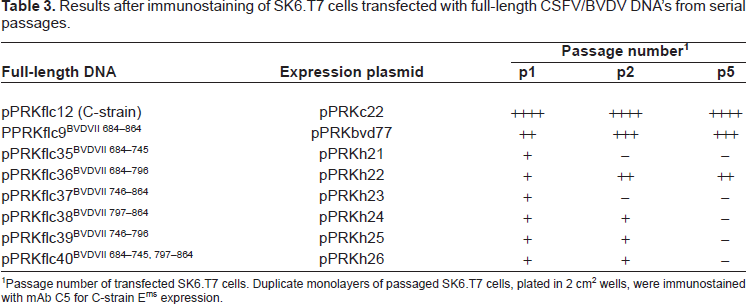
Passage number of transfected SK6.T7 cells. Duplicate monolayers of passaged SK6.T7 cells, plated in 2 cm2 wells, were immunostained with mAb C5 for C-strain Erns expression.
Analysis of Chimeric Virus vflc36BVDVII 684–796
Supernatants derived from p5 of SK6.T7 cells transfected with pPRKflc36BVDVII 684–796 had only virus titers of 102.6 pfu/ml, whereas supernatants of pPRKflc9-transfected SK6.T7 cells (p5) already had a virus titer of 105.5 pfu/ml, and 106.6 pfu/ml for C-strain, which are average virus titers expected after 5 passages. The virus titer did not increase after further passaging. Supernatant from p16 had the same virus titer (102.6 pfu/ml), indicating that the this chimeric virus was somehow hampered in virus replication, compared to viruses vflc9 and vflc12. Virus vflc36BVDVII 684–796 obtained from p5 and p16 was still able to bind mAbs V3/4 and WB166, indicating that the hybrid CSFV/BVDV E2 protein still exposed the domains important for binding these mAbs. Analysis of sequences derived from RT-PCR amplicons (p8) of the antigenic region of E2 showed no differences, which does not exclude mutations elsewhere.
Discussion
The envelope glycoprotein E2 of BVDV has two extra cysteine residues compared to CSFV-E2. In this report, we studied the influence of these two cysteines on mAb binding and functionality in viral background through reverse genetics to look for similarities or differences between CSFV and BVDV. Therefore, a set of interchimeric BVDVII/CSFV E2 proteins were tested for reactivity with a panel of BVDV and CSFV mAbs in a transient expression system on SK6 cells. This system has already been used successfully for epitope mapping studies of E2 of CSFV (van Rijn et al. 1994; van Rijn et al. 1993; van Rijn et al. 1992).
Transfection studies with chimeric E2 constructs of BVDV and CSFV showed that the binding of mAbs was the least affected in E2 expressed from pPRKh22, with the proposed “A” like domain of BVDV (Deregt et al. 1998b; Deregt et al. 1998a) and the A domain of CSFV (van Rijn et al. 1994). The A domain of CSFV is the most stable domain in chimeric background. All chimeric constructs (pPRKh21, 22 and 25) containing an A domain were recognised by a mAb specific for this domain. Binding of mAb V4 was reduced when the B/C domain of CSFV was exchanged with that of BVDVII. This was an unexpected finding since no extra cysteines were introduced. Probably, this region imposes a certain structure in E2, thereby affecting the A domain (Paton et al. 1997).
The B/C domain of CSFV appears to be less stable in chimeric background. Binding of mAbs specific for this domain did not recognise their epitopes in pPRKh23 and 25. In both cases, two extra cysteine residues were introduced from BVDVII. This suggests that introduction the two extra cysteines (Cys 751 and Cys798) disturb correct folding and expression of the B/C domain of CSFV.
The BVDV “A”-like domain (Deregt et al. 1998b), which epitopes are located in an immunodominant region from 760–764 is dependent on the presence of the BVDV equivalent of the B/C domain of CSFV. Mabs WB166 and BA-2, which epitopes are located in the 760–764 region, and mAb Lyon#4 and #5 recognised chimeric E2 from plasmid pPRKh22. MAb BA2 and Lyon #4 also recognised the smallest exchanged region, with the two extra cysteine residues from BVDV, between the B/C and A domain of CSFV. Although this region was also present in pPRKh23, it was not recognised by Lyon#4 and BA-2, indicating structural influences of the region downstream the epitopes of BA-2 and Lyon#4.
None of the chimeric E2 proteins were recognised by mAbs BA-20 and BA-29. These mAbs only recognised nat1ive E2 of BVDVII in pPRKbvd77. MAbs BA20 and BA-29 were raised against BVD-VII virus followed by peptides located in the N-terminus of E2 (Deregt et al. 1998b) and according to competition studies bind to different domains of BVDVII. We were not able to confirm these findings. Since these mAbs did not recognise any of the chimeric E2 proteins we were also not able to map these mAbs. We concluded from these results that the proposed B and C domain Mabs (BA-29 and BA-20 respectively) seem to be dependent on the presence of the total antigenic region of BVDVII.
The obtained results from the transfection studies with the chimeric E2 CSFV /BVDVII constructs indicate that there are major structural differences in E2 of CSFV compared to that of BVDVII. We found no equivalent for the A and B/C domain of CSFV, although we might not have the right tools (e.g. more mAbs). Recently, van Rijn discovered a common neutralizing epitope on E2 of different pestiviruses, located in the B domain of E2, indicating that similarities are present between different pestiviruses (van Rijn, 2007). This and other studies (Deregt et al. 1998b; Paton et al. 1992) strongly support the opinion that there is an immunodominant domain A (Deregt et al. 1998b) which is located between the 760–764 region and the importance of aa 761 in BVDV. The majority of BVDV epitopes have been mapped for this particular amino acid residue in the 760–764 region. Interestingly, no escape mutants have been mapped in this region for CSFV, indicating that this region does not have the same importance for CSFV.
The role of the extra two cysteine residues remain unclear, although some influence of the cysteines was observed in hybrid E2 proteins it cannot be excluded that this is the result of the introduction of the BVDV region harbouring the epitopes. Paton et al. (Paton et al. 1997) already showed that binding of mAb WB166 is only dependent on the presence of an intact pair of the first two cysteines.
It is possible that the reduction in some MAb binding with chimeric E2 proteins could be due to misfolding of the E2 protein due to different interactions of sulfhydryl groups or to simple degradation of the E2 protein. Even if misfolding occurred, eukaryotic cells have a system for retaining misfolded proteins in the endoplasmic reticulum and cycle these defective proteins back to the ubiquitin-proteosome system for hydrolysis (Plemper and Wolf, 1999). Since Mab reactive (and therefore intact) E2 protein could be identified, it is likely that any reduction in reactivity of Mabs with the chimeric E2 proteins in these experiments was not the result of drastically misfolded or degraded protein. To circumvent the problems with incorrect folding by mispairing of cysteine residues, it would be feasible to make E2 chimeras between two BVDV strains (e.g. BVDVI and BVDVII). Thereby the cysteine distribution remains intact within these chimeric E2's and conformational changes due to incorrect folding seem less probable, although the primary structure of a protein is determined by its amino acid sequence.
We were able to rescue only one virus (vflc36) through reverse genetics which had a functional chimeric E2. This virus contained a chimeric E2 with the “A” like domain of BVDVII (Deregt et al. 1998b) and the A-domain of CSFV (van Rijn et al. 1994). This chimeric E2 also bound to most of the mAbs located in the two domains. The B/C domain and A domain of CSFV are also able to function as separate antigenic units which are recognised by mAbs and are able to elicit a protective antibody response in pigs (van Rijn et al. 1999; van Gennip et al. 2002). Further studies should be performed to test the protective capacity of this possible marker vaccine vflc36. The fitness of this virus seemed to be reduced compared to vflc9 (with the complete antigenic region of BVDVII). Virus titers reached maximum values of titers of 102.6 pfu/ml compared to 105.5 pfu/ml for vflc9 and 106.6 pfu/ml for parent vaccine C-strain. Furthermore, virus vflc36 did not grow on bovine cells (data not shown). This was not very surprising, since vflc9 also showed reduced infectivity on FBE cells (van Gennip et al. 2000). The functionality of this chimeric E2 in vflc36 seems to be reduced, which is most likely caused by conformational changes. These changes could affect functional domains involved in interaction with cellular receptors. We were not able to rescue detectable amounts of infectious viruses from any the other chimeric DNA constructs, probably due to non-functional chimeric E2's in these viruses. For some of the chimeric constructs, RNA replication and translation could be detected in SK6.T7 cells indicating autonomous replication, but at a very low level. Due to dilution by passaging transfected SK6.T7 cells the number of positive immunostained cells decreased to undetectable levels. For further characterization of these non-viable viruses they should be trans-complemented through a E2-complementing SK6 cell line, which were already successfully used in another study to rescue defective RNA's with deleted parts of E2 (van Gennip et al. 2002).
In a recent study from Wehrle et al. they showed that a chimeric virus vRiems-ABC-Gif (Wehrle et al. 2007), which is similar in concept to our Flc9 (van Gennip et al. 2000), also had similar marker vaccine properties compared to our Flc9 (de Smit et al. 2001). Since the only difference is the background of these viruses this implies a broad use of these kind of strategies. Additionally, in accordance to their study, we also found that the B/C domain could be exchanged resulting in a infectious virus Flc36. Virus titers of Flc36BVDVII 684–796 were lower (102.6 pfu/ml) compared to that of vRiems-BC-Gif 104.3 TCID50/ml. However, our Flc36BVDVII 684–796 contains about fifty amino acids more than vRiems-B/C-Gif, including the two extra cysteines from the BVDV 5250 strain. Their vRiems-B/C-Gif resembles our vflc35BVDVII 684–745, which in our hands did not result in a viable virus. Small differences could account for these results, but other unknown factors can also attribute to our findings. Our study also confirmed their findings with respect to the A domain exchange in vRiems-A-Gif, which behaved like a replicon. In their hands, this replicon could not be trans-complemented in an E2 expressing cell line, indicating misfolding or incorrect E1-E2 heterodimerization, which is a prerequisite for efficient cell entry of the virus particle (Wang et al. 2004).
The results presented here show that the immunodominant domain “A” in BVDVII together with the A-domain from CSFV forms a functional E2 in viral background, although with reduced fitness. The major structural differences, including the two extra cysteine residues in BVDV, between CSFV and BVDV are probably responsible for the non-functional E2 proteins. More structural knowledge of both CSFV and BVDV E2 is necessary to open the possibility to develop mutant viruses with chimeric E2 protein. The general conformational stability of the BVDV “A” domain and the CSFV A-domain, however, suggest possible targets in the E2 protein for the development of effective and specific marker vaccines.